
The property ladder in the UK means buying a starter home, building equity as its value grows, then using that equity to trade up to a larger or better-located property. That is the theory. The practical first step for most first-time buyers right now is simpler than it sounds: get a Mortgage in Principle, work out your realistic affordability zone, and build a deposit plan around that number. ONS housing data confirms that affordability pressure is real and regional, while Barclays' H1 2026 analysis shows 68.5% of first-time purchases are now concentrated below £300,000. The ladder still exists, but it looks different from how it did twenty years ago.
Key takeaways
Deposit accumulation is the primary barrier to homeownership for most UK first-time buyers, and co-buying is one of the most direct ways to close that gap faster.
| Point | Details |
|---|---|
| Deposit is the main barrier | Resolution Foundation confirms deposit accumulation, not income rules, blocks most aspiring buyers. |
| Only 12.1% could afford locally | Skipton's Q4 2025 data shows how narrow affordability is in many areas; regional variation is significant. |
| Most FTB purchases are under £300,000 | Barclays H1 2026 data shows 68.5% of first-time purchases fall below this threshold; compromise on location or size is common. |
| Co-buying requires legal structure | A deed of trust, exit terms, and a contribution schedule are non-negotiable safeguards for any joint purchase. |
| Cohaus supports co-buyers | Cohaus provides community matching, shared deposit management, and legal protections for buyers who want to pool resources. |
Table of Contents
- What does the property ladder mean in the UK?
- Is the UK property ladder still real? Key statistics for buyers
- What are the realistic routes onto the property ladder in the UK?
- A step-by-step checklist for buying your first home in the UK
- What costs should you budget for when buying your first home?
- How does co-buying work, and what legal safeguards do you need?
- Should you try to get on the ladder now? Scenario-based guidance
- Co-buying and the modern property ladder: an honest perspective
- How Cohaus supports first-time buyers and co-buyers
- Sources
What does the property ladder mean in the UK?
The phrase "property ladder" describes a progression: you buy a small, affordable home first, your equity grows as prices rise, and you use that equity as a deposit on something bigger. Starter home to family home to larger property. Each rung up requires less borrowing relative to the asset's value, so the process compounds over time.
It worked reliably through the late twentieth century and into the early 2000s because house prices grew faster than wages, meaning early buyers accumulated equity quickly and could trade up within a decade. The structural conditions that made it function included:
- Relatively low price-to-income multiples (typically 3–4x salary in most regions)
- Plentiful starter-home supply from council house sales and new builds
- Accessible mortgage products with modest deposit requirements
- Steady wage growth that kept pace with early repayments
Those conditions have shifted considerably. The Adam Smith Institute's commentary argues that the traditional multi-step ladder has weakened for many buyers, identifying a "property cliff" where renters without family support face deposit-saving periods that stretch well beyond what earlier generations experienced. The ladder is still a useful metaphor, but it is not a guarantee. For a growing share of buyers, the first rung is the hardest to reach, and the second rung has a gap that did not exist before.
Is the UK property ladder still real? Key statistics for buyers
The short answer is yes, but with significant caveats depending on where you live and what support you have access to.
The Skipton Group's Home Affordability Index for March 2026 reports that buying affordability improved slightly, reaching 51.4 in Q4 2025, with gradual further improvement forecast through to 2028. That figure tells you something important: affordability is improving, but from a very low base.
Only a small proportion of potential first-time buyers could afford the local first step in Q4 2025 — Skipton Group Home Affordability Index, March 2026.
Resolution Foundation research adds a critical nuance: income-based lending rules are not the primary barrier for most aspiring buyers. Deposit accumulation is. Many people who would pass a lender's income stress test simply cannot save a large enough lump sum fast enough, particularly when paying high rents simultaneously.
Knight Frank's analysis of the housing ladder's missing middle identifies a supply-side problem that compounds this: developer starts in London have fallen substantially, and regional price performance varies considerably, making upward moves harder for second-steppers in high-demand areas.
| Metric | Figure | Source |
|---|---|---|
| First-time purchases below £300,000 | the majority of all FTB purchases | Barclays H1 2026 |
| Buying affordability index (Q4 2025) | moderate level | Skipton Group, March 2026 |
| Share of potential FTBs who could afford local first step (Q4 2025) | a small share | Skipton Group, March 2026 |
| Primary barrier to ownership | Deposit accumulation, not income rules | Resolution Foundation |
| Regional divergence | Significant; Scotland ranks more favourably on affordability | Skipton Group, March 2026 |
The picture is not uniformly bleak. Mortgage rates have begun to ease from their 2023 peaks, and some regional markets, particularly in Scotland and parts of the North of England, remain more accessible than London and the South East. The ladder still functions; it just requires more planning, more compromise, and often more support than it once did.
What are the realistic routes onto the property ladder in the UK?
There is no single path. The right route depends on your income, savings, location, and whether you have access to family support. Here are the main options, with an honest look at each.
Saving a deposit and applying for a standard mortgage The most straightforward route. The challenge is that saving while renting is slow, and Resolution Foundation's findings confirm deposit accumulation is where most aspiring buyers stall.
They carry higher interest rates and stricter affordability checks, but they are a legitimate route for buyers with good income and limited savings. Barclays' data shows more buyers are using higher LTV products as cost pressures persist.
Shared ownership You can "staircase" upward over time, buying more shares as your finances allow. The entry deposit is lower, but service charges, rent, and staircasing costs add up. Check the lease carefully: some shared ownership leases carry restrictions on subletting and resale that limit flexibility.
Family support: the Bank of Mum and Dad Parental gifts or loans remain a significant factor in UK first-time purchases. Barclays' H1 2026 research confirms family support is a meaningful contributor for a substantial share of buyers. If you receive a gift, lenders will ask for a signed letter confirming it is not a loan. If it is a loan, it affects your affordability calculation.
Co-buying with friends, family, or matched partners Pooling deposits and mortgage responsibility with one or more co-buyers is one of the most direct responses to the affordability gap. It reduces the individual deposit burden and can unlock a higher combined borrowing capacity. We cover this in detail below, including the legal safeguards you need.

Compromising on location or property type Skipton Group's survey work found that many prospective first-time buyers expect to compromise on features such as outdoor space, number of bedrooms, or property condition. Buying further from a city centre, choosing a flat over a house, or targeting a less fashionable postcode can all bring the first rung within reach.
Pro Tip: Watch the leasehold trap. Flats are often the most affordable entry point, but a short lease (under 80 years) dramatically reduces resale value and makes remortgaging harder. Always check the remaining lease length and annual service charge before making an offer. GOV.UK's How to buy a home guide explains the leasehold vs freehold distinction clearly.
A step-by-step checklist for buying your first home in the UK
The full process from decision to completion typically takes around seven months, according to Rightmove's buying timeline guide. Starting each step at the right time makes a real difference to how competitive your offer looks.
-
Check your credit report (start 6–12 months before buying). Use Experian, Equifax, or TransUnion. Correct any errors, pay down revolving credit, and avoid new credit applications in the months before you apply for a mortgage. A clean report improves both your approval odds and the rates you are offered.
-
Set a realistic budget (6–12 months before). Calculate your maximum deposit, estimate what you can borrow (typically 4–4.5x your annual income, though some lenders go higher), and factor in all purchase costs, not just the deposit. MoneyHelper's mortgage calculator is a good starting point.
-
Open a Lifetime ISA if eligible (as early as possible). You must be aged 18–39 to open one. The 25% government bonus applies to savings up to £4,000 per year, and the account must be open for at least 12 months before you use it to buy.
-
Get a Mortgage in Principle (3–6 months before). A Mortgage in Principle (MIP) is a lender's conditional agreement to lend you a specific amount. It is not a guarantee, but it shows sellers you are a serious buyer and speeds up the formal application once you find a property. Speak to a whole-of-market mortgage broker rather than going direct to one lender.
-
Search and make an offer (ongoing once MIP is in place). Focus your search on properties within your affordability zone. When you find one, make an offer through the estate agent. Being chain-free (i.e., not selling a property simultaneously) strengthens your position considerably.
-
Instruct a solicitor and commission a survey (immediately after offer accepted). Your solicitor handles conveyancing: checking title, raising enquiries, and managing the exchange of contracts. Commission at least a HomeBuyer Report; a full structural survey is worth the extra cost on older properties. Speak to your solicitor about any leasehold issues before exchange.
-
Exchange contracts (typically 8–12 weeks after offer accepted). At exchange, the sale becomes legally binding and you pay your deposit. You need buildings insurance in place from this point.
-
Complete and collect keys (usually 1–4 weeks after exchange). Your mortgage funds are released, the balance transfers to the seller, and you receive the keys. Your solicitor registers the title with HM Land Registry.
What costs should you budget for when buying your first home?
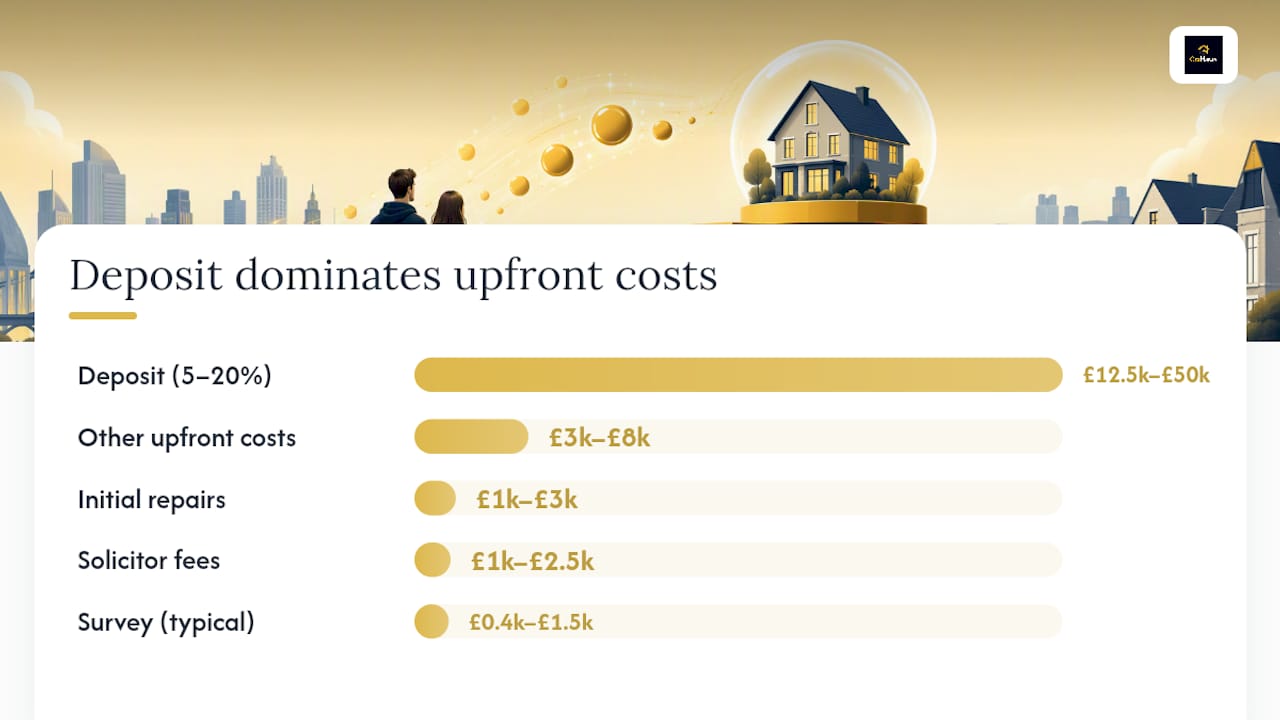
The deposit is the biggest number, but it is far from the only one. First-time buyers frequently underestimate the total upfront spend.
Upfront costs to plan for:
- Deposit: typically 5–20% of the purchase price. On a £250,000 property, that is £12,500–£50,000.
- Stamp Duty Land Tax: first-time buyers pay no SDLT on the first £425,000 of a property's value (on properties up to £625,000), though this threshold is subject to change. Check GOV.UK for current rates before you budget.
- Solicitor/conveyancing fees: typically £1,000–£2,500 depending on complexity and property type.
- Survey: a HomeBuyer Report costs roughly £400–£900; a full structural survey runs £600–£1,500 or more.
- Mortgage arrangement fee: some products carry a product fee of £500–£2,000, which can often be added to the mortgage (though this increases the total interest paid).
- Mortgage broker fee: whole-of-market brokers may charge a flat fee of £300–£600, or work on lender commission with no direct charge to you.
Moving and immediate running costs:
- Removal costs: £300–£1,500 depending on volume and distance.
- Initial repairs and redecoration: variable, but budget at least £1,000–£3,000 for a typical starter home.
- Higher utility bills and council tax: factor these into your monthly affordability calculation from day one.
A conservative estimate of total upfront costs on a £250,000 property, excluding the deposit itself, sits in the range of £3,000–£8,000. Add that to your deposit target when planning your savings. MoneyHelper's mortgage and buying calculators are a practical tool for building a realistic total.
How does co-buying work, and what legal safeguards do you need?
Co-buying means purchasing a property jointly with one or more people, sharing both the deposit and the mortgage. It is one of the most direct responses to the affordability gap, and it is more common than many buyers realise. Barclays' H1 2026 data shows a rise in solo buyers, but also confirms that pooled purchases remain a significant route for those who can arrange them.
Joint ownership structures
There are two main legal arrangements for co-buyers in England and Wales:
- Joint tenancy: both owners hold the property equally. If one owner dies, their share passes automatically to the other, regardless of any will.
- Tenants in common: each owner holds a defined share (which need not be equal). Shares can be passed via a will. This is usually the right structure for co-buyers who are not in a relationship, as it protects unequal contributions. Read our guide on tenants in common vs joint tenancy for a full breakdown.
Legal safeguards every co-buyer should put in place
- Deed of trust (declaration of trust): a legally binding document that records each party's share, how costs are split, and what happens if one party wants to sell. This is not optional. Our deed of trust guide covers what to include.
- Exit terms: agree in writing what triggers a sale, how a buyout is valued, and the notice period required. Ambiguity here is the most common source of co-buyer disputes.
- Contribution schedule: document who pays what, including deposit, mortgage payments, and ongoing costs such as maintenance and insurance.
- Life insurance: a joint mortgage creates shared liability. If one co-buyer dies, the other remains responsible for the full debt. Life insurance for a joint mortgage explains the options clearly.
Pro Tip: Before you commit to a co-buyer, agree the exit terms in writing, not just the entry terms. The question "what happens if one of us wants to sell in three years?" is far easier to answer before you buy than after.
Co-buying versus solo purchase: a practical comparison
For buyers who want to co-buy but do not have a ready partner, Cohaus offers community matching alongside structured legal and financial support.
Should you try to get on the ladder now? Scenario-based guidance
The right answer depends on your specific situation. Here are four realistic profiles and what the evidence suggests for each.
-
Solo buyer with family support: if you have a parental gift covering part of the deposit and a stable income, a 90% or 95% LTV mortgage on a property under £300,000 is achievable in many regions. Prioritise getting a Mortgage in Principle and focus your search on areas where Skipton's affordability data shows better conditions, such as Scotland or the North of England.
-
Couple with good combined income but limited savings: your borrowing capacity is likely strong, but deposit accumulation is the bottleneck, exactly as Resolution Foundation's research identifies. A LISA for each of you, combined with a focused 18–24 month savings plan, is often the fastest route. Consider a mortgage with lodger income if you are already renting a room out.
-
Renter with low savings and no family support: this is the profile most affected by the "property cliff" identified in Adam Smith Institute commentary. Co-buying with a trusted friend or colleague, or exploring shared ownership, are the most realistic near-term routes. Buying alone in a high-cost area is likely to require several more years of saving.
-
Buyer in a high-price urban centre (London, South East): Knight Frank's missing middle analysis is most relevant here. Supply constraints and price levels mean compromise is almost unavoidable: a smaller property, a less central location, or a co-buying arrangement. Waiting for prices to fall significantly is not a reliable strategy in supply-constrained markets.
Pro Tip: Before deciding whether to act or wait, check the local price-to-income ratio for your target area using ONS data, and look at how long properties are sitting on the market. A rising average days-on-market figure in your target postcode suggests less competition and more negotiating room.
Co-buying and the modern property ladder: an honest perspective
The property ladder is not broken. But it has changed shape in ways that the standard advice rarely acknowledges honestly.
For many buyers in their twenties and early thirties, the ladder's first rung is genuinely out of reach as a solo endeavour. That is not a personal failing; it is a structural outcome of deposit requirements that have grown faster than wages in most parts of the UK. The Resolution Foundation's finding that deposit accumulation, not income eligibility, is the primary barrier is one of the most important pieces of research for any first-time buyer to understand. It reframes the problem: the question is not "can I afford the repayments?" but "can I save the lump sum fast enough?"
Co-buying is a credible, practical answer to that question for a lot of people. It is not a compromise or a second-best option. It is a structured way to pool resources, share risk, and get on the ladder sooner than you could alone. The legal framework exists to protect everyone involved, provided you use it properly: a deed of trust, clear exit terms, and a shared understanding of what happens if circumstances change.
The missing piece, historically, has been the infrastructure to make co-buying feel safe and manageable. That is exactly what platforms like Cohaus are designed to address. If you are considering co-buying, the next practical step is to understand the ownership structures available to you and speak to a mortgage broker who has experience with joint applications.
How Cohaus supports first-time buyers and co-buyers
Getting on the property ladder is harder when you are doing it alone. Cohaus is built for buyers who want to pool resources with others, whether that is a friend, a family member, or someone they have been matched with through the community.

Where most of the process leaves co-buyers to figure out the legal and financial complexity themselves, Cohaus provides community matching, shared deposit management, legal protections, and transparent exit terms as part of a structured process. It is particularly well suited to friends pooling deposits, solo buyers seeking a co-ownership partner, and anyone who has found that the solo route simply does not add up yet.
If you are ready to explore co-buying as a route onto the ladder, visit Cohaus to learn how the platform works and what support is available. You can also read our practical guide on buying a house with friends for a grounded introduction to what the process involves.
Sources
These are the primary sources used throughout this guide. Each one is worth bookmarking for your own research.
- H1 Property Trends: confidence, compromise and changing expectations
- The Skipton Group Home Affordability Index: March 2026
- Goodbye to the property ladder — Adam Smith Institute
- The housing ladder’s missing middle
- Credit where credits due
- Ons
This article is general information, not a substitute for advice from a qualified financial advisor. Consult a qualified financial professional about your own circumstances before acting on anything here.