
Yes, you can legally buy a house with friends in the UK. Up to four people can co-own a property together, and doing it well comes down to three things: choosing the right ownership structure, getting a formal legal agreement in place, and understanding what a joint mortgage actually means for each of you.
Here is what you need to know before you start:
- UK law offers two ownership types: joint tenancy and tenancy in common. For friends, tenancy in common is almost always the right choice.
- A Declaration of Trust (also called a Deed of Trust) records each person's share, how costs are split, and what happens if someone wants to leave.
- A joint mortgage means joint and several liability. If one person stops paying, the others are responsible for the full amount.
- Lenders assess combined incomes, but they check each applicant's credit history individually.
- The minimum deposit between co-buyers is typically 5% combined.
Getting these foundations right protects your money, your friendship, and your home.
What are the pros and cons of buying a house with friends?
Co-buying with friends opens the property market to people who would otherwise be priced out. Pooling deposits and combining incomes can unlock a larger mortgage and a better property than either person could reach alone. Shared running costs, from council tax to repair bills, also make monthly outgoings more manageable.
The risks are real, though. Joint and several liability means your finances are tied to your co-buyer's behaviour. If a friend loses their job and misses payments, your credit score takes the hit too. Differing life plans create friction: one person may want to sell in three years while another plans to stay for a decade.
Advantages at a glance:
- Larger combined deposit and borrowing power
- Shared monthly costs, including mortgage, bills, and maintenance
- Faster route onto the property ladder
- Potential to build equity together
Disadvantages to weigh up:
- Full mortgage liability if a co-buyer defaults
- Credit score exposure for all parties
- Complications if one person wants to sell or move out
- Relationship strain if expectations are not aligned from the start
How does legal ownership work when friends buy together?
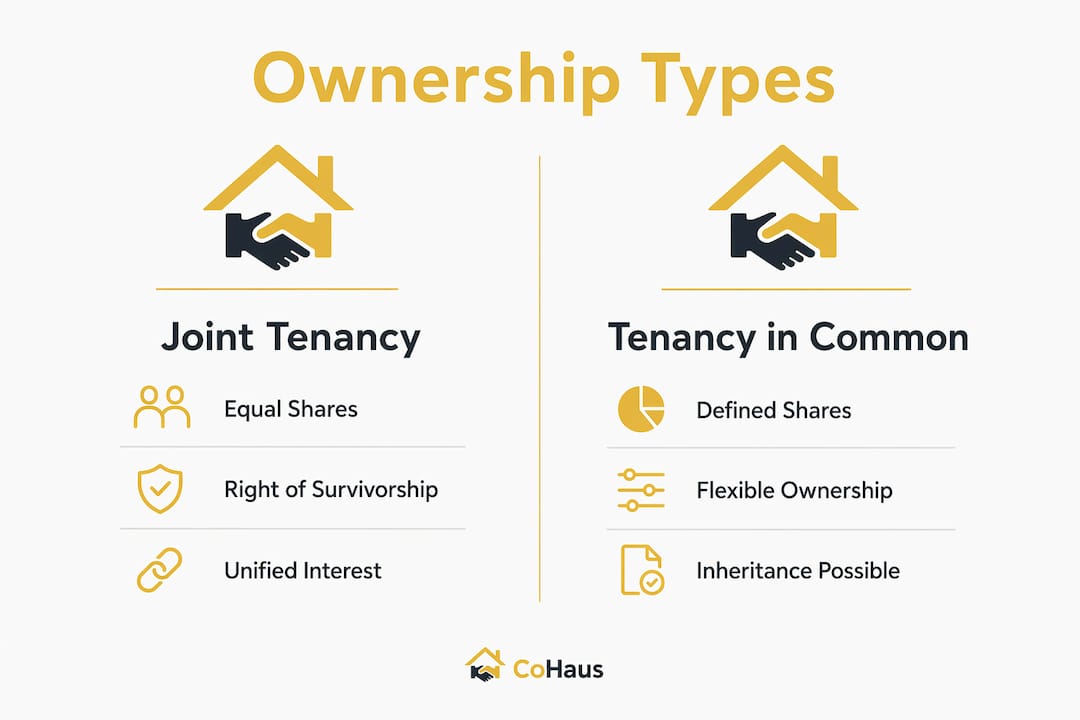
UK property law gives co-owners two options: joint tenancy or tenancy in common. The difference matters enormously for friends.

Under joint tenancy, all owners hold the property as one unified interest with equal shares. The right of survivorship means that if one owner dies, their share passes automatically to the surviving owners, bypassing any will. For friends, this is rarely the intended outcome. A deceased friend's family would receive nothing.
Tenancy in common gives each owner a distinct, defined share. Shares can be equal or unequal, and each person can leave their share via a will to whoever they choose. This structure suits friends because it reflects different deposit contributions and protects each person's interests independently.
| Feature | Joint tenancy | Tenancy in common |
|---|---|---|
| Ownership shares | Equal only | Equal or unequal |
| Right of survivorship | Yes, automatic | No, passes via will |
| Can leave share in a will | No | Yes |
| Reflects unequal deposits | No | Yes |
| Recommended for friends | No | Yes |
A Declaration of Trust should accompany any tenancy in common arrangement. It sets out each person's percentage share, how the deposit was contributed, how mortgage costs are divided, and the process for buying out a departing owner. A solicitor typically drafts one for a modest fee relative to the transaction.
Pro Tip: Ask your solicitor to include a minimum ownership period clause in the Declaration of Trust. Requiring co-owners to hold for at least two years before demanding a sale prevents impulsive exits that could force the whole group to sell.
How do joint mortgages work for friends buying together?
Lenders treat a joint mortgage application from friends the same way they treat any joint application, with one important nuance: non-couple applications often receive closer scrutiny. Every applicant's income, credit history, and existing financial commitments are assessed individually, even though the combined income drives the affordability calculation.
Joint and several liability is the critical concept here. The lender can pursue any one borrower for the entire outstanding balance. Your internal agreement about who pays what does not protect you from the lender's claim. If your co-buyer stops paying, you owe the full mortgage.
Ownership splits do not have to be 50/50. As tenants in common, you could agree a 70/30 or 60/40 split reflecting each person's deposit contribution, recorded in the Declaration of Trust. The mortgage liability, however, remains 100% for each borrower regardless of that split.
Before applying, agree on:
- Each person's deposit contribution and the resulting ownership split
- How monthly mortgage payments will be divided
- What happens if one person cannot pay their share
- Your exit plan if circumstances change
Pro Tip: Poor credit on one borrower can derail the whole application. Check all credit files at least three months before applying and resolve any missed payments, outdated addresses, or unused accounts.
Practical tips for co-owning a home smoothly
Open communication before you exchange contracts prevents most disputes. Agree on a shared budget, decide how you will handle unexpected repair costs, and set up a joint account specifically for household expenses. Putting money in each month for maintenance means you are never caught short when the boiler needs replacing.

Shared financial obligations should be documented, not assumed. Who pays for what, how decisions about improvements are made, and whether partners can move in are all conversations worth having early. Keep records of contributions to shared costs, particularly any significant repairs one person funds.
Review your arrangements annually. Circumstances change, incomes shift, and what felt fair at the start may need adjusting. If one co-owner funds a significant renovation, consider whether the Declaration of Trust should be updated to reflect an increased share.
What happens when someone wants to leave or disputes arise?
Exit complications are among the most common problems in co-ownership, and the best time to plan for them is before you buy. A Declaration of Trust that includes clear buyout provisions and agreed valuation methods removes most of the ambiguity when someone wants out.
When one co-owner wants to leave, the remaining owners can buy out their share. This typically requires a remortgage into fewer names, which depends on whether the remaining owners can meet affordability criteria alone. If they cannot, the property may need to be sold. Specifying an independent RICS valuation as the pricing method in the Declaration of Trust avoids arguments about what the departing share is worth.
Omitting a buyout procedure entirely often leads to forced sales when one co-owner cannot sustain their mortgage contributions. A co-owner who cannot be bought out and refuses to sell can apply to court under the Trusts of Land and Appointment of Trustees Act 1996 for an order for sale. That process is costly and damaging to relationships. A well-drafted Declaration of Trust makes it unnecessary.
For disputes short of a full exit, a pre-agreed mediation process keeps things out of court. Name a neutral third party in your agreement, or commit to using a professional mediator before taking legal action.
How Cohaus helps friends co-buy with confidence
The practical and legal complexity of co-buying is exactly the problem that Cohaus was built to address. Cohaus is a community platform that matches co-buyers, manages shared deposits, and provides legal protections and transparent exit terms so that groups of friends can buy together with less uncertainty and risk.
Co-buying with friends is not just about splitting costs. It is about building a structured process that protects everyone involved, from the deposit stage through to an eventual exit. Cohaus provides the framework that makes that possible, with community support and open terms that keep co-owners informed and in control.
The platform supports renters and first-time buyers who feel locked out of the market individually. By pooling resources within a structured framework, Cohaus members gain access to shared deposit management, peer advice forums, and legal safeguards that a standard conveyancing process does not automatically provide. For groups exploring three-person mortgage arrangements or more complex ownership splits, the community offers practical guidance from people who have navigated the same process.
If you are working with a property sourcing specialist to find a suitable co-buy property, understanding how property sourcers work can help you assess whether that route suits your group's needs.
Tax implications of co-owning property with friends
Stamp Duty Land Tax (SDLT) applies to the full purchase price, not each person's share. If any co-buyer has previously owned a property, the group loses access to first-time buyer SDLT relief entirely. All buyers must be genuine first-time buyers for the relief to apply. This is a frequently overlooked point that can add thousands to the upfront cost.
Capital Gains Tax (CGT) applies when you sell your share at a profit. Each co-owner is taxed on their individual gain, based on their ownership percentage. The annual CGT allowance applies per person, which is one advantage of tenancy in common with defined shares.
Inheritance tax considerations apply if a co-owner dies. Under tenancy in common, the deceased's share forms part of their estate and may be subject to inheritance tax depending on the total estate value. Under joint tenancy, the share passes outside the estate via survivorship, which can have different tax consequences. A solicitor or tax adviser can model the implications for your specific situation.
Choosing and qualifying for a joint mortgage with friends
Most UK lenders accept multiple applicants on a joint mortgage, though many use only the two highest incomes for affordability calculations. A combined income of £80,000 could support borrowing of 4.5 to 5 times that total, depending on credit commitments and outgoings, according to Midas Financial Planning.
Lenders assess each applicant's credit profile individually. One person with a poor credit history can reduce the available mortgage or trigger a rejection, even if the other applicants are financially strong. Checking all credit files well in advance and addressing any issues is the single most effective preparation step.
A mortgage broker with whole-of-market access is worth engaging early. The joint borrower sole proprietor structure is one alternative worth exploring if one friend wants to boost affordability without appearing on the property title. For a detailed breakdown of tenancy in common ownership as it applies to your mortgage choice, the Cohaus guide to tenants in common covers the key considerations.
Before speaking to a lender, agree on your budget, each person's deposit contribution, the ownership split, and your exit plan. Arriving at that conversation prepared makes the process faster and reduces the risk of surprises.
Buying a house with friends is a practical path into homeownership when the legal and financial groundwork is done properly. Cohaus exists to make that process clearer and safer for everyone involved.
Join the Cohaus community and start your co-buying journey with the support, structure, and legal protections you need.

Key takeaways
Buying a house with friends in the UK is legally straightforward but requires tenancy in common ownership, a Declaration of Trust, and a clear understanding of joint mortgage liability to protect all parties.
| Point | Details |
|---|---|
| Ownership structure | Tenancy in common suits friends; it allows unequal shares and lets each person leave their share via a will. |
| Declaration of Trust | This legal document records shares, cost splits, and exit procedures; solicitors typically charge £200–£600 to draft one. |
| Joint mortgage liability | Each borrower is liable for 100% of the mortgage debt, regardless of the agreed ownership split. |
| Minimum deposit | Co-buyers can apply with as little as 5% combined between them. |
| Exit planning | Agreeing buyout procedures and valuation methods in advance prevents forced sales and protects friendships. |