
Tenants in common is defined as a form of shared property ownership where two or more people each hold a distinct, separately transferable share of the same property. Unlike joint tenancy, there is no right of survivorship: when one owner dies, their share passes to their chosen heirs rather than automatically to the other co-owners. Shares can be equal or unequal, reflecting each person's financial contribution, and around 35% of co-owned residential properties use this structure. That figure signals just how common this model has become, particularly among unmarried couples, friends buying together, and property investors seeking flexible co-ownership arrangements.
What does tenants in common actually mean?
Tenants in common gives each co-owner a defined percentage stake in a property. That stake represents a financial interest, not a physical portion of the building. One person might own 60% and another 40%, but neither has the exclusive right to occupy a specific room or floor.
Each owner holds an undivided interest in the whole property. That means all co-owners have equal rights to use and occupy the entire property, regardless of their percentage share. A 30% owner cannot be locked out of the kitchen by a 70% owner.

Ownership percentages do matter financially. When the property is sold, proceeds are divided according to each person's share. The same logic applies to rental income from an investment property: a 70% owner receives 70% of the net rent.
This structure suits people whose financial contributions differ. Two friends buying together where one puts in a larger deposit can record a 65/35 split on the title deed, protecting each person's actual investment from day one.
How ownership shares and usage rights work
The flexibility of unequal ownership splits is one of the most practical features of this structure. Splits such as 70/30 or 60/40 are straightforward to record and can reflect different deposit sizes, different mortgage contributions, or agreed investment ratios.
Key points about shares and usage rights:
- Financial interest, not physical space. Your percentage defines what you receive on sale or from rental income, not which rooms you can use.
- Equal occupation rights. All co-owners may use the whole property. Disputes about day-to-day use need a co-ownership agreement, not a change to the deed.
- Independent transferability. You can sell, gift, or mortgage your share without the other owners' consent, unless your co-ownership agreement restricts this.
- Adjustable over time. Shares can be varied by deed if contributions change, for example if one owner funds a major renovation.
- Mortgage responsibilities. Each owner's financial obligations should mirror their share, though lenders often assess all owners jointly.
Pro Tip: Record the agreed ownership split in a Declaration of Trust at the time of purchase. This document sits alongside the title deed and provides clear evidence of each person's financial interest, which matters enormously if the relationship between co-owners breaks down.
The flexibility here is real, but it requires active management. Leaving shares undefined or relying on verbal agreements creates risk that a written record eliminates.
What are the legal and financial implications?
The absence of a right of survivorship is the single most important legal feature of this ownership model. When a co-owner dies, their share passes via their will or intestacy rules, not automatically to the surviving co-owners. This gives each person genuine control over who inherits their stake.
That control comes with a responsibility. Without a valid will, intestacy rules in England and Wales determine who inherits. A co-owner's share could pass to a distant relative or an estranged spouse, leaving the surviving co-owners in a property with an unwanted new partner.
Key legal and financial risks to understand:
- Forced partition actions. Any co-owner can apply to court to force a sale of the entire property, even if they hold a minority share. Court-ordered sales are common when co-owners cannot agree voluntarily.
- Creditor claims. A co-owner's individual share can be targeted by their creditors. If one owner becomes insolvent, their share may be seized, bringing an unwanted third party into the ownership structure.
- Mortgage complexity. Lenders typically assess all owners' credit profiles jointly when financing a purchase. Separate financing for individual shares is possible but less common and more complex to arrange.
- Tax allocation. Default income tax treatment assumes an equal split between spouses or civil partners, even if ownership is unequal. Filing a Form 17 with HMRC is required to reflect the actual shares for tax purposes.
- Estate tax exposure. The full value of a deceased owner's share is included in their estate for inheritance tax purposes, unlike joint tenancy where survivorship rights can reduce estate exposure.
Understanding these risks before purchase is far less costly than resolving them through litigation afterwards.
How to structure a co-ownership agreement
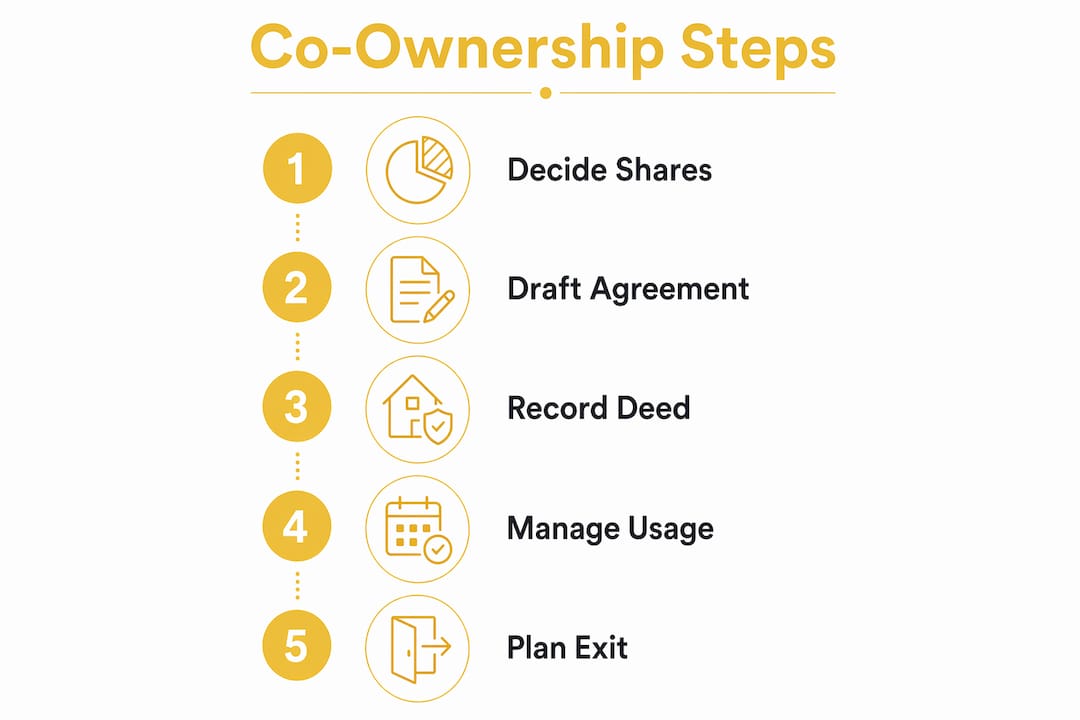
A title deed alone does not govern how co-owners live together, pay bills, or exit the arrangement. Failing to create a separate co-ownership agreement is the most frequent error that leads to costly disputes. The deed records who own what; the agreement records how ownership actually works.
A well-drafted co-ownership agreement should cover:
- Ownership shares and contributions. Confirm each person's percentage and how ongoing costs such as mortgage payments, insurance, and maintenance are split.
- Decision-making rules. Define which decisions require unanimous agreement and which can be made by a majority.
- Improvements and renovations. Specify whether the cost of improvements adjusts ownership shares or is treated as a shared expense.
- Exit terms. Set out buyout rights, share valuation methods, and timelines for when one owner wants to sell.
- Dispute resolution. Include a mediation clause before any court action is permitted. Mediation is faster and far cheaper than litigation.
Pro Tip: Include a Right of First Refusal clause. This prevents unwanted third parties from entering the ownership structure by giving existing co-owners the first opportunity to buy any share that comes up for sale.
The comparison below shows what a basic deed covers versus what a full co-ownership agreement adds.
| Area | Title deed only | With co-ownership agreement |
|---|---|---|
| Ownership percentages | Recorded | Recorded and explained |
| Cost sharing | Not covered | Defined per owner |
| Exit process | Not covered | Buyout rights and timelines set |
| Dispute resolution | Not covered | Mediation clause included |
| Right of First Refusal | Not covered | Explicitly protected |
A solicitor specialising in property co-ownership can draft this agreement at the time of purchase. Doing it later, once a disagreement has already started, costs significantly more.
Who actually uses this ownership structure?
Co-ownership under this model suits a wide range of buyers, not just investors. The common thread is that each person needs their financial interest clearly defined and protected.
Practical examples include:
- Unmarried couples. This structure suits unmarried co-owners because it clearly separates ownership shares and inheritance paths. If the relationship ends, each person's contribution is already on record.
- Friends or siblings buying together. Two people pooling deposits to get onto the property ladder can record a split that reflects exactly what each person put in.
- Property investors. Investors co-owning a rental property can allocate income and expenses according to their agreed shares, making accounting straightforward.
- Inherited property. When siblings inherit a family home, they automatically become co-owners. Formalising the arrangement with an agreement prevents future conflict over sale decisions.
- Flexible entry and exit. New co-owners can be added by transferring a portion of an existing share. This makes the structure adaptable as circumstances change.
The structure works best when co-owners enter it with clear expectations and a written agreement that anticipates the moments when those expectations might diverge.
Key takeaways
Tenants in common is the most flexible co-ownership structure available in the UK, but it requires a written agreement, a clear Declaration of Trust, and an up-to-date will to function safely.
| Point | Details |
|---|---|
| No right of survivorship | Each owner's share passes via their will, not automatically to co-owners. |
| Unequal shares are allowed | Splits like 70/30 or 60/40 reflect actual financial contributions and are legally binding. |
| A co-ownership agreement is essentially | The deed alone does not cover costs, disputes, or exit terms. |
| Forced sale risk is real | Any co-owner can apply to court to compel a sale, even a minority shareholder. |
| Tax requires active management | Unequal income splits between spouses need a Form 17 filed with HMRC to be recognised. |
Why I think most people underestimate the paperwork
Most buyers focus entirely on the mortgage and the deposit. The legal structure of ownership feels like a detail to sort out later. In my experience, that instinct is exactly backwards.
The deed takes minutes to set up correctly. The co-ownership agreement takes a few hours and a modest legal fee. But the consequences of skipping both can run to tens of thousands of pounds and years of stress if a co-owner dies, goes bankrupt, or simply wants out at the wrong moment.
The right of survivorship question is the one that catches people most off guard. Couples who buy as joint tenants assume their partner will inherit automatically. Couples who buy as co-owners under this structure need a will to achieve the same outcome. Neither arrangement is wrong, but you need to know which one you are in.
The other thing I would stress is the forced partition risk. Court-ordered sales are not rare. A minority owner who feels ignored or financially squeezed has a genuine legal weapon available. A good co-ownership agreement with a mediation clause removes the incentive to use it.
Get the agreement drafted before you exchange contracts. It is far easier to agree on hypothetical exit scenarios when everyone is still on good terms.
— Martin
Co-ownership made clearer with Cohaus
Buying a property with someone else is one of the most significant financial decisions you will make. Getting the structure right from the start protects everyone involved.

Cohaus is built for people who want to co-buy a home without the confusion and risk that comes from informal arrangements. The platform brings together co-buyers, supports shared deposits and mortgage responsibilities, and provides legal protections and clear exit terms from day one. If you are exploring flexible co-ownership options and want a structured, transparent process, Cohaus is designed to make that possible. Visit cohaus.life to learn more about how co-buying works in practice.
FAQ
What is the difference between tenants in common and joint tenants?
Joint tenants own property equally with a right of survivorship, meaning a deceased owner's share passes automatically to the other owners. Tenants in common hold defined, potentially unequal shares with no right of survivorship, so each share passes via the owner's will.
Can tenants in common owners have unequal shares?
Yes. Ownership splits can reflect different financial contributions, such as 70/30 or 60/40, and are recorded in a Declaration of Trust alongside the title deed.
What happens if one co-owner wants to sell?
A co-owner can sell or transfer their individual share without the other owners' consent, unless a co-ownership agreement restricts this. If no agreement exists, they can also apply to court for a forced partition sale of the entire property.
Do I need a will if I own property as a tenant in common?
Yes. Without a valid will, your share passes under intestacy rules, which may not reflect your wishes. A will is the only way to control who inherits your stake in the property.
How does Form 17 affect tenants in common?
Form 17 is filed with HMRC to declare that rental income should be split according to actual ownership shares rather than the default equal split. It applies to married couples and civil partners who hold unequal shares and want their tax liability to reflect that.