
TL;DR:
- A three person mortgage is a shared loan where three individuals jointly apply and are fully responsible for repayment. It allows co-buyers to pool incomes and increase their borrowing capacity, but joint liability means each person is liable for the entire debt. Proper legal ownership structures and clear exit plans are essential to manage risks and ensure a smooth shared ownership experience.
A three person mortgage is a legal arrangement where three individuals jointly apply for a single home loan and share full responsibility for its repayment. This structure falls under what lenders formally call a joint mortgage, and it is one of the most direct ways for co-buyers to pool incomes and increase their borrowing capacity. UK Land Registry allows up to four persons on a property's title deeds, and many lenders permit the same number on the mortgage contract itself. For anyone feeling priced out of the property market, combining three incomes can make a meaningful difference to what you can actually afford.
What is a three person mortgage and how does it work?
A three person mortgage works by treating all three applicants as co-borrowers on a single loan secured against one property. Each person's income, credit history, and financial commitments are assessed together during the application. The combined income figure is what lenders use to calculate the maximum loan amount, which is why this arrangement appeals to buyers who individually cannot meet affordability thresholds.
The industry term for this arrangement is a joint mortgage with multiple applicants, sometimes called a multi-borrower mortgage. The three person framing is widely used in searches but the lender's paperwork will refer to joint borrowers or co-applicants. Knowing both terms helps when speaking to brokers or comparing mortgage products.
One important distinction exists between being on the mortgage and being on the property deeds. You can be a borrower without being a legal owner, and you can be an owner without being a borrower. This separation is the foundation of structures like the Joint Borrower Sole Proprietor mortgage, which is covered in the ownership section below.
How does joint liability affect all three borrowers?
Joint and several liability is the legal principle that governs every joint mortgage in the UK. It means each borrower is individually responsible for the full mortgage debt, not just their share of it.
The practical consequences are significant:
- If one borrower stops paying, the lender can pursue the remaining two for the entire monthly repayment.
- A missed payment by any one of the three affects the credit files of all three borrowers.
- Each borrower's future ability to take out additional credit, such as a car loan or personal loan, is linked to the joint mortgage appearing on their credit record.
- Lenders do not split liability into thirds. Each person on the mortgage is legally responsible for the full monthly repayment, regardless of what private agreements exist between co-owners.
The financial association created by a joint mortgage is recorded by credit reference agencies. This means one borrower's poor credit behaviour can affect the others' credit profiles even after the mortgage is paid off, unless a formal disassociation is requested.
Pro Tip: Draft a written payment agreement before completion that specifies each person's monthly contribution, what happens if someone cannot pay, and who contacts the lender first. This document is not legally binding in the same way as a Declaration of Trust, but it creates a clear record of intent and reduces the risk of disputes.
What ownership structures work for three co-buyers?
Three co-buyers have two main legal ownership structures to choose from: joint tenants and tenants in common. The choice has significant financial and practical consequences.

Joint tenants means all three own the property equally and indivisibly. If one owner dies, their share passes automatically to the surviving owners, regardless of what their will says. This structure suits buyers who want equal stakes and are comfortable with that inheritance rule.
Tenants in common allows each owner to hold a defined percentage of the property. One person might own 50%, another 30%, and the third 20%, reflecting their deposit contributions. Each owner can leave their share to whoever they choose in their will. A formal Declaration of Trust is the document that records these shares and sets out the rules for what happens if someone wants to exit.
| Ownership type | Shares | Inheritance | Exit flexibility |
|---|---|---|---|
| Joint tenants | Equal and automatic | Passes to survivors | Requires all to agree |
| Tenants in common | Defined by agreement | Follows individual will | Can sell or transfer own share |
A Declaration of Trust should also cover exit terms. Failure to formalise exit strategies is one of the most common and costly mistakes in multi-owner mortgages. Any sale or refinancing typically requires unanimous agreement, so the rules for how one person can exit need to be agreed before completion, not after a dispute arises.
A third option worth knowing is the Joint Borrower Sole Proprietor mortgage. JBSP mortgages allow up to four borrowers to contribute income to the application, but only one person appears on the title deeds as the legal owner. This preserves the sole owner's first-time buyer stamp duty relief and avoids the additional 5% surcharge that would apply to co-owners who already own property.
Pro Tip: Instruct a solicitor to draft the Declaration of Trust at the same time as the conveyancing. Doing it later costs more and creates a window where shares and exit terms are undefined.
How do lenders assess a joint mortgage for three applicants?
Lender policies on multi-borrower mortgages vary considerably, and this is where many three-way applications run into difficulty. Most lenders restrict income assessment to two applicants even when they allow three or four names on the mortgage contract. That means the third income may not increase the loan amount at all with certain lenders.
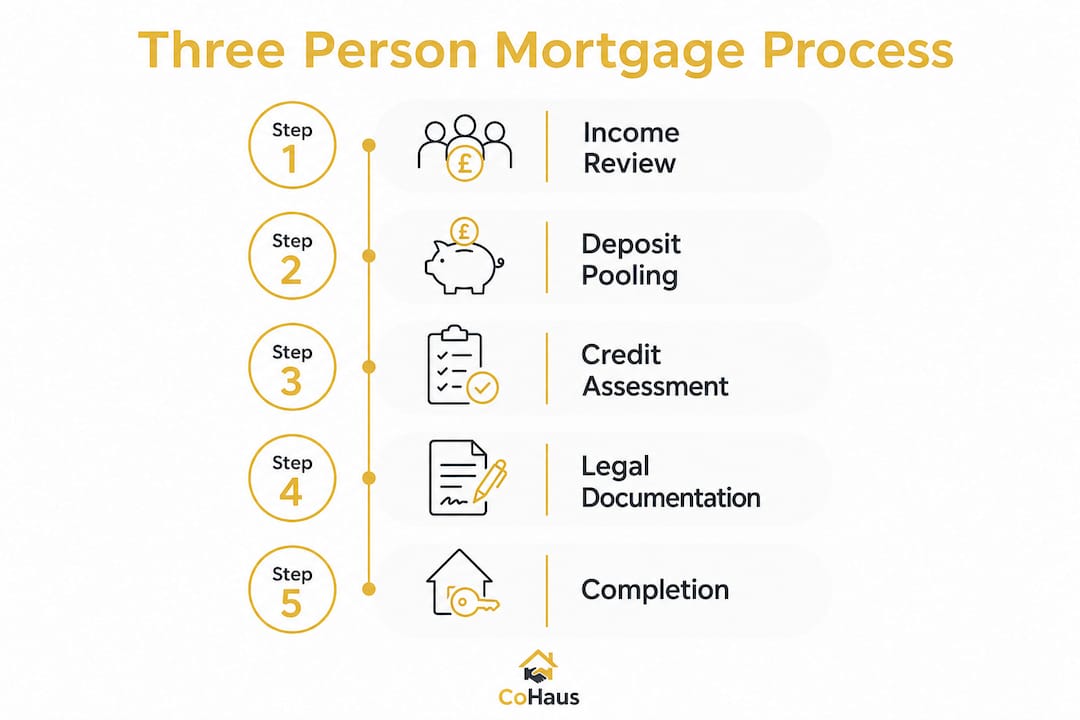
A smaller number of lenders will consider all three incomes in full. These lenders are typically found through whole-of-market brokers rather than going direct to a high street bank. The difference in borrowing capacity between a two-income and three-income assessment can be substantial, so identifying the right lender is one of the most consequential decisions in the process.
What lenders check for all three applicants:
- Full credit history and credit score for each borrower
- Proof of income, including payslips, tax returns for the self-employed, and bank statements
- Existing financial commitments such as loans, credit cards, and other mortgages
- Deposit source and size, with all three contributions documented
- Affordability under stress-tested interest rates, not just the current rate
The deposit itself can be pooled from all three buyers. Each person's contribution should be clearly documented, particularly if the split is unequal, as this feeds directly into the Declaration of Trust and the ownership share calculation.
Pro Tip: Use a whole-of-market broker when applying as three people. They have access to lenders who consider all three incomes, which can meaningfully increase what you can borrow compared to going directly to a mainstream bank.
What practical challenges come with a three person mortgage?
Managing a mortgage between three people requires more coordination than a standard two-person arrangement. The financial and relational complexity increases with each additional borrower, and the risks are real if the groundwork is not laid properly.
The most effective practical tool is a shared account for mortgage payments and household expenses. Each borrower contributes their agreed amount monthly, and the mortgage direct debit runs from that account. This creates a clear paper trail and removes ambiguity about whether payments have been made.
Common challenges to plan for:
- One borrower's financial circumstances change, such as job loss or reduced income, affecting their ability to contribute.
- Disagreements about property maintenance, improvements, or decisions that require joint consent.
- One person wants to sell their share or exit the arrangement, triggering a need to refinance or find a replacement borrower.
- The joint mortgage reduces each borrower's individual borrowing capacity, which matters if any of the three wants to buy another property later.
Experts emphasise that exit planning is the area most often neglected and most often regretted. A co-owner who wants to leave cannot simply walk away. The remaining borrowers must either buy out the departing person's share, find a new co-borrower acceptable to the lender, or sell the property entirely. Each route takes time and money, so agreeing the process in advance removes much of the friction.
Pro Tip: Schedule a brief annual review with all three co-owners to assess whether the current arrangement still works for everyone. Catching problems early is far less costly than resolving a dispute after relationships have broken down.
Key takeaways
A three person mortgage can significantly increase borrowing capacity, but it requires clear legal agreements, the right lender, and a shared plan for managing the arrangement over time.
| Point | Details |
|---|---|
| Joint liability is total | Each borrower is liable for the full debt, not just their share of it. |
| Ownership structure matters | Tenants in common with a Declaration of Trust protects each person's defined share. |
| Lender choice is critical | Only some lenders count all three incomes; use a whole-of-market broker to find them. |
| Exit planning is non-negotiable | Agree the exit process before completion to avoid costly disputes later. |
| JBSP is a useful alternative | Joint Borrower Sole Proprietor mortgages let multiple incomes support one owner's purchase. |
My honest view on three person mortgages
Three person mortgages work. I have seen them work well for friends pooling resources, for adult children buying with a parent, and for colleagues who trust each other enough to share a long-term financial commitment. The structure is sound. The risks are manageable. But the people who struggle are almost always the ones who skipped the legal groundwork because they trusted each other and assumed that was enough.
Trust is necessary but not sufficient. A Declaration of Trust, a clear payment agreement, and a documented exit plan are not signs of distrust. They are signs of respect for the complexity of the arrangement. The borrowers who get into trouble are typically those who treated the legal steps as optional extras rather than foundations.
The lender selection piece is also underestimated. Going directly to a high street bank and discovering they only count two incomes is a frustrating and avoidable outcome. A whole-of-market broker who regularly places three and four-applicant mortgages will know which lenders run full income assessments and which do not. That knowledge alone can change what you can borrow by tens of thousands of pounds.
Co-ownership is a genuinely viable path to property ownership for people who cannot get there alone. The key is treating it with the same seriousness as any other major financial and legal commitment, because that is exactly what it is.
— Martin
How Cohaus supports shared home ownership
Buying a home with two others is a significant decision, and having the right support makes the process clearer and less daunting.

Cohaus is built for people who want to co-buy a home but need a structured way to do it safely. The platform brings together co-buyers, guides them through shared deposit arrangements, and provides the legal protections and exit terms that make co-ownership work in practice. If you are considering a shared home purchase and want a community that understands the process from the inside, Cohaus is worth exploring. The goal is straightforward: make collaborative home ownership a realistic option for people who are currently locked out of the market.
FAQ
Can three people get a mortgage together in the UK?
Yes. Three people can apply for a joint mortgage together in the UK. UK Land Registry permits up to four legal owners on a property, and many lenders accept up to four borrowers on the mortgage contract.
Do all three incomes count when applying for a joint mortgage?
Not always. Some lenders only assess two incomes even with three applicants, while others consider all three in full. Using a whole-of-market broker is the most reliable way to find lenders who count every income.
What is the difference between joint tenants and tenants in common?
Joint tenants own the property equally and indivisibly, with shares passing automatically to survivors on death. Tenants in common hold defined percentage shares that can be left to anyone in a will, making it the more flexible structure for three co-buyers with unequal contributions.
What happens if one person wants to leave a three-way mortgage?
The remaining borrowers must either buy out the departing person's share, find a replacement borrower the lender approves, or sell the property. Agreeing this exit process in advance in a Declaration of Trust prevents costly disputes.
What is a Joint Borrower Sole Proprietor mortgage?
A Joint Borrower Sole Proprietor mortgage allows multiple borrowers to support a single owner's application. JBSP supporting borrowers carry full liability for repayments but do not appear on the title deeds and gain no ownership rights.