
TL;DR:
- A JBSP mortgage allows a supporting family member to share repayment liability while only one person owns the property. It preserves first-time buyer SDLT relief and reduces possible surcharge costs. However, supporting borrowers bear full legal responsibility and face significant future exit challenges.
A joint borrower sole proprietor (JBSP) mortgage is a financing arrangement where two or more people share full legal responsibility for mortgage repayments, but only one person holds ownership of the property. This structure lets first-time buyers combine incomes with a parent or family member to increase borrowing capacity, while the buyer alone appears on the title deeds. The sole proprietor retains first-time buyer status and, crucially, qualifies for Stamp Duty Land Tax (SDLT) relief. For buyers who are financially stretched but not without support, a JBSP mortgage is one of the most tax-efficient routes into homeownership available in the UK today.
What is a joint borrower sole proprietor mortgage and how does it differ from other products?

A JBSP mortgage separates legal ownership from mortgage liability. The sole proprietor owns the property outright. The supporting borrowers, often parents or close family members, are named on the mortgage but hold no rights to the property itself.
This is a meaningful distinction from a standard joint mortgage, where all named parties own a share of the property. It also differs from a guarantor mortgage. In a guarantor arrangement, the guarantor's liability is secondary and only activated if the primary borrower defaults. In a JBSP mortgage, all parties hold joint and several liability from day one. That means every borrower is equally responsible for the full debt from the moment the mortgage completes.
The legal separation in JBSP means the owner holds title exclusively, while supporting borrowers have no property rights but carry full repayment liability. This structure is what makes the tax advantages possible, and it is also what makes the legal obligations so serious.
What are the benefits and tax implications of a JBSP mortgage?
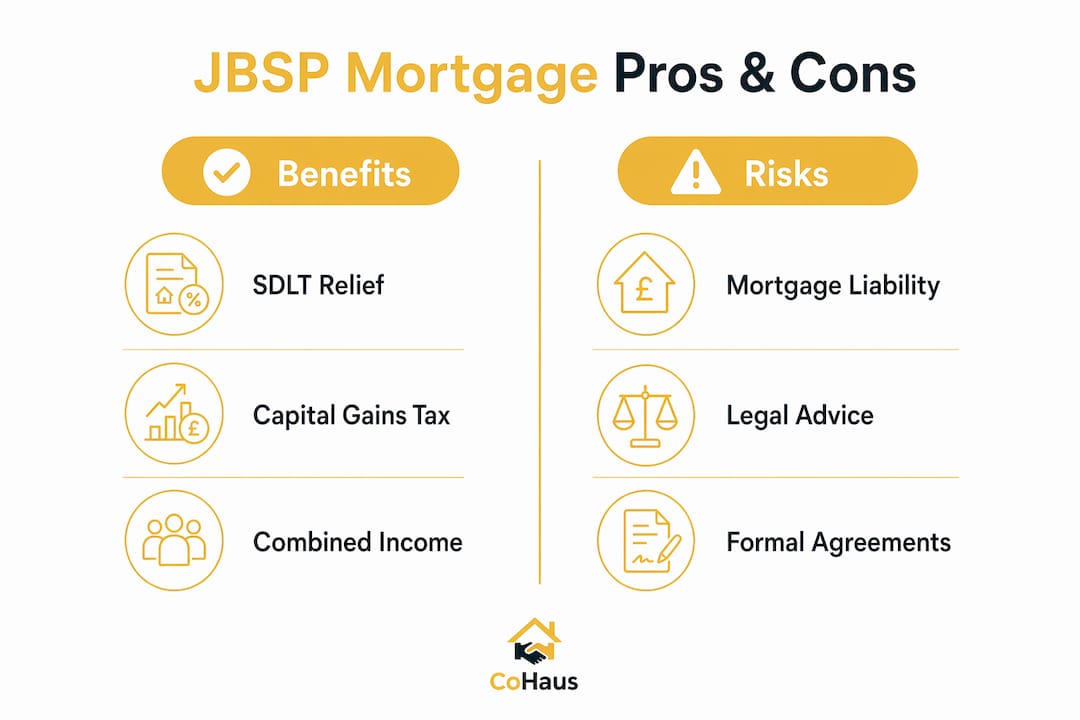
The most significant financial benefit of a JBSP mortgage is the preservation of first-time buyer SDLT relief. Stamp duty is assessed solely on who is named on the title deeds, not on who holds mortgage liability. This means a supporting borrower who already owns a home does not trigger the additional dwelling surcharge.
That surcharge currently stands at 5% on top of standard SDLT rates. For a £320,000 home, a JBSP arrangement could save £16,000 in SDLT surcharges by keeping the non-owner off the title. That is a substantial saving that a standard joint mortgage would forfeit entirely.
| Scenario | Ownership structure | SDLT surcharge applies? | Estimated saving |
|---|---|---|---|
| Standard joint mortgage | Both parties on title | Yes, if one already owns | Up to £16,000 on £320,000 |
| JBSP mortgage | Sole proprietor only | No | Surcharge avoided |
| Guarantor mortgage | Sole proprietor only | No | Surcharge avoided |
The JBSP route also keeps the sole proprietor's Capital Gains Tax position cleaner if they sell in future, since no co-owner holds a share of the asset. For families helping a child onto the property ladder in 2026, this structure is often more tax-efficient than gifting a deposit and taking a joint ownership stake.
Pro Tip: If the supporting borrower owns their own home, always model the SDLT cost of a standard joint mortgage before choosing your structure. The surcharge saving alone often justifies the JBSP route.
What are the risks and legal responsibilities for supporting borrowers?
Supporting borrowers carry the full weight of the mortgage debt, not a portion of it. JBSP is not a light commitment. Supporting borrowers are legal primary borrowers, responsible for repayments from the first month, with no secondary fallback position.
The key risks every supporting borrower must understand before signing:
- Credit file impact. The JBSP mortgage appears on supporting borrowers' credit files, reducing their future borrowing capacity for as long as the liability remains.
- Full repayment liability. If the sole proprietor cannot pay, the lender pursues all named borrowers equally. There is no protected position.
- No property rights. Supporting borrowers carry all the financial risk with none of the ownership benefit. They cannot force a sale or claim equity.
- Difficult exit. Removing a supporting borrower requires refinancing when the sole proprietor prequalifies alone, based on current market conditions, not the original terms.
- Impact on their own mortgage. If a supporting borrower wants to remortgage or move home while named on a JBSP, lenders will count the JBSP liability against their affordability.
Independent legal advice is not optional for supporting borrowers. It is the only way to be certain they understand what they are signing. Many lenders require evidence of this advice before the mortgage completes.
Formalising family agreements with trust declarations helps prevent future conflicts over ownership rights and sale decisions. A Declaration of Trust, drafted by a solicitor, sets out what happens if circumstances change, including relationship breakdowns or financial difficulties.
Pro Tip: Ask your solicitor to draft a clear written agreement covering what happens if the sole proprietor misses payments, wants to sell, or the supporting borrower needs to exit. Verbal family agreements do not hold up.
How do lenders assess affordability and eligibility for JBSP mortgages?
Lenders calculate affordability using the combined incomes of all borrowers, minus existing debts, committed expenditure, and any other mortgage liabilities. This combined figure is what unlocks higher borrowing for the sole proprietor.
Most UK lenders permit up to four borrowers on a JBSP application. More borrowers means more income in the affordability calculation, though lenders scrutinise each applicant's financial position individually.
Key eligibility factors lenders assess:
- Age of supporting borrowers. Older supporting borrowers may face loan term restrictions, which can shorten the mortgage term, increase monthly payments, and reduce overall affordability.
- Existing credit commitments. Any outstanding loans, credit cards, or mortgages held by supporting borrowers reduce the net income available for affordability calculations.
- Relationship to the sole proprietor. Lender requirements vary. Some restrict JBSP to immediate family members. Others accept friends or unmarried partners.
- Employment and income type. Self-employed income, rental income, and variable pay are all assessed differently. Supporting borrowers with complex income structures may need specialist lenders.
- Deposit source. Lenders require evidence of where the deposit originates, particularly if it comes from a supporting borrower.
Documentation requirements are thorough. Expect to provide payslips, bank statements, tax returns for self-employed applicants, and proof of any existing mortgage commitments. Gaps or inconsistencies in paperwork slow applications significantly.
Practical steps when applying for a JBSP mortgage
Preparation separates successful JBSP applications from stalled ones. These steps give you the clearest path forward.
- Agree an exit plan before you apply. Financial advisors recommend establishing exit strategies for supporting borrowers to be released from the mortgage once the sole proprietor's income grows. Set a target timeline and review it annually.
- Get independent legal advice for the supporting borrower. This is non-negotiable. The solicitor must be separate from the one acting for the sole proprietor to avoid conflicts of interest.
- Draft a Declaration of Trust. A solicitor should formalise the arrangement in writing, covering repayment responsibilities, what happens on sale, and the process for releasing supporting borrowers.
- Select a lender experienced with JBSP products. Not all high street lenders offer JBSP mortgages. A whole-of-market mortgage broker can identify lenders whose criteria match your specific circumstances.
- Prepare complete financial documentation for all borrowers. Collect three months of payslips, six months of bank statements, and any evidence of additional income for every person named on the application.
- Model the affordability ceiling honestly. Use a broker to calculate the maximum borrowing based on combined incomes, then stress-test it against a rate rise of 2–3 percentage points to confirm the repayments remain manageable.
If you are exploring co-buying as part of your route to ownership, Cohaus offers a structured co-buying process that covers shared deposits, legal protections, and exit planning from the outset.
Key takeaways
A JBSP mortgage is the most tax-efficient way for a first-time buyer to use family income support without losing SDLT relief or sharing property ownership.
| Point | Details |
|---|---|
| Ownership stays with one person | Only the sole proprietor holds the title deeds; supporting borrowers have no property rights. |
| SDLT relief is preserved | Stamp duty is assessed on title holders only, so the 5% surcharge is avoided when a property-owning parent supports via JBSP. |
| Supporting borrowers carry full liability | All named borrowers are equally responsible for the full debt from day one, not as a secondary fallback. |
| Exit planning is essential | Removing a supporting borrower requires refinancing under current market conditions, so plan for this from the start. |
| Legal documentation protects everyone | A Declaration of Trust and independent legal advice for supporting borrowers prevent disputes and clarify obligations. |
Why JBSP deserves more caution than most families give it
I have seen too many families treat a JBSP mortgage as a paperwork formality. A parent signs on to help their child buy, everyone feels good about it, and nobody reads the small print carefully enough. That is where things go wrong.
The liability is real and immediate. A supporting borrower who signs a JBSP mortgage in january and then applies for a buy-to-let in march will find their borrowing capacity has shrunk. The JBSP debt sits on their credit file and lenders count it in full. This is not a technicality. It is a direct financial consequence that affects real decisions.
The other thing families underestimate is how hard it is to exit. Releasing a supporting borrower is not a simple admin task. It requires the sole proprietor to remortgage and qualify entirely on their own income, under whatever lending conditions exist at that point. If rates have risen or the sole proprietor's income has not grown as expected, the exit can be delayed by years.
My honest advice: treat the exit plan as seriously as the entry. Write it down. Review it every year. And make sure the supporting borrower has their own solicitor before they sign anything. The arrangement works well when everyone understands it fully. It causes real damage when they do not.
— Martin
How Cohaus supports co-buyers navigating complex financing
Buying a home with financial support from family is a practical solution, but it comes with real legal and financial complexity. Cohaus is built for people who want to buy together without the confusion.

Cohaus brings co-buyers together through a structured process that covers shared deposits, legal protections, and clear exit terms from the start. Whether you are a first-time buyer exploring JBSP options or a family member thinking about how to help without taking on unexpected risk, Cohaus offers guidance designed around real co-buying situations. The platform makes the legal and financial side of shared homeownership clearer, so you can make decisions with confidence rather than guesswork.
FAQ
What is a JBSP mortgage in simple terms?
A JBSP mortgage lets two or more people share mortgage repayment responsibility while only one person legally owns the property. It is commonly used by first-time buyers who need family income support to borrow enough.
Does a JBSP mortgage affect the supporting borrower's credit score?
Yes. The mortgage appears on the supporting borrower's credit file for the full duration of the liability, which reduces their capacity to borrow for other purposes such as remortgaging their own home.
Can a supporting borrower be removed from a JBSP mortgage?
A supporting borrower can only be removed through a full remortgage, once the sole proprietor qualifies for the loan independently under current lending conditions. There is no simpler administrative route.
How many people can be on a JBSP mortgage?
Most UK lenders allow up to four borrowers on a single JBSP application. Each borrower's income and financial commitments are assessed individually as part of the affordability calculation.
Is a JBSP mortgage better than a guarantor mortgage?
A JBSP mortgage typically allows higher borrowing because all incomes are included in the affordability calculation from the start. A guarantor mortgage only activates the guarantor's liability on default, but the borrowing ceiling is usually lower as a result.