
Yes, multiple co-buyers can each use their own Lifetime ISA towards a single shared deposit. HMRC rules place no limit on how many people can pool individual LISAs for one property, provided each person meets the eligibility conditions independently. The key constraints to know upfront:
- Each account must have been open for at least 12 months since the first payment
- The property must cost £450,000 or less
- Funds go directly to an eligible conveyancer, never to you
- Unauthorised withdrawals trigger a 25% charge that can leave you with less than you put in
MoneyHelper and gov.uk both confirm this structure is permitted. Cohaus exists specifically to help co-buyers coordinate this process safely, with legal templates and deposit management guidance built around these rules.
Table of Contents
- How does a Lifetime ISA deposit work for co-buyers?
- What every co-buyer must confirm before withdrawing
- Step-by-step: coordinating multiple LISAs for a joint purchase
- Timing, costs and common pitfalls when pooling LISAs
- How to protect unequal deposit contributions legally
- Combining your LISA with other deposit sources
- How Cohaus supports co-buyers through the LISA process
- Key takeaways
- What coordinating multiple LISAs actually taught us
- Cohaus helps you pool deposits and protect every contribution
- Useful sources and further reading
How does a Lifetime ISA deposit work for co-buyers?
Each co-buyer holds their own individual LISA. The accounts are separate, but the funds can arrive with the same conveyancer at the same time, combining into a single deposit pot for the purchase.

The core numbers:
| Rule | Detail |
|---|---|
| Annual contribution limit | £4,000 per person, per tax year |
| Government bonus | 25% of contributions, up to £1,000 per year per person |
| Property price cap | £450,000 maximum purchase price |
| Minimum account age | At least 12 months from first payment |
| Completion window | 90 days from conveyancer receiving funds |
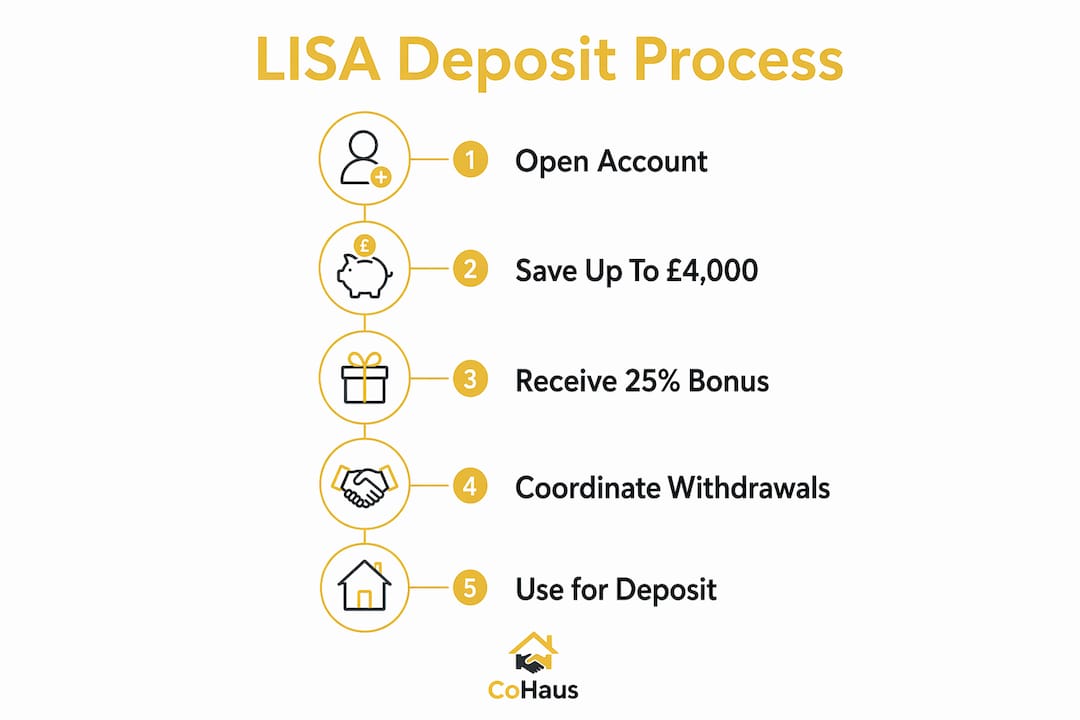
The £4,000 annual limit counts toward your overall ISA allowance (currently £20,000), so factor that into any broader savings plan. Two co-buyers each contributing the maximum can accumulate a substantial sum per year including bonuses, and three buyers can combine even more. That collective power is precisely what makes LISAs attractive for co-buying.
Funds are not paid to you. The ISA manager pays your conveyancer directly, within 30 days of receiving the required declarations. The conveyancer holds the money until the transaction is completed.
Key figures at a glance: £4,000 annual cap per person, 25% government bonus (max £1,000/year per person), £450,000 property price cap, 12-month minimum account age, 90-day completion window.
What every co-buyer must confirm before withdrawing
Each person must tick these off individually. One person failing a condition does not block the others, but it does mean their LISA funds cannot be used for this purchase.
- First-time buyer status: you must never have owned a residential property anywhere in the world
- 12-month rule: your account must have been open for at least 12 months since the first payment
- Property price: the agreed purchase price must be £450,000 or less
- Mortgage condition: the purchase must be funded by a mortgage secured on the property; buy-to-let does not qualify
- No double bonus: if you have claimed a Help to Buy ISA government bonus for this purchase, you cannot also use your LISA bonus for the same transaction
- Connected person restriction: from 6 April 2024, a purchase funded by a mortgage from a connected person (as defined under section 993 of the Income Tax Act 2007) does not qualify for a charge-free withdrawal
- Eligible conveyancer: confirm your solicitor or conveyancer is registered with an approved professional body and willing to handle LISA withdrawals
Pro Tip: Check the connected person restriction early if any co-buyer's family is involved in funding the mortgage. This rule, introduced in April 2024, has caught buyers off guard when informal family lending arrangements were in place.
Step-by-step: coordinating multiple LISAs for a joint purchase
-
Agree the ownership split and contribution plan. Before anyone withdraws anything, confirm what percentage of the deposit each person is contributing and how that maps to ownership shares. Document this in writing.
-
Confirm each LISA has been open for 12 months. If any account is newer, that person's funds cannot be used until the anniversary passes. Plan your purchase timeline around the latest account opening date.
-
Instruct an eligible conveyancer early. Tell them at offer stage that multiple LISAs are involved. Each buyer must provide their account number, ISA manager details, property address, purchase price, and a declaration of first-time buyer status.
-
Each ISA manager releases funds to the conveyancer. Managers should pay within 30 days of receiving complete declarations. Stagger your withdrawal requests if accounts are held with different providers to avoid delays.
-
Complete within 90 days of the conveyancer receiving funds. If completion looks likely to overrun, ask the ISA manager for a 60-day extension, followed by a further 30-day extension if needed.
-
After completion, the conveyancer notifies each ISA manager within 10 business days, confirming the completion date, account number, and their professional registration number.
Pro Tip: Coordinate withdrawal requests so all funds arrive with the conveyancer within a similar window. If one buyer's funds arrive 60 days before another's, the first buyer's 90-day clock is already running.
Timing, costs and common pitfalls when pooling LISAs
The 90-day completion window is the most common source of stress in co-buying with LISAs. It starts the moment the conveyancer receives each person's funds, not when you exchange contracts.
Watch out for these:
- Property over £450,000: even £1 above the cap means no co-buyer can use their LISA for that purchase without incurring the 25% charge
- The 25% withdrawal charge: MoneyHelper is clear that this charge recovers the government bonus and more, potentially leaving you with less than your original contributions
- Confusing Help to Buy ISA and LISA bonuses: you can hold both, but you cannot claim both government bonuses on the same property
- Purchase falls through: if the sale does not complete, the conveyancer must return the full withdrawn amount to each ISA manager within 10 business days of the 90-day window expiring. Any shortfall is treated as a withdrawal and charged accordingly
Pro Tip: Ask your conveyancer to confirm in writing that they have submitted all required declarations to each ISA manager before funds are released. Administrative gaps here are the most common cause of delayed or rejected withdrawals.
How to protect unequal deposit contributions legally
When co-buyers contribute different amounts, a Deed of Trust (also called a Declaration of Trust) is the standard way to record those shares. Without one, the law may assume equal ownership regardless of what each person contributed.
- Deed of Trust: records each person's exact percentage ownership, what happens on sale, and how proceeds are divided
- Declaration of beneficial interests: used alongside the legal title to specify that beneficial ownership differs from the names on the mortgage
- Explicit mortgage arrangements: if one person contributes more deposit and another takes a larger mortgage share, both documents should reflect this consistently
The conveyancer handling the LISA withdrawals is well placed to draft or review these documents at the same time, keeping all instructions consistent.
| Milestone | Deadline |
|---|---|
| ISA manager pays conveyancer | Within 30 days of receiving declarations |
| Completion window | 90 days from conveyancer receiving funds |
| Extension (if needed) | 60 days, then a further 30 days |
| Conveyancer notifies manager post-completion | Within 10 business days |
| Conveyancer returns funds if purchase fails | Within 10 business days of 90-day expiry |
Pro Tip: Register your ownership split instructions with both the conveyancer and the mortgage lender at offer stage. Changing these arrangements after exchange is time-consuming and can delay completion.
Combining your LISA with other deposit sources
LISA funds sit alongside cash savings, gifted deposits, and other ISA funds without any restriction, provided the total deposit is applied to a qualifying purchase. A few practical points:
- Gifted deposits: mortgage lenders will ask for a signed gift letter confirming the money is not a loan. Document the source clearly and separately from LISA funds
- Other ISAs: cash or stocks and shares ISA funds can supplement a LISA deposit freely; only the LISA portion attracts the government bonus
- Help to Buy ISA transfers: you can transfer Help to Buy ISA funds into a LISA, but the transferred amount counts toward the £4,000 annual LISA limit. Switching also resets the 12-month clock on the new account
- Two government bonuses, one property: this is not permitted. If you have claimed a Help to Buy ISA bonus for this purchase, your LISA bonus is unavailable for the same transaction
For a fuller picture of how joint mortgage affordability works alongside pooled deposits, it is worth understanding how lenders assess multiple deposit sources at underwriting.
Pro Tip: Document the provenance of every deposit source before you instruct your conveyancer. Lenders and HMRC both have the power to request evidence, and a clear paper trail avoids delays.
How Cohaus supports co-buyers through the LISA process
Cohaus is built around the practical reality that co-buying involves more moving parts than a solo purchase. When multiple LISAs are involved, the coordination risk multiplies.
- Deed of Trust templates: Cohaus provides standard legal templates that record unequal contributions, ownership percentages and exit mechanics, aligned with what conveyancers need to process split LISA withdrawals
- Deposit management guidance: the platform helps co-buyers plan contribution timelines, track the 12-month account rule and coordinate withdrawal requests so no one's 90-day window expires before the others are ready
- Conveyancer coordination checklists: Cohaus checklists mirror the gov.uk declaration requirements, reducing the risk of incomplete paperwork causing a rejected or delayed withdrawal
- Community and peer support: co-buyers using Cohaus can access forums and guides from others who have navigated the same process, including the post-April 2024 connected person restriction
Pro Tip: Use Cohaus documentation and templates at offer stage, not exchange. Getting consistent instructions to your conveyancer and lender early removes the most common sources of last-minute rework.
Key takeaways
Multiple co-buyers can each use their own Lifetime ISA toward a single property deposit, provided every individual meets the eligibility conditions and the conveyancer process is followed correctly for each account.
| Point | Details |
|---|---|
| Individual eligibility applies | Each co-buyer must independently meet the 12-month rule, first-time buyer status and the £450,000 price cap. |
| Annual contribution limit | Each person can contribute up to £4,000 per year and receive a government bonus of up to £1,000. |
| Conveyancer is mandatory | Funds go directly to an eligible conveyancer; withdrawing to your own account triggers the 25% charge. |
| 90-day completion window | Coordinate withdrawal timing so all co-buyers' funds arrive within a workable window before completion. |
| Cohaus tools reduce risk | Cohaus provides Deed of Trust templates and conveyancer checklists to protect unequal contributions and reduce administrative delays. |
What coordinating multiple LISAs actually taught us
The paperwork side of a joint LISA withdrawal is manageable, but only if you treat it as a project with a timeline rather than something to sort out once you have an offer accepted. The 12-month rule is the one that catches people most often: one co-buyer opens their account six months after the others, and suddenly the whole purchase has to wait.
The other lesson is documentation. Agreeing verbally who contributes what is fine at the planning stage, but by the time you are at exchange, you need that split in writing, signed, and in the hands of your conveyancer. The Deed of Trust is not a formality; it is the document that protects everyone if circumstances change.
Three things you can act on today: agree your ownership split in writing, check every co-buyer's LISA opening date, and confirm your conveyancer handles LISA withdrawals before you instruct them.
Cohaus helps you pool deposits and protect every contribution
Co-buying with multiple LISAs is one of the most effective ways to build a meaningful deposit when individual savings fall short. The process works, but it requires every co-buyer to be organised, and it requires your conveyancer to handle several sets of declarations simultaneously.
Cohaus gives co-buyers the structure to do this confidently. From Deed of Trust templates that record unequal contributions, to conveyancer coordination checklists aligned with gov.uk requirements, the platform reduces the administrative risk that causes withdrawals to be delayed or rejected. You also get access to a community of co-buyers who have been through the same process.
If you are planning a co-buying arrangement and want to make sure your LISA funds are protected from the start, visit Cohaus to access templates and begin your co-buying plan.
Useful sources and further reading
Official guidance:
- Lifetime ISA: overview and eligibility, GOV.UK
- Lifetime ISA withdrawals for a first-time residential purchase, GOV.UK
- Conveyancers: first-time residential purchase with a Lifetime ISA, GOV.UK
- Conveyancers: Lifetime ISA technical guidance, GOV.UK
Accessible explanations:
- Lifetime ISAs, MoneyHelper
- Help to Buy ISA or Lifetime ISA?, MoneyHelper
Cohaus co-buying resources:
- Co-buying guides and articles, Cohaus
- Buying a house with friends: your 2026 UK guide
- Joint mortgage with friends: your 2026 UK guide
This article is general information, not legal or financial advice. Confirm current rules with gov.uk or a qualified professional before making decisions about your own situation.