
What's the real difference between tenants in common and joint tenancy?

When you buy a property with someone else in the UK, you hold your beneficial interest in one of two ways: as joint tenants or as tenants in common. That choice shapes what happens to your share if the relationship breaks down, if one owner dies, or if you want to exit.
Here is the core distinction:
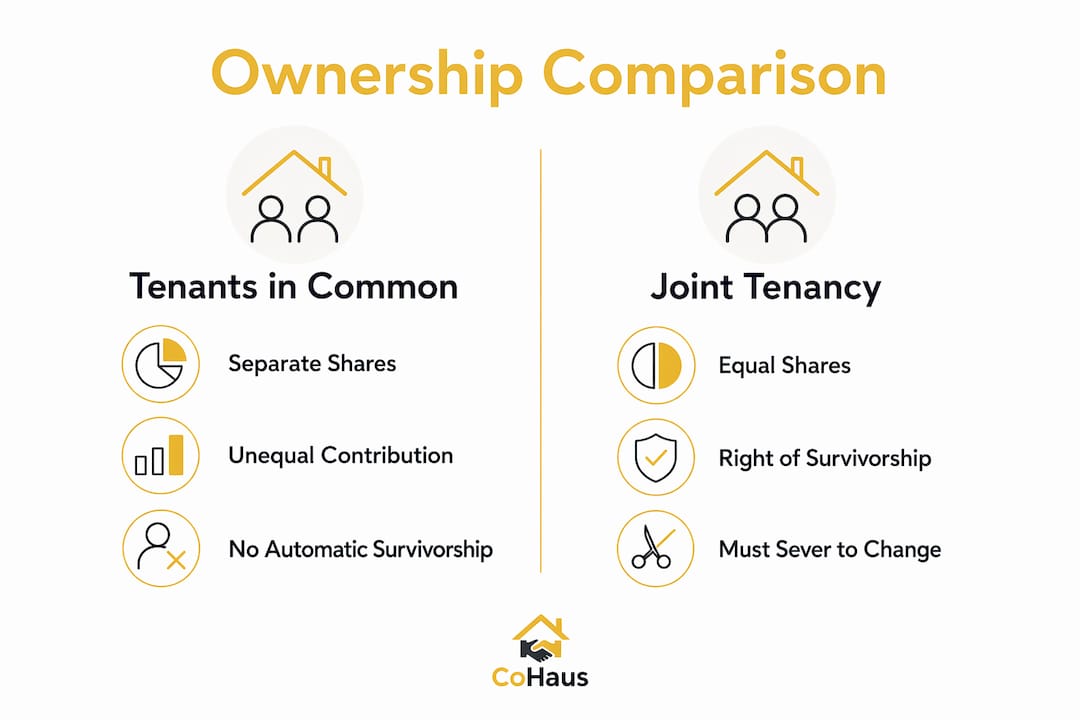
- Joint tenancy: all owners hold the property equally as a single unit. No one has a defined percentage. If one owner dies, their interest passes automatically to the surviving owners through the right of survivorship. You cannot leave your share in a will.
- Tenants in common: each owner holds a defined share, which can be equal or unequal. On death, that share passes according to the owner's will or the rules of intestacy. You can leave your portion to anyone you choose.
- Ownership shares: joint tenancy always means equal stakes; tenants in common can reflect the actual money each person put in, such as a 70/30 split matching deposit contributions.
- Control: joint tenants must act together as a single owner; tenants in common have individual shares they can transfer or mortgage separately in principle, though most lenders still require a joint mortgage in practice.
For co-buyers pooling resources with friends or acquaintances, that difference in share definition is often the deciding factor.
Table of Contents
- How UK property law governs your ownership structure
- How to change your ownership structure through severance
- Why tenants in common with a Declaration of Trust protects unequal contributions
- Risks, exit strategies, and mortgage responsibilities compared
- How Cohaus supports UK co-buyers with legal protections and shared ownership
- Co-buying with Cohaus: a clearer path to shared ownership
- Key takeaways
How UK property law governs your ownership structure
Understanding the legal framework helps you see why the choice matters more than it first appears.
Since the Law of Property Act 1925, legal title is always held as joint tenants. You cannot hold the legal estate as tenants in common. What you can choose is how the beneficial interest is held, and that is where the real financial rights sit.
- Legal estate vs beneficial interest: the legal estate is the formal ownership registered at HM Land Registry. The beneficial interest determines who actually benefits financially from the property, including sale proceeds and rental income.
- HM Land Registry and the Form A restriction: if you hold as tenants in common, a Form A restriction is entered on the title register. This signals that a sole surviving owner cannot deal with the property without appointing a second trustee, protecting the deceased owner's share.
- Identifying your ownership type: the title register does not explicitly label owners as tenants in common. A Form A restriction is the indicator, but further documents may be needed for absolute confirmation.
- Impact on tax liabilities: ownership shares in a tenants in common arrangement affect how rental income and capital gains are allocated between owners for tax purposes. Married couples holding unequal shares must file HMRC Form 17 to declare those shares on rental income.
- Stamp Duty Land Tax: both ownership types involve the same SDLT rules on purchase, but the share each person holds can affect future tax planning, particularly for higher-rate taxpayers.
Pro Tip: When you complete your purchase, check panel 10 of the TR1 form carefully. This panel specifies whether you are registering as joint tenants or tenants in common. Leaving it blank or ticking the wrong box can mean your intended ownership structure is never formally recorded.
How to change your ownership structure through severance
Ownership decisions do not have to be permanent. For detailed legal processes, see the Sale Instruction Form from Parramatta Conveyancing. If your circumstances change, you can convert from joint tenancy to tenants in common through a process called severance.
- What severance does: it ends the joint tenancy and converts the beneficial interest into defined shares, typically equal unless a Declaration of Trust specifies otherwise.
- Serving notice: to sever unilaterally, one owner serves a written notice of severance on the other owners. This does not require their consent, which is an important legal protection if co-owners disagree.
- Registering the change: you then register a Form A restriction at HM Land Registry using Form SEV (when all owners agree) or Form RX1 (when acting unilaterally). HM Land Registry charges no fee for registering this restriction.
- When all owners agree: the process is straightforward and can be completed without going to court.
- Why it matters for co-buyers: severance gives you a clear exit route if a co-buying arrangement changes, without needing the other party's cooperation to protect your financial stake.
You can also move in the other direction, converting from tenants in common back to joint tenancy, for example if co-buyers marry and want to simplify their arrangement.
Why tenants in common with a Declaration of Trust protects unequal contributions
For most co-buyers, especially friends or people who have contributed different deposit amounts, tenants in common combined with a Declaration of Trust is the structure that actually reflects reality.
- Customised shares: tenants in common allows you to record a 60/40 or 70/30 split, or any proportion that matches what each person contributed. Without a Declaration of Trust, a joint tenancy defaults to equal beneficial interest regardless of actual financial input.
- What a Declaration of Trust does: it is a legally binding document that records each owner's share, sets out what happens if one person wants to sell, and can specify how mortgage payments and costs are divided. It is drawn up by a solicitor.
- Protection during disputes: if the co-buying arrangement breaks down, the Declaration of Trust is the document that determines what each person receives from a sale. Without it, disputes become far more complicated and expensive to resolve.
- A common misconception: many people assume tenants in common means each person owns a physical part of the property, such as one floor each. In law, each owner holds a share of the entire property, not a separate physical portion.
- Cohaus practical guides on tenants in common for co-buyers walk through how to structure these arrangements and what to ask a solicitor.
Pro Tip: If you are buying with friends, an unmarried partner, or multiple co-buyers who have contributed different amounts, a Declaration of Trust is not optional. It is the document that makes your financial agreement enforceable. Getting one drawn up at the point of purchase is far cheaper than resolving a dispute later.
Risks, exit strategies, and mortgage responsibilities compared
Choosing the wrong ownership structure can create real financial exposure. Here is where the two types diverge most sharply.
- Credit exposure in joint tenancy: in both ownership types, a joint mortgage means all owners are jointly and severally liable for the full debt. If one person stops paying, the lender can pursue the others for the entire outstanding amount. This applies whether you hold as joint tenants or tenants in common.
- Inheritance risk in joint tenancy: if you die as a joint tenant, your share passes automatically to the surviving owners, regardless of what your will says. For co-buyers who are not spouses, this can mean your financial contribution goes to someone you never intended to benefit.
- Exit flexibility in tenants in common: because shares are defined, selling or transferring your portion is clearer. A well-drafted Declaration of Trust can include exit clauses specifying notice periods and sale procedures, reducing the risk of one owner blocking another's exit.
- Relationship breakdown: if co-buyers separate or fall out, joint tenancy leaves little room to reflect unequal contributions. Tenants in common, with a Declaration of Trust, gives each person a documented financial position to negotiate from.
- Inheritance planning: tenants in common allows you to leave your share to children from a previous relationship, a family member, or anyone else. Joint tenancy removes that option entirely.
- Managing mortgage responsibilities: regardless of ownership type, all borrowers on a joint mortgage share full liability. Understanding this before you commit is part of responsible co-buying, particularly when considering a three-person mortgage arrangement.
For co-buyers with unequal financial stakes, tenants in common consistently offers clearer protection and more practical exit options than joint tenancy.
How Cohaus supports UK co-buyers with legal protections and shared ownership
Co-buying works best when the legal and financial foundations are solid from the start. Cohaus is built around exactly that principle.
The Cohaus platform helps people who want to buy together but need structure to do it safely. It facilitates co-owner matching, shared deposit management, and mortgage sharing, with transparent exit terms built into the process. Legal protections, including support for Declaration of Trust arrangements, are part of how Cohaus reduces the risks that come with informal co-buying agreements.
- Community and education: Cohaus provides guides and forums where co-buyers can learn from others navigating the same decisions, from choosing an ownership structure to understanding what a Declaration of Trust should cover.
- Mitigating joint ownership risks: by building legal safeguards into the co-buying process, Cohaus addresses the credit exposure and inheritance risks that catch joint tenants off guard.
- Transparent exit terms: knowing how you can leave an arrangement before you enter it is one of the most practical protections a co-buyer can have.
Pro Tip: Before you commit to any co-buying arrangement, use the Cohaus resources to understand which ownership structure fits your financial situation. The guides are written for people in exactly your position, not for lawyers.
Co-buying with Cohaus: a clearer path to shared ownership
If you have been reading about tenants in common and joint tenancy and thinking "this is complicated," you are right. The legal structure of co-buying matters enormously, and getting it wrong is expensive to fix. Cohaus exists to make that process clearer and safer for people who want to buy together but need the right framework to do it.
Where informal co-buying arrangements leave people exposed, Cohaus provides matched co-buyers, shared deposit management, legal protections, and exit terms that are agreed upfront. You are not navigating this alone or relying on a handshake agreement. The platform is designed for people who are serious about co-ownership and want the protections that make it work long-term.
If you are ready to explore co-buying with the right legal and community support in place, visit Cohaus and see how the platform works for people in your situation.
Key takeaways
Tenants in common with a Declaration of Trust is the ownership structure that best protects co-buyers with unequal financial contributions, giving each person a defined, enforceable share.
| Point | Details |
|---|---|
| Core distinction | Joint tenancy means equal ownership with survivorship rights; tenants in common means defined, inheritable shares. |
| Legal title rule | Under UK law, the legal estate is always held as joint tenants; only the beneficial interest can be tenants in common. |
| Changing structure | Severance converts joint tenancy to tenants in common; Form SEV or RX1 registers the change at HM Land Registry at no fee. |
| Declaration of Trust | Without one, a joint tenancy defaults to equal beneficial interest regardless of actual contributions; a Declaration of Trust makes shares enforceable. |
| Cohaus | Cohaus supports co-buyers with matched ownership arrangements, legal protections, and transparent exit terms built into the process. |