
Taking out a joint mortgage with friends is one of the most practical ways to get onto the property ladder when individual incomes simply do not stretch far enough. Under UK mortgage rules, all borrowers are collectively and individually liable for the full debt, regardless of any internal agreement about shares. Here is what that means in practice:
- Up to four borrowers can be named on a single mortgage, each assessed on income, age, and credit history
- Pooling deposits and salaries increases overall borrowing power, unlocking properties that might be unaffordable individually
- The lender treats the group as one unit; your internal split does not affect their claim
- Legal ownership structure must be chosen at the point of purchase and registered with HM Land Registry
- A formal agreement between co-buyers is not optional if you want to protect your individual share
Getting these foundations right before you sign anything makes every subsequent decision easier.
Table of Contents
- Which ownership structure is right for friends co-buying property?
- Why a Declaration of Trust protects everyone in the group
- What lenders look at and the risks you share
- How to future-proof your co-buying agreement
- How Cohaus supports friends co-buying together
- Managing financial responsibilities between co-buyers
- Steps to apply for a joint mortgage with friends
- How to exit a joint mortgage or sell the shared property
- Insurance considerations for joint mortgage borrowers
- Cohaus makes co-buying structured and supported
- Key takeaways
Which ownership structure is right for friends co-buying property?
The two options under UK law are joint tenants and tenants in common, and for friends the choice is almost always straightforward.
- Tenants in common lets each person hold a defined, separate share. Shares can be unequal to reflect different deposit contributions. Crucially, you can leave your share to whoever you choose in your will.
- Joint tenants means you all own the whole property equally, with no individual shares. If one owner dies, their interest passes automatically to the surviving owners, bypassing any will entirely.
The right of survivorship under joint tenancy can produce outcomes nobody intended: a surviving friend could inherit a deceased friend's share instead of that person's family. For most friend groups, tenants in common with clearly documented shares is the correct structure. You can always change from one to the other later via HM Land Registry, but getting it right from the start avoids complications.
Pro Tip: Ask your conveyancer to confirm your choice is recorded correctly in panel 10 of the Transfer (TR1) form before you sign. HM Land Registry checks this panel when registering the property, and an unclear entry defaults to a Form A restriction.
Why a Declaration of Trust protects everyone in the group
A Declaration of Trust (also called a Deed of Trust) is a legal document that records each person's beneficial interest and sets out how the property is managed day to day. Without one, resolving a dispute about selling or exiting may require costly court intervention.
A well-drafted Declaration of Trust should cover:
- The percentage share each person holds, and how unequal deposits are accounted for
- How mortgage repayments, maintenance costs, and service charges are divided
- What happens if one person stops paying their share
- The process for valuing the property and buying out a departing co-owner
- Set a minimum ownership period before any party can demand a sale
- Dispute resolution procedures if agreement cannot be reached
Legal experts are clear that this document is a professional tool, not a sign of mistrust. Treating the arrangement like a business from day one protects the friendship as much as the investment. A floating Declaration of Trust can also adjust shares over time to reflect ongoing contributions, such as one person funding a renovation.
What lenders look at and the risks you share
Lenders assess all applicants together for affordability, credit history, and age. Where more than two borrowers are involved, many lenders only use the two highest incomes when calculating the maximum loan, so adding more friends does not always increase borrowing power proportionally. It is worth checking individual lender criteria before applying.
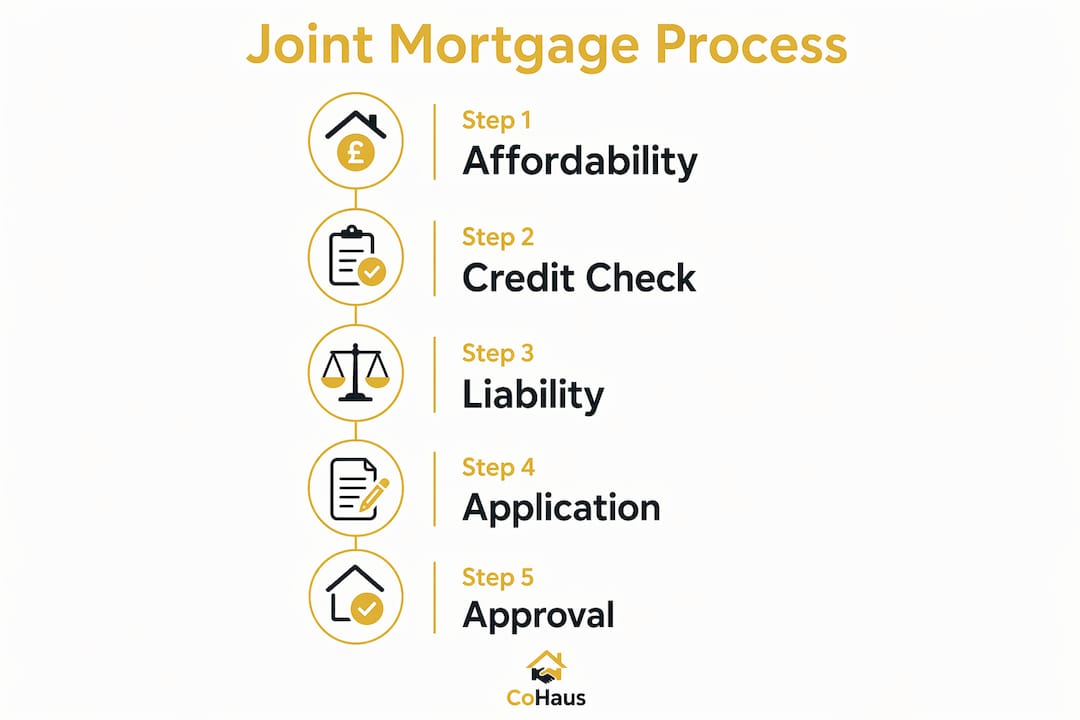
The more significant issue is joint and several liability. This means the lender can pursue any single borrower for the entire outstanding balance if others default. If one friend loses their job and stops contributing, the remaining co-borrowers must cover the full payment or face missed payment records on their credit files. That shared credit risk can affect everyone's ability to borrow independently in the future, including for their own solo mortgage later on. Understanding this risk before you apply, rather than after, is the single most useful thing you can do. For a deeper look at how liability is shared across multiple applicants, the three person mortgage guide on the Cohaus blog covers the mechanics in detail.
How to future-proof your co-buying agreement
Life changes. People get married, change jobs, or simply want to move on. Conveyancers consistently advise documenting future scenarios before purchase, not after a problem arises.
- Agree a minimum ownership period before any party can trigger a sale
- Specify that an independent RICS valuation sets the buyout price, with a clear timeline for the process
- Include a right of first refusal so remaining co-owners can buy out a departing friend before the share is offered externally
- Plan for what happens if someone marries and wants to add a partner to their share
- Revisit your wills after purchase to reflect your new asset
- Consider whether mortgage payment protection insurance makes sense for each borrower's portion
Cohaus builds community support around exactly these conversations, connecting co-buyers who are working through the same questions and helping them access the right legal and financial guidance before problems arise.
How Cohaus supports friends co-buying together
Cohaus is a co-buying platform built specifically for people who want to buy with others but need more than a mortgage broker to make it work safely.
- Shared deposit management reduces the individual financial barrier to entry
- Transparent exit terms are built into the platform's framework from the start
- Guidance on Declarations of Trust and legal ownership structures is part of the onboarding process
- The Cohaus community connects members who are at similar stages, so you can learn from people who have already navigated the same decisions
- Blog content covers current mortgage options, legal frameworks, and practical co-buying steps relevant to 2026
The platform is designed for people who are still renting, still saving, and feel locked out of the market individually. Co-buying through Cohaus gives that process a structure and a support network.
Managing financial responsibilities between co-buyers
The mortgage payment is the most visible shared cost, but it is rarely the only one. Council tax, buildings insurance, utilities, and maintenance all need a clear split agreed in writing before you move in.

Opening a dedicated joint account for property costs is the most practical approach. Each person contributes their agreed share monthly, and all property bills are paid from that account. This creates a clear record and removes ambiguity about who has paid what. The Declaration of Trust should specify what happens if the joint account falls short, including whether one person can cover a shortfall and claim it back, and on what timeline.
Steps to apply for a joint mortgage with friends
The application process follows the same broad path as any mortgage, with a few additional steps for group applicants.
- Check everyone's finances together: credit scores, existing debts, and realistic deposit contributions. Use a mortgage calculator to estimate what the group can borrow.
- Agree your ownership structure and instruct a solicitor to draft a Declaration of Trust before you make an offer.
- Speak to a mortgage broker who has experience with group mortgage applications in the UK. Not all lenders accept more than two applicants, and product availability varies.
- Gather documentation: proof of identity, three months of payslips or accounts for self-employed applicants, bank statements, and proof of deposit for each borrower.
- Submit the application with all borrowers named. The lender will conduct affordability and credit checks on the group collectively.
- Instruct a conveyancer to handle the legal transfer, register the correct ownership structure with HM Land Registry, and finalise the Declaration of Trust.
Common mortgage pitfalls at the application stage often come down to mismatched credit profiles or undisclosed debts. Transparency within the group before you apply saves time and avoids surprises.
How to exit a joint mortgage or sell the shared property
Exiting a shared mortgage is more complex than leaving a rental. The options are: one co-owner buys out the others and takes over the mortgage, the group sells the property and splits the proceeds according to the Declaration of Trust, or a departing owner sells their share to an agreed third party.
Under the Trusts of Land and Appointment of Trustees Act 1996 (TOLATA), any co-owner can apply to court for an order for sale if agreement cannot be reached. A well-drafted Declaration of Trust reduces this risk by setting out a clear process. For the tenants in common structure, the buyout price is typically set by an independent RICS valuation. All parties should take independent legal advice before any transfer of ownership is completed.
Insurance considerations for joint mortgage borrowers
Each borrower on a joint mortgage carries the full liability if others cannot pay. Insurance is one practical way to manage that exposure.
- Life insurance: each borrower should consider a policy that covers at least their share of the outstanding mortgage, so the remaining co-owners are not left with an unmanageable debt if one person dies
- Critical illness cover: pays out a lump sum if a borrower is diagnosed with a serious illness and cannot work
- Income protection insurance: replaces a portion of income if a borrower is unable to work due to illness or injury, helping them maintain their mortgage contributions
- Mortgage payment protection insurance: covers repayments for a defined period if a borrower loses their job, though policy conditions vary and should be checked carefully
Each policy should be arranged individually, not as a single group policy, so that a claim by one person does not affect the others' cover. A financial adviser can help each co-buyer assess which combination is appropriate for their circumstances.
Cohaus makes co-buying structured and supported
Getting a joint mortgage with friends is achievable, but the legal and financial groundwork takes real effort to get right. Cohaus exists to make that process less daunting.
We built Cohaus for people who are ready to stop renting but cannot do it alone. The platform brings together shared deposit management, legal guidance on co-ownership structures, transparent exit terms, and a community of people at the same stage. You get the structure of a formal co-buying process without having to piece it together yourself from scratch. If you are considering buying property with friends and want a clearer path forward, join the Cohaus community and see how co-buying can work for you.
Key takeaways
A joint mortgage with friends requires legal ownership as tenants in common, a Declaration of Trust, and a clear understanding of joint and several liability before any offer is made.
| Point | Details |
|---|---|
| Ownership structure | Tenants in common is the right choice for friends; it allows unequal shares and lets each person pass their share via a will. |
| Declaration of Trust | This legal document governs repayment splits, exit procedures, and buyout mechanisms, and prevents costly disputes. |
| Joint and several liability | Any borrower can be pursued for the full mortgage debt if others default, affecting all co-borrowers' credit records. |
| Future-proofing | Agree minimum ownership periods, buyout valuations, and life-change scenarios in writing before you complete. |
| Cohaus | Cohaus provides shared deposit management, legal guidance, and community support to help friends co-buy with confidence. |