
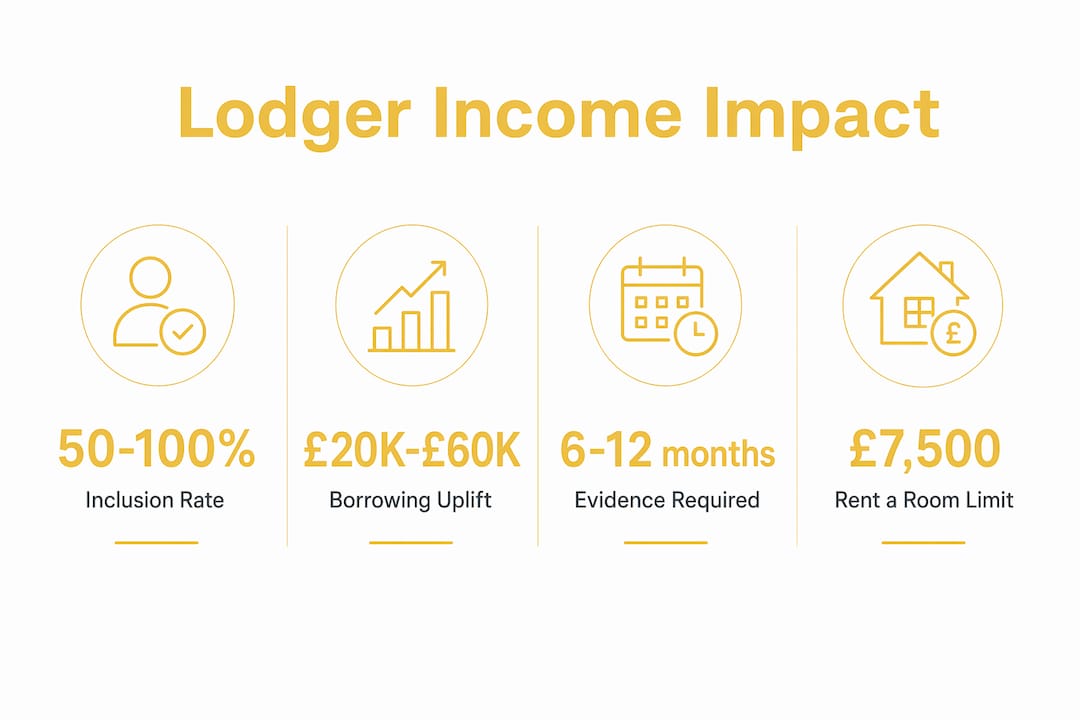
A mortgage with lodger income is a standard residential mortgage where a lender includes rental payments from a live-in lodger when calculating how much you can borrow. This single adjustment can increase borrowing capacity by £20,000 to £60,000 depending on how the lender treats that income. For buyers struggling to reach the borrowing threshold they need, that is a meaningful difference. The UK's Rent a Room scheme adds another layer of benefit, allowing up to £7,500 per year in lodger income to be received completely tax-free. Understanding how lenders assess this income, and what evidence they require, is the difference between a successful application and a declined one.
How do lenders assess lodger income for mortgage applications?
Lodger mortgages are not a separate product category. They are standard residential mortgages where selected lenders choose to include lodger income within their affordability calculations. Not every lender does this, and those that do apply very different rules.

What percentage of lodger income counts?
Lenders typically apply 50% to 100% of lodger income when assessing affordability. The exact figure depends on whether the lodger is already in place or is only projected. An existing lodger with a track record of payments attracts a higher inclusion rate. A prospective lodger, where you plan to rent out a room after purchase, is treated with more caution and typically discounted to 25–50% of the expected rent.
To illustrate the maths: a lodger paying £450 per month, assessed at 75% inclusion and multiplied by a standard 4.5x income multiplier, adds £24,300 to your maximum borrowing. That figure alone can close the gap between what you can currently borrow and what you need.
What evidence do lenders require?
For existing lodger arrangements, lenders ask for 6–12 months of bank statements showing rent payments clearly labelled and received consistently. A formal tenancy agreement or lodger agreement is also required. Informal cash payments, even if regular, rarely satisfy underwriting requirements.
For prospective income, lenders compare your estimated rent against local market benchmarks. Platforms like SpareRoom and Rightmove are commonly used to validate whether your projected rental figure is realistic. Overstated estimates get discounted to conservative figures before they enter the affordability calculation.
Key documentation to prepare:
- Six to twelve months of bank statements showing lodger rent receipts
- A signed lodger agreement or assured shorthold tenancy document
- Evidence of market rent from platforms such as SpareRoom or Rightmove
- SA302 tax forms or a self-assessment return if income exceeds the Rent a Room threshold
- Written confirmation of the lodger's current arrangement if they are already in residence
Pro Tip: Label lodger rent payments clearly in your bank account by asking your lodger to use a consistent reference such as "room rent" when transferring. Lenders look for a clear, consistent pattern and ambiguous references slow down underwriting.
How does lender policy vary?
Most lenders permit lodgers in a property under a standard residential mortgage, but permitting a lodger and counting their income in your affordability assessment are two entirely separate policies. A lender may allow you to have a lodger while refusing to use that income to increase your loan size. Always confirm both policies before choosing a lender.
What property and legal criteria affect using lodger income?
Lenders do not accept lodger income simply because you intend to rent out a room. The property itself must meet specific criteria, and the legal arrangement must be properly structured.
The most common property requirements are:
- Minimum two bedrooms. The property must have at least two bedrooms. Studio flats and one-bedroom properties are typically excluded because there is insufficient living space to accommodate both owner and lodger comfortably.
- Adequate shared or separate living space. Some lenders require the lodger to have access to a separate bathroom or at minimum a clearly defined private space. A box room with no other facilities may not qualify.
- Formal lodger agreement in place. A written lodger agreement is not optional. Lenders require formal arrangements and informal rent payments do not qualify as evidenced income. The agreement should specify rent amount, payment frequency, and notice terms.
- No HMO licensing complications. A single lodger in your home does not require planning permission or an HMO (House in Multiple Occupation) licence. If you plan to have multiple lodgers, HMO rules apply and most residential mortgage lenders will not accept the arrangement under a standard product.
- Location and property type suitability. Some lenders restrict lodger income inclusion to certain property types or locations. Flats in blocks with restrictive leases, for example, may prohibit subletting entirely, which would invalidate the lodger arrangement before it begins.
Checking your lease or freehold title for subletting restrictions is a practical step that many buyers overlook. A lodger income strategy built on a property that legally prohibits it will fail at the point of underwriting.
How does the UK Rent a Room scheme affect your mortgage?
The Rent a Room scheme is a HMRC tax relief that allows owner-occupiers to earn up to £7,500 per year from a lodger completely free of income tax. That works out at £625 per month before tax becomes relevant. The scheme applies automatically if your income stays below the threshold; you do not need to register separately.
Tax relief versus mortgage affordability
The Rent a Room scheme and mortgage affordability calculations are separate systems. Lenders apply their own caps on how much lodger income they will count, regardless of what HMRC permits tax-free. A lender may include only £400 per month of a £625 monthly rent in their affordability model, even though the full amount is tax-free.
| Scenario | Tax treatment | Lender treatment |
|---|---|---|
| Lodger pays £500/month (£6,000/year) | Tax-free under Rent a Room | 50–100% included, subject to lender policy |
| Lodger pays £800/month (£9,600/year) | £7,500 tax-free; £2,100 taxable | Lender applies own cap; SA302 may be required |
| Prospective lodger, no current tenant | No tax yet | 25–50% of estimated rent included |
If your lodger income exceeds £7,500 per year, you must declare the surplus through self-assessment and submit an SA302 or tax return. Lenders may request this as proof of tax compliance during underwriting. Failing to declare income above the threshold, and then presenting it to a lender, creates a credibility problem that can derail an application.
Pro Tip: Keep Rent a Room income and buy-to-let income clearly separate in your records. Lenders treat them differently. Lodger income from your main residence is assessed under residential mortgage rules, not buy-to-let criteria, and mixing the two in your documentation creates unnecessary confusion.
What practical steps help you include lodger income in your application?
Getting lodger income accepted requires preparation well before you submit a mortgage application. The steps below reflect what lenders actually look for.
- Gather consistent bank statement evidence. Six months is the minimum; twelve months is stronger. Every lodger payment should appear as a regular, clearly labelled credit. Gaps or irregular amounts raise questions.
- Use realistic rent valuations. Check current listings on SpareRoom or Rightmove for comparable rooms in your area. Your estimated rent should sit within the range of what similar rooms actually achieve. Excessive rent estimates are discounted by lenders, so a conservative but credible figure serves you better than an optimistic one.
- Confirm the property meets room criteria. Before making an offer, verify the property has at least two bedrooms and no lease restrictions on subletting. Ask the estate agent directly and check the lease documents.
- Use a specialist mortgage broker. Not all brokers know which lenders accept lodger income and on what terms. A broker who works regularly with lodger-inclusive lending will know which lenders apply 75% or 100% inclusion rates and which exclude prospective income entirely. That knowledge saves time and protects your credit file from unnecessary applications.
- Have a financial fallback plan. Lodger arrangements change. A lodger may leave, and a gap in rental income should not put your mortgage payments at risk. Lenders will ask whether you can service the mortgage on your own income alone. Having a credible answer to that question strengthens your application.
Only named mortgage applicants' incomes count by default. A lodger cannot be added as a joint applicant. Their income enters the calculation only as evidenced rental income under the lender's specific policy, which is why the documentation trail matters so much.
Key takeaways
A mortgage with lodger income can meaningfully increase your borrowing capacity, but only when the property qualifies, the arrangement is formally documented, and the lender's specific policy accepts that income type.
| Point | Details |
|---|---|
| Borrowing uplift is real | Lodger income can add £20,000 to £60,000 to your maximum borrowing, depending on lender policy. |
| Lender policies vary widely | Some lenders count 100% of lodger income; others exclude it entirely, even if they permit lodgers. |
| Evidence is non-negotiable | Six to twelve months of clearly labelled bank statements and a formal lodger agreement are required. |
| Tax compliance matters | Income above £7,500 per year must be declared; lenders may request SA302 forms as proof. |
| Property must qualify | Minimum two bedrooms and no lease restrictions on subletting are standard lender requirements. |
What I have learned about lodger income and mortgage applications
The most common mistake I see is buyers treating lodger income as a guaranteed boost before they have confirmed a single lender will accept it. The assumption that any lender will count the income, simply because the Rent a Room scheme exists, is wrong. The tax relief and the mortgage assessment are entirely separate systems, and conflating them leads to real disappointment at the point of application.
Formal documentation is where most applications succeed or fail. A handshake arrangement with a friend paying cash into your account looks like nothing to an underwriter. A signed lodger agreement, consistent bank credits, and a rent figure that matches local market evidence looks like income. The difference is paperwork, not the underlying reality of the arrangement.
I would also caution against building your entire affordability case around projected lodger income. Lenders discount it heavily for good reason. If you cannot service the mortgage on your own income, and the lodger leaves in month three, you face a serious problem. Use lodger income to strengthen an already viable application, not to make an unaffordable one viable.
Working with a broker who specialises in this area is not optional advice. It is the most efficient path. They know which lenders apply the most generous inclusion rates, which require the longest evidence trail, and which will simply decline regardless of documentation quality. That knowledge is worth more than any amount of time spent researching lender criteria independently.
— Martin
How Cohaus supports buyers navigating mortgage affordability
Buying a home when your income alone does not stretch far enough is a problem many people face. Cohaus was built specifically for that situation.

Cohaus is a co-buying community that helps people pool deposits and share mortgage responsibilities, making home ownership genuinely reachable for those who feel locked out of the market. If you are exploring lodger income as one piece of a larger affordability puzzle, Cohaus offers a structured, transparent process that reduces financial risk and builds in legal protections from the start. Whether you are a renter, a first-time buyer, or someone who has been saving for years without quite getting there, Cohaus can help you find a realistic path forward.
FAQ
Can lodger income be counted towards a mortgage?
Yes, selected lenders include lodger income in affordability calculations, but this is lender-specific and not automatic. You must provide formal documentation and the property must meet minimum room criteria.
How much can lodger income increase my mortgage borrowing?
Lodger income can increase borrowing by £20,000 to £60,000 depending on how the lender calculates it. A lodger paying £450 per month, assessed at 75% inclusion with a 4.5x multiplier, adds approximately £24,300 to your maximum loan.
Does the Rent a Room scheme help with mortgage affordability?
The Rent a Room scheme provides tax relief on up to £7,500 per year of lodger income, but lenders apply their own affordability caps independently of this relief. Tax-free status does not guarantee the income will be fully counted by your lender.
What evidence do I need to include lodger income in my application?
Lenders typically require 6–12 months of bank statements showing regular lodger payments, a signed lodger agreement, and market rent evidence from sources such as SpareRoom or Rightmove.
Can a lodger be added as a joint mortgage applicant?
No. A lodger cannot be named as a joint applicant on a mortgage. Only named borrowers' incomes count by default; lodger income enters the calculation solely as evidenced rental income under the lender's specific policy.