
A deed of trust UK is a legally binding document that records exactly who owns what share of a property and on what terms. Also known as a Declaration of Trust, it protects ownership interests when co-owners contribute unequal deposits, pay different amounts towards the mortgage, or hold financial interests that the Land Registry title simply does not reflect. Without one, disputes over money and ownership can become costly and deeply personal.
Here is what a deed of trust typically covers:
- Each co-owner's percentage share of the property
- Who paid what towards the deposit and ongoing mortgage
- Whether ownership shares are fixed or adjust over time with contributions
- What triggers a sale, and how proceeds are divided
- Buyout provisions if one party wants to leave
- Dispute resolution steps before legal action
Under the Trusts of Land and Appointment of Trustees Act 1996 (TOLATA), courts treat a properly executed deed as conclusive evidence of each person's share at the point of purchase. That makes it the single most important document you can have when buying with another person.
How does a deed of trust work in joint property ownership?

A deed of trust separates the legal title, which appears on the Land Registry, from the beneficial ownership, which reflects who actually holds the financial interest. Two people can be registered as legal owners in equal shares while the deed records a 70/30 split based on their actual contributions.
The deed applies differently depending on how you hold the property:
- Tenants in common: shares can be any split and must be defined in the deed. This is the arrangement where a declaration of trust is most essential for co-buyers.
- Joint tenants: shares are always 50/50 by law, so a deed is less relevant unless you plan to sever the joint tenancy later.
Ownership shares can be fixed (they stay the same regardless of future payments) or floating (they shift as each person makes further contributions). The deed should also include clauses covering running costs, what happens if one party stops paying the mortgage, and how improvements affect shares. Registering a Land Registry restriction on the title then prevents any sale or remortgage without all parties' consent.
When do you need a deed of trust in the UK?

The short answer: any time two or more people buy property together and their financial contributions are not equal, or their relationship is not a marriage. Married couples have separate legal protections on divorce; everyone else relies on what the deed says.
Specific situations where a deed is strongly recommended:
- One person contributes a larger deposit than the other
- Parents gift or loan money towards a purchase and want their interest documented
- Friends or investors buy together and need clear obligations recorded
- One person pays the mortgage while the other contributes less or not at all
- Unmarried couples want protection if the relationship ends
- A joint mortgage arrangement involves more than two people
Lenders generally need to know about a deed of trust because it creates a beneficial interest. Gifted deposits are usually preferred by lenders over loans, since a loan reduces affordability. Either way, the deed should document the arrangement clearly so there is no ambiguity later.
What are the legal requirements for a valid deed of trust?
Three conditions, known as the "three certainties," must be met for a deed of trust to be legally valid: certainty of intention, certainty of subject matter, and certainty of objects. In plain terms, the document must clearly show that a trust was intended, identify the property, and name the beneficiaries and their shares.
Section 53(1)(b) of the Law of Property Act 1925 requires the declaration to be in writing and signed by the person creating it. Signing in the presence of an independent witness is common practice and strongly advisable, though not strictly required by statute. What matters legally is the written, signed document.
A deed can be challenged in court on several grounds:
- Fraud: forged signatures or deliberate misrepresentation
- Undue influence: one party's free will was overborne by another
- Duress: unlawful pressure or coercion at the time of signing
- Mistake: the document records different terms from what was actually agreed
Courts can set aside or rectify a deed where any of these grounds are proven. The 2024 case Nilsson v Cynberg [2024] EWHC 2164 (Ch) confirmed that a later unwritten agreement can also displace an earlier express declaration, so keeping the deed updated matters.
Regarding HMRC registration: most property holding trusts do not need to register with HMRC unless they have a UK tax liability. If the trust becomes liable for Capital Gains Tax, Income Tax, Inheritance Tax, or Stamp Duty Land Tax, registration on the Trust Registration Service is required within 90 days.
How do you get a deed of trust in the UK?
The best time to create a deed of trust is during the conveyancing process. Property values and contributions are fresh, the solicitor already holds all the relevant details, and the cost is lower. Creating the deed at purchase avoids the complications of retrospective valuations and the risk that circumstances have already changed.
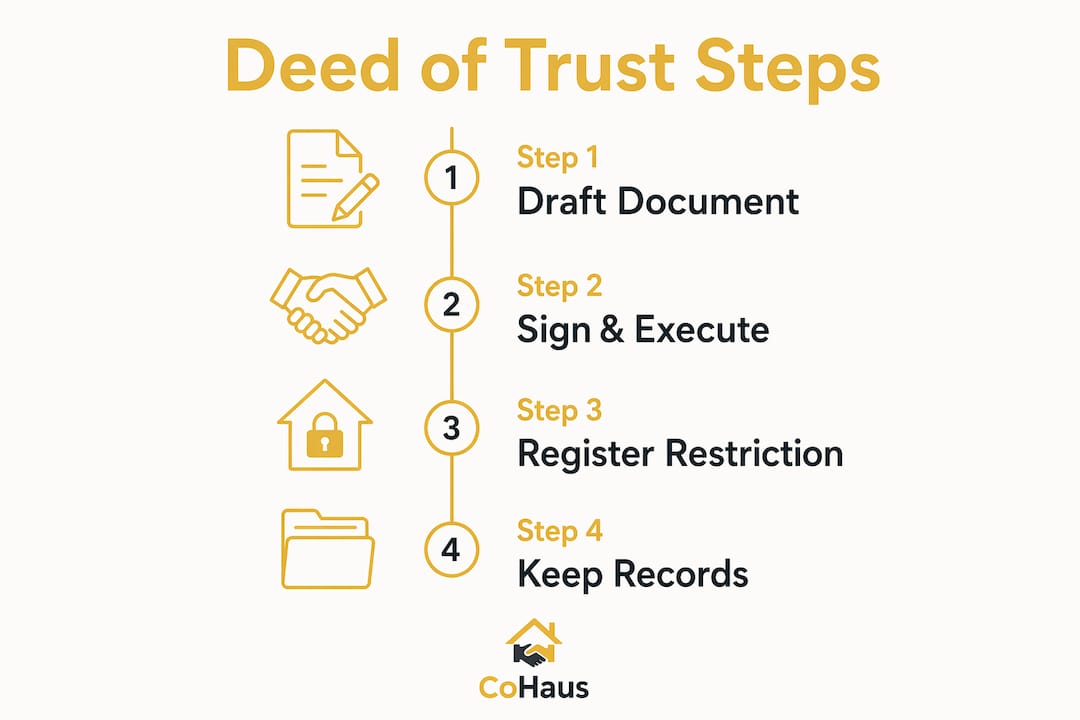
Practical steps to follow:
- Agree ownership shares and all financial terms with your co-buyer before instructing a solicitor
- Engage a qualified solicitor or conveyancer to draft a bespoke deed
- Provide full details: deposit amounts, mortgage split, any gifts or loans, buyout terms, and dispute procedures
- All parties review and approve the draft before signing
- Sign in the presence of an independent adult witness
- Store the signed deed with your mortgage and property documents
Pro Tip: Register a restriction at the Land Registry using Form RX1 after signing. This costs around £40 and prevents the property from being sold or remortgaged without all parties' written consent, giving your beneficial interest a public safeguard.
Which UK providers can help you get a deed of trust?
Two providers cover this space in meaningfully different ways. Deed of Trust (Corporate Office in London) focuses specifically on drafting trust deeds for property co-owners, while Cohaus operates as a co-buying platform with legal protections built into its membership structure.
| Provider | Services offered | Ease of application | Delivery | Cost transparency | Specialisation | Rating |
|---|---|---|---|---|---|---|
| Deed of Trust (Corporate Office in London) | Deed drafting, legal agreements, property ownership structuring | Online application | Email and post | Not publicly listed | Joint ownership agreements, property interest protection | 5★ (1 review) |
| COHAUS LLC | Co-buying platform, shared deposit management, legal protections, exit terms | Platform-based | Digital | Not publicly listed | Community co-buying, shared ownership structures | 4.4★ (9 reviews) |
Deed of Trust (Corporate Office in London) is the specialist choice for anyone who simply needs a bespoke deed drafted and delivered. The online application process and dual delivery by email and post make it accessible, and the focus on property ownership structuring means the drafting is tailored to co-ownership scenarios rather than generic legal templates.
Cohaus suits buyers who want the legal protections built into a broader co-buying framework, with shared deposit management and transparent exit terms alongside the deed itself.
How much does a deed of trust cost in the UK?
Costs vary depending on when you create the deed and how complex your arrangement is. Typical solicitor fees range from £200–£500 when done during conveyancing, rising to £300–£800 if created after purchase. The Land Registry restriction costs approximately £40.
Additional costs to factor in:
- Independent legal advice for each party: around £150–£300 per person
- Online templates for very simple arrangements: £50–£200, though these carry real risk for anything beyond a straightforward 50/50 split
The timing matters financially. A deed created during conveyancing is cheaper because the solicitor already has the property details and the valuation is current. Waiting until after completion means a separate instruction, a fresh valuation, and higher fees. Skipping the deed entirely to save money tends to cost far more if a dispute arises later, particularly for unmarried co-owners who have no automatic legal protections.
Can you change or end a deed of trust?
A deed of trust can be amended or ended, but only with the agreement of all parties. The standard route is a deed of variation, a new signed document that updates the original terms. Both parties should take independent legal advice before signing any variation to protect the enforceability of the change.
Common reasons to amend a deed include:
- One person has paid significantly more of the mortgage over time and wants shares adjusted
- A relationship changes and a buyout is agreed
- A co-owner wants to exit and the remaining party needs new terms recorded
When the property is sold, the deed governs how the proceeds are divided. If one party wants to buy the other out, the deed's buyout provisions set the process, typically requiring an independent valuation. Disputes over changes that cannot be resolved between parties can go to mediation and, if necessary, to court under TOLATA. Any amendments that affect the Land Registry restriction should be updated with a fresh application to keep the public record accurate.
What Cohaus knows about co-buying and legal protections
At Cohaus, we work with people who want to buy a home but cannot do it alone. The legal side of co-ownership is one of the areas where we see the most uncertainty, and a deed of trust is consistently the document that makes the biggest practical difference. It creates a shared understanding before money changes hands, which is when conversations are still straightforward.
Our platform is built around the principle that co-buying works best when the legal and financial arrangements are clear from the start. That means shared deposit management, transparent exit terms, and guidance on the ownership structures that protect everyone involved. We publish UK-focused guides on co-ownership rights, mortgage structures, and legal protections to help buyers understand what they are agreeing to before they sign anything.
The most common gap we see is buyers who hold property as joint tenants when they should be tenants in common with a deed in place. Changing that arrangement after completion is possible but adds cost and complexity. Getting it right at purchase, with the right legal documentation, is always the simpler path.
Cohaus: a different route to co-ownership with legal clarity
If you are buying with someone else and want the legal protections sorted as part of the process rather than as a separate legal instruction, Cohaus offers a different approach to the providers compared above.
Rather than hiring a solicitor separately for a deed and managing the co-buying arrangement yourself, Cohaus brings the community matching, shared deposit structure, legal protections, and exit terms together in one place. It is built for people who feel locked out of the housing market and want to buy with others in a way that is fair, clear, and supported throughout.
If you are still saving, still renting, and working out how to make ownership realistic, explore co-buying with Cohaus and see whether the community approach fits your situation.
Key takeaways
A deed of trust is the primary legal document protecting co-owners' financial interests in UK property, and creating it at the time of purchase is consistently the most cost-effective and legally sound approach.
| Point | Details |
|---|---|
| Create at purchase | Drafting during conveyancing typically involves solicitor fees and avoids retrospective valuation complications. |
| Register a restriction | A Land Registry restriction imposes a charge preventing sale or remortgage without all parties' consent. |
| HMRC registration | Most property trusts only need HMRC registration if a UK tax liability arises. |
| Amending the deed | Changes require all parties' agreement and a signed deed of variation, ideally with independent legal advice. |
| Cohaus for co-buyers | Cohaus combines shared deposit management, legal protections, and exit terms in one co-buying platform for UK buyers. |