
For most co-buyers on a shared mortgage, two single life policies offer better long-term protection than one joint policy, even though the price difference is often small. A joint policy pays out once on the first death and then ends, leaving the surviving co-owner uninsured. Two singles pay out independently, allow different cover levels, and stay intact if circumstances change.
Your three immediate steps:
- Get comparative quotes for both a joint policy and two single policies before accepting anything a lender suggests.
- Check whether your lender requires mortgage protection insurance and, if so, confirm you are free to choose your own insurer (you almost always are).
- Ask any insurer or broker about writing the policy into trust so the payout reaches the right person without probate delays.
Table of Contents
- How life insurance for a joint mortgage actually works in the UK
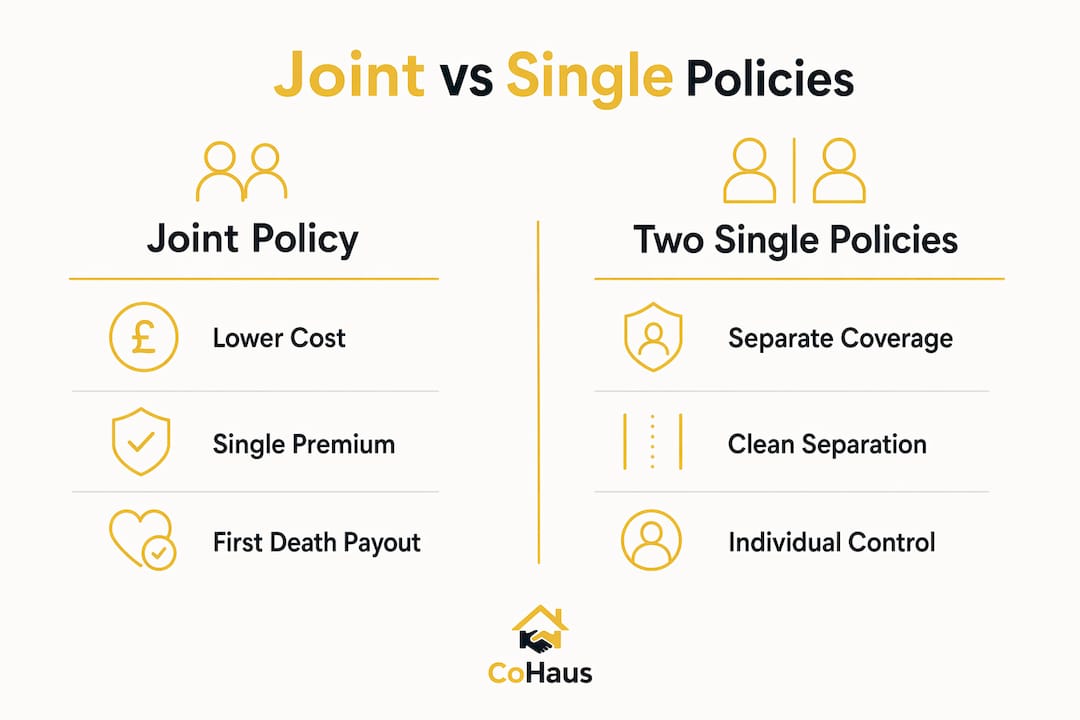
- Joint policy versus two single policies: what actually changes for co-buyers
- How to calculate the cover you need and the right term
- Tax, estate, and trust steps to protect co-buyers' payouts
- Questions to ask insurers, lenders, and advisers before you commit
- Which approach fits your co-buying situation?
- Key takeaways
- Why insurance belongs in your co-buying plan from day one
- How Cohaus supports co-buyers in organising shared ownership
- Useful sources and next steps
How life insurance for a joint mortgage actually works in the UK
A joint life policy covers two people under one application and one monthly premium. It pays out to the surviving insured when one person dies, and the policy then ends. This is called a "first-death" basis, and it is by far the most common structure for mortgage-linked cover. A second-death (or "last survivor") policy pays only when both people have died; it is rarely used for mortgage protection and more common in estate planning.
Single life policies cover one person each. If both co-buyers hold separate policies and one dies, that policy pays out while the other remains active. The survivor keeps their own cover in place.
Decreasing term cover is the standard choice for a repayment mortgage: the insured sum falls roughly in line with the outstanding mortgage balance over the term, which keeps premiums lower. Level term cover keeps the insured sum fixed throughout, which suits interest-only mortgages or situations where co-buyers want a cash buffer beyond just clearing the debt.
A quick example. Two friends buy together with a £250,000 repayment mortgage over 25 years. Friend A dies in year eight. On a joint first-death policy, the payout clears the remaining mortgage balance and the policy ends. Friend B is now uninsured. On two single decreasing policies, Friend A's policy pays out, Friend B's policy continues, and Friend B still has cover for the rest of the term.

Lenders sometimes prefer decreasing term cover tied to the mortgage, but you are not obliged to use the lender's own insurer. Always compare independent quotes.
Joint policy versus two single policies: what actually changes for co-buyers
| Factor | Joint first-death policy | Two single policies |
|---|---|---|
| Cost | Slightly lower single premium | Modest additional cost; often small difference |
| Payout structure | One payout on first death | Two potential payouts, one per death |
| Cover after first death | Policy ends; survivor uninsured | Survivor's policy continues |
| Flexibility on separation | Many insurers cannot split the policy | Each policy is independent; unaffected |
| Different cover amounts | Not possible; both insured for same sum | Each person can choose their own level |
| Trust arrangements | One trust deed needed | Separate trust deeds per policy |
| Admin | One application, one premium | Two applications, two premiums |
The cost gap is frequently modest. A sample comparison from LifeSearch showed a joint policy at £16.93/month versus two single policies totalling £18.90/month for the same couple. In that example, the cost difference is £1.97 per month. For that small saving, a joint policy gives up a second payout and, critically, leaves the survivor without cover the moment the first claim is made.
Two singles also handle separation more cleanly. Many insurers cannot convert a joint policy into two separate ones without fresh underwriting. If co-buyers are older or in worse health when they separate, new cover can be significantly more expensive or unavailable altogether.
Pro Tip: Financial experts advise not to conflate simplicity with value. While a joint policy simplifies admin, two single policies often give better long-term protection for only a modest additional cost.
How to calculate the cover you need and the right term
Work through these steps before you request any quotes.
- Start with the mortgage balance. Your cover should be at least enough to clear the outstanding debt. For a repayment mortgage, decreasing term cover matches this automatically.
- Add other shared liabilities. Include any joint loans, credit cards, or shared financial commitments.
- Consider income replacement. If a co-buyer's death would leave the survivor unable to meet monthly costs, level term cover for an income-replacement sum may be worth adding alongside mortgage cover.
- Account for dependants. Co-buyers with children or caring responsibilities need more than mortgage cover alone.
- Match the term to the mortgage. Align the policy term with the mortgage end date. If your co-ownership agreement includes exit clauses at specific points, factor those in too.
- Split responsibilities clearly. In a multi-borrower arrangement, decide whether each person's policy covers their proportional share of the mortgage or the full balance.
Sample premium illustration (UK, healthy non-smokers, aged 30):
| Cover amount | Policy type | Indicative monthly premium |
|---|---|---|
| — | 25-year level term | — |
| £250,000 | 25-year level term | — |
These are illustrative ranges only. Your actual premium depends on age, health, smoking status, and the insurer. Always get personalised quotes.
For a joint borrower sole proprietor mortgage, the person on the title deeds typically needs cover that reflects their full ownership stake, not just their income contribution.
Tax, estate, and trust steps to protect co-buyers' payouts
By default, a life insurance payout can form part of the deceased's estate. That creates two problems: probate delays that could last months, and potential inheritance tax (IHT) exposure if the estate exceeds the nil-rate band. Writing a policy into trust removes the payout from the estate, so it goes directly to the named beneficiaries without waiting for probate.
In practice, writing into trust means completing a trust form with the insurer, naming trustees (often the co-buyers themselves plus a third party), and specifying beneficiaries. Most insurers provide standard trust forms at no extra cost.
Check three things on any policy document: who is named as the legal owner, who is named as beneficiary, and whether the policy wording allows the payout to go directly to the mortgage lender to clear the debt. If the ownership or beneficiary wording is unclear, the payout may not reach the right person quickly.
Pro Tip: A deed of trust for co-buyers can work alongside a policy trust to make sure both the property ownership and the insurance payout are handled consistently. Ask a solicitor to review both documents together.
Consult a regulated financial adviser or solicitor for trust wording specific to your arrangement. This article is general information, not legal or financial advice.
Questions to ask insurers, lenders, and advisers before you commit
Ask insurers and brokers:
- Does the policy pay on first death or second death?
- Can the policy be split into two single policies if co-buyers separate?
- Is there a guaranteed conversion option, and at what cost?
- Who is the legal owner and who are the named beneficiaries?
- Are there any exclusions that would prevent a payout in our circumstances?
Ask your lender:
- Do you require mortgage protection insurance as a condition of the mortgage?
- Will you accept a policy written in trust, and how do you take payment to clear the mortgage on a claim?
- Are you recommending your own insurer, and are we free to use an independent provider?
Red flags to watch for:
- A joint policy with no separation or conversion option
- Unusually low quotes that omit standard exclusions
- Unclear beneficiary wording that could delay a payout
- A lender pressuring you to use their own insurer without explaining alternatives
Pro Tip: Agree in writing who pays the premium and what happens if one co-buyer falls behind. A lapsed policy protects no one. Include this in your co-ownership agreement from the start.
Which approach fits your co-buying situation?
Friends sharing a 50/50 mortgage with no dependants. A single joint decreasing policy is the simplest option and may be acceptable if both parties are confident the arrangement will not change. Two single decreasing policies are still the safer choice, particularly if either person might want to sell their share or remortgage independently later.
Unequal incomes or one co-buyer with dependants. A joint policy insures both for the same amount, which can leave the higher earner under-insured and the lower earner over-insured. Two single policies, sized to each person's actual needs, work better here. Some co-buyers combine a joint decreasing policy for the mortgage with individual level-term policies for personal income replacement.
Three or more co-buyers. A standard joint policy covers only two lives. For a three-person mortgage, individual decreasing policies for each borrower are the practical solution. Each person's policy covers their share of the mortgage, and the policies remain independent if one co-buyer exits the arrangement. Pooled contingency funds within the co-ownership agreement can complement individual policies for short-term gaps.
For friends buying a house together, the ownership structure (joint tenants versus tenants in common) also affects how a payout should be directed, so check the tenants in common implications before finalising any policy.
Key takeaways
Two single life policies usually give co-buyers on a shared mortgage better long-term protection than one joint policy, because they provide two independent payouts, stay intact after separation, and allow different cover levels for each person.
| Point | Details |
|---|---|
| Joint vs single cover | Two singles usually outperform one joint policy; the cost difference was £1.97/month in a typical LifeSearch example. |
| Write into trust | Always write your policy into trust to avoid probate delays and potential IHT exposure on the payout. |
| Match term to mortgage | Align the policy term with your mortgage end date and review cover whenever you remortgage or a co-buyer exits. |
| Get regulated advice | Speak to a regulated financial adviser or mortgage broker before accepting any lender-suggested policy. |
| Cohaus resources | Cohaus provides co-buying guides, legal templates, and community support to help co-buyers plan protections alongside shared ownership. |
Why insurance belongs in your co-buying plan from day one
We see co-buyers focus hard on deposits, mortgage approvals, and legal agreements, then treat insurance as an afterthought. That ordering creates real risk. If a co-buyer dies before a policy is in place, the surviving co-owner may face the full mortgage on their own with no financial buffer and no legal mechanism to exit cleanly.
Our view at Cohaus is that insurance planning should sit alongside the co-ownership agreement, not after it. The questions you answer when choosing cover (who owns what share, what happens if someone leaves, how is the mortgage cleared) are the same questions your legal documents need to answer. Treating them together produces a more consistent, more protective outcome.
The conventional wisdom is to sort the mortgage first and worry about insurance later. We think that gets it backwards. A co-buying arrangement without agreed protection is a shared liability without a shared safety net.
How Cohaus supports co-buyers in organising shared ownership
Co-buying a home is genuinely more affordable when you share the deposit and mortgage responsibilities with people you trust. The harder part is making sure the legal, financial, and protective structures are in place before anything goes wrong.

Cohaus brings together co-buyers through community matching, shared deposit management, legal templates, and practical guides covering everything from co-ownership agreements to multi-borrower mortgages. We do not sell life insurance, but we help co-buyers understand what protections they need and connect them with the right resources and advisers to put those protections in place.
If you are ready to explore co-buying, start with Cohaus and see how the platform can support your path to shared ownership.
Useful sources and next steps
UK guidance and regulation:
- MoneyHelper — free, impartial guidance on life insurance and mortgage protection from the Money and Pensions Service
- Financial Conduct Authority (FCA) — check that any adviser or insurer you use is FCA-authorised before proceeding
- HMRC inheritance tax overview — understand the nil-rate band and how trust arrangements affect IHT on life insurance payouts
Your next steps:
- Gather your mortgage details: outstanding balance, remaining term, repayment type, and any exit clauses in your co-ownership agreement.
- Get comparative quotes for both a joint policy and two single policies from an independent broker.
- Ask specifically about trust options, conversion rights, and what happens to the policy if co-buyers separate or remortgage.
- Speak to a regulated financial adviser or solicitor before signing anything.