
A co-ownership agreement is the legal document that protects your financial interests and clarifies ownership rights when two or more people jointly own a property in England and Wales. Without one, the law makes assumptions about your shares that may not reflect what you actually contributed. Getting this right from the start matters far more than most co-buyers realise.
Here is what a solid co-ownership agreement covers:
- Ownership shares and how they reflect each person's financial contribution
- Mortgage and maintenance responsibilities split between co-owners
- Exit strategies, including buyout rights and sale procedures
- Dispute resolution processes to avoid costly court proceedings
- Inheritance provisions clarifying what happens to a share if an owner dies
In England and Wales, the relevant legal framework includes the Trusts of Land and Appointment of Trustees Act 1996 (TOLATA) and HM Land Registry's recording of legal ownership. A co-ownership agreement, often formalised as a Deed of Trust or Declaration of Trust, sits alongside the Land Registry title and governs the beneficial interests between co-owners. It is the document courts look to first in any dispute.
What are the two types of co-ownership in England and Wales?
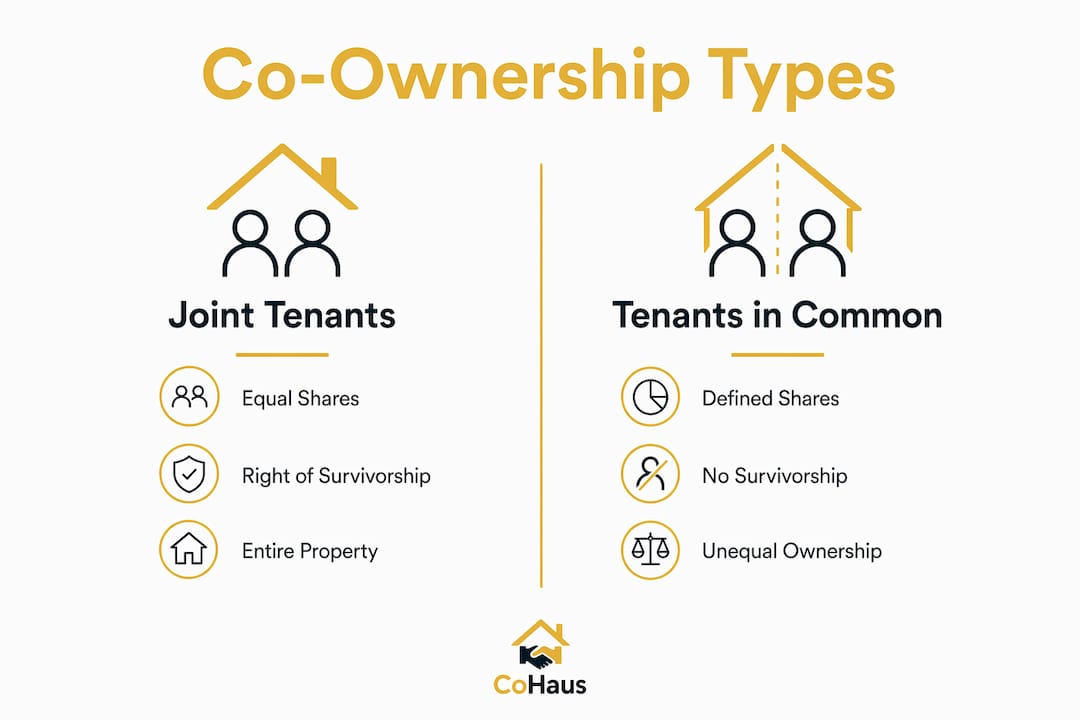
Joint tenants and tenants in common are the two recognised forms of property co-ownership under English law, and they work very differently.

Joint tenants own the entire property together. Neither person holds a specific percentage share. If one owner dies, their interest passes automatically to the surviving owner under the right of survivorship, regardless of any will. You cannot sell or mortgage your portion independently, and all owners must agree to any sale.
Tenants in common each hold a defined share, which can be unequal. A 70/30 split is just as valid as 50/50. Each owner can leave their share to whoever they choose in a will, and the right of survivorship does not apply. This structure suits friends, relatives, or anyone contributing different deposit amounts.
The distinction between the legal estate and beneficial interest is central here. HM Land Registry records the legal estate, which must be held as joint tenants when there are multiple owners. But the beneficial interest, meaning who actually benefits from the property and in what proportion, can be held as tenants in common with unequal shares. A Form A restriction in the register usually signals that a trust exists and beneficial interests may differ from the legal title.
Pro Tip: Check your title register for a Form A restriction before assuming you know how your property is held. Its presence or absence tells you a great deal about your beneficial ownership position.
What should a co-ownership agreement include?
A well-drafted shared ownership contract covers far more than just percentages. These are the clauses that genuinely protect co-owners:
- Ownership shares: state each person's percentage clearly, tied to their actual financial contribution including deposit, mortgage payments, and renovation costs
- Mortgage responsibilities: specify who pays what each month and what happens if one person cannot pay
- Maintenance and running costs: agree how ongoing expenses such as insurance, repairs, and service charges are split
- Sale procedure: set out how and when the property can be sold, how much notice is required, and how proceeds are divided
- Buyout rights: give co-owners the first option to purchase another's share before it is offered externally
- Decision-making: clarify what decisions require unanimous agreement versus majority consent
- Non-payment provisions: define the consequences and recourse if one owner defaults on their obligations
- Inheritance and transfer: address what happens to a share on death or if an owner wants to transfer their interest
- Dispute resolution: include a mediation clause before any party can pursue court proceedings
A Deed of Trust formalises all of these terms into a legally binding document. Specialists in this area draft bespoke agreements covering scenarios such as gifted deposits, separation, or unequal contributions. The deed sits alongside the Land Registry title and governs the relationship between co-owners in practice.
How does the law handle disputes and what does TOLATA mean for you?
When co-owners cannot agree, TOLATA provides the legal framework for resolution in England and Wales. Under Section 14 of TOLATA, any person with a legal or beneficial interest in a property can apply to court for an order. The court can decide ownership shares, determine occupation rights, and order a forced sale.

Courts do not grant sale orders automatically. Section 15 requires judges to weigh several factors: the original purpose of the purchase, the welfare of any children living in the property, and the wishes of all beneficiaries. Where children are involved, courts often postpone a sale rather than order one immediately.
Early mediation resolves co-ownership disputes more swiftly and at far lower cost than court proceedings. Alternative dispute resolution (ADR) allows for flexible outcomes and avoids the legal fees that can erode the very equity co-owners are trying to protect. A co-ownership agreement that includes a mediation clause makes this route easier to pursue before things escalate.
Registering a Form A restriction with HM Land Registry protects beneficial interests by preventing a sole owner from disposing of the property without the other's involvement. Despite what is recorded at the Land Registry, the actual co-ownership rights are governed by the underlying Deed of Trust, making that written document the critical reference point in any dispute.
What happens if you have no co-ownership agreement?
Without a formal joint ownership agreement, the default legal position in England and Wales assumes equal ownership, regardless of how much each person actually contributed. If you paid 70% of the deposit and your co-owner paid 30%, the law does not automatically recognise that difference.
The risks compound quickly:
- Unequal contributions go unprotected: courts cannot award you a larger share simply because you paid more, without documentary evidence of a different intention
- Sale deadlock: any co-owner can refuse a sale, and without agreed procedures, resolving this requires a TOLATA application
- Mortgage default exposure: on a joint mortgage, all borrowers are equally liable. If one co-owner stops paying, the others must cover the shortfall or risk their credit rating and the property itself
- Common law marriage misconceptions: unmarried couples have no automatic property rights without a formal agreement. The myth of common law marriage leads many cohabiting partners to assume protections that simply do not exist in English law
- Inheritance uncertainty: without a will and a clear agreement, a co-owner's share may pass to unintended beneficiaries
The practical safeguard is straightforward. Before completing a purchase, document each person's intended contribution, agree on the ownership structure, and have a solicitor draft a Deed of Trust. Doing this at the outset costs a fraction of what a TOLATA dispute costs later.
What do UK experts and providers say about co-ownership agreements?
Practitioners in this area consistently make the same point: the agreement matters more than the Land Registry entry when it comes to resolving internal disputes. HM Land Registry itself notes that beneficial interests are not recorded on the title register, which means co-owners relying solely on registry documents have an incomplete picture of their legal position.
Deed of Trust specialists advise that bespoke drafting is worth the investment, particularly where deposits have been gifted by parents, where contributions are unequal, or where co-owners are not in a relationship. A generic template rarely captures the specific intentions of the parties, and it is those intentions that courts examine under TOLATA.
Cohaus, which supports co-buyers through shared deposits, structured legal agreements, and transparent exit terms, takes the view that legal protections should be built into the co-buying process from the start rather than added as an afterthought. The platform's approach reflects what property law practitioners recommend: clarity on shares, responsibilities, and exit routes before any money changes hands.
For anyone exploring tenants in common arrangements or considering a three-person mortgage, the same principle applies. The more complex the ownership structure, the more detailed the agreement needs to be.
Pro Tip: Each co-owner should obtain independent legal advice before signing a co-ownership agreement. An agreement signed without independent advice can be challenged later on the grounds that one party did not fully understand its terms.
If you are tracking properties while planning a co-purchase, tools like NestNoted can help you organise listings and compare options before committing.
Key takeaways
A co-ownership agreement is the single most important document for protecting your financial interests in jointly owned property in England and Wales.
| Point | Details |
|---|---|
| Always use a Deed of Trust | A Deed of Trust legally records ownership shares and exit terms, governing disputes beyond what HM Land Registry shows. |
| Choose your ownership type carefully | Joint tenants share equally with right of survivorship; tenants in common hold defined, willable shares that can be unequal. |
| Include exit and default clauses | Agreements must address what happens if one co-owner cannot pay, wants to sell, or dies, to avoid TOLATA litigation. |
| Mediation before court | ADR under TOLATA saves substantial costs; a mediation clause in your agreement makes this the default first step. |
| No agreement means equal shares by default | Without a formal agreement, the law assumes equal ownership regardless of actual financial contributions. |