
House hacking UK style means pooling deposits and mortgage responsibility with people you trust, backed by proper legal protections. It works when you treat it as a structured partnership rather than a casual arrangement between friends.
Co-buying is feasible in England and Wales, but only if you get two things right from day one. First, choose your ownership type deliberately, usually tenants in common rather than joint tenants. Second, instruct a solicitor to draft a deed of trust before you exchange contracts. Skip either step and you're relying on goodwill instead of law.
Before you go further, get these two things moving:
- Decide on tenants in common ownership so your shares are recorded and inheritable
- Instruct a solicitor for a deed of trust setting out contributions, buyout terms, and what happens if someone wants out
Key Takeaways
Co-buying works in the UK when trusted co-buyers combine tenants in common ownership with a properly drafted deed of trust covering shares, liability and exit terms.
| Point | Details |
|---|---|
| Choose tenants in common | Defined, inheritable shares suit most non-couple co-buyers better than joint tenancy. |
| Get a deed of trust drafted | Solicitors typically charge £200 to £600 to cover shares, buyouts and disputes upfront. |
| Understand joint liability | Lenders can pursue any co-borrower for the full mortgage balance if others default. |
| Plan for rental income and tax | Rental income and Capital Gains Tax follow beneficial shares recorded in your deed, not who collects the rent. |
| Use CoHaus for matching and structure | CoHaus helps find compatible co-buyers and manage shared deposits, alongside independent solicitor and broker advice. |
Table of Contents
- How does joint property ownership work in England and Wales?
- What happens with the mortgage and money side?
- What should a deed of trust actually include?
- How do you actually start co-buying step by step?
- What happens if a co-buyer wants out or defaults?
- How does CoHaus help you co-buy in the UK?
- What insurance do co-buyers need to think about?
- How do you split rental income and rental arrangements fairly?
- Does co-buying affect government schemes or benefits?
- What tax implications come with co-buying?
- What legal protections matter most with non-family co-buyers?
- Why co-buying deserves more credit than it gets
- Ready to find your co-buyers?
- Frequently asked questions
- Sources
How does joint property ownership work in England and Wales?
HM Land Registry records who legally owns a property, the registered proprietors, but it says nothing about beneficial interest: who actually gets what share of the value. That gap is where co-buyers get caught out if they haven't documented things properly.
You have two options for structuring ownership: See the property types & forms of ownership glossary for a clear explanation of different ownership forms.
- Joint tenants — you and your co-buyers hold equal interest, and if one of you dies, their share passes automatically to the others (right of survivorship), regardless of what a will says.
- Tenants in common — you hold defined shares, which can be unequal, and each share can be left to whoever you choose in a will.
GOV.UK's guidance on joint property ownership confirms these are the only two routes UK law recognises. For most co-buyers who aren't couples, tenants in common is the sensible default: it protects unequal deposit contributions and means your share doesn't vanish into someone else's estate.
Your conveyancer should apply a Form A restriction at the Land Registry to flag the tenants in common arrangement, and your beneficial shares get recorded properly in a trust deed rather than left to assumption. Our guide to tenants in common vs joint tenancy breaks down real examples of how this plays out.
What happens with the mortgage and money side?
Here's the part that catches people off guard: most lenders treat co-borrowers as jointly and severally liable for the mortgage. That means the lender can chase any one of you for the full outstanding balance if the others stop paying. It doesn't split the debt neatly by your ownership percentage.
Deposits typically amount to a small percentage of the purchase price, though this depends on the lender and the deal you qualify for. On top of that, budget for solicitor fees, a survey, and mortgage arrangement costs. Buying a home in England and Wales takes around five months on average, longer if you're stuck in a chain.
To manage the joint liability risk:
- Keep a shared record of who's paid what, ideally in writing, from month one
- Consider income protection or life insurance that covers your share of repayments
- Agree in advance what happens if someone loses their job or falls behind
Our joint mortgage with friends guide goes deeper into how brokers assess affordability for groups.
What should a deed of trust actually include?
A deed of trust (also called a declaration of trust) is the document that turns a verbal understanding into something enforceable. Without one, courts often default to assuming equal ownership, which can badly penalise whoever put in more money.
Ask your solicitor to cover:
- Each person's percentage share and how it was calculated
- The deposit split and who contributed what
- How ongoing costs, mortgage payments, and repairs get divided
- A buyout formula and timeline if someone wants to leave
- The valuation method for a buyout, usually a RICS valuation
- Dispute resolution steps and what happens if a co-owner dies
Solicitors typically charge a few hundred pounds to draft this, often in the range of £200 to £600 depending on complexity. That's a small outlay against the cost of a dispute with no framework to resolve it. Legal advisers recommend getting this signed before exchange of contracts, not after.
Pro Tip: Ask your solicitor to cross-reference the deed with the Land Registry's TR1 form (Panel 10), so your chosen ownership structure is reflected consistently across both documents.
Our deed of trust guide has a fuller clause-by-clause breakdown.
How do you actually start co-buying step by step?
Getting from "we should buy together" to holding keys follows a fairly predictable order, even if the timeline stretches depending on your chain.
- Find and vet co-buyers. Talk money early: income, existing debt, credit history, and what happens if one of you changes your mind.
- Set expectations in writing, even informally, before you spend money on advisers.
- See a mortgage broker to check affordability. Bring payslips, bank statements, ID and proof of deposit funds for everyone involved.
- Instruct a conveyancer once you have an offer accepted, and ask them to prepare the deed of trust alongside the standard conveyancing.
- Order surveys on the property, and review the deed draft carefully before signing.
- Exchange contracts, then complete, at which point ownership registers at HM Land Registry.
A few things to sort out before step one even starts:
- Agree who's the main point of contact with the broker and solicitor
- Check whether everyone's credit history will pass lender checks
- Discuss what "trusted" actually means to your group, references, shared history, or a formal credit check
Our guide to finding a co-buyer you can trust and our buying a house with friends guide walk through both ends of this process in more detail.
What happens if a co-buyer wants out or defaults?
Most disputes trace back to the same handful of triggers: someone loses their job, a relationship ends, or one person simply wants to sell sooner than the others. A well-drafted deed anticipates these with a buyout formula, a minimum ownership period before a forced sale can be requested, and a mediation step before anyone goes near a court.
If informal resolution fails, co-owners can apply under the Trusts of Land and Appointment of Trustees Act (TOLATA), which lets a court decide on sale, occupation rights or how proceeds get divided. Practitioner guidance strongly recommends specifying a RICS valuation route and a minimum ownership period in the deed itself, so you're not negotiating those terms under pressure.
- Build a minimum ownership period into the deed to deter premature forced sales
- Specify RICS valuation for any buyout to avoid arguments over property value
- Consider staged contributions or an emergency fund for missed payments
Pro Tip: If a co-owner does stop paying, don't wait for the situation to escalate. Our guide on what to do if a co-owner stops paying the mortgage sets out the practical first moves.
How does CoHaus help you co-buy in the UK?
CoHaus exists because most people trying to co-buy in the UK don't know where to start, or who to trust. The platform focuses on the parts that trip groups up: finding compatible co-buyers, managing shared deposit contributions transparently, and giving everyone legal protections and clear exit terms from the outset.
Co-buying works best when it stops being a favour between friends and starts being a structured process, with the same rigour you'd expect from any joint financial commitment.
What CoHaus offers:
- Community matching with people genuinely looking to co-buy, not just house-share
- Shared deposit management so contributions are tracked from the start
- Legal protection frameworks and open exit terms built into the process
CoHaus doesn't replace your solicitor or mortgage broker. It sits alongside them, helping with matching, structure and community support, while the legal and financial specifics still need qualified professional advice. Browse the full library of co-buying guides for more detail.
What insurance do co-buyers need to think about?
Standard buildings insurance works the same way for co-owned property as it does for a solo purchase, but the practicalities of who pays and who's covered need agreeing upfront. Buildings insurance is typically a mortgage condition, and with joint and several liability on the mortgage itself, it's worth naming all owners as policyholders or at least as named interested parties, so a claim doesn't get delayed by a dispute over who's entitled to make it.
Life insurance and income protection matter more in a co-buying context than a solo one. If your mortgage carries joint and several liability, one co-owner's death or serious illness doesn't just affect their household, it exposes everyone else to covering their share. A term life policy that covers each person's proportion of the outstanding mortgage, written into your deed of trust as an expectation rather than an afterthought, closes that gap cleanly.
Contents insurance gets trickier with shared households. If you're co-buying with people you're not related to, consider whether you want joint contents cover or individual policies for personal belongings. Joint cover is usually cheaper, but claims can get complicated if only one person's possessions are damaged.
Rental scenarios add another layer. If any part of the property gets let out, standard home insurance won't cover it, you need landlord insurance, and your mortgage lender needs informing regardless of who's living there.
How do you split rental income and rental arrangements fairly?
If your co-buying arrangement includes letting out a room or the whole property at some point, rental income and arrangements need the same upfront clarity as the deposit and mortgage split.
The starting principle: rental income typically follows beneficial ownership shares, not just who happens to collect the rent. This is exactly why the deed should address rental income explicitly, even if letting isn't part of your immediate plan.
Practical arrangements worth agreeing before it becomes an issue:
- Who manages tenant relationships and repairs if a room or the property is let
- How rental income gets distributed, monthly, quarterly, or held in a joint account
- Whether rental income offsets mortgage payments before or after other costs are deducted
- What happens if one co-owner wants to live in the property rent-free while others don't
If one co-owner lives in the property and others don't, some groups arrange for the resident owner to pay a notional rent to the non-resident owners, reflecting their equity stake. This needs documenting properly, both for fairness and because HMRC will want clarity on any income if you're ever asked.
Does co-buying affect government schemes or benefits?
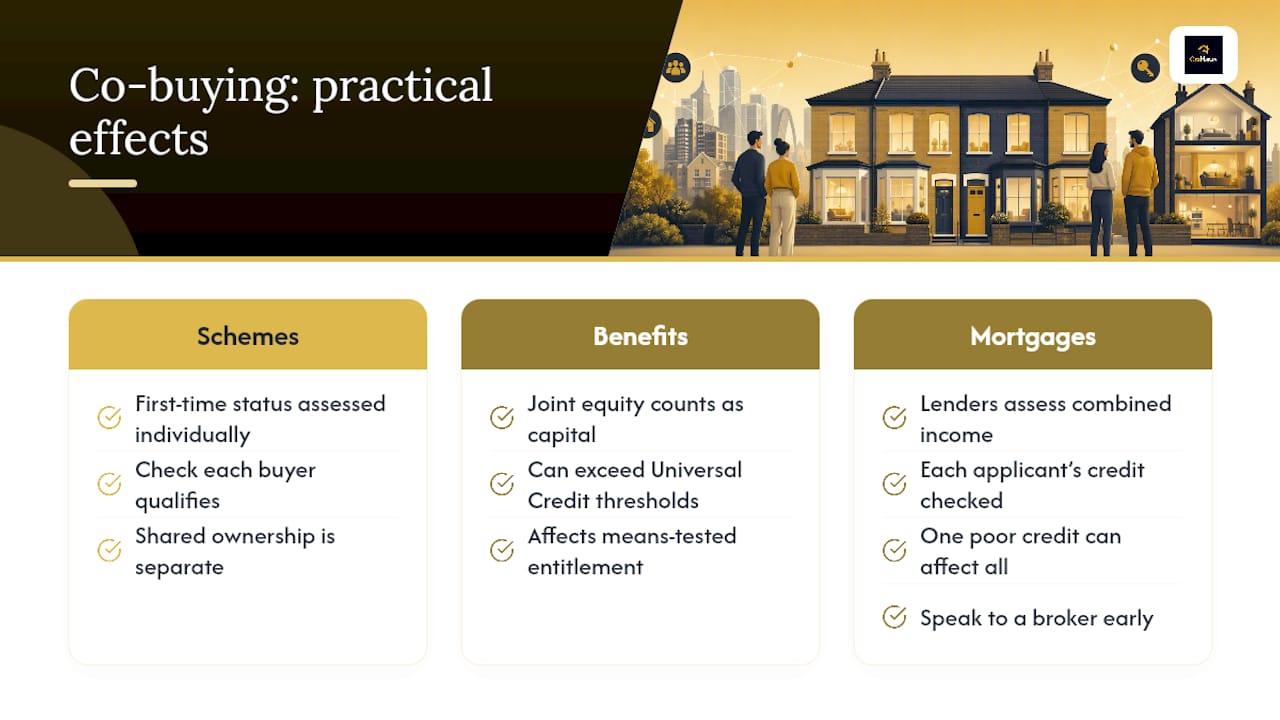
Co-buying can change your eligibility for certain support, so it's worth checking before you assume a scheme applies to your situation. Many first-time buyer schemes and mortgage products define "first-time buyer" status individually, meaning each co-buyer needs to qualify separately, not as a household.
Citizens Advice's guidance on buying a home draws a clear line between shared ownership schemes, a specific government-backed product where you buy a percentage of a property and pay rent on the rest, and private co-buying among friends or family, which is what this guide covers. They are legally distinct and shouldn't be confused when you're checking scheme eligibility.
If you or a co-buyer currently receive means-tested benefits, becoming a property owner with equity in a home can affect entitlement, since benefits calculations often account for capital and assets. Universal Credit and similar benefits have capital thresholds that jointly-owned property equity can bump you over, depending on your share's value.
Mortgage affordability assessments also treat co-buying differently to a sole application. Lenders assess combined income and outgoings, but each applicant's individual credit history and existing debt still gets scrutinised, so one co-buyer's poor credit history can affect the whole application. Speak to a mortgage broker early to understand exactly how your specific group's finances will be assessed, rather than assuming everyone's individual circumstances average out neatly.
What tax implications come with co-buying?
Stamp Duty Land Tax applies to co-buying the same way it does to any purchase, calculated on the total purchase price, not split by individual share. If any co-buyer already owns another property anywhere in the world, the additional-property surcharge can apply to the whole transaction, so it's worth checking every co-buyer's existing property situation before you commit, not after.
Capital Gains Tax becomes relevant if the property isn't your main residence, or if you sell your share for a profit later on. Each co-owner is liable for CGT on their own share of any gain, calculated against their percentage ownership as recorded in the deed of trust, which is another reason that document needs to be precise from the outset.
If you rent out any part of the property, whether a spare room or the whole home while you live elsewhere, rental income is taxable, and each co-owner declares their share according to their beneficial interest, not according to who collected the rent. HMRC expects this reported through Self Assessment, and the split needs to match what's documented in your deed of trust, so inconsistencies between your tax return and your legal paperwork are worth avoiding entirely.
None of this replaces proper advice from an accountant or tax adviser familiar with your specific ownership structure, particularly if your group includes unequal shares or a mix of residents and non-residents.
What legal protections matter most with non-family co-buyers?
Buying with friends or acquaintances carries different risks to buying with family, mainly because the informal trust that smooths over disagreements in families doesn't automatically exist elsewhere. That's not a reason to avoid it, but it is a reason to be more deliberate about the paperwork.
The deed of trust is your primary protection, and with non-family co-buyers it needs to be more explicit than it might be between siblings, covering scenarios that feel awkward to discuss upfront: what happens if someone stops speaking to the group, wants to sell within the first year, or brings a partner into the property without agreement.
Joint and several mortgage liability doesn't discriminate between family and non-family co-buyers, but the practical risk feels sharper with people you haven't known your whole life. Running basic reference and financial checks before committing isn't paranoid, it's the same due diligence a lender would apply, just done earlier and by you.
Consider also that with non-family members, inheritance becomes more sensitive. Tenants in common ownership means your share can go to whoever you name in your will, rather than automatically to your co-buyers, which matters considerably more when your co-buyers aren't people you'd necessarily want inheriting your share by default. Our guide on co-ownership agreements covers the specific clauses that tend to matter most when co-buyers aren't related.
Why co-buying deserves more credit than it gets
The conventional advice on buying with friends treats it as a slightly riskier version of buying alone, something to be talked out of rather than planned for properly. That undersells what's actually possible when a group treats the legal and financial groundwork with real seriousness.
Where most people go wrong isn't the co-buying itself, it's skipping the deed of trust because it feels awkward to discuss money and exit terms with people you like. That awkwardness is exactly why the document matters. A deed of trust doesn't create distrust between co-buyers; it removes the guesswork that turns minor disagreements into legal disputes years later.
If you're weighing this route, prioritise the paperwork before the property search gathers momentum. Find people whose financial habits and life plans genuinely align with yours, get the deed drafted early, and treat tenants in common ownership as the sensible default rather than an afterthought. Do that, and co-buying stops being a compromise. It becomes a genuinely workable path onto the property ladder.
Ready to find your co-buyers?
If pooling a deposit with people you trust sounds more achievable than saving alone for years, CoHaus is built specifically for that first, hardest step: finding the right co-buyers and getting the structure right from day one. Unlike working through solicitors and brokers cold, with no idea whether your prospective co-buyer's finances or intentions actually align with yours, CoHaus starts with matching and community, so you're not building trust from zero once contracts are already in motion.

Visiting the CoHaus site gets you access to a community of people exploring co-buying seriously, along with guides, deed of trust templates, and shared deposit tools that make the financial side transparent from the outset. CoHaus won't replace your solicitor or mortgage broker, those conversations still need qualified advice, but it gives you a running start on the part most people struggle with most: finding people you can actually trust to buy with. Visit the CoHaus co-buying platform to register your interest and start exploring who's out there.
Frequently asked questions
What does house hacking mean in the UK context?
In this guide, house hacking UK refers to co-buying: multiple people pooling deposits and sharing mortgage responsibility, with legal protections like a deed of trust and clearly defined exit terms.
Is co-buying with friends legal in the UK?
Yes. UK law fully recognises multiple owners through joint tenancy or tenants in common, and lenders regularly approve mortgages for groups of co-buyers who meet affordability criteria.
Do I need a solicitor for a deed of trust?
Yes. A deed of trust is a legal document, and a solicitor ensures it's properly drafted, covers the right clauses, and aligns with how ownership is recorded at HM Land Registry.
What happens if one co-buyer wants to sell early?
This depends entirely on what your deed of trust specifies. A well-drafted deed sets a minimum ownership period and a buyout formula, often based on a RICS valuation, to handle this without going to court.
Can co-buying affect my first-time buyer status?
Potentially. Many schemes assess first-time buyer status individually per applicant, so check the specific scheme's rules rather than assuming your co-buyer's history doesn't matter.