
Yes, you can find a co-buyer, and the process starts long before you meet anyone. Get your finances mapped, decide on your preferred ownership structure and write down your deal-breakers, and you're ready to look properly. A Declaration of Trust protects everyone once you've found the right person, and platforms like Cohaus exist specifically to help you get to that point safely.
Before you contact anyone, do three things:
- Gather affordability documents: payslips, bank statements, three months of outgoings, and your credit report.
- Decide whether you're leaning towards joint tenancy or tenants in common, and why.
- Speak to a mortgage broker who handles multi-applicant mortgages, so you know your borrowing power before you start looking.
Table of Contents
- Where to find a co-buyer: platforms, agents and community routes
- How do you vet a potential co-buyer?
- Ownership types, mortgage liability and the agreements you need
- Is shared ownership better than private co-buying?
- How to start: your practical checklist
- Why Cohaus makes co-buying safer from the start
- Where to check the rules yourself
- What most co-buying advice gets wrong
- Find your co-buyer with Cohaus, not a spreadsheet and a hope
- Frequently asked questions
- Sources
Where to find a co-buyer: platforms, agents and community routes
Dedicated co-buying platforms are the most direct route. Look for verified profiles, identity checks, and clear guidance on shared deposits before you commit any personal details. Cohaus was built around this exact problem: matching people with compatible finances and goals, then supporting them with legal protections and open exit terms once they've connected.
Estate agents and new-build sales offices are worth approaching too, particularly for shared ownership schemes, though most agents assume you already have your co-buyer and finances sorted before they'll take you seriously.
Community routes work, but they need more caution. Facebook groups, local co-buying forums, workplace networks and university alumni pages all throw up genuine leads, but you're relying entirely on your own screening.
- Ask for proof of employment and a rough budget before any face-to-face meeting.
- Meet in public first, and don't share financial documents until you've had at least two proper conversations.
- Treat informal introductions with the same rigour as a platform match, not less.
Buying with family or friends brings existing trust, which helps, but it also means a financial dispute can damage a relationship that matters to you outside the property.
Pro Tip: Never skip the paperwork just because you already know someone. The people most likely to skip a co-purchase agreement are friends and family, and they're the ones with the most to lose if things go wrong.
How do you vet a potential co-buyer?
Screening a co-buyer properly takes a few weeks, not a few conversations. Follow this before you go any further:
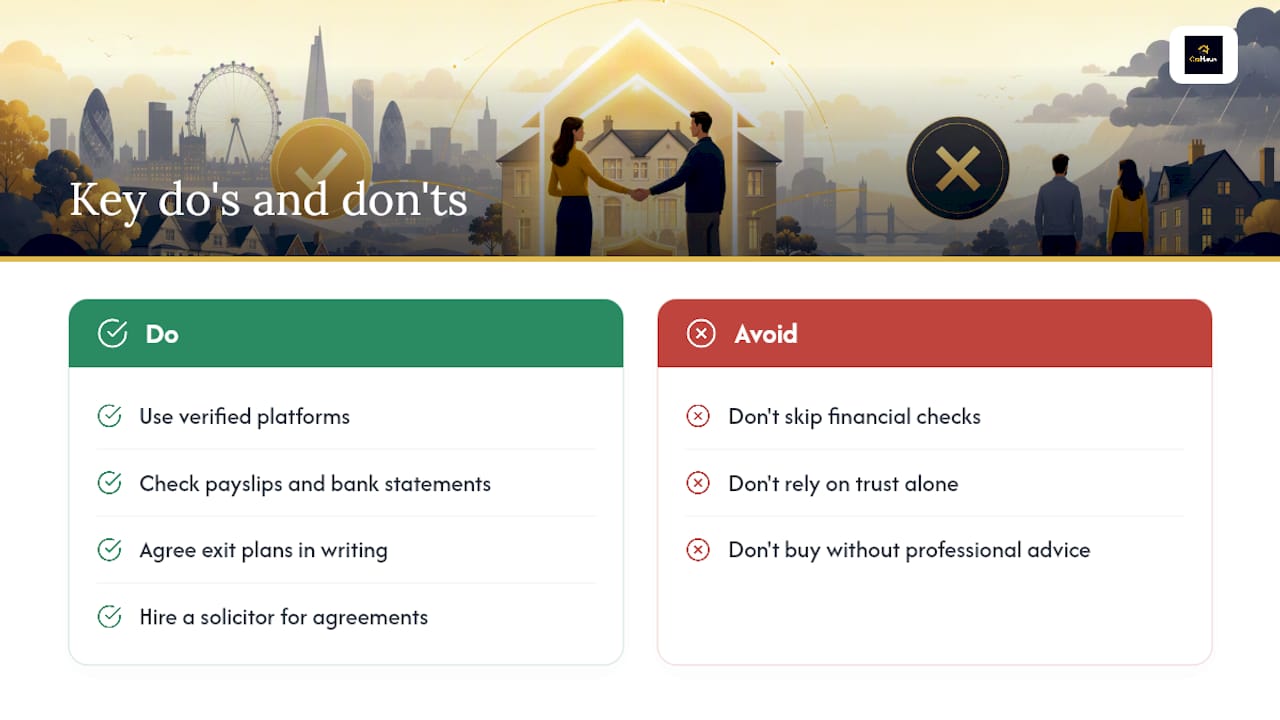
- Request identification, recent payslips, bank statements and a credit report, with their consent, so you can compare affordability honestly.
- Talk through five-year plans: career moves, relationships, children, and whether either of you might need to sell sooner than expected.
- Cover the practical rules early: guest policies, pet ownership, who handles repairs, and how bills get split.
- Ask directly how they'd want to handle an exit, and watch how comfortable they are answering.
Certain responses should stop the process. Refusal to share financial details, reluctance to sign a written agreement, or a pattern of unstable employment are all reasons to walk away before you've spent money on legal advice.
Before instructing a broker or solicitor, request: proof of income, three to six months of bank statements, a credit check, and written confirmation of how much each of you plans to contribute towards the deposit.

Pro Tip: If a potential co-buyer gets defensive when you raise money questions early on, that reaction tells you more than anything they actually say.
Ownership types, mortgage liability and the agreements you need
Two ownership structures matter here, and the choice affects what happens to your money for years. Joint tenancy means you own the property equally, with automatic survivorship if one owner dies. Tenants in common allows unequal shares reflecting different deposit contributions, and each person can leave their share to whoever they choose in a will. In England and Wales, up to four people can be registered as legal owners on a single title.
Without a formal declaration, courts often assume equal ownership regardless of who paid what into the deposit, which can cost the bigger contributor dearly if the relationship breaks down.
On the mortgage side, every named borrower is jointly and severally liable for the full debt. Lenders assess your combined income and outgoings, but if your co-buyer stops paying, the lender can chase you for the entire mortgage, not just your half.
This is what a co-purchase agreement needs to cover:
- Exact share percentages and a running record of who's contributed what.
- A monetised buyout formula and agreed valuation method if one person wants out.
- Notice periods for sale and a process for resolving disagreements.
- Occupational rent terms if one person moves out but keeps their name on the mortgage, to avoid disputes under ToLATA 1996.
Solicitors advise pairing this with life insurance covering each co-buyer's share, buildings insurance in joint names, and legal advice before you exchange contracts, not after.
Is shared ownership better than private co-buying?
Shared ownership works differently to co-buying with someone you've chosen. You buy a share of the property, typically between 10% and 75% of its market value, and pay rent to a housing association on the rest.
- Household income thresholds apply, with limits typically set for eligibility, varying by location
- Deposits on your share commonly run at 5–10%, far lower than a full-market deposit.
- Lenders assess joint applicants together, so a partner or friend's income and credit history both count towards eligibility.
Shared ownership suits people who don't have a specific co-buyer in mind and want a lower entry cost. Privately co-buying with someone you've vetted gives you full ownership of your share and more control over an exit, but it demands far more upfront legal groundwork.
How to start: your practical checklist
Move through these steps in order, and don't skip ahead to viewings before the groundwork is done:
- Agree finances and ownership shares in writing, even in draft form.
- Vet your co-buyer using the checks above.
- Get quotes from a mortgage broker experienced with multi-applicant mortgages, since lender policies on multiple incomes vary widely.
- Instruct a solicitor to draft your Declaration of Trust and co-purchase agreement.
- Finalise the agreement, then arrange life and buildings insurance before exchange.
Expect affordability checks and lender processing to take two to four weeks, and solicitor searches a similar stretch again. The most common delay is starting property viewings before the mortgage broker has confirmed what you can actually borrow together.
Why Cohaus makes co-buying safer from the start
Cohaus was built around the exact risks this guide covers. It pools deposits, applies legal protections, and sets transparent exit terms before anyone signs anything, so the vetting and agreement stages aren't left to chance.
- Matching that prioritises financial compatibility, not just shared interest in a postcode.
- Structured deposit pooling that removes the awkwardness of tracking contributions informally.
- Open exit terms agreed upfront, addressing the exact gap that causes most co-buying disputes.
- Access to introductions for solicitors and specialist mortgage brokers once you've found a match.
Most co-buying disputes trace back to one missing document: a clear exit plan agreed before moving in, not after a disagreement forces the issue.
| Point | Details |
|---|---|
| Screen before you search | Prepare affordability documents and credit checks before approaching any potential co-buyer. |
| Choose ownership structure early | Decide between joint tenancy and tenants in common before instructing a solicitor. |
| Document the exit first | A co-purchase agreement with a monetised buyout formula prevents costly disputes later. |
| Understand liability fully | Every named borrower is jointly and severally liable for the full mortgage debt. |
| Consider a platform route | Cohaus pools deposits and builds in legal protections and exit terms from the outset. |
The most reliable path to co-buying safely combines rigorous vetting, a written Declaration of Trust, and an exit strategy agreed before you exchange contracts.
Where to check the rules yourself
- HM Land Registry: legal estates and beneficial interests
- Gov
- Ashfords: practical guide for joint owners
What most co-buying advice gets wrong
Most guides treat finding a co-buyer and protecting yourself legally as two separate problems. They aren't. The vetting conversation and the legal agreement should happen almost in parallel, because the questions you ask a potential co-buyer about their finances are the same ones your solicitor will need answered anyway.
The conventional advice leans heavily on "get a solicitor" as the fix-all step. A solicitor drafts what you tell them to draft. If you haven't already agreed a buyout formula, notice periods, and who pays what if one person's circumstances change, you're paying legal fees to formalise gaps rather than close them.
What I'd prioritise first, based on everything the evidence here points to: agree the exit before you agree the deposit split. Everyone focuses on affordability and deposits because that's the exciting part. The boring conversation, about what happens when someone wants out, is the one that actually determines whether the arrangement survives five years, not five months.
Find your co-buyer with Cohaus, not a spreadsheet and a hope
Forums and Facebook groups can connect you with people, but they leave the vetting, the deposit tracking, and the exit planning entirely up to you. Cohaus is built to handle the parts that usually get skipped: it matches you with financially compatible co-buyers, pools deposits transparently, and puts legal protections and exit terms in place before you're relying on goodwill.
If you're ready to stop screening strangers on your own, explore how Cohaus works and see what a structured, protected co-buying process actually looks like from the first match to exchange.
Frequently asked questions
Is it safe to find a co-buyer online? It can be, provided the platform verifies identity and finances and you still run your own checks: payslips, bank statements, and a proper conversation about exit plans before committing.
What's the difference between joint tenancy and tenants in common? Joint tenancy means equal ownership with automatic survivorship; tenants in common allows unequal shares based on contributions, each of which can be left in a will.
Do I need a solicitor to buy with a co-buyer? Yes. A solicitor drafts your Declaration of Trust and co-purchase agreement, covering share percentages, buyout terms, and dispute resolution, all of which protect you if things change.
Can family members act as co-buyers? Yes, but the same written agreement and financial checks apply. Existing trust doesn't replace a documented buyout formula or clear exit terms.
Is shared ownership easier than finding a private co-buyer? It can be for people without a co-buyer in mind, since deposits are lower and eligibility is set by income thresholds rather than finding a compatible match.
This article is general information, not a substitute for advice from a qualified financial advisor. Consult a qualified financial professional about your own circumstances before acting on anything here.
Sources
- HM Land Registry — Legal estates and beneficial interests
- Gov
- Shelter — financial issues for cohabiting joint owners
- Gillespie Macandrew — Why you need a co-purchase agreement when buying a property in 2026