
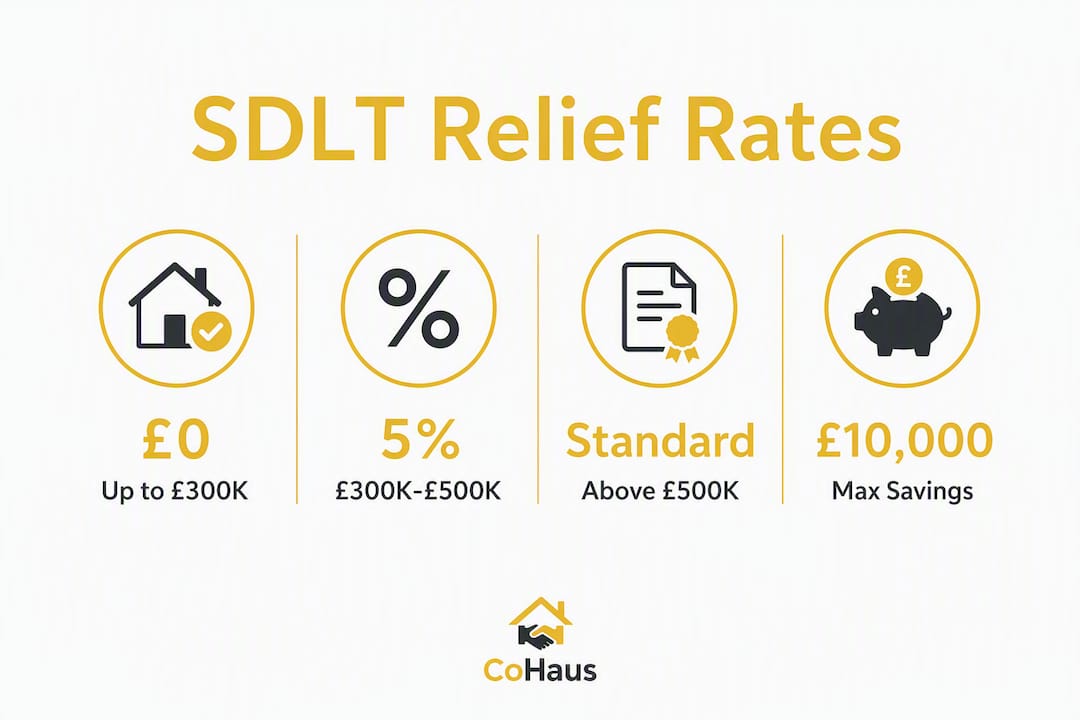
If you're buying your first home in England or Northern Ireland and the purchase price is within the eligible threshold, you may qualify for Stamp Duty Land Tax (SDLT) relief that could save you significant amounts. The rates are straightforward: a zero percent rate applies on the initial portion of the purchase price, then a reduced rate applies on the next portion up to the eligibility cap. Cross the eligibility threshold by even a small amount and the relief disappears entirely, meaning standard SDLT rates apply to the full purchase price.
Two traps catch buyers out more than any other. First, the eligibility cliff: a property priced just above the threshold can cost significantly more in SDLT than one priced just below it, with no taper or gradual withdrawal. Second, joint purchases: if even one person in a co-buying group has previously owned property anywhere in the world, the entire group loses the relief, not just that individual.
- A zero percent SDLT rate applies on the first portion of the purchase price
- A reduced 5% rate applies on the portion from £300,001 to £500,000. No relief applies if the purchase price exceeds £500,000.
- Every purchaser in a joint transaction must independently meet the first-time buyer test
These rates have applied since 1 April 2025, replacing the previous threshold of £625,000 that was in place from September 2022 to March 2025.
Table of Contents
- Who counts as a first-time buyer under SDLT rules?
- Exact rates and worked examples for England and Northern Ireland
- How shared ownership and leasehold purchases are treated
- Buying with others: what co-buyers need to check before making an offer
- Cohaus perspective: co-buyer pitfalls we see most often
- How to claim the relief and what your solicitor does at completion
- Why Scotland and Wales have different rules
- Common mistakes that cost first-time buyers money
- Key takeaways
- Why early SDLT checks matter more for co-buyers
- How Cohaus helps co-buyers manage the practical side of SDLT eligibility
- Useful sources and official guidance
Who counts as a first-time buyer under SDLT rules?
The legal test is global and binary. To qualify, you must never have been the purchaser of a major interest in a dwelling anywhere in the world. That means a flat in Barcelona you bought ten years ago, a house inherited from a relative, or a property held through a trust can all disqualify you, even if you no longer own any of them.
HMRC's definition, set out in Schedule 6ZA of the Finance Act 2003, covers the following conditions:
- You have never previously acquired a major interest in a dwelling in the UK or abroad
- The property you are buying must be your only or main residence
- The purchase price must be £500,000 or less
- You must be the purchaser, not simply a beneficial owner or occupier
Inherited property counts. Receiving a property through an estate, even if you later sold it, typically counts as a prior acquisition and will disqualify you. The HMRC internal manual is clear that failure to disclose prior major interests risks HMRC reclaiming the relief with interest and penalties.
Joint purchases: the all-or-nothing rule

For joint buyers, the relief is binary. Every purchaser must independently meet the first-time buyer test; one person in the group who has previously owned property voids the relief for everyone. There is no partial relief, no pro-rata calculation, and no workaround.
Nominee and bare trust arrangements
A 2024 update brought an important exception. Purchases made via nominees or bare trustees for safety reasons, such as domestic abuse survivors who cannot safely register property in their own name, can now retain first-time buyer relief provided the intended occupier meets the test and will live in the property as their main residence. This applies to transactions with effective dates on or after 6 March 2024. If you are buying through a nominee arrangement for any other reason, speak to a solicitor before assuming the relief applies.
Pro Tip: Ask your solicitor to confirm your eligibility in writing before you make an offer. A written declaration that covers every purchaser's ownership history is the single most useful document you can have if HMRC ever queries the relief.
Exact rates and worked examples for England and Northern Ireland
The rate structure for qualifying purchases is simple. For purchases above £500,000, standard SDLT rates apply and the first-time buyer relief does not exist.
| Purchase price band | First-time buyer rate | Standard SDLT rate |
|---|---|---|
| Up to £300,000 | 0% | 0%–2% |
| £300,001 to £500,000 | 5% | 5% |
| Above £500,000 | Relief withdrawn; standard rates apply | 5%–12% |
Worked example 1: £250,000 purchase
A first-time buyer purchasing at £250,000 pays 0% on the full amount. SDLT due: £0. A non-first-time buyer at the same price would pay 0% on the first £125,000 and 2% on the next £125,000, totalling £2,500. The saving here is £2,500.
Worked example 2: £400,000 purchase
A first-time buyer pays 0% on the first £300,000 (£0) and 5% on the remaining £100,000 (£5,000). Total SDLT: £5,000. A standard buyer at £400,000 pays 0% on £125,000, 2% on £125,000, and 5% on £150,000, totalling £10,000. The saving is £5,000.
Worked example 3: the £500,000 cliff
At the eligibility threshold, a first-time buyer pays reduced rates on the qualifying bands. Just exceeding the threshold results in the loss of relief entirely, causing a significant increase in SDLT payable despite a marginal increase in purchase price.
This cliff matters in negotiations. If a seller is asking £505,000, it is worth modelling whether agreeing a price at or below £500,000 benefits both parties. Use the GOV.UK SDLT calculator to run the figures on your specific price before making an offer.
How shared ownership and leasehold purchases are treated
Shared ownership adds a layer of complexity, but the relief is still available in many cases. The key condition is that the total market value of the property must be £500,000 or less, not just the share you are buying.
For shared ownership purchases, there are two approaches to calculating SDLT:
- Paying SDLT on the initial premium only: you pay SDLT on the share you are buying at the point of purchase. If you later buy additional shares (staircasing), each transaction is assessed separately.
- Paying SDLT on the full market value upfront: you pay SDLT on the total market value at the outset, which can simplify future staircasing transactions because no further SDLT is due on those additional shares.
First-time buyer relief can apply to shared ownership purchases when the total market value is £500,000 or less, regardless of which approach you use. The relief is applied to the relevant consideration under whichever method you choose.
For leasehold purchases, SDLT is charged on both the premium (the purchase price) and, in some cases, the net present value of the rent. New leases with a high rent element can trigger additional SDLT even when the premium qualifies for relief. Existing leases assigned to a new buyer are treated differently from new leases, so the structure of your transaction matters.
Pro Tip: Before exchange, ask your solicitor to model both the staged-payment and full-market-value approaches for your shared ownership purchase. The right choice depends on your staircasing plans and the property's total value, and the difference in upfront SDLT can be significant.
For a broader look at shared ownership risks, the Cohaus guide to shared ownership pitfalls covers the practical traps buyers encounter.
Buying with others: what co-buyers need to check before making an offer
Co-buying with friends, a partner, or family members is increasingly common, and Cohaus is built around making that process structured and supported. But the SDLT rules for joint purchases are strict, and a single oversight can cost the whole group thousands.
The core rule is unchanged: every purchaser must independently meet the first-time buyer test. One person with a prior ownership interest, anywhere in the world, voids the relief for the entire transaction. There is no mechanism to exclude that person's share from the calculation.
Before any co-buying group makes an offer, work through this checklist:
- Ownership history for each buyer: has anyone in the group ever owned a major interest in a dwelling, in the UK or abroad, including through inheritance or a trust?
- Nominee or trust arrangements: if any buyer is purchasing through a nominee, confirm with a solicitor whether the 2024 legislative update applies to your situation
- Mortgage eligibility: confirm that all buyers meet lender criteria; a joint mortgage application affects all parties' financial positions
- Additional dwellings surcharge: if any purchaser or their spouse owns another property, the surcharge under Schedule 4ZA of the Finance Act 2003 may apply and will disqualify the first-time buyer relief entirely
- Solicitor disclosure: brief your solicitor on every buyer's ownership history before the SDLT return is filed
The interaction between the additional dwellings surcharge and first-time buyer relief is mechanically strict. If any joint purchaser, or their spouse or civil partner, owns another major interest, the surcharge applies and the relief is lost.
Pro Tip: Record each co-buyer's ownership history in a written declaration before exchange. Share it with your solicitor so they can use it to populate the SDLT return accurately. If a dispute arises later, that document is your evidence.
For practical guidance on buying a house with friends, including how to structure group agreements and exit terms, the Cohaus blog has a dedicated guide.
Cohaus perspective: co-buyer pitfalls we see most often
At Cohaus, we work with groups of buyers at different stages of the process, and the same SDLT errors come up repeatedly. Here are three scenarios that illustrate where things go wrong.
Scenario one: mixed ownership history. A group of three friends plans to buy together. Two are genuine first-time buyers. The third owned a flat abroad five years ago and sold it before moving to the UK. Nobody thinks to mention it because the property is long gone. The solicitor files the SDLT return with relief code 32. HMRC queries the return, the relief is disallowed, and the group faces a repayment demand plus interest. The fix is simple: a pre-offer ownership audit for every buyer.
Scenario two: the £500,001 bid. A co-buying pair sets a budget of £500,000 and agrees to go to £505,000 if needed. They win at £503,000 without modelling the SDLT consequence. The relief is withdrawn on the full purchase price, and the additional tax bill is unexpected and unbudgeted. A quick check of the GOV.UK SDLT calculator before bidding would have flagged this.
Scenario three: nominee arrangement not updated. A buyer purchasing through a nominee arrangement for personal safety reasons does not inform their solicitor of the 2024 legislative update. The solicitor applies standard rules, the relief is not claimed, and the buyer overpays. An amendment is filed within 12 months, but the process takes time and creates stress.
The practical checklist for Cohaus users:
- Run a pre-offer ownership audit for every purchaser and document the results
- Brief your solicitor on each buyer's history before the SDLT return is prepared
- Confirm that relief code 32 will be entered on the SDLT1 return
- Model SDLT at your target price and at £300,000 and £500,000 to understand the thresholds
- For nominee arrangements, share the GOV.UK guidance with your solicitor and confirm which rules apply
Cohaus's shared deposit management and transparent exit terms reduce the financial risk of co-buying, but they do not replace professional SDLT advice. For edge cases, particularly nominee arrangements, inherited property, or overseas ownership history, a tax adviser or specialist conveyancer is the right call.
Pro Tip: Nominate one person in the co-buying group to hold the written ownership declarations and act as the single point of contact with the solicitor for SDLT purposes. Clear lines of responsibility prevent things from falling through the gaps.
How to claim the relief and what your solicitor does at completion
The relief does not apply automatically. It must be actively claimed on the SDLT return by entering relief code 32 in the reliefs field. In practice, your solicitor or conveyancer handles this as part of the completion process, but you should confirm it explicitly.
- Confirm your eligibility with your solicitor before exchange, sharing written ownership declarations for every purchaser.
- Instruct your solicitor to enter relief code 32 on the SDLT1 return and confirm they will do so in writing.
- At completion, your solicitor files the SDLT return and pays any tax due (or confirms £0 is payable) within 14 days of the effective date of the transaction.
- Check the filed return once it is submitted. Ask your solicitor to share the SDLT reference number and confirm the relief has been applied.
- If the relief is omitted, an amendment can be filed within 12 months of the original filing date to reclaim overpaid tax. After 12 months, a formal overpayment relief claim is required and the process is more involved.
HMRC warning: Making an incorrect declaration on an SDLT return, whether intentionally or negligently, can result in penalties and interest on the unpaid tax. If you are unsure about any aspect of your eligibility, seek professional advice before the return is filed, not after. HMRC has the power to open enquiries into SDLT returns and to recover relief that was incorrectly claimed.
The GOV.UK guidance on claiming SDLT relief confirms that you must complete an SDLT return even when no tax is due. Skipping the return because you expect to pay nothing is an error.
Why Scotland and Wales have different rules
First-time buyer SDLT relief applies only in England and Northern Ireland. If you are buying in Scotland or Wales, a different tax applies entirely.
- Scotland: Land and Buildings Transaction Tax (LBTT) is administered by Revenue Scotland. Scotland has its own first-time buyer relief, which increases the nil-rate band for first-time buyers. Check the current thresholds directly with Revenue Scotland before making an offer.
- Wales: Land Transaction Tax (LTT) is administered by the Welsh Revenue Authority. Wales does not currently offer an equivalent first-time buyer LTT relief. Standard LTT rates apply to all residential purchases in Wales regardless of buyer status.
If you are buying across the border or in a devolved nation, confirm which tax applies to your specific property address. The postcode determines the tax, not where you live.
Common mistakes that cost first-time buyers money
Several misconceptions come up repeatedly, and each one can result in a lost relief or an unexpected bill.
- "Overseas property doesn't count." It does. The test is global. A property owned abroad, even decades ago, disqualifies you.
- "Inherited property is different." Inheriting a property typically counts as acquiring a major interest and will disqualify you, even if you never lived in it and sold it immediately.
- "Buy-to-let purchases qualify." They do not. The property must be your only or main residence. An investment purchase, even by a genuine first-time buyer, does not attract the relief.
- "One non-qualifying buyer just loses their share of the relief." No. The relief is all-or-nothing for the whole transaction.
- "The additional dwellings surcharge doesn't affect us." If any purchaser or their spouse owns another property, the surcharge can apply and will disqualify the first-time buyer relief under Schedule 4ZA of the Finance Act 2003.
Quick checks to run with your conveyancer before exchange:
- Has every purchaser confirmed in writing that they have never owned a major interest in a dwelling anywhere in the world?
- Is the purchase price £500,000 or less?
- Will the property be your only or main residence?
- Does any purchaser or their spouse own another property that could trigger the additional dwellings surcharge?
- Has your solicitor confirmed that relief code 32 will be entered on the SDLT return?
Key takeaways
First-time buyer SDLT relief in England and Northern Ireland saves eligible buyers up to £10,000, but the £500,000 price cap and the all-or-nothing joint-buyer rule mean that small details can have large financial consequences.
| Point | Details |
|---|---|
| Headline rates | 0% on the first £300,000; 5% on £300,001–£500,000; no relief above £500,000. |
| Joint-buyer rule | Every purchaser must independently qualify; one prior owner voids the relief for the whole group. |
| Claim the relief actively | Your solicitor must enter relief code 32 on the SDLT1 return; it is not applied automatically. |
| The £500,000 cliff | A purchase at £500,001 loses the relief entirely, adding roughly £5,000 in SDLT versus £500,000. |
| Cohaus co-buying support | Cohaus provides shared deposit management and legal protections to help co-buying groups stay organised and reduce SDLT risk through structured ownership audits. |
Why early SDLT checks matter more for co-buyers
From our experience at Cohaus, the buyers who run into SDLT problems are rarely the ones who misunderstood the rules. They are the ones who assumed everything would be sorted at completion. By then, the offer is accepted, the price is agreed, and there is no room to renegotiate.
Running an ownership audit for every co-buyer before making an offer takes an hour. Recovering from a disallowed relief claim, or discovering mid-transaction that the purchase price needs to drop by £5,000 to stay below the cliff, takes weeks and causes real stress. The maths strongly favours doing the work early.
Cohaus is built around the idea that buying with others should be structured, not chaotic. The platform's shared deposit management and legal protections give co-buying groups a clear framework, but the SDLT eligibility check sits outside the platform and needs a qualified solicitor. What Cohaus can do is help you ask the right questions and connect you with the right professionals before you commit. The Cohaus articles section has practical guides on joint mortgages, ownership structures, and deposit planning that are worth reading before you make an offer.
How Cohaus helps co-buyers manage the practical side of SDLT eligibility
Sorting out SDLT eligibility as a co-buying group is one of the most practical challenges buyers face, and it is one where early organisation pays off. Cohaus gives co-buying groups a structured environment to manage shared deposits, coordinate legal protections, and keep exit terms transparent from the start.
When a group uses Cohaus, the ownership audit process becomes part of the onboarding rather than an afterthought. Members can document their ownership history, share it with a recommended solicitor, and confirm SDLT eligibility before any offer goes in. That structure reduces the risk of the joint-buyer trap and the £500,000 cliff catching the group off guard.
If you are buying with others and want to make sure the SDLT side is handled correctly, visit Cohaus to see how the platform supports co-buyers from first conversation to completion. For tailored SDLT advice on your specific situation, a specialist conveyancer or tax adviser is the right next step, and Cohaus can help connect you with one.
This article is general information, not professional tax or legal advice. Confirm current SDLT rules and your eligibility with HMRC or a qualified solicitor before proceeding.
Useful sources and official guidance
- GOV.UK: Stamp Duty Land Tax residential property rates — current SDLT rates and thresholds for England and Northern Ireland, including first-time buyer rates from 1 April 2025
- GOV.UK: SDLT reliefs and exemptions — overview of all available SDLT reliefs and how to claim them
- GOV.UK: SDLT relief for land or property transactions — detailed guidance on first-time buyer relief, shared ownership, and nominee arrangements
- HMRC internal manual: first-time buyers' relief introduction — HMRC's own technical guidance on eligibility and thresholds
- HMRC internal manual: claiming the relief — how to enter relief code 32 and what happens if it is omitted
- GOV.UK SDLT calculator — use this to model your specific purchase price and buyer status before making an offer
- Cohaus: joint mortgage with friends guide — practical guidance on multi-party mortgage arrangements and SDLT considerations
- Cohaus: three-person mortgage guide — details on three-party mortgage structures and eligibility checks
- Cohaus articles — full collection of co-buying guides covering deposits, ownership structures, and legal protections
For edge cases, including inherited property, overseas ownership history, or nominee arrangements, consult a solicitor or tax adviser with SDLT experience before exchange.