
Shared ownership means you buy a share of a property (between 10% and 75%) and pay rent to a housing association on the rest. Shared equity means you own 100% of the legal title from day one, while an equity partner holds a registered financial charge against the property. The single most important practical consequence for co-buyers: shared ownership adds a rent obligation on top of the mortgage, while shared equity preserves full title but shares your capital gains on exit.
Before going further, check three things:
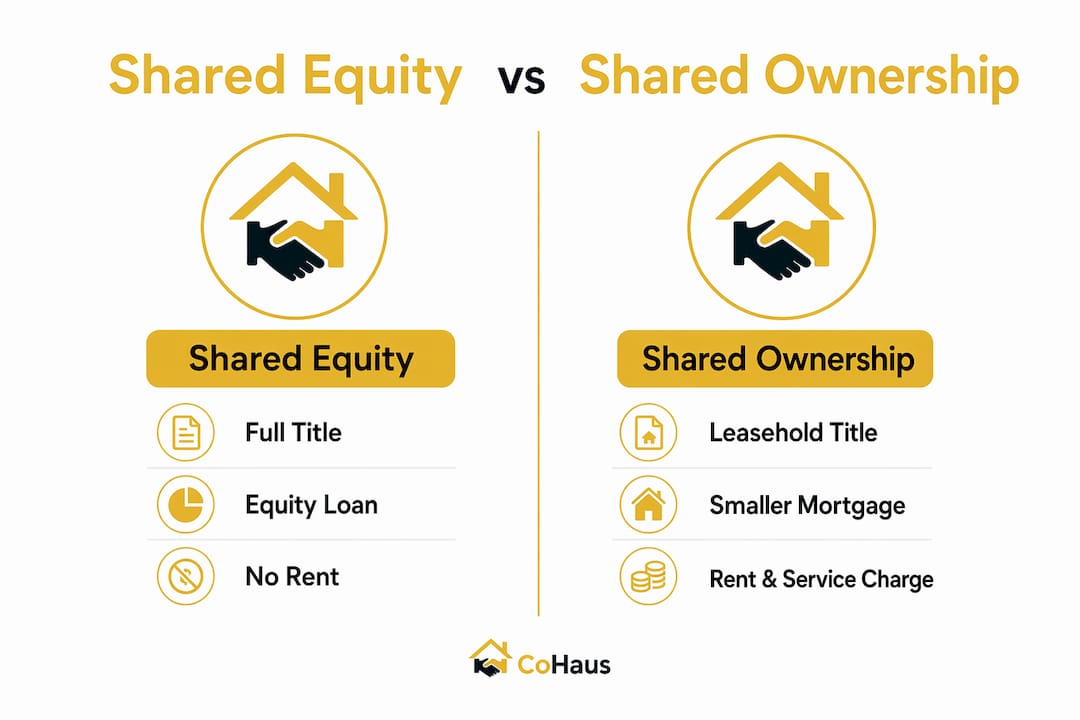
- Who holds legal title? In shared equity, your name is on the title register outright. In shared ownership, a housing association retains the freehold and you hold a leasehold interest.
- Will you pay rent? Shared ownership always involves rent on the unowned share. Shared equity does not.
- What are the exit terms? Both models tie repayment to current market value, not the original purchase price. Read those clauses before you sign anything.
Table of Contents
- How do shared equity and shared ownership actually compare?
- Who legally owns the property, and why does it matter for co-buyers?
- How do deposits, mortgages and monthly payments work in practice?
- How do exit and repayment mechanics work?
- Which model suits your situation?
- What are the main risks and red flags to check in contracts?
- How Cohaus supports co-buyers navigating these choices
- Key takeaways
- A practical note on what co-buyers often miss
- Ready to start co-buying with Cohaus?
- Useful sources for co-buyers
How do shared equity and shared ownership actually compare?
| Dimension | Shared equity | Shared ownership |
|---|---|---|
| Legal ownership | Buyer owns 100% of title; equity partner holds a registered charge | Buyer holds a lease for their share; housing association retains freehold |
| Mortgage responsibility | Mortgage covers full value minus equity loan | Mortgage covers the purchased share only |
| Rent on unowned share | None | Yes, typically up to 3% of the unowned share value annually |
| Typical deposit | 5–10% of full purchase price | 5–10% of the share being purchased |
| Monthly cashflow | Higher mortgage, no rent | Lower mortgage, plus rent and service charge |
| Exit or repayment | Equity partner repaid as a % of current market value on sale or at set trigger | Staircasing to buy more shares; housing association may have first refusal on resale |
| Eligibility | Varies by developer or provider; often first-time buyers | Household income caps (£80,000 outside London, £90,000 in London); local connection criteria in some schemes |
| Best use case | Buyers with sufficient income but a deposit gap | Buyers with modest deposit and income who need a smaller mortgage |
The core long-term trade-off: shared ownership reduces your monthly mortgage burden now but adds recurring rent that compounds over time. Shared equity preserves full title and all capital gains on your owned share, but the equity partner's repayment grows in cash terms if the property rises in value.
Who legally owns the property, and why does it matter for co-buyers?
With shared equity, the buyer appears as the registered owner on the title deeds from day one. The equity partner holds a registered charge, not a share of the title. With shared ownership, the housing association retains the freehold and grants you a leasehold interest for your share. That distinction has real consequences.
As a shared ownership leaseholder, you carry full service charge obligations regardless of the share you own. Service charges on flats can be a substantial annual cost. You also inherit standard leasehold obligations: repair responsibilities, restrictions on subletting, and the need for landlord consent on certain changes.
For co-buyers splitting a deposit and mortgage between two or more people, the legal structure matters even more. Whether you use shared ownership or shared equity, you need to record how each person's contribution is held. A tenants in common arrangement with a deed of trust is the standard approach in England and Wales. It specifies each co-buyer's percentage, what happens if one person wants to exit, and how a future sale is handled.
- Shared ownership leases can restrict subletting until you staircase to 100%.
- If you sell before reaching 100%, the housing association may nominate the buyer for the remaining share.
- Lease length affects remortgaging: most lenders require at least 70–85 years remaining.
Pro Tip: Check the lease length before exchange. A lease below 80 years will restrict your remortgage options and add the cost of a lease extension to your exit plan.
How do deposits, mortgages and monthly payments work in practice?
In shared equity, your mortgage covers the full property value minus the equity loan. A typical illustrative structure might be a 5% deposit, a 75% mortgage, and a 20% equity loan. You own the whole property and carry the full mortgage, but the equity loan reduces the amount you need to borrow at the outset.
In shared ownership, the mortgage covers only the share you purchase. A smaller loan means lower monthly mortgage payments, but rent on the unowned share is added on top. Rent is typically calculated as a percentage of the unowned share value annually, and it rises each year under a formula in the lease.

| Scenario (illustrative property) | Shared equity | Shared ownership (typical share) |
|---|---|---|
| Share / loan | 20% equity loan | Share |
| Monthly rent | None | Monthly rent on unowned share |
| Service charge | Standard | Full charge regardless of share |
For co-buyers using a joint mortgage, lenders assess combined income and affordability against the mortgage amount. In shared ownership, the rent obligation is also factored into affordability checks, which can reduce the mortgage amount lenders will offer. Co-buyers should model total monthly outgoings, not just the mortgage payment, before deciding which structure works for their group.
How do exit and repayment mechanics work?
In shared equity, the equity partner is repaid as a percentage of the property's current market value at the point of sale or at a contractually agreed trigger. If you borrowed 20% and the property has risen in value, you repay 20% of the higher figure. Strong appreciation means a larger cash repayment to the equity provider, even though the percentage stays fixed.
Shared ownership uses staircasing. You buy additional shares over time, each priced at the current market value. Under the standard lease introduced in April 2021, you can staircase in 1% annual increments through gradual staircasing, or in minimum 5% steps through standard staircasing. Each transaction carries costs: a RICS valuation, legal fees, and landlord administration fees. Frequent small staircases add up.
For co-buyers, exit mechanics need to be agreed in writing before exchange, not after a dispute arises:
- Agree which valuation method applies and who commissions it.
- Specify what happens if one co-buyer wants to sell their share before the group is ready to exit.
- Include a buy-out mechanism with a clear timeline and a fallback if the parties cannot agree on price.
Pro Tip: Include a valuation trigger clause in your co-ownership agreement: specify that any buy-out or exit uses an independent RICS valuation instructed jointly, with costs split equally. This removes the most common source of co-buyer disputes.
Which model suits your situation?
Shared ownership is structured for buyers who need a smaller mortgage and have a modest deposit. Eligibility typically requires first-time buyer status, a household income below £80,000 (or £90,000 in London), and sometimes a local connection to the area. Housing associations administer the schemes, and availability depends on local development pipelines.
Shared equity suits buyers who have enough income to service a near-full mortgage but cannot yet raise a competitive deposit. Government-backed equity loans ended in 2023; current options are mostly developer or housing provider specific, so availability is patchy. Check what is on offer in your target area before assuming a scheme exists.
For co-buying groups, a quick self-assessment:
- Deposit size: Can your group pool enough for 5–10% of the full purchase price? Shared equity may work. Is the pooled deposit only enough for a share? Shared ownership may be the entry point.
- Tolerance for rent: If monthly cashflow is tight, adding rent on top of a mortgage may not be sustainable. Shared equity avoids this.
- Capital gains intention: If your group wants to capture the full upside on resale, shared equity preserves that. Shared ownership shares gains with the housing association on the unowned portion.
- Planned timeframe: Shared ownership works best for buyers who plan to staircase over time. If your group wants a clean exit within five years, the staircasing costs and valuation requirements deserve careful scrutiny.
For broader context on creative financing approaches, the house hacking strategies explored in other markets show how pooling resources and structuring ownership carefully can make a meaningful difference to long-term affordability.
What are the main risks and red flags to check in contracts?
Most co-buyers focus on the deposit and the monthly payment. The risks that actually derail plans tend to sit in the contract small print.
- Unexpected service charges on leasehold shared ownership properties, sometimes including major works bills running into thousands of pounds.
- Lease length: a short lease limits remortgaging and adds extension costs.
- Landlord consent requirements for subletting, alterations, and mortgage changes.
- Valuation timing on exit: if the market has risen sharply, both staircasing costs and equity loan repayments are higher than buyers anticipated.
- Caps on staircasing in some older shared ownership leases, preventing full ownership.
- Nomination rights: the housing association may have first refusal if you sell before reaching 100%.
Before exchanging contracts on any shared ownership or shared equity property, get independent legal advice from a solicitor experienced in leasehold and affordable housing. Check the lease length, service charge history, staircasing rules, and any restrictions on sale or subletting. A co-ownership agreement between co-buyers should address buy-out mechanics, valuation timing, and what happens if one party defaults on their share of the mortgage. These are not optional extras; they are the foundation of a co-buying arrangement that holds together under pressure.
For a detailed walkthrough of the most common shared ownership pitfalls, the Cohaus blog covers lease traps and staircasing costs in practical terms.
How Cohaus supports co-buyers navigating these choices
Cohaus is built specifically for people co-buying together, and the platform addresses the practical gaps that shared ownership and shared equity leave open for groups.
- Match and community: Cohaus connects co-buyers with compatible goals, deposit sizes, and timelines, reducing the uncertainty of finding the right group before approaching a lender.
- Deposit pooling and documentation: The platform helps co-buyers record each person's contribution clearly, which is the foundation of any tenants in common arrangement and a requirement for most lenders.
- Mortgage preparation: Cohaus supports groups in understanding joint mortgage affordability, including how shared ownership rent obligations affect lender assessments and how a joint borrower structure might affect title.
- Legal templates and co-ownership agreements: Cohaus provides co-ownership agreement templates covering buy-out mechanics, valuation timing, and exit rules, reducing the risk of disputes later.
Check scheme eligibility and title details with a solicitor before committing. Cohaus is the platform layer that helps your group get organised, documented, and legally protected before you reach that stage.
Key takeaways
Shared equity preserves full legal title and avoids rent, but shares capital gains with the equity partner on exit; shared ownership reduces the mortgage but adds rent, service charges, and leasehold complexity.
| Point | Details |
|---|---|
| Title vs leasehold | Shared equity gives you 100% of the title; shared ownership gives you a leasehold interest for your share only. |
| Monthly cashflow trade-off | Shared ownership has a smaller mortgage but adds rent and service charges; shared equity carries a larger mortgage with no rent. |
| Exit costs | Both models repay at current market value; staircasing and equity loan repayments grow in cash terms as the property rises. |
| Eligibility check | Shared ownership has income caps (£80,000 outside London); shared equity availability depends on the developer or provider. |
| Cohaus next step | Cohaus helps co-buyers pool deposits, document contributions, and access legal templates before approaching lenders or schemes. |
A practical note on what co-buyers often miss
The conversation about shared equity vs shared ownership tends to focus on monthly payments. That is understandable, but it misses the bigger risk for co-buying groups: the exit.
Both models tie repayment to current market value, not what you originally paid. In a rising market, that is fine for your own equity but it means the equity partner or housing association also benefits from appreciation you helped create by maintaining the property and holding it through a cycle. Co-buyers who plan to exit within five to seven years should model the repayment at two or three different future valuations before they commit, not just at today's price.
The other thing most guides skip: co-buyers need their internal agreement sorted before they approach a lender or a housing association, not after. Lenders want to see how contributions are split. Housing associations want to know who is on the lease. Getting the deed of trust and co-ownership agreement in place early removes friction at every subsequent stage.
Ready to start co-buying with Cohaus?
If you are pooling deposits with friends, family, or a co-buying group, Cohaus gives you a structured starting point. The platform helps you get matched, document your contributions, and access legal templates designed for co-buyers in England and Wales, so you arrive at a lender or housing association with everything in order.

To get started, prepare your deposit amount, your target area, and a rough sense of your preferred mortgage structure. Cohaus handles the matching, the deposit documentation, and the co-ownership legal framework from there. Visit cohaus.life to join the community and take the first step.
This article is general information, not legal or financial advice. Always confirm current scheme rules and eligibility with a qualified solicitor or mortgage adviser before making any commitment.
Useful sources for co-buyers
- GOV.UK: Shared ownership homes — buying, improving and selling — eligibility rules, staircasing rights, and how the scheme works in England. Start here for official scheme guidance.
- GOV.UK: Key information for shared owners of houses — practical detail on lease obligations, service charges, and sale restrictions. Read before signing a shared ownership lease.
- NAO: Investigation into shared ownership — independent policy analysis covering eligibility caps, staircasing costs, and market context.
- MoneySuperMarket: The shared equity scheme explained — plain-English overview of how shared equity financing works and what repayment looks like.
- Share to Buy: Introduction to shared equity — practical step checklist and property search tool for buyers looking for available shared equity schemes.
- Clovers Report: Difference between shared ownership and shared equity — market context and structural comparison, including notes on the end of Help to Buy and current availability.