
TL;DR:
- The right of first refusal allows leaseholders to buy their building's freehold before a landlord sells it to a third party. Leaseholders must act collectively within strict deadlines after a proper notice, or they risk losing their opportunity. This statutory right is reactive and different from proactive collective enfranchisement, which leaseholders can initiate independently.
The right of first refusal is defined as the statutory right giving qualifying leaseholders legal priority to purchase the freehold or superior lease of their building before a landlord sells it to a third party. Governed primarily by the Landlord and Tenant Act 1987, this right applies across England and Wales and protects leaseholders from losing control over who owns their building. A March 2026 Court of Appeal ruling has added fresh complexity to how the right operates in multi-building developments. Whether you are a first-time buyer, a co-buyer, or a property investor, understanding this right is the difference between acting in time and losing your opportunity entirely.
What is the right of first refusal in property?
The right of first refusal gives qualifying leaseholders the chance to buy the freehold before anyone else. The landlord cannot simply sell to a third party without first offering leaseholders the same deal on the same terms. This is a statutory right, meaning it exists by law rather than by contract, and it cannot be waived by a lease clause.

The Landlord and Tenant Act 1987 sets out the conditions. The right is triggered when a landlord proposes a "relevant disposal," which covers not just outright freehold sales but also grants of headleases and transfers of parts of buildings. Many landlords are caught out because disposals they do not regard as sales can still trigger the right. That breadth makes early legal advice non-negotiable.
The right of first refusal is not a negotiating tool. Leaseholders cannot use it to push for a lower price or different terms. It grants only the opportunity to match what a third party has already agreed to pay.
Who qualifies for the right of first refusal?
Eligibility rests on three conditions, all of which must be met simultaneously.
The building must qualify. It must contain at least two flats. More than 50% of the flats must be held by qualifying tenants. The residential floor area must exceed the non-residential floor area. Mixed-use buildings with significant commercial space, such as a block where ground-floor retail takes up more than half the total floor area, fall outside the right.
The tenants must qualify. A qualifying tenant holds a long lease, typically granted for more than 21 years. Tenants with short-term assured shorthold tenancies do not qualify. Tenants who own three or more flats in the same building are also excluded.
The disposal must be a relevant one. Not every transaction triggers the right. Transfers arising solely from trustee appointments or replacements are exempt. Intra-group transfers and estate planning disposals are common areas where landlords wrongly assume an exemption applies without taking advice first.
The March 2026 Court of Appeal ruling introduced an important nuance for complex developments. Where a landlord owns multiple buildings, they must now assess whether those structures are "functionally integrated." If they are not, the landlord must serve separate notices for each building rather than bundling them into a single transaction. The test asks whether the structures share essential infrastructure or could stand independently.
Pro Tip: If your building is part of a larger estate or mixed-use development, take specialist advice before assuming the right applies or does not apply. The 2026 ruling has changed the analysis for many sites.
How does the right of first refusal process work?
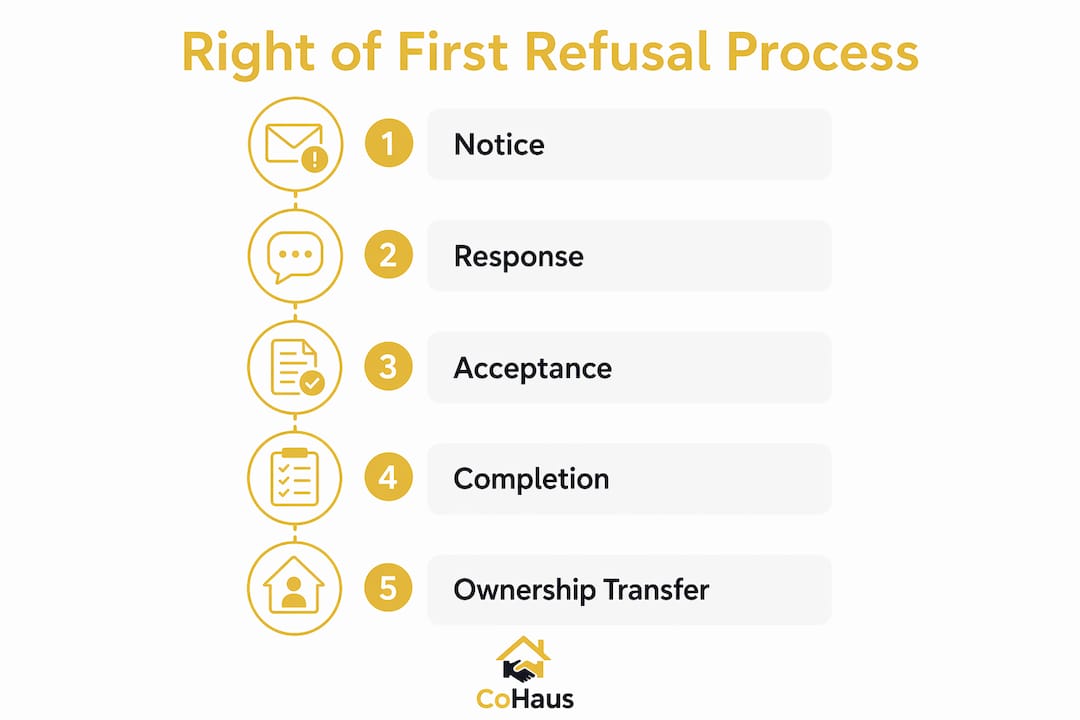
The process follows a strict statutory sequence. Missing any step can derail a sale or expose a landlord to criminal liability.
-
The landlord serves a Section 5 notice. This notice sets out the proposed disposal terms, including the price and conditions. It must be served on all qualifying tenants, not just a selection. The Section 5 notice must give at least two months for leaseholders to accept. Where the disposal is by auction, the acceptance period extends to four months.
-
Leaseholders decide collectively. More than 50% of the qualifying tenants must agree to proceed. Individual leaseholders cannot exercise the right alone. This collective requirement means coordination is critical, particularly in larger blocks.
-
Leaseholders nominate a purchaser. Once acceptance is confirmed, leaseholders nominate a person or company to complete the purchase on their behalf. This is often a residents' management company set up for the purpose.
-
Completion follows on the original terms. The purchase proceeds on exactly the terms set out in the Section 5 notice. If the landlord changes the terms, they must re-serve the notice and restart the clock entirely.
-
If leaseholders decline or do not respond, the landlord may sell to a third party. However, the sale must be at no less than the price offered to leaseholders and must complete within 12 months of the notice period ending.
Non-compliance is a criminal offence for landlords. If a landlord sells without serving a valid Section 5 notice, qualifying tenants can compel the purchaser to sell the freehold back to them on the original terms. That right to pursue the purchaser lasts for 12 months from when tenants become aware of the breach.
Pro Tip: If you receive a Section 5 notice, do not wait. Contact your fellow leaseholders immediately and appoint a solicitor with leasehold expertise. The two-month window closes fast.
Right of first refusal vs collective enfranchisement: what is the difference?
These two rights are frequently confused, but they operate in fundamentally different ways.
The right of first refusal is a reactive right. It is triggered only when the landlord decides to sell. Leaseholders cannot force it to happen. They can only respond when the landlord acts. The governing legislation is the Landlord and Tenant Act 1987.
Collective enfranchisement is a proactive right. Leaseholders initiate it themselves, regardless of whether the landlord wants to sell. The governing legislation is the Leasehold Reform, Housing and Urban Development Act 1993. Leaseholders can serve notice on the landlord and compel a sale at a price determined by an independent valuation process.
The right of first refusal is limited to matching the third-party offer on fixed terms. Collective enfranchisement allows leaseholders to buy at independently valued prices, which may be lower or higher than a market offer depending on circumstances.
| Feature | Right of first refusal | Collective enfranchisement |
|---|---|---|
| Who initiates | Landlord triggers it by deciding to sell | Leaseholders initiate at any time |
| Governing law | Landlord and Tenant Act 1987 | Leasehold Reform, Housing and Urban Development Act 1993 |
| Price setting | Must match the third-party offer | Set by independent valuation |
| Participation needed | Over 50% of qualifying tenants | At least 50% of qualifying tenants |
| Leaseholder control | Reactive only | Fully proactive |
Clear distinctions between these two rights help leaseholders and landlords understand when and how to act. If your landlord has not signalled any intention to sell, collective enfranchisement is the only route to taking control of your building's ownership.
Common challenges and risks with the right of first refusal
The right of first refusal carries real risks for both leaseholders and landlords. Knowing where things go wrong is as useful as knowing how the process works.
Missing the deadline is the most common mistake. The two-month acceptance window is strict. Leaseholders who fail to coordinate in time lose the right entirely for that transaction. The landlord can then sell to a third party on the same terms without any further obligation.
Assuming exemptions apply without checking. Landlords regularly assume that intra-group transfers or estate planning moves fall outside the right. Exemptions are narrow, and common mistakes arise from acting without specialist advice. A wrongly assumed exemption can result in a criminal conviction.
Coordination failures among leaseholders. The collective nature of the right means that one disengaged or hostile leaseholder can block the majority from acting. For co-buyers and investors in shared buildings, this is a particular risk. Agreeing in advance on how decisions will be made, and who will lead the process, reduces this risk significantly. A clear legal structure, such as the arrangements covered in a tenants in common guide, can help co-buyers set expectations before a notice ever arrives.
Commercial contract ambiguity. In non-statutory contexts, such as a private first refusal agreement written into a contract, precise definitions matter enormously. Vague drafting around what triggers the right, how long the offeree has to respond, and what "matching" the offer means leads to disputes. Always have a solicitor review any contractual first refusal clause before signing.
Pro Tip: If your building is sold without a Section 5 notice being served, do not assume the opportunity has passed. You may have up to 12 months to compel the purchaser to sell the freehold back to you on the original terms. Act quickly and take legal advice.
Key takeaways
The right of first refusal gives qualifying leaseholders a statutory priority to buy their building's freehold before a landlord sells to a third party, but it only works if leaseholders act collectively and within strict deadlines.
| Point | Details |
|---|---|
| Statutory trigger | The right activates only when a landlord proposes a relevant disposal, not on leaseholder demand. |
| Strict deadlines | Leaseholders have two months to accept a Section 5 notice, or four months if the sale is by auction. |
| Collective action required | Over 50% of qualifying tenants must agree to proceed, making coordination among leaseholders critical. |
| Criminal consequences | A landlord who sells without serving a valid Section 5 notice commits a criminal offence. |
| Different from enfranchisement | Collective enfranchisement is proactive and leaseholder-initiated; the right of first refusal is reactive and landlord-triggered. |
Why I think most leaseholders are underprepared for this right
Most leaseholders learn about the right of first refusal only after a Section 5 notice lands on their doormat. By that point, they have two months to coordinate with neighbours, appoint a solicitor, arrange finance, and nominate a purchaser. That is not enough time if you are starting from scratch.
The investors and co-buyers I have seen handle this well share one trait: they had already discussed it. They knew who among them would lead the process, had a rough sense of what the freehold might be worth, and had a solicitor they trusted. When the notice arrived, they moved in days rather than weeks.
The 2026 Court of Appeal ruling on what constitutes a "building" is a genuine shift that many landlords and leaseholders have not yet absorbed. Developers with large mixed-use sites now face a more complex compliance picture. For leaseholders in those developments, it creates new opportunities to assert rights that might previously have been bundled away.
My honest view is that the right of first refusal is underused not because leaseholders lack interest, but because they lack preparation. If you are in a qualifying building, the time to understand this right is now, not when the notice arrives.
— Martin
How Cohaus supports co-buyers navigating property rights
Understanding your property purchase rights is one thing. Having the financial and community support to act on them is another.
Cohaus is built for people who want to buy property but find the financial barriers too high to clear alone. By pooling deposits and sharing mortgage responsibilities, co-buyers through Cohaus reduce the upfront cost of ownership and gain a structured framework for making collective decisions, exactly the kind of coordination that the right of first refusal demands. Whether you are a renter looking for your first step onto the property ladder or an investor exploring shared ownership, Cohaus membership gives you the tools, legal protections, and community to move with confidence when property rights come into play.
FAQ
What is the right of first refusal in property?
The right of first refusal is a statutory right under the Landlord and Tenant Act 1987. It gives qualifying leaseholders the legal priority to buy the freehold or superior lease of their building before the landlord sells to a third party.
How long do leaseholders have to respond to a Section 5 notice?
Leaseholders have at least two months to accept a Section 5 notice. Where the disposal is by auction, the acceptance period extends to four months.
What happens if a landlord sells without serving a Section 5 notice?
Failing to serve a valid Section 5 notice is a criminal offence. Qualifying tenants can compel the purchaser to sell the freehold back to them on the original terms within 12 months of becoming aware of the breach.
How is the right of first refusal different from collective enfranchisement?
The right of first refusal is reactive and triggered only when a landlord decides to sell. Collective enfranchisement is proactive and allows leaseholders to initiate a purchase at any time under the Leasehold Reform, Housing and Urban Development Act 1993.
Can one leaseholder exercise the right of first refusal alone?
No. More than 50% of qualifying tenants in the building must agree to proceed collectively. A single leaseholder cannot exercise the right independently.