
Parents helping a child onto the property ladder in the UK have seven realistic routes: a gifted deposit, Joint Borrower Sole Proprietor (JBSP), a guarantor mortgage, joint ownership, a parental loan secured by legal charge, trust ownership, or co-buying through a platform such as Cohaus. For most families, a gifted deposit or JBSP works best because both usually keep the child as sole legal owner, sidestep the additional dwelling Stamp Duty Land Tax (SDLT) surcharge, and protect first-time buyer relief. Joint ownership and trusts have their place, but they carry heavier tax and estate consequences under HMRC's Inheritance Tax (IHT) rules.
Here's the quick map:
-
Gifted deposit — child owns outright; parent has no legal stake but faces a seven-year IHT clock.
-
JBSP — parent's income boosts the mortgage; child stays sole owner; parent carries repayment liability.
-
Guarantor mortgage — parent is a backstop, only liable if the child defaults.
-
Joint ownership — both names on the title; SDLT surcharge and lost first-time buyer relief usually apply.
-
Parental loan with legal charge — money is lent, not gifted, and secured against the property.
-
Trust ownership — trustees hold the property for the child; useful for complex family situations, but triggers its own IHT rules.
-
Co-buying via Cohaus — several buyers pool deposits and mortgage capacity with documented shares and clear exit terms.
| Route | Ownership | Who's liable | Typical tax outcome |
|---|---|---|---|
| Gifted deposit | Child only | Child | PET for IHT; 7-year taper |
| JBSP | Child only | Parent + child | Usually no SDLT surcharge |
| Joint ownership | Parent + child | Both | SDLT surcharge likely |
Pro Tip: Before you decide anything, book an affordability assessment with a whole-of-market broker and write down the date and intent behind any gift. Both steps protect you later, whichever route you choose.
Key Takeaways
The safest and most tax-efficient route for most UK families is a gifted deposit or JBSP, because both usually keep the child as sole owner and avoid the SDLT surcharge that joint ownership triggers.
| Point | Details |
|---|---|
| Start with affordability | Get a whole-of-market broker to model gifted deposit, JBSP and joint ownership before deciding. |
| Watch the SDLT trap | Going on the title with your child can trigger a 5% surcharge and lose first-time buyer relief. |
| Track the seven-year clock | A gifted deposit is a PET for IHT and only becomes fully exempt if you survive seven years. |
| Document everything | Use a Deed of Gift or Declaration of Trust, never rely on a verbal understanding. |
| Consider co-buying platforms | Cohaus offers a documented, exit-planned alternative for families or groups pooling deposits together. |
Table of Contents
- What are the practical routes for parents buying with a child in the UK?
- What tax and inheritance rules apply when parents help a child buy?
- How do mortgage lenders treat parental help with a deposit or income?
- How do parents legally protect the money they put in?
- What happens if the arrangement goes wrong?
- What's the step-by-step process for helping a child buy?
- Which professionals should parents speak to first?
- Is co-buying with a platform a viable alternative?
- Why the standard advice on helping a child buy misses the point
- A more flexible way to buy: what Cohaus offers
- Frequently asked questions
- Sources
What are the practical routes for parents buying with a child in the UK?
Every route solves a different problem. Some boost what a child can borrow. Some protect the money parents put in. Few do both, so it helps to know exactly what each one is built for before you pick.
Gifted deposit. This is the simplest and most common form of help. Parents transfer money outright, the lender issues a gifted deposit letter confirming there's no expectation of repayment, and the child buys alone. Handled correctly, it preserves the child's first-time buyer relief because they remain the sole purchaser. For Inheritance Tax purposes, the gift is treated as a Potentially Exempt Transfer, meaning it only falls fully outside your estate if you survive seven years, and only if you don't keep any benefit from the money (living rent-free in the property you helped fund, for example).
Joint Borrower Sole Proprietor. JBSP has become the default "family assist" mortgage for a reason: it lets a parent's income strengthen the application while the child remains the only person on the title. Parents are named on the mortgage and legally responsible for repayments, but they own nothing. That single distinction is why JBSP usually avoids the SDLT surcharge that joint ownership triggers.
Guarantor mortgages. Often confused with JBSP, a guarantor arrangement is closer to a safety net than a partnership. The parent only pays if the child defaults, rather than sharing liability from day one. Lenders increasingly favour JBSP over guarantor products because the legal position is clearer for everyone involved.
Joint ownership. Sometimes parents go on the title because a lender insists, or because the family wants shared equity from the start. It's workable, but it usually means paying the extra SDLT and losing the child's first-time buyer status, so it's worth confirming there's no cheaper structure first.
Parental loan with a legal charge. Instead of gifting, some parents lend the money and secure it with a second charge on the property. This keeps the funds recoverable if things go wrong, but it must be formally documented, or HMRC may treat it as a gift anyway.
Trust ownership. Less common, but useful where a family wants trustees to hold the property for a child, perhaps because the child is young, vulnerable, or the family wants more control over how the asset passes down. Trusts bring their own IHT complications, including potential charges every ten years.
Co-buying via a platform. Cohaus takes a different angle entirely: instead of one set of parents backing one child, several buyers, sometimes including family members, pool deposits and mortgage capacity together, with shared ownership formally documented and clear exit terms agreed upfront.
Pro Tip: If you're choosing between JBSP and joint ownership purely to boost affordability, ask your broker to model both. The SDLT difference alone can run into thousands of pounds.
What tax and inheritance rules apply when parents help a child buy?
Tax is where good intentions get expensive if nobody checks the detail first. Four taxes matter here: SDLT, IHT, Capital Gains Tax (CGT), and, less obviously, income tax on any rent or interest.
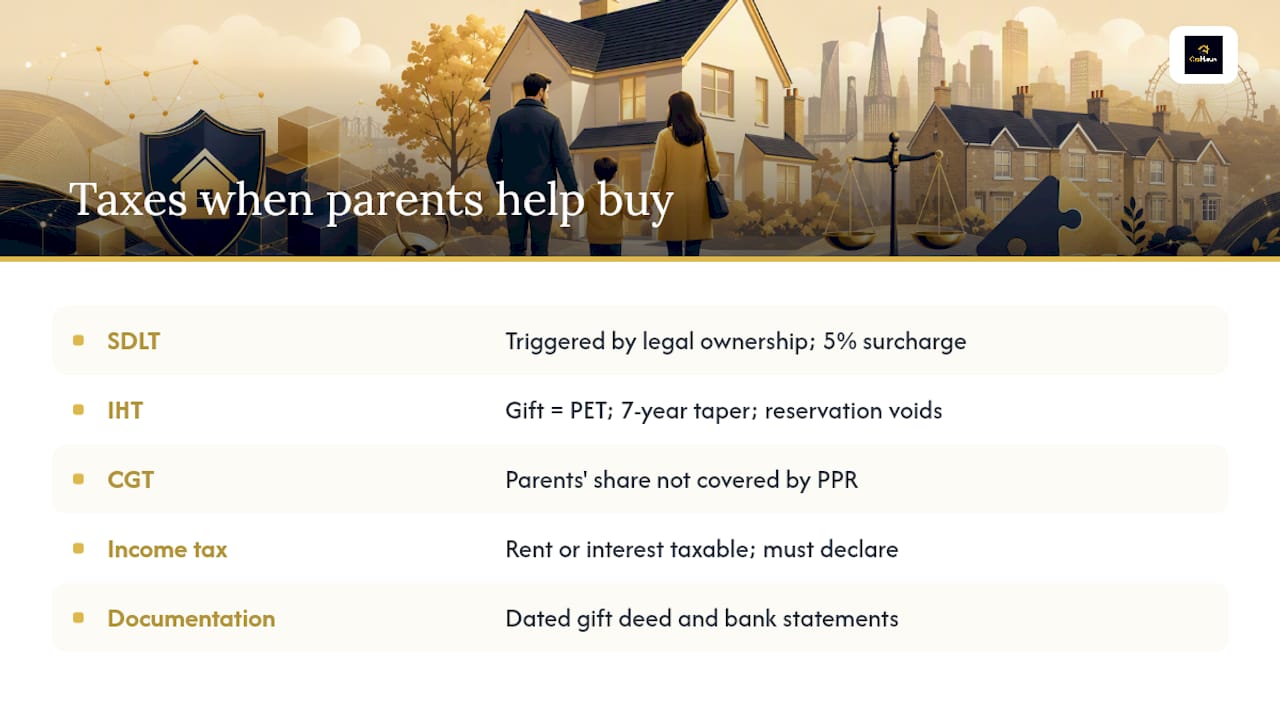
Stamp Duty Land Tax. Being named on the title alongside your child is what triggers the additional dwellings surcharge, not simply helping financially. HMRC looks at legal ownership, not the mortgage. That's why JBSP usually escapes the 5% surcharge while joint ownership usually doesn't. On a £350,000 purchase, that surcharge alone is £17,500, and families who put parents on the title can lose tens of thousands compared with the gifted deposit route.
Inheritance Tax. A gift is a PET. Survive seven years and it falls outside your estate entirely; die within that window and a taper applies, with the tax owed reducing the closer you get to year seven. The catch most families miss is reservation of benefit: if you keep using or benefiting from what you've gifted, the exemption can be voided outright. Annual exemptions (£3,000 per tax year) can chip away at larger gifts too, though they rarely dent a full deposit on their own.
Capital Gains Tax. If the child ever sells and it's been their only or main home throughout, Private Residence Relief should shelter the gain. Where parents hold a share through joint ownership, their portion of any future gain is not automatically covered by that relief, because it isn't their main residence. That's a real cost to weigh against the convenience of being on the title.
Income tax. Charge your child rent, or interest on a formal loan, and that income is taxable and must be declared to HMRC. Parents sometimes assume family arrangements sit outside the tax system. They don't.
Document everything. A dated letter or gift deed confirming the money was a gift, not a loan, is the single cheapest piece of insurance available to any family doing this.
Pro Tip: Keep bank statements showing the transfer and a signed note confirming intent. If HMRC ever queries the estate years later, that paper trail is what settles it.
How do mortgage lenders treat parental help with a deposit or income?
Lenders have caught up with the "Bank of Mum and Dad" reality, but the products still work quite differently from one another, and picking the wrong one costs real money.
With JBSP, a lender combines the parent's income with the child's to calculate what the household can borrow, while the child alone appears on the title. The parent is fully liable for the mortgage even without owning a brick of the property. That liability shows up on the parent's credit file and eats into their own future borrowing capacity, and many lenders cap the mortgage term against the older applicant's age, which can force a shorter term and higher monthly payments across the whole loan.
Guarantor mortgages work on a different principle. The guarantor only pays if the borrower defaults, rather than being jointly liable from the outset. That makes guarantor status feel lighter on paper, though lenders still factor the guarantee into their risk assessment, and it can still affect what the parent can borrow elsewhere.
Joint borrower and joint owner mortgages, where the parent actually goes on the title, bring the SDLT and first-time buyer consequences already covered. Lenders sometimes insist on this structure anyway, particularly where affordability is tight or the parent's contribution is very large relative to the child's.
A few practical wrinkles catch families out. Age caps vary sharply between lenders, some cap the mortgage term at 70 or 75 for the oldest applicant, others stretch further. How a lender treats the parent's share of liability also varies: some apply the full loan against the parent's own affordability calculations, while others apply only a proportional share, which is exactly why working with a whole-of-market broker rather than a single high-street branch matters. And where a JBSP or guarantor structure leaves the parent off the title, most lenders require the parent to obtain an independent legal advice certificate, confirming they understand what they're signing up to before completion.
Some parents prefer springboard or family assist arrangements instead of gifting outright. Here, the parent places savings (often around 10% of the purchase price) in a lender-held account as security, letting the child borrow a higher percentage without a straight cash gift, and the parent typically gets that money back after a set period if repayments have been maintained.
Lenders worth raising with a broker as a starting point for these conversations include Skipton Building Society, Halifax, Nationwide and Barclays, all of which have offered JBSP-style or family assist products at various points. That's not a recommendation of any one of them over another. Panel availability and terms shift constantly, and a broker will know which lender's current criteria actually fit your situation. For the full mechanics of how JBSP compares against guarantor structures, our JBSP mortgage guide breaks down lender-by-lender differences in more depth.
Pro Tip: Ask upfront whether the lender allows the parent to be removed from a JBSP mortgage by remortgage alone, or whether it forces a full new application. Some lenders make an exit far harder than others.
How do parents legally protect the money they put in?
Money without paperwork is a gift by default, whatever anyone intended. HMRC and the courts both look at what was documented, not what was said at the kitchen table.

A Deed of Gift is the right tool when there's genuinely no expectation of repayment. It should record the amount, the date, that it's a gift rather than a loan, and be signed by the person giving the money. Keep it simple, but keep it in writing.
A Declaration of Trust does something different: it records beneficial ownership shares when parents contribute financially but don't want, or aren't going, on the legal title. It works alongside a tenants in common arrangement, so that if the property is later sold, each party's share is clear rather than assumed to be equal. Our guide to tenants in common versus joint tenancy covers how these shares get recorded in practice.
If parents are lending rather than gifting, a legal charge (second charge) secures that loan against the property, giving parents some priority if things go wrong, though the mortgage lender's charge still ranks first. Restrictions registered at HM Land Registry can also stop a child selling or remortgaging without the parent's consent, useful where a large parental contribution needs an extra layer of protection.
None of this replaces independent legal advice, and for JBSP or guarantor mortgages, most lenders require it as a condition of completion, via a signed certificate confirming the parent understands their liability.
What your solicitor should confirm before you sign anything:
- Whether the arrangement risks a reservation of benefit for IHT purposes.
- Which form of trust or declaration best fits your family's situation.
- How and when to register a charge or restriction at the Land Registry.
- That the Deed of Gift or loan agreement is properly drafted and dated.
- How the arrangement interacts with your existing will.
Pro Tip: Ask your solicitor to check your will alongside any Deed of Gift. Large lifetime gifts can change how your estate is meant to be divided among other children, and it's far cheaper to fix that on paper now than in a dispute later.
What happens if the arrangement goes wrong?
Family situations change, and each route responds differently when they do.
If a child divorces, unprotected joint ownership or an undocumented gift can see parental money treated as part of the marital assets to be split. A properly drafted Declaration of Trust, made before the relationship even existed, is what solicitors most commonly point to as protection against that outcome.
If a child defaults on a JBSP mortgage, the parent is contractually liable for the missed payments and the default appears on both credit files, not just the child's. Guarantor arrangements expose parents in a similar way, just at the point of default rather than from day one.
If parents themselves need to remortgage their own home while still tied into a JBSP, that JBSP liability counts against their own affordability, and lender age caps can make refinancing harder than parents expect.
If parents gift a deposit and die within seven years, the PET taper applies, and the family may face an IHT bill on a sliding scale depending on how many years had passed.
- Build an exit plan from day one: remortgage to remove the parent, repayment on sale, or a scheduled transfer of equity once the child's income allows it.
- Consider life insurance to cover the parent's share of JBSP liability if something happens to them mid-term (our guide to life insurance on joint mortgages covers this in more detail).
- Revisit the paperwork every few years, family situations and lender products both move on.
Pro Tip: Set a calendar reminder for the seven-year anniversary of any large gift. It's a small thing, but it's the exact date that determines the IHT outcome.
What's the step-by-step process for helping a child buy?
- Book an affordability assessment with a whole-of-market broker to see which routes are actually available to your family.
- Decide between gift, loan, or JBSP, based on whether you want ownership, security, or simply the biggest affordability boost.
- Gather documents: ID, proof of funds, bank statements, existing mortgage statements, and any relevant estate paperwork.
- Draft a Deed of Gift or a formal loan agreement, with a solicitor, not a template found online.
- Obtain independent legal advice where the lender requires it, typically for JBSP and guarantor mortgages.
- Agree an exit plan and timeline before completion, not after.
For families weighing several income sources at once, our three-person mortgage guide sets out how combining incomes across more than two people typically works in practice.
Which professionals should parents speak to first?
Start with a whole-of-market mortgage broker, then move to an independent solicitor, and bring in a tax adviser if the IHT or CGT picture looks complicated.
Ask your broker: Which lenders on their panel currently offer JBSP? What are the age caps for this term? What are the drop-off terms if we want the parent removed later? Does the parent need to go on the deeds for this lender? Will the lender require a legal advice certificate?
Ask your solicitor: Could this arrangement count as reservation of benefit for IHT? Which form of trust or declaration fits our situation? How do we register a charge or restriction correctly? Can you draft the Deed of Gift? How does this interact with my will?
Is co-buying with a platform a viable alternative?
Not every family fits neatly into "parent gifts, child buys." Some want to pool resources with more than one buyer, or want the legal groundwork done properly without piecing it together themselves. That's the gap Cohaus is built for.
Cohaus works by matching people who want to co-buy, then supporting them through shared deposit management, documented ownership shares, and legal protections that mirror the same Declarations of Trust and exit planning covered above, but structured for a group rather than a single family pairing. Exit terms are agreed upfront, so nobody is left guessing what happens if one buyer's circumstances change. Our guide to buying a house with friends walks through how these shared purchases are typically structured in practice.
-
Community matching connects buyers with compatible goals and budgets.
-
Shared deposit management spreads the upfront cost across more than one party.
-
Legal protections document each person's share from the outset.
-
Transparent exit terms are agreed before anyone commits.
Pro Tip: Whichever route you're leaning towards, the checklist earlier in this guide, affordability check, decision on structure, documentation, legal advice, exit plan, maps directly onto what Cohaus asks co-buyers to work through at onboarding.
Why the standard advice on helping a child buy misses the point
Most guidance on this topic treats the decision as purely financial: which structure saves the most tax, which boosts affordability furthest. That framing misses the actual risk, which is almost always relational, not fiscal.
The families who come out of this well are the ones who treated the paperwork as protection for the relationship, not just for HMRC. A Declaration of Trust doesn't just clarify ownership shares; it removes the ambiguity that turns a divorce or a falling-out into a legal fight over what was "always understood." Reservation of benefit rules trip people up constantly, not because they're obscure, but because parents assume that helping with a deposit and later staying involved with the property is harmless. It rarely is, tax-wise.
If there's one thing worth prioritising above the tax arithmetic, it's the exit plan. Decide now how the parent comes off a JBSP mortgage, how a loan gets repaid, or what happens if the child's circumstances change. Families who skip that step are the ones who end up back at a solicitor's office years later, asking questions that should have been answered before completion.
A more flexible way to buy: what Cohaus offers
If gifting a deposit or taking on a JBSP mortgage feels like too much risk for one family to carry alone, pooling resources with other buyers under a properly documented structure is worth serious consideration. Cohaus exists for exactly this: it matches people who want to co-buy, manages shared deposit contributions, and puts legal protections and agreed exit terms in place before anyone signs a mortgage offer.

For a parent weighing whether to gift, guarantor, or go joint, Cohaus offers a third path where the financial exposure isn't carried by one family alone, and the ownership shares, exit triggers and legal protections are documented from the outset rather than assumed. If you're exploring options beyond the traditional Bank of Mum and Dad routes, visit Cohaus to see how community matching and shared deposit management could work for your family's situation, and start the conversation about what a documented, exit-planned co-buying arrangement could look like for you.
Frequently asked questions
Does parents buying with a child in the UK affect Child Benefit or Universal Credit?
Being named on a JBSP mortgage or gifting a deposit doesn't itself count as income for the parent, so it shouldn't affect their Child Benefit. For the child, if they're claiming Universal Credit, savings or capital above set thresholds can affect eligibility, so a large gift received shortly before a claim is worth discussing with a benefits adviser first.
Does buying with a parent affect a child's ability to use a Lifetime ISA or Help to Buy later?
If a child already owns a share of a property, whether through joint ownership or a trust, they typically lose first-time buyer status. That closes off Lifetime ISA (LISA) bonus eligibility and most Help to Buy style schemes for any future purchase, which is one more reason JBSP or a gifted deposit, where the child remains sole owner, tends to preserve more options down the line.
Will my child face Capital Gains Tax when they eventually sell?
If the property has been their only or main home throughout, Private Residence Relief should exempt the gain entirely. If they've let it out, lived elsewhere for periods, or hold it jointly with a parent who used it differently, part of the gain may become taxable, so it's worth reviewing before any sale.
Can parents charge their child rent, and is it taxed?
Yes, and any rent received is taxable income that must be declared to HMRC, the same as any other rental income. Some families use a modest rent arrangement instead of a loan, but it needs the same documentation discipline as a gift or loan to avoid confusion later.
Does gifting or selling the property to a child later trigger Stamp Duty?
Gifting outright generally doesn't trigger SDLT for the recipient in the way a purchase would, though the value can still matter for IHT purposes. If a parent sells their share to the child rather than gifting it, SDLT is usually due on the amount paid, so it's worth getting a solicitor to calculate this before agreeing a price.
How should co-owning parents and children handle property insurance?
Buildings insurance should reflect all parties with a legal or beneficial interest, and it's worth confirming with the insurer that everyone named on the title, or covered by a Declaration of Trust, is properly disclosed. Liability for repairs or accidents on the property is typically shared in proportion to ownership share, so it's worth setting this out in the same Declaration of Trust that records the financial split.
This article is general information, not a substitute for advice from a qualified financial advisor. Consult a qualified financial professional about your own circumstances before acting on anything here.
Sources
- Gifted deposits and how lenders treat them — NatWest
- Joint borrower sole proprietor mortgages — SPF Private Clients
- What is a joint borrower sole proprietor mortgage? — Unbiased
- Helping children buy: stamp duty for parents — CalculateMyStampDuty
Verify current thresholds and lender criteria before any adviser meeting, as these figures shift year to year.