
Yes. Siblings can apply for a joint mortgage in the UK, and lenders assess you exactly as they would any other pair of joint applicants, combining income, checking credit history and applying standard affordability rules. The catch is that a joint mortgage creates shared legal responsibility for the whole debt, not half each, so you need an agreed ownership structure and legal safeguards before you sign anything.
TL;DR:
- Siblings applying jointly for a mortgage are assessed on combined income and credit history, with shared legal responsibility for the full debt.
- Choosing tenants in common allows unequal ownership shares and protects individual contributions, unlike joint tenants who own the property equally.
- A JBSP mortgage enables a sibling's income to support affordability without sharing property ownership, but the non-owning sibling bears full repayment liability.
- Drafting a detailed Declaration of Trust and setting clear valuation and exit terms before purchasing prevents costly disputes later.
- A contingency payment fund and documented payment split are essential risk mitigations for joint liability and future borrowing prospects.
Table of Contents
- Mortgage with sibling UK: how lenders assess your application
- Joint tenants vs tenants in common: what siblings should choose
- What is a JBSP mortgage and when do siblings use one?
- Declaration of Trust: what to record and how to get one drafted
- What are the risks of a mortgage with sibling in the UK?
- How do you apply for a joint mortgage with a sibling?
- What CoHaus has learned from sibling co-buyers
- The gap between sibling mortgage advice and sibling mortgage reality
- Co-buying with a sibling through CoHaus
- Sources
- FAQ
Mortgage with sibling UK: how lenders assess your application
A joint mortgage means every person named on the mortgage deed is responsible for the entire loan, not a proportional slice of it. This is called joint and several liability: if your sibling stops paying, the lender can pursue you for the full monthly amount, regardless of what you agreed privately between yourselves.
Lenders don't treat sibling applications differently from any other joint application, but they do look closely at the combined picture. NatWest's guidance on joint mortgages confirms that affordability is assessed on total household income and outgoings, not each person in isolation.
What underwriters typically weigh up:
- Combined gross income, minus existing debts, credit card balances, and student loan repayments for each applicant
- Credit history for both siblings; a poor score on one side can drag down the whole application or the rate offered
- Age limits at the end of the mortgage term, which matter more when siblings have a wider age gap than a couple typically would
- Employment type and stability, especially where one sibling is self-employed or on a short-term contract
There's a detail worth knowing if more than two of you want to buy together: Which? notes that lenders often count only the two highest incomes when assessing multi-person applications. That shapes who ends up named on the mortgage versus who's simply on the deeds.
The long-term consequence is easy to miss at completion. Because your credit files become linked through the joint account, a missed payment or a later financial wobble for your sibling can affect your ability to remortgage or borrow again, years after you both signed.
Joint tenants vs tenants in common: what siblings should choose
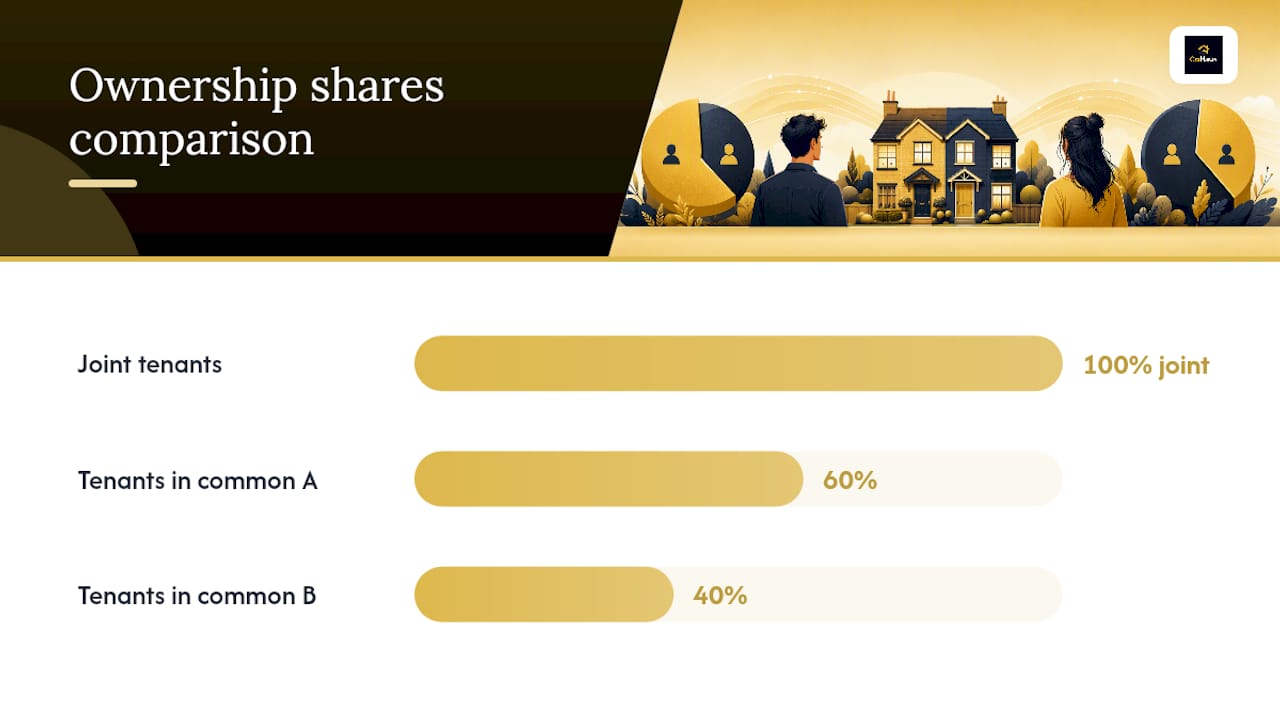
This decision matters more for siblings than for most other joint buyers, because siblings rarely put in equal deposits. HM Land Registry's guidance sets out two ownership structures, and picking the wrong one can cost you thousands later.
Joint tenants means you both own 100% of the property together, with no defined individual shares. If one of you dies, the other automatically inherits their share regardless of what a will says. This works for couples; it's often the wrong fit for siblings who put in different amounts.
Tenants in common lets you hold defined, unequal shares (60/40, 70/30, whatever reflects your actual contributions), and each share can be left to whoever you choose in a will rather than automatically passing to your co-owner. Which?'s consumer guidance recommends this route for most sibling and friend purchases precisely because it protects unequal contributions.
Practical points for your conveyancer:
- Confirm you want tenants in common, not joint tenants, at the outset. Changing later means fresh paperwork.
- A Form A restriction gets entered on the register when you own as tenants in common. It flags that a single owner can't sell without the other's consent or a court order.
- On the TR1 transfer form, panel 10 is where the shares get recorded. Tell your solicitor the exact percentage split before completion. This isn't something to fix afterwards.
- Bring your Declaration of Trust to the same appointment. It should mirror whatever percentages go into panel 10.
Compare our detailed guide to tenants in common versus joint tenancy if you want to see the mechanics played out with worked examples.
What is a JBSP mortgage and when do siblings use one?
A Joint Borrower Sole Proprietor (JBSP) mortgage lets a sibling's income boost affordability without putting their name on the property deeds. It's common when one sibling has the deposit and wants to own the home outright, but needs a second income to pass the lender's affordability test.
NatWest describes family-backed mortgages as structures where the supporting party is a borrower for mortgage purposes but never becomes a legal owner. The appeal for the non-owning sibling is real: they help a brother or sister onto the ladder without giving up their own first-time buyer status.
The risk sits almost entirely with the non-owning sibling. They carry legal responsibility for repayments but hold no stake in the property and see none of the equity growth. Elliot Mather's guidance on JBSP mortgages confirms lenders routinely require this to be spelled out before approval.
Key conditions to expect:
- Lenders will insist on independent legal advice for the non-owning sibling, usually confirmed by a signed certificate
- The certificate exists to prove the non-owner understood the liability they are taking on without equity ownership.
- Parachute Law's solicitor commentary stresses this advice must come from a solicitor with no conflict of interest, meaning not the same solicitor acting for the owning sibling
If this route interests you, our piece on joint mortgages with parents covers a near-identical structure with worked examples.
Declaration of Trust: what to record and how to get one drafted
A Declaration of Trust (sometimes called a Deed of Trust) is the document that turns your verbal agreement into something a court will actually enforce. Solicitors advise treating a sibling purchase as a formal transaction from day one, not a handshake between family, and this document is where that discipline shows up.
What it should cover, in order:
- The exact percentage share each sibling owns, matching panel 10 of your TR1
- How the property will be valued if one sibling wants to sell or buy the other out (an agreed surveyor, or an average of two independent valuations)
- The notice period required before a sale or buy-out can proceed, typically three to six months
- What happens if one sibling wants to sell and the other doesn't, including whether the property must go to market or be offered to the co-owner first
- Who pays for repairs, maintenance, and any shortfall if rental income (should you ever let a room) doesn't cover costs
- A simple dispute resolution route, such as mediation before either party can go to court
Which?'s guidance on ownership types is blunt about why this matters: without a written agreement, disputes default to whatever a court decides is fair, which rarely matches what either sibling actually wanted.
Costs vary by solicitor and complexity, so treat any figure you're quoted as a starting point for comparison rather than a fixed benchmark, and ask for a written estimate before instructing anyone. Drafting typically takes a few days once you've agreed the terms between yourselves, so don't leave it until the week before completion.
Pro Tip: Agree the buy-out valuation method before you fall out, not after. The single biggest cause of sibling property disputes isn't the split itself. It's disagreeing over what the house is worth when one of you wants out.
What are the risks of a mortgage with sibling in the UK?
Joint and several liability is the risk that catches people out, because it doesn't work the way most people assume. If your sibling misses three payments while you've been paying your half faithfully, the lender's arrears record still shows against both of you. ILA's commentary on joint borrower structures confirms that lenders treat every co-owner as liable for the full mortgage amount, which limits your own future borrowing even if you've never missed a payment yourself.
Sensible mitigations, most of which cost nothing but a conversation:
- Set up a joint payments account that both siblings feed monthly, so the mortgage always comes out of one pot rather than relying on two separate transfers landing on time
- Agree a contingency fund target, commonly cited as around three months' mortgage payments, held jointly for exactly this scenario
- Consider life insurance or critical illness cover written to benefit the surviving sibling, particularly where one contributed a larger deposit
- Document the payment split in writing, even if it seems obvious now
One detail worth flagging early: if your credit histories differ materially, pause before applying jointly. A strong applicant paired with a weak one doesn't average out. It can drag the whole application's rate or approval chances down, and it's worth getting independent financial advice before you commit. Our guide to joint and several liability walks through exactly how this plays out if repayments fall behind.
How do you apply for a joint mortgage with a sibling?
- Agree ownership structure first. Decide tenants in common versus joint tenants, and roughly what percentage split reflects your contributions, before you start looking at properties.
- Gather your paperwork. Both siblings need proof of income (three months' payslips or two years' accounts if self-employed), ID, and bank statements covering the last three to six months.
- Check your credit reports separately. Fix anything fixable before you apply. A joint application only links your files once the mortgage completes, but lenders check both files at application stage regardless.
- Get a Mortgage in Principle. This tells you what you can realistically borrow before you fall in love with a property you can't afford.
- Disclose every liability. Undisclosed debts or dependants are the single most common reason applications stall at underwriting.
- Instruct a solicitor. If you're using a JBSP structure, arrange the non-owning sibling's independent legal advice appointment now, not the week before completion.
- Choose your term and rate type. Sibling age gaps can affect maximum term length, so check this early rather than discovering it mid-application.
- At completion, register ownership and execute the Declaration of Trust simultaneously. Set up your joint payments account and any life cover the same week.
- Write down your exit plan. Even a one-page note on what happens if either of you wants to sell saves enormous stress later.
What CoHaus has learned from sibling co-buyers
Two patterns come up again and again among siblings who buy together. In the first, a brother and sister bought as tenants in common with a 65/35 split reflecting unequal deposits, wrote a Declaration of Trust before completion, and sold five years later without a single argument over money, because the valuation method was already agreed. In the second, a dispute over a kitchen renovation was headed off entirely because the trust deed already specified how repair costs would be split.
"Buying with family or friends has become one of the most common ways people get onto the property ladder, precisely because pooling resources solves the deposit problem that solo buyers can't." This shift is backed by wider industry data on why buyers increasingly pool resources with family to afford a first home.
Three rules of thumb we'd pass on to any sibling considering this: agree your exit plan before you agree your sofa. Keep a contingency fund separate from your personal savings. And put unequal contributions in writing, even when the relationship feels solid today.
The gap between sibling mortgage advice and sibling mortgage reality
Most guidance on sibling mortgages treats the legal paperwork as the finish line. Get the Declaration of Trust signed, get the Form A restriction on the register, job done. That's backwards. The paperwork matters, but it only earns its keep the day something goes wrong, and by then the relationship dynamics have usually already shifted.
What the conventional advice underplays is timing. Every safeguard in this article works better agreed in week one than negotiated in year three, once one sibling has had a pay rise, the other's had a redundancy, and neither wants to be the one who brings up money first. Write the exit plan while you're both still excited about the keys, not when one of you needs out.
If there's one thing readers should prioritise above all else, it's the buy-out valuation method. Splits and shares get argued about in principle. Valuation methods get argued about with real money on the table. Settle that question on paper before you settle on paint colours.
— Martin
Co-buying with a sibling through CoHaus
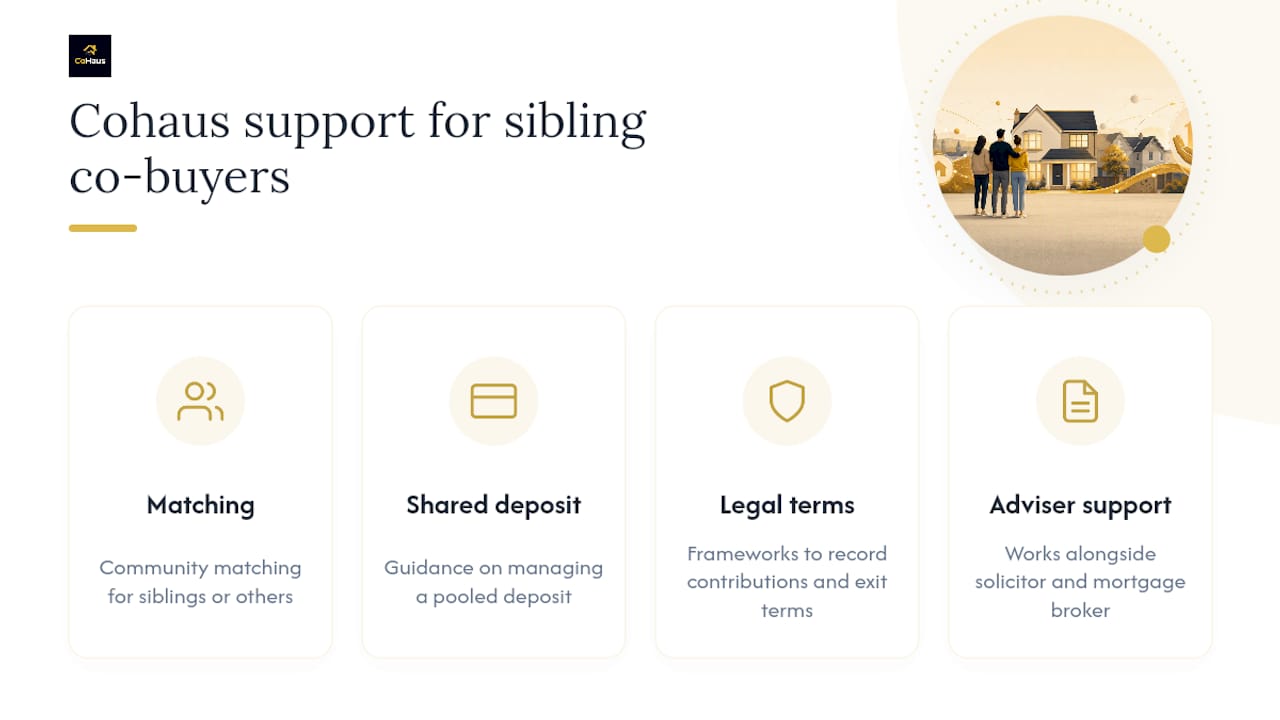
Cohaus provides support for people who want to buy but can't quite get there alone, and siblings pooling a deposit can benefit from this approach. The platform works alongside the solicitor and mortgage broker steps covered above, not instead of them, offering practical tools a sibling co-buy might need.

That means assistance with community matching if considering whether co-buying with a sibling (or anyone else) suits your situation, guidance on managing a shared deposit, and legal frameworks designed to keep contributions and exit terms transparent from day one, rather than left to a private conversation nobody wrote down. The platform does not replace your conveyancer or mortgage adviser but provides community support and a structured process to work out practical questions ahead of solicitor meetings.
If you're weighing up whether co-buying with your sibling is the right route onto the property ladder, visit Cohaus to learn how a platform might support co-buyers through matching, shared deposits, and transparent exit terms.
Sources
For the legal mechanics behind ownership shares, HM Land Registry's guidance on changing to tenants in common is the primary source, covering Form A restrictions and registration steps directly.
For lender-specific detail on joint and family-backed mortgages, NatWest's joint mortgage pages and Which?'s consumer guidance both explain lender behaviour and practical protections in plain terms.
For a deeper walkthrough of financing a purchase with a brother or sister, including worked examples of splitting contributions, see the CoHaus guide to buying with siblings.
This article is general information, not a substitute for advice from a qualified financial advisor. Consult a qualified financial professional about your own circumstances before acting on anything here.
- Gov
- Buying With Someone Else | Joint Mortgages - NatWest
- Joint tenants vs tenants in common - Which?
- Joint borrower sole proprietor mortgage legal advice - Parachute Law
FAQ
Can I get a mortgage with my sibling?
Yes. Most UK lenders accept sibling applicants on the same terms as any other joint mortgage application, assessing combined income, credit history, and affordability rather than your relationship to each other.
Can I buy a house with my brother in the UK?
Yes, and the process is identical whether your co-buyer is a brother, sister, friend, or partner. You'll need to agree whether to hold the property as joint tenants or tenants in common before completion.
How much money can you lend a family member in the UK?
There's no legal limit on how much one family member can lend another, but larger sums used towards a deposit should be documented in writing, ideally as a formal loan agreement or gifted deposit letter, to satisfy the mortgage lender's checks.
Is there a family opportunity mortgage in the UK?
Several UK lenders offer family-backed or Joint Borrower Sole Proprietor (JBSP) mortgages, which let a family member's income support an application without that person owning a share of the property. NatWest's family-backed mortgage guidance explains eligibility and the independent legal advice requirement that comes with it.
What happens if my sibling stops paying their share of the mortgage?
Because of joint and several liability, the lender can pursue you for the full monthly payment regardless of what you'd privately agreed, which is why a documented contingency fund and clear payment splits matter from the outset.