
TL;DR:
- Remortgaging within UK co-buying groups can facilitate buyouts by enabling a new mortgage and transfer of equity to release a departing co-owner. Proper planning, including legal agreements and timely valuations, is crucial to avoid delays or denials due to affordability or legal issues. Coordinating legal, financial, and lender processes on the same day ensures smooth ownership transfers and minimizes disputes.
Yes, you can usually remortgage within a UK co-buying or shared-ownership group to raise funds and buy out a departing co-buyer. The process involves two parallel tracks: a new mortgage (assessed on the remaining applicant's income and credit alone) and a transfer of equity to remove the departing co-owner from the title and release them from joint liability. Both must complete on the same day. Before you go further, run through these immediate checks:
- Affordability on sole income: Can the remaining applicant(s) borrow enough to cover the existing mortgage plus the buyout sum? Lenders will stress-test this independently.
- Redemption statement: Request one from your current lender to confirm the outstanding balance and any early repayment charges.
- Co-ownership deed or lease: Review exit clauses, valuation rights, and any staircasing deadlines that could create timing pressure.
- Stamp Duty Land Tax (SDLT): The buyout may trigger SDLT if the chargeable consideration (including assumed mortgage debt) crosses the relevant threshold. Get a solicitor's view early.
- Instruct a solicitor: Transfer of equity is a legal process. You need a conveyancing solicitor from day one, not after the mortgage offer arrives.
Table of Contents
- When does remortgaging to buy out a co-buyer actually work?
- How to remortgage and complete a transfer of equity, step by step
- Costs to budget for and tax implications
- Which professionals do you need, and what documents?
- Common problems and how to reduce the risk of a failed buyout
- Key takeaways
- Why the exit plan matters more than the exit itself
- How Cohaus supports co-buyers through a remortgage buyout
- Useful sources and further reading
When does remortgaging to buy out a co-buyer actually work?
The most common reason a co-owner buyout stalls is affordability. Lenders assess the remortgage on the remaining applicant(s) alone, applying standard income multiples, credit scoring, and loan-to-value (LTV) limits. If the new mortgage total (existing balance plus the buyout payment) pushes the LTV above the lender's ceiling, or if sole income does not support the repayments, the application will fail.
Ownership structure matters too. Tenants in common hold defined shares, so the departing co-buyer's share is clear. Joint tenants hold the property as a single unit, which means the shares must be agreed before any buyout figure can be calculated. A co-ownership agreement with written exit provisions removes ambiguity on both points.

For shared-ownership groups, lease-based staircasing rules add another layer. Staircasing agreements commonly impose a three-month completion window after valuation; miss that window and the offer lapses, forcing a fresh valuation and restarting the clock. Solicitor and lender timelines must be coordinated from the first day, not the last.
Two quick scenarios to calibrate against:
- Feasible: Two co-buyers own a property with a mortgage burden that can generally be supported if the remaining buyer has a moderate income level and fits within common lender income multiples.
- Not feasible without changes: Same property, but with a lower remaining buyer income, the debt service exceeds typical lender income multiples. A full remortgage alone will not work; adding a new co-applicant or reducing the settlement figure is necessary.
How to remortgage and complete a transfer of equity, step by step
Step 1: Feasibility checks (Week 1) Order a redemption statement from your current lender. Run an indicative affordability check with a mortgage broker. Review the co-ownership deed or lease for exit terms and any valuation obligations.
Step 2: Agree the buyout price (Weeks 1–2) Commission an independent RICS-registered valuation. Calculate each co-buyer's equity share based on the ownership deed. The buyout figure is typically: (property value × departing co-buyer's share) minus their proportion of the outstanding mortgage.
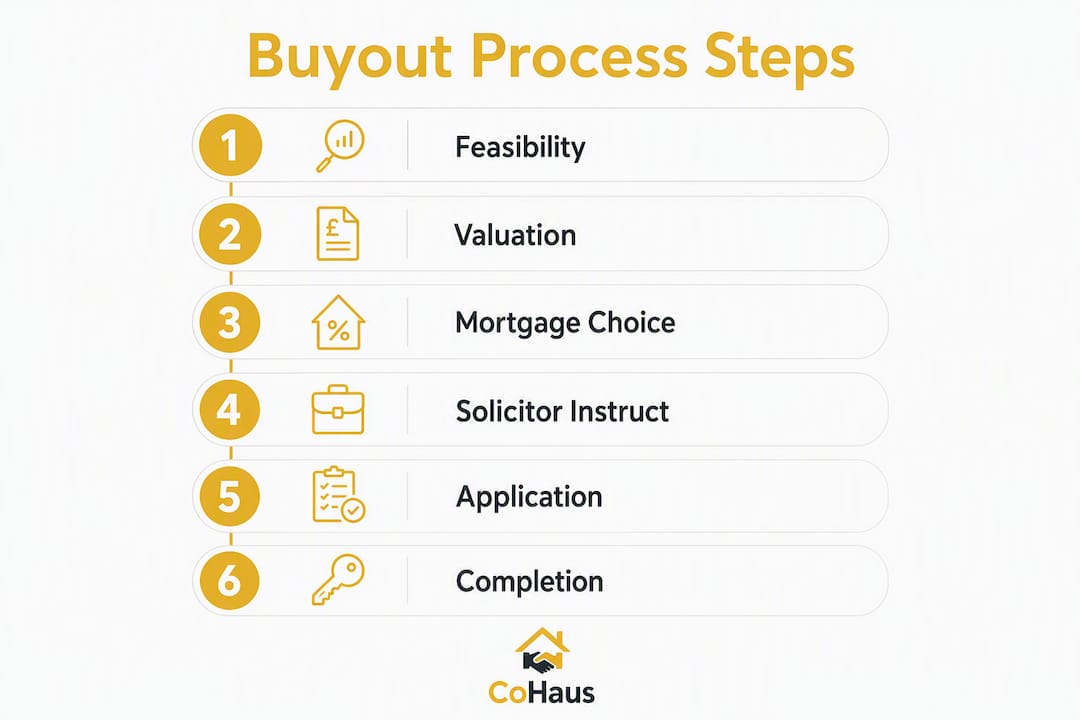
Step 3: Choose the right mortgage route (Week 2) Decide between a further advance on the existing mortgage, a full remortgage with a new lender, or adding a new co-applicant to meet affordability. A mortgage broker with whole-of-market access will model all three options against your income and credit profile.
Step 4: Instruct a solicitor for transfer of equity (Week 2) Your solicitor prepares the transfer deed, liaises with the lender's legal team, and confirms the departing co-buyer will be released from joint and several liability. Note: lenders do not automatically remove joint liability; they must approve the remaining borrower for the full debt before releasing the departing party.
Step 5: Mortgage application and valuation (Weeks 2–5) Submit the remortgage application. The lender commissions its own valuation. Respond to any conditions promptly to avoid delays.
Step 6: Synchronise and complete (Weeks 6–10) Transfer of equity and remortgage must complete on the same day. Your solicitor holds the buyout funds and releases them to the departing co-buyer on completion. Land Registry is updated to reflect the new ownership.
Most cases complete within six to ten weeks, though disputes, lease conditions, or lender queries can extend that.
Pro Tip: Confirm in writing with your lender exactly how completion funds will be released and that the departing co-owner's name will be removed from the mortgage on the same day. Verbal assurances are not enough.
Costs to budget for and tax implications
Cost breakdown
| Cost item | Typical range |
|---|---|
| Early repayment charge (if applicable) | 1%–5% of outstanding balance |
SDLT and the chargeable consideration trap
SDLT on a buyout is more complex than it first appears. The chargeable consideration is not just the cash payment to the departing co-buyer; it can include the share of the outstanding mortgage debt the remaining buyer assumes. This can push the total above SDLT thresholds even when the cash element looks modest.
Worked illustration (not tax advice):
- Property value: £300,000. Departing co-buyer holds a 50% share (£150,000).
- Outstanding mortgage: £160,000. Departing co-buyer's share of debt: £80,000.
- Cash payment to departing co-buyer: £70,000.
- Chargeable consideration = £70,000 + £80,000 = £150,000.
- At £150,000, this falls below the current residential SDLT threshold for first-time buyers but may attract SDLT for non-first-time buyers depending on their status. Always confirm with a solicitor or tax adviser.
Capital gains tax
If the departing co-buyer has lived in the property as their main residence throughout ownership, Private Residence Relief will usually eliminate any CGT liability on their share. Where the property has been let or used partly for business, a CGT calculation is needed. Seek independent tax advice.
Which professionals do you need, and what documents?
Roles and responsibilities
- Mortgage broker: Models affordability scenarios, identifies lenders willing to accept the new sole (or revised joint) application, and manages the application process.
- Conveyancing solicitor: Prepares the transfer of equity deed, coordinates with the lender's solicitors, holds and releases completion funds, and updates Land Registry.
- RICS valuer: Provides an independent market valuation to establish the buyout figure.
- Tax adviser: Advises on SDLT and any CGT exposure specific to your ownership history.
Document checklist
- Current mortgage redemption statement
- Title deeds and Land Registry entries
- Co-ownership deed or lease (including exit clauses)
- Proof of income: payslips, tax returns, or accounts (self-employed)
- Three to six months' bank statements
- Photo ID and proof of address for all parties
- Proposed settlement agreement signed by all co-buyers
- RICS valuation report
Key questions to ask your solicitor: Will you coordinate completion timing with the lender so both complete on the same day? Can you hold the buyout funds in escrow and release them on completion? For shared-ownership leases, what is the deadline after valuation?
One solicitor acting for both the remaining and departing co-buyer can reduce cost and speed coordination, but independent representation is advisable when there is any dispute over valuation or settlement terms.
Pro Tip: Ask your mortgage broker to confirm lender panel suitability before instructing a solicitor. Some lenders require their own panel solicitors for the remortgage work, which affects your choice.
Common problems and how to reduce the risk of a failed buyout
Lacking a clear co-ownership agreement is the single most common cause of a disputed or collapsed buyout. Without written exit provisions covering valuation method, right of first refusal, and timelines, co-buyers must negotiate from scratch under pressure, which often leads to expensive legal intervention or a forced sale.
Other red flags to watch for:
- Affordability shortfall on sole income: Model this before agreeing a settlement figure. If the numbers do not work, bringing in a new co-applicant or reducing the buyout sum are the two most practical routes.
- Lender refusal to release joint liability: Lenders will not remove a co-borrower without approving the remaining applicant for the full debt. A product transfer rarely achieves this; a full remortgage usually does.
- Staircasing deadlines: For shared-ownership leases, the three-month window after valuation is firm. Missing it restarts the process.
- Valuation disputes: Where co-buyers disagree on value, use the median of three independent estate agent valuations or a single RICS report both parties commission jointly.
- Unresolved disputes: When a co-owner refuses to engage, the options narrow quickly. A Mesher order can defer sale in family contexts, but it requires a court application and adds cost and time.
On the administrative side, once completion happens, update council tax, utility accounts, and direct debits promptly. The departing co-buyer remains liable for any joint accounts until they are formally closed or transferred.
Key takeaways
A remortgage to buy out a co-buyer in the UK requires simultaneous completion of the transfer of equity and the new mortgage, with lender affordability assessed on the remaining applicant(s) alone.
| Point | Details |
|---|---|
| Check affordability first | Run an indicative affordability check before agreeing any settlement figure with your co-buyer. |
| Same-day completion is mandatory | Transfer of equity and remortgage must complete on the same day to release joint liability. |
| SDLT includes assumed debt | Chargeable consideration can include the departing co-buyer's share of the mortgage, not just the cash payment. |
| A co-ownership deed prevents disputes | Written exit provisions covering valuation and timelines reduce the risk of a collapsed buyout significantly. |
| Cohaus provides structured exit support | Cohaus offers templated co-ownership agreements, exit planning guidance, and referrals to partner brokers and solicitors. |
Why the exit plan matters more than the exit itself
There is a tendency, in co-buying groups, to treat the buyout as a future problem. We see this regularly. Co-buyers spend months aligning on deposit splits, mortgage contributions, and décor choices, then write a single line in their agreement about what happens when someone wants to leave.
That single line is where most disputes begin. The valuation method is not specified. The timeline is vague. The right of first refusal is implied but not written. When one co-buyer wants out, those gaps become negotiating positions, and negotiating positions become delays, and delays become legal fees.
The co-owner buyout process in the UK is genuinely manageable when the groundwork is in place. The lender affordability check is a known process. The transfer of equity is a standard legal instrument. SDLT, while complex, is calculable. What is not manageable is trying to agree the rules of the exit at the same time as executing it.
The groups we work with at Cohaus who navigate exits most smoothly are the ones who treated the co-ownership agreement as a living document, not a formality. They revisited it when circumstances changed. They kept communication open. When the time came to sell a share of the house, there was a framework to follow rather than a blank page to fill under pressure.
How Cohaus supports co-buyers through a remortgage buyout
Co-buying exit planning is one of the areas where having the right structure in place from the start makes the biggest practical difference. Cohaus gives co-buyers the tools to build that structure before they need it.

Through Cohaus, you get access to templated co-ownership agreements with clear exit clauses, referrals to mortgage brokers and conveyancing solicitors who understand co-buyer arrangements, and a community of co-buyers navigating the same questions. If affordability is the sticking point, Cohaus can help you explore whether adding a new co-applicant is a realistic route, with guidance on finding and vetting a co-buyer who fits your group. If you are at the planning stage, the Cohaus exit planning guide walks through buyout mechanics, notice periods, and forced sale scenarios in plain language.
Cohaus is not a solicitor or a financial adviser, and nothing here replaces independent legal and tax advice. What we offer is the community infrastructure and practical resources to make the process less uncertain. Visit cohaus.life to explore the platform or connect with a partner adviser who can run your affordability numbers today.
Useful sources and further reading
Regulations and lender policy change. Verify current rules with a solicitor or mortgage adviser before acting on any figure or threshold below.
- SAM Conveyancing: how to buy someone out of a mortgage — practical overview of the transfer of equity process and solicitor coordination.
- Unbiased: buying someone out of a property — lender affordability checks, same-day completion mechanics, and joint liability release.
- Calchub: remortgaging to buy out a co-owner's share — SDLT chargeable consideration guidance and Mesher order context.
- Woodhall Mortgages: raise money for a co-owner buyout — timeline estimates and fallback options when affordability fails.
- Attwaters: shared-ownership staircasing guide — staircasing deadlines and solicitor/lender coordination for shared-ownership leases.
- Simpson Notaries: shared property ownership guide — co-ownership agreement essentials and the risks of proceeding without one.
- Taylor Rose Solicitors: buying a partner out of a property — joint tenants vs tenants in common and the legal rights underpinning a voluntary buyout.
- Cohaus co-ownership agreement guide — legal template and checklist for exit clauses in England and Wales.
- Cohaus exit planning guide — buyout mechanics, notice periods, and forced sale scenarios for co-buying groups.