
Yes, you can split mortgage payments between co-buyers — but the lender does not care about your private arrangement. The mortgage is a single debt, and every named borrower is responsible for the full amount. Three risks sit at the top of any co-buying conversation:
- Joint and several liability: if one co-buyer stops paying, the lender can pursue any of the others for the entire outstanding balance.
- Credit association: a joint mortgage links your credit files, which affects future borrowing for everyone named.
- Exit-phase risk: most disputes happen when someone wants to leave. Agreeing exit terms before you sign is the single most protective step you can take.
Agree your exit terms, your payment method, and your ownership split before you apply. Everything else follows from those three decisions.
Table of Contents
- How lenders treat split mortgage payments: joint liability explained
- Practical ways to split mortgage payments between co-buyers
- Ownership types and the legal documents that protect unequal contributions
- What lenders check when you apply for a joint mortgage
- Plan the exit first: options, timelines and typical costs
- Pre-signing checklist: what to agree and collect before you apply
- Worked example: splitting a £300,000 mortgage three ways
- What happens when one co-buyer pays more or less than agreed?
- Tax implications of splitting mortgage payments and ownership shares
- How relationship changes affect mortgage payment responsibilities
- Communication and dispute resolution between co-borrowers
- Key takeaways
- Why exit-first planning is the most honest advice we can give
- How Cohaus helps you split mortgage payments safely
- Useful sources
How lenders treat split mortgage payments: joint liability explained
Lenders treat a joint mortgage as one loan. They expect the full monthly payment to arrive, and they have no interest in how co-buyers divide it privately. If your arrangement is that Person A pays 40% and Person B pays 60%, that is entirely between you. The lender's position is unchanged.
Joint and several liability means each borrower is legally responsible for the whole debt, not just their share. If one co-buyer misses payments, the lender can pursue any remaining borrower for the full outstanding amount — regardless of what a private agreement says. This is not a technicality; it is the standard position for every joint mortgage in the UK.
A joint mortgage also creates a financial association on your credit report. That link stays visible to future lenders and can affect your ability to borrow independently, even after the property is sold. Say Person B has a patchy credit history: their record becomes part of your application, and their future missed payments can pull down your credit profile too. Removing that association requires a formal disassociation request once the mortgage is fully settled or transferred.
Practical ways to split mortgage payments between co-buyers
There is no single correct method. The right choice depends on how much you trust each other, how unequal the contributions are, and how much legal protection you want.
- Individual standing orders to the lender. Each co-buyer sets up a standing order for their agreed share. Simple and transparent, but some lenders do not accept split payments from multiple accounts. Check with your lender first.
- Single payer account with internal accounting. One co-buyer pays the lender from their account; others transfer their share to that person each month. Easy to set up, but the paying co-buyer carries the risk if others are late. Keep a written agreement and a payment ledger.
- Joint bank account with a direct debit. All co-buyers pay into a shared account; the mortgage direct debit runs from there. Visible and fair, though it requires everyone to fund the account on time. Works well when contributions are equal.
- Joint borrower sole proprietor (JBSP). A non-owner supports the mortgage application and shares repayment responsibility without appearing on the title deeds. Useful when a parent or family member wants to help without taking ownership. JBSP mortgages have distinct legal consequences and not all lenders offer them.
- Guarantor arrangements. A guarantor agrees to cover payments if the primary borrowers default. The guarantor does not own the property but is liable if payments fail. Lenders treat named parties differently depending on the product.
Pro Tip: Whatever method you choose, record it formally. A signed payment agreement, monthly bank statements, and a simple ledger are your best evidence if a dispute arises later — especially during a buyout calculation.
Ownership types and the legal documents that protect unequal contributions
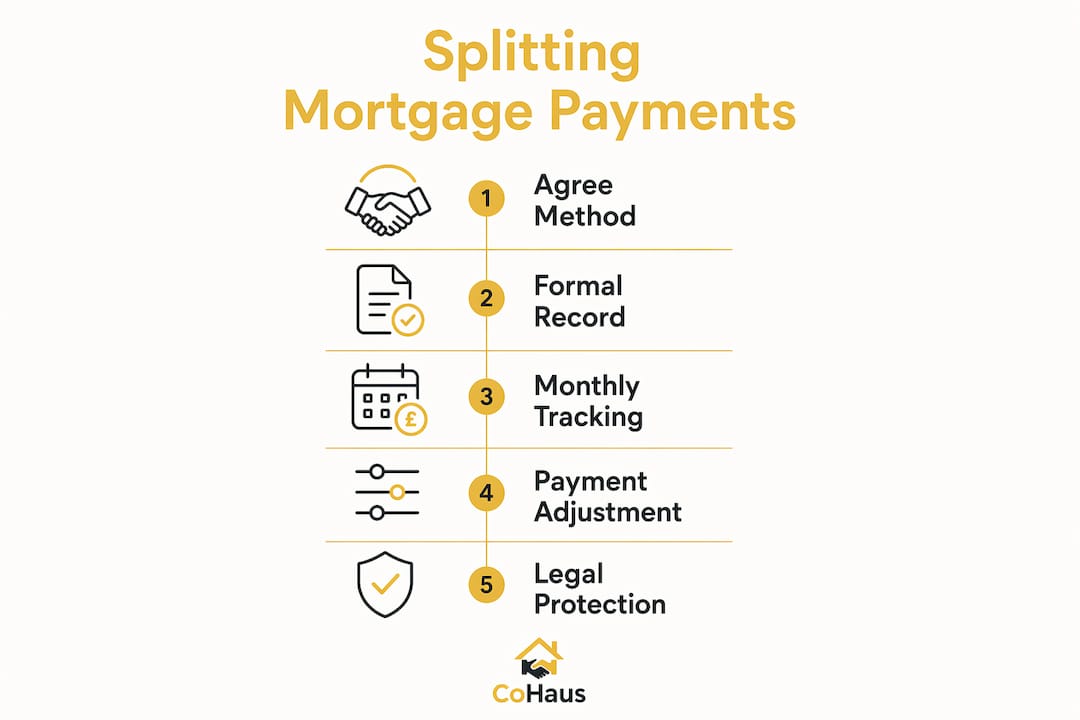
Ownership and mortgage liability are separate. You can hold unequal ownership shares while remaining jointly liable for the full mortgage. Understanding this distinction matters before you choose your ownership structure.

Under UK law, joint ownership takes one of two forms. Joint tenants hold equal rights to the whole property; if one owner dies, their share passes automatically to the others. You cannot leave your share in a will. Tenants in common each hold a defined share, which can be unequal, and each person can pass their share on through their will. For co-buyers with different deposit contributions or different payment shares, tenants in common is almost always the right choice.
A declaration of trust records each person's share, their deposit contribution, and how sale proceeds will be divided. A solicitor should draft it before completion. Key clauses to include: each party's percentage share, the method for valuing the property on exit, notice periods for triggering a sale, and what happens if one party cannot meet their payment obligations. Without this document, disputes default to general property law, which rarely reflects what co-buyers actually agreed.
What lenders check when you apply for a joint mortgage
Lenders base affordability on combined incomes and combined liabilities. Applying together can increase how much you can borrow: typical income multiples run at about four times combined salary, and some schemes extend this where both applicants meet enhanced criteria. The trade-off is that every applicant's credit history, existing debts, and employment stability are assessed together.
Lenders will check:
- Income and employment: payslips, tax returns for the self-employed, and evidence of stable income for all applicants.
- Existing debts and outgoings: personal loans, credit cards, and any other financial commitments reduce the amount you can borrow.
- Credit history: all applicants' credit files are reviewed; a poor record on one file can affect the whole application.
- Deposit source: lenders want to see where the deposit comes from and whether contributions are equal or unequal.
A mortgage broker who works with co-buyers can identify lenders that accept multiple applicants and advise on whether a JBSP or guarantor arrangement suits your group's circumstances. Being transparent about all debts from the outset avoids delays and protects your application.
Plan the exit first: options, timelines and typical costs
Most disputes in co-buying arrangements happen at the exit stage. Agreeing the process before you sign costs very little; resolving it through solicitors or court after a breakdown costs considerably more.
| Exit option | Typical timeline | Approximate costs |
|---|---|---|
| Buyout by remaining co-buyer | weeks long | Valuation, solicitor fees, mortgage admin fee (varies by lender) |
| Sale and split proceeds | weeks long | Estate agent fees, solicitor conveyancing fees, any early repayment charge |
| Transfer of equity | weeks long | Solicitor fees, lender affordability reassessment, Land Registry fee |
| Mediation | weeks long | Mediator fees per hour, typically shared |
A transfer of equity requires lender approval and a full affordability reassessment of the remaining borrower. The lender will only release a departing party once they are satisfied the remaining co-buyer can service the mortgage alone. Build this into your exit plan from the start.
Pre-signing checklist: what to agree and collect before you apply
Before committing to a joint mortgage, work through every item below with your co-buyers. Gaps here become disputes later.
Agree in writing:
- Ownership split (equal or unequal; tenants in common or joint tenants)
- Payment method and each person's monthly contribution
- Who pays which household bills and how shared costs are divided
- Exit triggers (e.g. one party wants to sell, relationship breakdown, job relocation)
- Valuation method on exit (independent surveyor, RICS valuation, agreed estate agent)
- Dispute resolution process (mediation before legal action)
- What happens if one party cannot meet their payment obligations
Collect before signing:
- Photo ID and proof of address for all applicants
- Three to six months' payslips or tax returns
- Credit reports for each applicant (check these before the lender does)
- Proof of deposit contributions (bank statements showing source of funds)
- Draft declaration of trust reviewed by a solicitor
- Solicitor contact details confirmed and instructed
- Agreed timeline for completion
A guide to finding and vetting a co-buyer can help you ask the right questions before any legal commitment is made.
Worked example: splitting a £300,000 mortgage three ways
The scenario: three friends buy together with a £300,000 repayment mortgage over 25 years at a representative interest rate. They agree to split payments 40/35/25 to reflect unequal deposit contributions.
| Co-buyer | Share | Approx. monthly payment |
|---|---|---|
| Person A | 40% | — |
| Person B | 35% | — |
| Person C | 25% | — |
| Total | 100 | £1,600 |
(Monthly total is illustrative; actual figures depend on the interest rate agreed with your lender.)
If Person C stops paying: Persons A and B must cover the full £1,600 between them to avoid a missed payment on the mortgage. The lender does not adjust its expectations. Person A and B can pursue Person C for the shortfall privately, but the mortgage must be paid in full each month regardless.
Buyout calculation: if Person C wants to leave and the property has risen in value to £360,000, their 25% share of the equity (after deducting the outstanding mortgage balance) would be calculated and paid by the remaining co-buyers. A three-person mortgage guide covers the mechanics in more detail.
What happens when one co-buyer pays more or less than agreed?
Overpayments and underpayments do not change the mortgage balance in proportion to who paid what. The lender records one loan and one balance. Internally, however, they create a real imbalance between co-buyers.
If Person A consistently covers Person B's shortfall, Person A is effectively increasing their financial contribution to the property without automatically gaining a larger ownership share. Without a written record, that extra contribution is very difficult to recover at sale. A payment ledger, updated monthly, is the practical solution. If the imbalance becomes significant, co-buyers should revisit the declaration of trust and consider formally amending ownership shares with a solicitor.
Overpayments to the lender (paying more than the required monthly amount) reduce the overall mortgage balance and can shorten the term or reduce future payments. Most lenders allow overpayments up to a set annual limit without an early repayment charge; check your mortgage terms before making them.
Tax implications of splitting mortgage payments and ownership shares
Splitting payments does not in itself create a tax event, but the ownership structure does. Two taxes are most relevant for co-buyers.
Stamp Duty Land Tax (SDLT) is calculated on the full purchase price, not on individual shares. First-time buyer relief applies only if all buyers qualify as first-time buyers; if one co-buyer has previously owned a property, the relief is lost for the whole purchase. Check current SDLT thresholds on GOV.UK before exchanging contracts.
Capital Gains Tax (CGT) applies to any gain made when the property is sold, based on each person's ownership share. If the property is your main residence throughout ownership, Private Residence Relief typically eliminates CGT. If any co-buyer does not live in the property, their share of any gain may be subject to CGT at the applicable rate. Each co-buyer's CGT position is assessed individually, so unequal ownership shares produce unequal tax liabilities on sale.
This article is general information, not tax or legal advice. Confirm your position with a qualified solicitor or tax adviser before proceeding.
How relationship changes affect mortgage payment responsibilities
A change in relationship status does not automatically change who is responsible for the mortgage. If two co-buyers separate, both remain jointly liable until the mortgage is formally restructured or the property is sold.
The practical options are the same as any exit: one party buys the other out (requiring lender approval and an affordability reassessment), or the property is sold and proceeds are divided according to the declaration of trust. Neither option is automatic. Until a transfer of equity is completed and approved by the lender, both parties remain on the mortgage and both remain financially associated on their credit files.
For married couples or civil partners, divorce proceedings can involve court orders that direct how property is dealt with. For friends or unmarried co-buyers, there is no equivalent automatic legal process; the declaration of trust and any co-ownership agreement are the primary documents. This is another reason to have both in place before completion.
Communication and dispute resolution between co-borrowers
Clear communication prevents most disputes from becoming serious. Agree a regular check-in, whether monthly or quarterly, where co-buyers review payments, discuss any financial changes, and flag concerns early. A shared document or spreadsheet tracking contributions is a simple tool that removes ambiguity.
When disagreements do arise, the sequence that works best in practice is: direct conversation first, then mediation if direct conversation fails, then legal action as a last resort. Build this into your co-ownership agreement explicitly. The Centre for Effective Dispute Resolution (CEDR) and local mediation services can facilitate structured conversations at a fraction of the cost of litigation.
One practical rule: any change to the payment arrangement, ownership split, or exit terms should be documented in writing and signed by all parties. Verbal agreements are very difficult to enforce.
Key takeaways
Splitting mortgage payments is straightforward in practice but legally complex: joint liability means every co-buyer is responsible for the full debt, and exit planning is the most important protection you can put in place.
| Point | Details |
|---|---|
| Joint liability is absolute | Every named borrower is liable for the full mortgage, not just their agreed share. |
| Exit terms must be written down | Agree valuation method, notice periods, and buyout formula before you sign. |
| Ownership and payment are separate | You can hold unequal shares as tenants in common while splitting payments differently. |
| Records protect everyone | A payment ledger and bank statements are your evidence in any dispute or buyout. |
| Cohaus supports co-buyers | Cohaus provides guides, templates, and introductions to solicitors and brokers for co-buyers at every stage. |
Why exit-first planning is the most honest advice we can give
Most co-buying guides lead with the excitement of buying together and save the hard conversation for a footnote. We think that gets it backwards. The legal and financial complexity of a joint mortgage is manageable, but only if co-buyers have genuinely worked through what happens when circumstances change. A declaration of trust and a clear exit agreement are not pessimistic documents; they are what make the whole arrangement fair and workable for everyone involved.
The co-buyers who run into serious difficulty are almost always the ones who assumed goodwill would be enough. It usually is, right up until it isn't. Putting the exit terms in writing costs a few hundred pounds in solicitor time. Not having them can cost tens of thousands.
How Cohaus helps you split mortgage payments safely
Co-buying is more achievable when you have the right support around you from the start. Cohaus brings together co-buyers who are serious about home ownership, and gives them the tools to do it properly: educational guides on joint mortgages and payment splitting, declaration of trust templates, and direct introductions to solicitors and mortgage brokers who understand co-buying arrangements.

The community aspect matters too. Through Cohaus, you can connect with others who are navigating the same questions, share what you've learnt, and find co-buyers whose financial goals and timelines align with yours. Whether you're at the research stage or ready to apply, Cohaus gives you a structured process rather than a guessing game. Join the Cohaus community and take the first step towards buying together with confidence.
Useful sources
- MoneyHelper — free, impartial guidance on mortgages, budgeting, and debt; includes mortgage calculators and a directory of regulated advisers.
- GOV.UK joint property ownership — official guidance on joint tenants versus tenants in common, how to register ownership, and how to change ownership type.
- HM Land Registry — explains how ownership types are registered and what documents are held; useful when checking your title register.
- Citizens Advice — practical guidance on housing rights, separation, and what to do if a co-owner stops paying.
- Financial Conduct Authority (FCA) — check that your mortgage broker is FCA-regulated before taking advice; the FCA register is searchable online.
For document drafting, declaration of trust preparation, or a transfer of equity, instruct a qualified solicitor. For mortgage product selection and affordability assessment, use an FCA-regulated mortgage broker with experience in multi-applicant applications.