
A joint and several liability mortgage means every named borrower is legally responsible for the entire debt. The lender can pursue any one of you for the full outstanding balance if the others stop paying — not just your share. Before you exchange contracts, agree your ownership shares and record them in a Declaration of Trust registered with HM Land Registry. That single document is the most important protection most co-buyers never get around to signing.
Many co-buyers assume they are only liable for their percentage of the mortgage. Lenders do not see it that way — each named borrower is 100% liable to the lender, regardless of any private agreement between co-buyers. Cohaus builds Declaration of Trust support and transparent exit terms into its co-buying process precisely because this misconception causes so much financial harm.
Table of Contents
- How joint mortgage liability works in practice
- Ownership shares and mortgage liability are not the same thing
- Practical protections to put in place before you sign
- How to exit a joint mortgage: transfer of equity and remortgage
- Common pitfalls and legal risks for co-buyers
- A practical checklist before and after signing
- Negotiating responsibilities and exit strategies between co-buyers
- Can one person be released without a full remortgage?
- Key takeaways
- Co-buying is manageable when the structure is right
- Cohaus makes co-buying structured and clear
- Useful sources
How joint mortgage liability works in practice
When you take out a joint mortgage, the lender treats every borrower as fully liable for the whole debt. If one co-buyer loses their job and stops contributing, the lender will pursue any remaining borrower for the full monthly payment. That is not a worst-case scenario — it is standard lender behaviour.
Three common situations show how this plays out:
- One borrower defaults. The lender can demand the full outstanding balance from any remaining borrower, regardless of whose fault the default was.
- One borrower dies. Unless life insurance is in place, the surviving co-buyers remain liable for the entire mortgage.
- One borrower loses income temporarily. The lender will still expect full payment and may register missed payments against all borrowers' credit files.
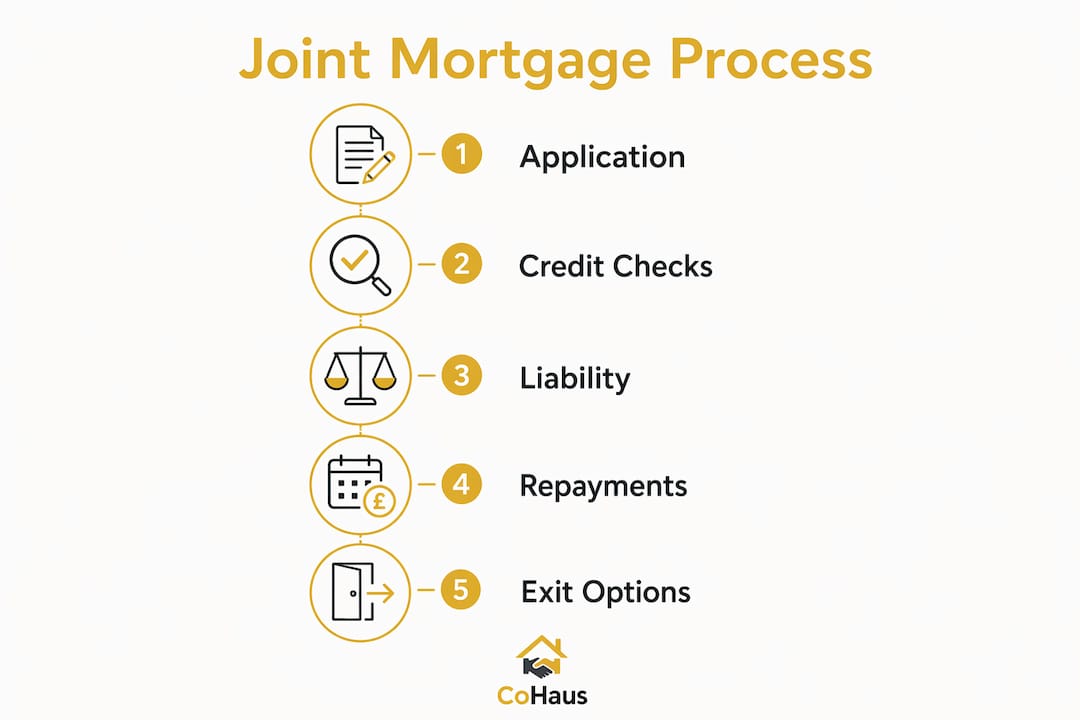
At application, lenders typically require proof of income and credit checks for every named borrower, a mortgage deed signed by all parties, and confirmation that all borrowers understand their joint liability. After a default, lenders can demand full repayment, begin possession proceedings, or register the missed payment against all co-borrowers.
All named borrowers' credit files are linked, so a missed payment by one person affects the credit score and future borrowing options of everyone on the mortgage.

Pro Tip: A private apportionment agreement between co-buyers — agreeing who pays what — does not bind the lender. Record it anyway, because it gives you a legal basis to recover overpaid amounts from a defaulting co-buyer later.
Ownership shares and mortgage liability are not the same thing
Co-buyers often conflate two separate legal concepts: who owns the property and who owes the mortgage. They are governed by different documents and different rules.
| Feature | Joint tenants | Tenants in common |
|---|---|---|
| Ownership shares | Equal shares only | Can hold unequal shares |
| On death | Property passes automatically to surviving owners | Your share passes via your will |
| Can sell your share independently | No | Yes |
| Mortgage liability | Joint and several (full debt) | Joint and several (full debt) |
The critical point in that table: mortgage liability is joint and several regardless of whether you hold the property as joint tenants or tenants in common. Choosing tenants in common to reflect a 70/30 deposit split does not reduce your exposure to the lender — you are still each liable for the whole debt.
The key documents that record each concept are the mortgage deed (liability), the title register at HM Land Registry (legal ownership), and the Declaration of Trust (beneficial shares and contribution schedule). Without a Declaration of Trust, courts default to equal contribution between co-buyers regardless of what was actually paid. Our tenants in common guide explains how to record unequal shares correctly.
Practical protections to put in place before you sign
The window between agreeing a purchase and exchanging contracts is when you have the most leverage to protect yourself. Use it.
- Draft a Declaration of Trust. Record each co-buyer's beneficial share, the contribution schedule, what triggers a sale, and how an exit works. This is the single most effective safeguard available to co-buyers before completion.
- Agree payment apportionment in writing. Decide who pays what each month and what happens if one person cannot pay. Without a written agreement, the law assumes equal contribution.
- Get independent legal advice. Each co-buyer should have their own solicitor review the trust deed and mortgage terms. Sharing a solicitor creates a conflict of interest.
- Take out appropriate insurance. Joint life cover pays out on the first death; critical illness cover protects against serious illness; mortgage payment protection insurance covers temporary loss of income. Decide who holds each policy and whether it is written in trust.
- Check every borrower's affordability. A poor credit score from one applicant affects the whole application and may reduce the amount you can borrow.
Our co-ownership agreement guide provides a practical template for England and Wales.
How to exit a joint mortgage: transfer of equity and remortgage
Leaving a joint mortgage is rarely straightforward. Lender consent is mandatory, and the remaining borrower must pass a fresh affordability assessment before anyone is released from the debt.
The three main exit routes are:
Transfer of equity. The departing co-buyer transfers their ownership share to the remaining borrower(s). The lender must agree, and the remaining borrower must demonstrate they can service the full mortgage alone. A solicitor handles the legal transfer, and the lender will commission a property valuation. Typical cost items include solicitor fees, a valuation fee, and possibly a lender arrangement fee if the mortgage product changes.
Remortgage. If the existing lender will not consent to a transfer of equity, or if the remaining borrower wants a better rate, a full remortgage with a new lender is the alternative. The process takes longer and involves full underwriting, but it releases the departing borrower cleanly. Understanding mortgage documents involved in this process helps co-buyers prepare for what lenders will request.
Sale of the property. If the remaining borrower cannot meet affordability checks alone, selling is often the only option. The mortgage is repaid from the sale proceeds and both parties are released.
Timescales vary, but a transfer of equity typically takes 4–8 weeks once the lender has agreed in principle. A full remortgage can take 8–12 weeks. Plan for both to take longer if valuations or legal queries arise.
Common pitfalls and legal risks for co-buyers
Most disputes between co-buyers are predictable and preventable. These are the situations we see cause the most damage:
- No Declaration of Trust. Without one, costly court disputes over ownership shares are far more likely, particularly for unmarried couples or friends.
- Informal payment agreements. A verbal agreement about who pays what is almost impossible to enforce. Put it in writing before completion.
- Linked credit histories. Once you take out a joint mortgage, your credit files are associated. One person's financial difficulties affect everyone's ability to borrow in future.
- One co-buyer stops paying. The non-defaulting borrower must cover the full payment or face missed-payment markers on their own credit file.
Recovering overpaid amounts from a defaulting co-buyer is a separate legal action — often slow and expensive unless the contribution schedule was agreed contractually in advance.
Pro Tip: A formal apportionment agreement in your Declaration of Trust does not bind the lender, but it significantly reduces the cost and complexity of recovering your money from a co-buyer who defaults.
A practical checklist before and after signing
Before signing, ask every prospective co-buyer:
- Is your income stable, and do you have any undisclosed debts?
- What is your credit history, and have you checked your credit file recently?
- What are your plans for the next five years — do you expect to move, marry, or change jobs?
- Are you willing to sign a Declaration of Trust and take independent legal advice?
Documents to collect before exchange:
- Photo ID and proof of income for all borrowers
- Mortgage offer and full terms from the lender
- Draft Declaration of Trust reviewed by a solicitor
- Title register from HM Land Registry
- Insurance documents for all relevant policies
Red flags that should pause or stop the purchase:
- A co-buyer refuses to sign a Declaration of Trust
- Undisclosed debts emerge during the process
- One borrower cannot demonstrate they could cover the full payment in an emergency
- Any co-buyer is evasive about their credit history
Our buying a house with friends guide covers multi-party purchases in more detail.
Negotiating responsibilities and exit strategies between co-buyers
The mortgage deed binds you to the lender. What you negotiate with your co-buyers is a separate matter, and it needs to be written down. A well-drafted Declaration of Trust should cover who pays what proportion of the monthly mortgage, how deposit contributions are recorded, what triggers a forced sale (relationship breakdown, job loss, a co-buyer wanting to move), and how a departing co-buyer is bought out.
Exit strategy clauses are often the most contentious part to agree, but they are the most valuable. Decide in advance whether a departing co-buyer must offer their share to the remaining owners first, how the buyout price is calculated (independent valuation is standard), and what happens if no one can afford to buy the other out. Agreeing this before you are emotionally or financially stressed by a real exit makes the conversation far easier.
Can one person be released without a full remortgage?
In limited circumstances, yes. Some lenders will agree to a deed of release or a consent to change of parties without requiring a full remortgage, particularly if the remaining borrower has a strong affordability profile and the loan-to-value ratio is low. This is sometimes called a "transfer of equity without remortgage."
The lender's decision is entirely discretionary. They will still run a full affordability check on the remaining borrower, commission a valuation, and charge an administration fee. If the remaining borrower does not meet the lender's current criteria, the lender can refuse, leaving the departing co-buyer still legally liable for the debt. In that situation, the options narrow to a full remortgage with a new lender or a sale. Our joint borrower sole proprietor guide covers related lender stipulations in more detail.
Key takeaways
A joint and several liability mortgage makes every named borrower fully liable for the whole debt, so the single most important action any co-buyer can take is to sign a Declaration of Trust before exchange.
| Point | Details |
|---|---|
| Full liability for every borrower | The lender can pursue any co-buyer for the entire outstanding balance, not just their share. |
| Ownership and liability are separate | Holding property as tenants in common does not reduce your mortgage liability to the lender. |
| Declaration of Trust is essential | Record beneficial shares, contribution schedules, and exit terms before completion to avoid court disputes. |
| Exiting requires lender consent | Transfer of equity or remortgage needs lender approval and a fresh affordability check for remaining borrowers. |
| Cohaus supports co-buyers | Cohaus builds Declaration of Trust support, shared deposit management, and transparent exit terms into its co-buying process. |
Co-buying is manageable when the structure is right
The legal exposure in a joint mortgage is real, and most co-buyers underestimate it until something goes wrong. What I find striking, having worked through many of these cases, is that the problems are almost always structural rather than personal. Two people with good intentions and a verbal agreement still end up in dispute because the paperwork was never done.
The conventional wisdom is to focus on the mortgage rate and the deposit. The more useful focus is on the Declaration of Trust, the exit clause, and the insurance. Those three things determine whether a co-buying arrangement holds together under pressure.
Co-buying with friends or colleagues is not inherently riskier than buying with a partner — it just requires more explicit agreement upfront. The legal framework exists to protect everyone involved; the question is whether you use it. A solicitor who specialises in co-ownership is worth the fee before exchange, not after a dispute has started.
Cohaus makes co-buying structured and clear
Co-buying without a clear framework leaves you exposed to exactly the risks this article describes. Cohaus is built around removing that uncertainty. The platform matches co-buyers for compatibility, supports shared deposit management, and helps co-buyers put legal protections in place from the start — including guidance on Declaration of Trust documents and transparent exit terms that all parties agree to before moving forward.

If you are considering co-buying and want a process that addresses joint liability, ownership shares, and exit routes from day one, Cohaus gives you the structure to do it with confidence. Visit cohaus.life to find out how the platform works and whether it fits your situation.
Useful sources
- GOV.UK — Joint property ownership: the primary UK government reference on joint tenants vs tenants in common and how to register ownership with HM Land Registry.
- Ashworths Solicitors — Implications of signing a mortgage document: plain-language explanation of what joint and several liability means when you sign a mortgage deed.
- LexisNexis — General principles of contribution and exoneration: authoritative legal commentary on how courts apportion mortgage debt between co-buyers.
- LegalMortgage — Apportioning the mortgage debt: practical guidance on contribution rights and what enforcement looks like between co-buyers.
- The Mortgage Network — Joint mortgages: what to consider: covers lender consent requirements and affordability checks for transfer of equity.
- Cohaus blog — Deed of Trust UK: your complete guide: step-by-step guide to drafting a Declaration of Trust for co-buyers in England and Wales.
This article is general information, not legal or financial advice. Confirm the current rules with HM Land Registry, your lender, or a qualified solicitor for your own situation.