
TL;DR:
- You can apply to court for a sale when a co-owner refuses to sell, weighing various factors.
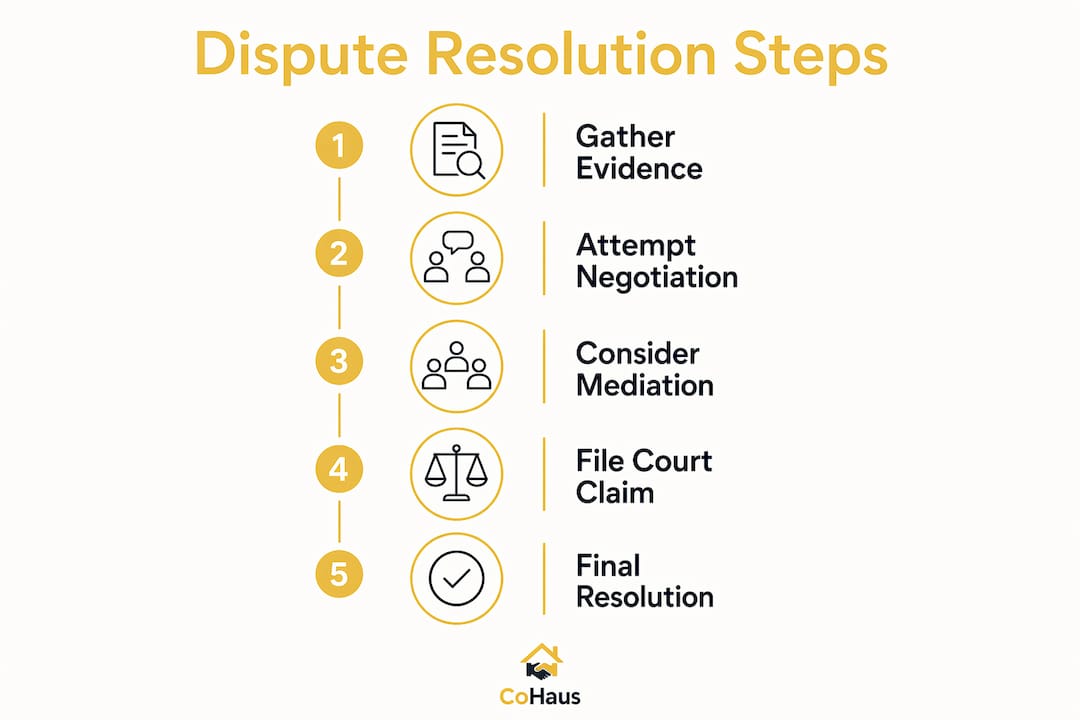
- Gather evidence, attempt mediation, and seek expert legal advice to strengthen your position.
If your co-owner refuses to sell, you are not stuck. Under Section 14 of TOLATA, any person with a beneficial interest in a jointly owned property can apply to the court for an Order for Sale. Courts grant these regularly, though the outcome depends on the Section 15 factors a judge must weigh: the original intentions behind the purchase, the welfare of any children in the home, and the interests of secured creditors such as your mortgage lender. Before you file anything, try mediation and build a clear paper trail. Courts look more favourably on applicants who have genuinely attempted to resolve the dispute first.
Your immediate priorities:
- Secure copies of the title register, any declaration of trust, mortgage statements, and all written communications with your co-owner.
- Send a formal letter before action by recorded post, setting out your position and inviting a response within 14 days.
- Contact a solicitor with TOLATA experience, even for a one-hour paid consultation.
- Register a restriction at HM Land Registry if you fear the other owner might try to deal with the property without your consent.
Table of Contents
- What to do in the first 7–14 days
- How the court can step in: TOLATA s14 and the s15 factors
- How to bring a claim: the Part 8 CPR process
- Non-court options: negotiation, mediation and buy-outs
- What evidence to gather before mediation or court
- Realistic timings, costs and likely outcomes
- How to protect yourself before a dispute arises
- When to instruct a solicitor and how to brief them
- Key takeaways
- Why clear exit terms matter more than most co-buyers realise
- Cohaus helps you co-buy with protections built in
- Useful sources and further reading
What to do in the first 7–14 days
Act quickly to preserve your position. Courts and mediators both respond better when you have a clear, dated record of events.
- Pull your official title register from GOV.UK (a small fee applies) and check whether you hold as joint tenants or tenants in common, as this affects your rights.
- Gather every financial record: deposit receipts, mortgage statements, utility bills you have paid, and bank transfers related to the property.
- Send a short, factual email to your co-owner confirming you wish to sell and asking for a written response. Keep the tone neutral.
- Contact an estate agent and ask them to confirm in writing that access for a valuation has been requested. If your co-owner refuses entry, that email becomes useful evidence later.
- Look into a RICS-accredited surveyor for an independent valuation, which strengthens any buy-out negotiation.
- Research accredited mediators via the Civil Mediation Council and make a formal approach in writing.
- Speak to Citizens Advice or Shelter for free initial guidance if cost is a concern.
Pro Tip: Ask the estate agent to confirm in a brief email that they attended the property and were refused access. That single email, dated and signed, can carry real weight in front of a judge.
How the court can step in: TOLATA s14 and the s15 factors
Section 14 of TOLATA gives any co-owner the right to apply to the court for an order relating to the property, including an order to sell it. The court does not grant these automatically. Under Section 15, the judge must weigh a specific set of factors before deciding:
- Original intentions: Why did the parties buy the property together? A home bought as a family residence is treated differently from one bought as an investment.
- Current purpose: If the original purpose (say, housing a family) can no longer be achieved, the court is more likely to order a sale.
- Welfare of minors: Children living in the property carry significant weight. A judge may postpone a sale until a child reaches a certain age.
- Secured creditors: Your mortgage lender's position is a mandatory consideration. If the lender supports a sale, that strengthens your case.
- Parties' circumstances and wishes: The court hears both sides and considers hardship, conduct, and financial need.
Depending on these factors, a judge may order an immediate sale, a postponed sale, a buy-out by one party, or an occupation order. Courts can also grant conduct of sale to one owner, allowing them to manage the marketing process and accept offers within an agreed margin, which limits the other owner's ability to obstruct viewings.
How to bring a claim: the Part 8 CPR process
When the dispute is essentially a single question, whether to sell, Part 8 of the Civil Procedure Rules offers a simpler, lower-cost route than full contested proceedings. Here is what the process looks like in practice:
- Pre-action letter: Send a formal letter before action, giving the other party a reasonable time to respond and confirming you have attempted mediation.
- Claim form (N208): File the Part 8 claim form at the County Court, supported by a witness statement and your evidence bundle.
- Serve on the respondent: The other owner is served and given time to file an acknowledgement of service and any evidence in reply.
- Directions hearing: The court may list a short hearing to set a timetable, agree the issues, and confirm whether a final hearing is needed.
- Final hearing: A judge considers the evidence and the s15 factors, then makes an order. If the resisting owner still refuses to sign conveyancing documents after an order is made, the court can nominate someone to sign on their behalf under Section 39 of the Senior Courts Act 1981.
Budget for solicitor and counsel fees, a RICS valuation, and court fees. Part 8 is cheaper than full litigation, but costs can still erode equity quickly if the matter is contested.
Non-court options: negotiation, mediation and buy-outs
Mediation and ADR are strongly recommended before any court application, partly because litigation costs can quickly eat into the equity you are trying to release. The main alternatives are:
- Buy-out: One owner buys the other's share, funded by a remortgage or bridging loan. This works when one party has the means and the other simply wants out.
- Structured payment plan: The buying-out party pays in instalments over an agreed period, secured against the property.
- Agreed postponement: Both parties agree to delay the sale to a fixed date, perhaps tied to a child finishing school or a mortgage product ending.
- Mediation: A neutral third party helps both sides reach a binding agreement, usually within weeks rather than months.
- Occupation rent: If one owner has exclusive use of the property, the other may be entitled to a notional rent for that period, which can be offset against the buy-out price.
For co-buying exit planning, the cleaner the original agreement, the easier any of these routes becomes.
| Option | Best when | Typical timeframe |
|---|---|---|
| Buy-out | One party can refinance | Weeks to months |
| Mediation | Relationship can be salvaged | Weeks |
| Agreed postponement | Children or fixed-term mortgage involved | Months to years |
| Part 8 TOLATA claim | All else has failed | Several months |

What evidence to gather before mediation or court
Good evidence does two things: it strengthens your negotiating position and, if you go to court, it helps the judge understand the full picture. Collect:
- Official title register and any declaration of trust
- Mortgage statements and records of who paid what
- Bank statements showing your deposit contribution
- All written communications: texts, emails, letters
- A dated diary of refusals, missed meetings, and obstructions
- Estate agent emails confirming access was denied
- Photographs of the property's condition if relevant
Pro Tip: Create a simple chronology document: one row per event, with the date, what happened, and the supporting document reference. Solicitors and judges both find this format easy to follow, and it saves billable time.
For unmarried co-owners, the absence of a declaration of trust means you may need to rely on constructive trust arguments to prove your share, which adds complexity and cost.
Realistic timings, costs and likely outcomes
Mediation can resolve matters in a few weeks. A Part 8 TOLATA claim from issue to final order typically takes several months, and can stretch longer if the respondent contests every step. In cases involving children, a judge may postpone the sale for years.
Costs vary considerably. Mediation fees are generally modest. Solicitor and counsel fees for a contested TOLATA claim can run to thousands of pounds, depending on complexity. Add a RICS valuation and court fees on top. If the resisting owner obstructs the sale after an order, enforcement costs rise further.
Common outcomes include:
- Immediate Order for Sale with conduct of sale granted to the applicant
- Postponed sale tied to a specific event (child turning 18, mortgage term ending)
- Buy-out order directing one party to purchase the other's share
- Occupation order regulating who lives in the property during proceedings
- Enforced signature under Section 39 Senior Courts Act 1981 if the owner refuses to sign the TR1
For inherited property disputes, the common mistakes when selling inherited properties are worth reviewing before you proceed.
How to protect yourself before a dispute arises
The single most effective protection is a properly drafted deed of trust agreed at the point of purchase. A good deed should include:
- Each owner's share and how it was calculated
- A buy-out formula and the valuation method (RICS or agreed surveyor)
- Notice periods before a sale can be triggered
- What happens if one party stops contributing to the mortgage
- A dispute resolution clause requiring mediation before any court application
- Exit timetable and conditions for an agreed sale
Beyond the deed, vet your co-buyer carefully. Check proof of deposit source, affordability, exit intentions, and references. Cohaus builds this vetting into its platform, alongside shared deposit protections and clear exit terms, so that the conditions for a deadlock are much harder to reach in the first place. For a full checklist, the guide on finding and vetting a co-buyer is a practical starting point.
Understanding tenants in common vs joint tenancy also matters: joint tenants cannot sever their interest unilaterally without notifying the other owner, while tenants in common hold distinct shares that can be dealt with separately.
When to instruct a solicitor and how to brief them
Get a solicitor involved early if any of the following apply:
- Your co-owner is actively obstructing viewings or communications
- There is a risk of insolvency or bankruptcy (a trustee in bankruptcy can apply for a sale independently)
- Children live in the property
- The equity at stake is substantial
- You cannot locate the other owner
When you go to that first meeting, bring your title register, any deed of trust, mortgage statements, and your evidence chronology. Ask the solicitor directly: what is the realistic outcome under s15, would Part 8 be appropriate here, what is the likely cost range, and should we attempt mediation first?
Agree a funding plan upfront. Options include a fixed fee for document review, staged billing tied to milestones, or a limited retainer for advice only. Find a solicitor through The Law Society's Find a Solicitor tool or check the Solicitors Regulation Authority register to verify credentials.
Key takeaways
When a co-owner refuses to sell, your strongest legal route is a Section 14 TOLATA application, but courts weigh Section 15 factors carefully, so evidence, conduct, and attempted negotiation all shape the outcome.
| Point | Details |
|---|---|
| Secure evidence immediately | Gather title register, mortgage statements, and all communications before taking any other step. |
| Try mediation first | Courts view attempted ADR favourably; it also costs far less than a contested TOLATA claim. |
| Know your s15 factors | Children's welfare, original intentions, and creditor interests all influence whether a judge orders an immediate sale. |
| Budget realistically | A Part 8 claim can take several months and cost thousands; factor in valuations and potential enforcement costs. |
| Use Cohaus protections | A deed of trust with clear exit terms, agreed at purchase through Cohaus, is the most practical way to prevent deadlock. |
Why clear exit terms matter more than most co-buyers realise
Most people entering a co-buying arrangement focus on getting in, not on getting out. That is understandable. But the disputes that end up in court almost always trace back to one missing document: a deed of trust with no exit clause, or a verbal agreement that neither party can now prove.
What strikes us at Cohaus is that the legal framework, TOLATA, CPR Part 8, Section 39 of the Senior Courts Act, is actually quite well designed. Courts have real tools to resolve these disputes. The problem is that using those tools costs time, money, and goodwill that most co-buyers cannot easily spare. A contested TOLATA claim can run for months and cost more than the equity it releases.
The practical answer is not to avoid co-buying. It is to co-buy with the right structure in place from day one. A deed of trust that names a valuation method, sets a notice period, and includes a mediation clause before any court step is not pessimistic planning. It is what makes co-buying genuinely workable. We think that is worth saying plainly, because too many guides treat it as a footnote.
Cohaus helps you co-buy with protections built in
Shared deposit protection, clear exit terms, and a community of vetted co-buyers: these are the practical safeguards that reduce the chance of a joint ownership dispute reaching court in the first place.

Cohaus gives co-buyers a structured process for agreeing ownership shares, exit timetables, and dispute resolution steps before you exchange contracts. Every member goes through compatibility and affordability checks, and the platform guides you towards a deed of trust that covers the clauses solicitors say matter most. If a disagreement does arise, you have a written framework to fall back on rather than a costly court application.
If you are planning to co-buy, or already in a shared ownership arrangement and want to put better protections in place, visit Cohaus to see how the platform works and what safeguards are available to you.
Useful sources and further reading
The sources below are worth bookmarking before you brief a solicitor. Bring the statutory references in particular: a solicitor will expect you to know them.
- TOLATA 1996, Sections 14 and 15: The primary statute for co-ownership disputes in England and Wales. Available via legislation.gov.uk.
- Civil Procedure Rules, Part 8: The procedural route for single-issue property disputes. Full text at justice.gov.uk.
- GOV.UK: Joint property ownership: Plain-language overview of co-ownership rights, including what happens when one owner loses mental capacity.
- Shelter England: Detailed guidance on joint owner rights and how to register a restriction at HM Land Registry.
- Citizens Advice: Free initial guidance on housing disputes and signposting to local legal help.
- The Law Society / Solicitors Regulation Authority: Use the Find a Solicitor tool to locate a TOLATA-experienced practitioner and verify their registration.
- Tozers Solicitors: Practitioner overview of s14 and s15 TOLATA, including the factors courts weigh.
- Prettys Solicitors: Guidance on declarations of trust and the role of ADR in TOLATA disputes.
- The Barristers Inc: Barrister's perspective on likely outcomes, including postponement and buy-out orders.
- TSABI Law: Practical notes on conduct of sale and pre-action steps.
- Birketts Solicitors: Detailed procedural guide covering Part 8, evidence bundles, and enforcement under Section 39 Senior Courts Act 1981.
This article is general information, not legal advice. Property law turns on the specific facts of each case. Confirm the current rules with a qualified solicitor or the relevant primary source before acting.