
TL;DR:
- Getting a mortgage with parents in the UK is possible through three main options: standard joint mortgages, JBSP, and guarantor mortgages. Each structure offers different ownership and liability arrangements, with JBSP preserving first-time buyer benefits by keeping parents off the title. Proper legal planning, including wills and independent advice, is essential to protect both parties' interests and future borrowing ability.
Yes, you can get a mortgage with your parents in the UK. Most lenders will consider it, and there are three distinct routes depending on whether your parents want to own the property, simply support your borrowing, or act as a safety net.
Here are your three main options at a glance:
- Standard joint mortgage: your parents are named on both the mortgage and the title deeds as co-owners. All parties share legal ownership and full repayment liability.
- Joint Borrower Sole Proprietor (JBSP): your parents are named on the mortgage to boost affordability but do not appear on the title. You are the sole legal owner.
- Guarantor mortgage: your parents offer their savings or property as security. They are not typically making monthly repayments from day one but step in if you cannot pay.
The first thing to check is whether your parents want legal ownership of the property or only want to help you borrow more. That single question usually determines which route fits. Run a combined affordability estimate with a broker before committing to any structure, because the difference between routes affects your parents' future borrowing, your stamp duty bill, and what happens to the property if either party dies.
Table of Contents
- What is a joint mortgage with parents, and which UK options exist?
- How ownership is recorded and who is liable for repayments
- How lenders assess your joint application and what it means for borrowing
- Pros and cons for both the buyer and the parent
- Legal safeguards you and your parents should arrange before completing
- How to apply: a step-by-step process with typical costs
- Alternatives to putting parents on the mortgage
- Inheritance tax and estate planning considerations
- Tax implications when parents gift deposits or make payments
- Key takeaways
- What we have learned from working with co-buyers
- Co-buying without putting parents on the mortgage
- Useful sources for further reading
What is a joint mortgage with parents, and which UK options exist?
A joint mortgage with parents is a mortgage application where one or both parents are named alongside you, either as co-owners or as supporting borrowers. The three main variants work quite differently in practice.
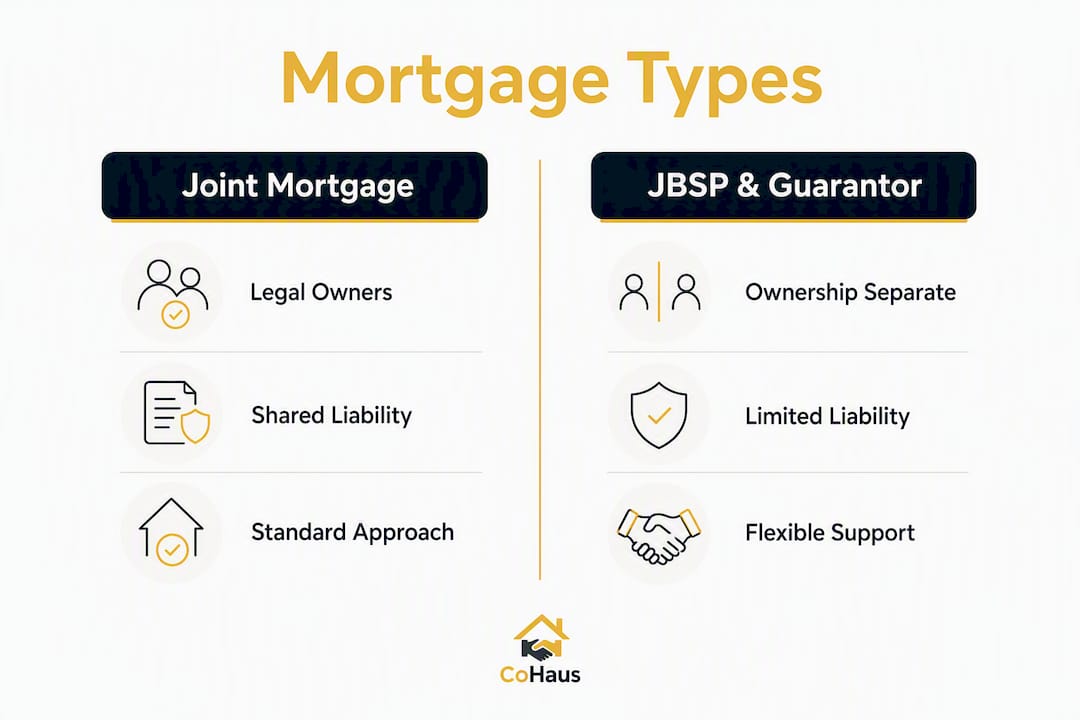
Standard joint mortgage places all applicants on both the mortgage and the title deeds. Every named person is a legal owner and is jointly and severally liable for repayments. If one person stops paying, the lender can pursue any of the others for the full amount.

Joint Borrower Sole Proprietor (JBSP) separates borrowing from ownership. JBSP mortgages allow up to four people to be named on the mortgage application to support affordability, while only one person is the legal owner on the title deeds. Supporting borrowers are fully liable for repayments from day one but hold no ownership stake. Lenders such as Principality describe it as an "income booster" that keeps the house in the proprietor's name alone.
Guarantor mortgage works differently again. The parent typically offers savings or property as security rather than making ongoing monthly repayments. They act as a secondary safety net: if you keep up payments, the guarantor may never pay anything. Consumer guides note that guarantors generally act as a safety net without day-one repayment responsibility, whereas JBSP borrowers share payment liability from the outset.
The table below shows the primary differences across the dimensions that matter most.
| Dimension | Standard joint mortgage | JBSP | Guarantor mortgage |
|---|---|---|---|
| Who is on the title | All applicants | Buyer only | Buyer only |
| Who is legally liable for repayments | All owners, jointly and severally | All named borrowers, including parents | Guarantor if buyer defaults |
| How lenders treat income | Combined incomes of all applicants | Combined incomes of all borrowers | Buyer's income primarily; guarantor's assets as security |
| Impact on parents' future borrowing | Full mortgage liability counted | Full mortgage liability counted | Contingent liability; lenders vary on how they treat it |
| Exit flexibility | Requires remortgage and legal transfer to remove a parent | Requires remortgage; no title change needed | Guarantee can often be released once buyer meets solo affordability |
| Typical costs and timelines | Solicitor fees, valuation, Land Registry; 8 weeks | Same as standard; solicitor's certificate for non-owner borrowers | Solicitor fees; potentially quicker if lender process is simpler |
Most lenders accept close family members (parents, step-parents, sometimes siblings) as supporting borrowers on a JBSP. The usual limit is four borrowers on a single application.
Pro Tip: JBSP is most useful when your parents already own property. Adding them to the title on a standard joint mortgage could trigger the 3% additional dwelling surcharge on Stamp Duty Land Tax and remove your first-time buyer SDLT relief. JBSP keeps you as the sole owner, so your SDLT position stays intact.
How ownership is recorded and who is liable for repayments
Once you have chosen a mortgage structure, you must decide how to hold the property. GOV.UK sets out two options: joint tenants and tenants in common, and the difference matters enormously if one party dies.
Joint tenants hold the property as a single unit with no separate shares. When one owner dies, their interest passes automatically to the surviving owner(s) by right of survivorship. You cannot leave your share to anyone else in a will, because there is no distinct share to leave.

Tenants in common hold defined, separate shares. Those shares can be equal or unequal, and each owner can leave their share to whoever they choose in a will. If your parents contribute a larger deposit, tenants in common allows you to record that formally. If a parent dies as a tenant in common, their share passes according to their will or intestacy rules, not automatically to you.
A practical example: if you and a parent own as joint tenants and the parent dies, you automatically become the sole owner. If you own as tenants in common and the parent dies without a will, their share could pass to their estate and potentially to other beneficiaries, complicating your ownership.
Liability for repayments follows the mortgage structure, not just the ownership type. On a standard joint mortgage, all owners are jointly and severally liable. On a JBSP, the supporting borrowers share full repayment liability even though they are not on the title. If a co-borrower dies, the surviving owner typically remains liable for repayments, and lenders will often require a refinance into the survivor's sole name once they can demonstrate they pass affordability checks alone.
Before you complete a purchase, work through this checklist:
- Decide joint tenants or tenants in common at the point of purchase, not afterwards. Changing from joint tenants to tenants in common later is possible but often costly and administratively burdensome.
- Make or update wills to reflect your intentions, especially if you are tenants in common.
- Consider life insurance for a joint mortgage to cover the outstanding debt if a borrower dies.
- Discuss whether your parents want any legal rights to the property, or whether JBSP better reflects their intentions.
For a detailed comparison of the two ownership types and how to register your choice with HM Land Registry, the Cohaus guide on tenants in common vs joint tenancy covers the practical steps clearly.
How lenders assess your joint application and what it means for borrowing
Lenders look at every named borrower on the application, not just the primary buyer, which is a key consideration explained in mortgage industry solutions. That cuts both ways: your parents' income can increase what you can borrow, but their existing debts, credit history, and any other mortgages they hold will also be scrutinised.
The standard affordability checks cover:
- Combined income: all named borrowers' salaries, self-employed profits, pension income, and other regular income.
- Credit history: a hard credit search on every applicant. One poor credit score can affect the rate offered or the lender's willingness to proceed.
- Existing financial commitments: outstanding loans, credit card balances, car finance, and any other mortgages your parents hold.
- Deposit size: a larger deposit typically unlocks better rates and reduces the lender's risk.
- Other property ownership: if a parent already owns property, lenders factor in that mortgage liability and, on a standard joint mortgage, the SDLT implications.
| Mortgage type | Applicants allowed | What boosts borrowing | Key lender concern | Typical income multiple |
|---|---|---|---|---|
| Standard joint mortgage | Up to 4 (varies by lender) | Combined incomes of all owners | Parent's existing mortgage counted in full | 4x combined income (illustrative) |
| JBSP | Up to 4 borrowers | Supporting borrowers' income added | Supporting borrower's liabilities still assessed | 4x combined income (illustrative) |
| Guarantor | Buyer plus guarantor | Guarantor's assets or savings as security | Guarantor's property equity or savings level | Buyer's income primarily |
One point that surprises many families: appearing on a child's mortgage as a JBSP borrower can reduce a parent's ability to borrow in future. Lenders include that liability in their affordability calculations when the parent later applies for a remortgage, equity release, or any new credit. This is worth modelling before you proceed, particularly if your parents are planning to move home or release equity in the next few years.
For more detail on how lenders handle applications with three or more borrowers, the Cohaus guide on three-person mortgages sets out the lender criteria clearly.
Pros and cons for both the buyer and the parent
Involving parents on a mortgage can make a purchase possible that would otherwise be out of reach. It also creates real obligations for both sides.
For the buyer:
Advantages
- Access to a larger loan by combining incomes, potentially buying in a better area or a bigger property.
- Lower deposit requirement in some cases, because a stronger application can unlock higher loan-to-value products.
- JBSP preserves your first-time buyer SDLT relief, which can save thousands on the purchase.
Disadvantages
- Inheritance complications if parents are on the title and their share passes to other beneficiaries.
- Dependency on parents' financial stability: if a parent's credit deteriorates or they face financial difficulty, it affects the shared mortgage.
- Remortgaging to remove parents later requires passing affordability checks alone, which may not be possible for several years.
For the parent:
Advantages
- JBSP allows genuine financial support without giving up estate planning flexibility or triggering additional SDLT.
- Helping a child onto the property ladder without a large cash gift.
Disadvantages
- Full repayment liability from day one on a JBSP, without any ownership stake.
- Reduced borrowing capacity for their own future plans, because lenders count the child's mortgage as the parent's liability.
- Credit impact: missed payments on the joint mortgage affect every named borrower's credit file.
Consider a realistic negative scenario: a parent joins a JBSP application in good health, but two years later faces redundancy. They are still fully liable for repayments. If the buyer cannot cover the full payment alone, both credit files suffer and the lender may pursue the parent directly. Separate wills, life insurance, and a clear written agreement about what happens in hardship scenarios reduce this risk considerably.
Legal safeguards you and your parents should arrange before completing
Getting the legal structure right at the start costs far less than fixing it afterwards. These are the protections that matter most.
Make or update wills. If you are tenants in common, your parent's share of the property will pass according to their will. Without one, intestacy rules apply and the outcome may not reflect anyone's intentions.
Choose your ownership type deliberately. Joint tenancy suits buyers who want automatic survivorship. Tenants in common suits buyers with unequal contributions or different estate planning goals. Record the decision at the point of purchase.
Consider a deed of trust. When contributions to the deposit or mortgage are unequal, a deed of trust (also called a declaration of trust) records each party's beneficial interest in writing. This is particularly relevant when parents contribute a larger deposit but are not on the title. The Cohaus guide on splitting ownership with unequal deposits explains how these documents work in practice.
Independent legal advice for non-owner borrowers. Most lenders require a solicitor's certificate confirming that any non-owner borrower has received independent legal advice and understands they are liable for the mortgage without owning the property. This is not optional: without it, many lenders will not proceed. Arranging this early avoids delays at the point of application.
Life insurance. If a borrower dies, the surviving parties remain liable for the mortgage. Life insurance covering the outstanding balance protects everyone named on the application.
Pro Tip: Getting independent legal advice early, before you apply, lets your parents understand the full implications for their estate and their own borrowing. Discovering a problem after exchange is expensive and stressful. A single session with a solicitor at the outset costs far less than post-completion changes.
How to apply: a step-by-step process with typical costs
The process for a joint mortgage with parents follows the same broad sequence as any mortgage application, with a few additional steps for non-owner borrowers.
-
Run a preliminary affordability check (1–2 weeks). Use a whole-of-market broker to model what you can borrow under each structure (joint, JBSP, guarantor). Confirm your combined incomes, existing debts, and deposit size. This step also surfaces any credit issues early.
-
Choose your mortgage structure and ownership type. Decide between standard joint mortgage, JBSP, or guarantor based on your parents' ownership preferences and SDLT position. Agree on joint tenants or tenants in common at this stage.
-
Arrange independent legal advice for non-owner borrowers (1–2 weeks). If you are using JBSP, your parents will need a solicitor's certificate. Book this early, as it can delay the application if left until the last moment.
-
Submit the formal mortgage application (2–6 weeks for lender decision). Your broker submits the application with all supporting documents. The lender conducts credit checks, income verification, and a property valuation.
-
Instruct a conveyancer and begin searches (4–8 weeks). Your solicitor or licensed conveyancer handles the legal transfer of ownership, local authority searches, and Land Registry registration. Timelines vary by area and chain complexity.
-
Exchange and complete. Once all searches are clear and the mortgage offer is confirmed, you exchange contracts (legally binding) and then complete on the agreed date.
Documents to gather before applying:
- Last three months' payslips (or two to three years' accounts if self-employed) for every applicant
- Last three months' bank statements for every applicant
- Proof of deposit (savings statements or gift letter if parents are gifting funds)
- Photo ID and proof of address for every applicant
- Details of any existing loans, credit cards, or mortgages
Typical costs to budget for:
- Solicitor/conveyancer fees: £1,000–£2,500 (varies by property value and complexity)
- Mortgage arrangement fee: £0–£2,000 depending on the product
- Valuation fee: £150–£1,500 depending on property value and lender
- Land Registry fee: based on property value (see GOV.UK fee scale)
- Stamp Duty Land Tax: depends on purchase price, buyer status, and whether any parent already owns property
Remortgaging to remove a parent later is possible once you can demonstrate you pass affordability checks alone. This typically involves a new mortgage application in your sole name, a fresh valuation, and solicitor fees to update the title if the parent was on it. Most buyers aim to do this within five to ten years as their income grows.
Alternatives to putting parents on the mortgage
A standard joint mortgage or JBSP is not the only way parents can help. Several alternatives are worth considering, depending on your circumstances.
- Gifted deposit: — parents give you a lump sum towards your deposit. You apply for the mortgage in your name alone. The lender will require a signed gift letter confirming the money is not a loan. See the tax implications section below before proceeding with large gifts.
Cohaus is built specifically for this last route. If your parents are hesitant about taking on mortgage liability, or if you would prefer to co-buy with someone closer to your own financial position, Cohaus matches you with compatible co-buyers and provides the legal framework to protect everyone involved. The platform suits buyers who want the affordability benefits of pooling resources without asking parents to accept full repayment liability. For more on how co-buying with a non-family member works, the Cohaus guide on joint mortgages with friends covers lender criteria and co-buyer agreements in detail.
A short note on gifted deposits and tax: large cash gifts from parents can have inheritance tax implications. If a parent gives you a deposit and dies within seven years, the gift may be counted as part of their estate for IHT purposes under the seven-year rule. Gifts that fall within the annual exemption (currently £3,000 per person per tax year) are generally free of IHT. For amounts above this, seek independent tax advice before the gift is made.
Inheritance tax and estate planning considerations
When parents are involved in a property purchase, the estate planning consequences deserve careful thought, not an afterthought.
If a parent is on the title as a joint tenant, their share passes automatically to the surviving owner on death. This bypasses their will entirely, which may conflict with their wider estate plans, particularly if they have other children or beneficiaries they intended to provide for.
Tenants in common gives parents more flexibility. Their share of the property can be left by will to whoever they choose, including back to you or to other family members. This matters when parents have contributed a significant deposit and want to ensure that contribution is recognised in their estate.
For parents who are JBSP borrowers but not on the title, the estate planning picture is different. They carry mortgage liability but hold no property asset. If they die, their estate may still carry a proportion of that liability depending on how the mortgage was structured. In some cases the deceased's estate can remain liable, and the surviving owner may need to refinance into their sole name.
The interaction between property ownership, mortgage liability, and IHT is complex enough that a specialist solicitor or financial adviser should review the full picture before you complete. This is general information, not legal or financial advice, and the rules can change; confirm current thresholds and reliefs with HMRC or a qualified professional.
Tax implications when parents gift deposits or make payments
Parents helping with a deposit or making mortgage payments on your behalf can trigger tax questions for both sides.
Gifted deposits: lenders require a signed gift letter confirming the money is not a loan and that the parent has no interest in the property. From a tax perspective, cash gifts are potentially exempt from inheritance tax if the donor survives seven years from the date of the gift (the "seven-year rule"). Gifts within the annual exemption of £3,000 per person per tax year are immediately outside the estate. Larger gifts are potentially exempt transfers (PETs) and taper in IHT liability over the seven-year period.
Regular payments towards the mortgage: if a parent makes regular contributions to your mortgage repayments, HMRC may treat these as gifts. Payments made from surplus income (above what the parent needs to maintain their standard of living) can qualify for the "normal expenditure out of income" exemption, which is immediately outside the estate with no seven-year wait. This exemption has specific conditions and requires clear record-keeping.
Stamp Duty Land Tax: as covered earlier, adding a parent to the title who already owns property can trigger the 3% additional dwelling surcharge. JBSP avoids this because the supporting parent is not added to the title, preserving both your first-time buyer SDLT relief and the parent's clean SDLT position.
Capital Gains Tax: if a parent is on the title and the property is not their main residence, any gain on their share when the property is sold may be subject to CGT. This is another reason why JBSP is often preferable for parents who already own their own home.
Tax rules change, and individual circumstances vary. Always take independent tax advice before completing a purchase that involves parental gifts or contributions.
Key takeaways
A joint mortgage with parents in the UK is achievable through three distinct routes, and choosing the right one depends on whether your parents want ownership, liability, or neither.
| Point | Details |
|---|---|
| Three routes available | Standard joint mortgage, JBSP, and guarantor each carry different ownership and liability consequences. |
| JBSP preserves SDLT relief | Supporting parents stay off the title, protecting your first-time buyer stamp duty status and avoiding the 3% surcharge. |
| Parents' borrowing is affected | Lenders count parental mortgage liability in future affordability checks, so model this before committing. |
| Legal advice is non-negotiable | Most lenders require a solicitor's certificate for non-owner borrowers; arrange this early to avoid delays. |
| Protect with wills and insurance | Decide ownership type at purchase, update wills, and take out life insurance to cover the outstanding mortgage. |
| Cohaus offers an alternative route | For buyers who prefer co-buying without parental liability, Cohaus provides community matching, legal protections, and shared deposit management. |
What we have learned from working with co-buyers
The most common surprise we see at Cohaus is parents underestimating the impact on their own borrowing. A parent who joins a JBSP application in good faith, intending to step back in a few years, often discovers that their lender counts the full mortgage liability when they later try to remortgage their own home or release equity. By that point, the options are limited: either the child remortgages into their sole name (which requires passing affordability alone) or the parent accepts a reduced borrowing capacity for years.
The lesson is not that parental involvement is a bad idea. It is that both sides need to model the long-term picture before signing anything. A deed of trust, a clear conversation about exit timelines, and independent legal advice for the parent are not bureaucratic formalities. They are the difference between a co-buying arrangement that works for everyone and one that creates resentment or financial difficulty down the line.
The same principle applies to estate planning. We regularly see families who chose joint tenancy without realising it bypasses the parent's will entirely. A single conversation with a solicitor at the outset would have resolved it. The protections are straightforward; the problem is that most people only discover they needed them after something has gone wrong.
Co-buying without putting parents on the mortgage
If you want the affordability benefits of pooling resources without asking your parents to take on full mortgage liability, Cohaus offers a practical alternative. The platform matches you with compatible co-buyers, manages shared deposit arrangements, and provides legal protections and transparent exit terms from the start.

Unlike asking a parent to join your mortgage, co-buying through Cohaus means your co-buyer is someone at a similar life stage, with aligned financial goals and a shared interest in making the purchase work. The platform handles the legal framework that protects both parties, so you are not relying on informal agreements or hoping a family relationship survives financial stress.
Cohaus is built for buyers who feel priced out on their own but want a structured, protected route into ownership. Community matching, shared deposit management, and open exit terms mean you go in with clarity, not uncertainty.
Join the Cohaus community to find out how co-buying could work for your situation.
Useful sources for further reading
- Joint property ownership: GOV.UK — the official government guide to joint tenants and tenants in common, including how to change ownership type.
- Joint Borrower Sole Proprietor mortgages: money.co.uk — a clear explanation of JBSP mechanics, lender availability, and how supporting borrowers are assessed.
- What is a JBSP mortgage: Unbiased — independent financial guidance on JBSP eligibility and how non-owner borrowers are treated.
- What happens to a jointly owned property if one owner dies: JMW Solicitors — legal guidance on survivorship, tenants in common, and the importance of wills.
- Tenants in common vs joint tenancy: Cohaus — a detailed co-buyer guide to choosing and registering your ownership type with HM Land Registry.
- Life insurance for a joint mortgage: Cohaus — explains why life cover matters for co-borrowers and how to choose the right policy.