Yes, unmarried people can get a joint mortgage in the UK. Almost every mainstream lender treats unmarried couples the same as married ones for affordability purposes, but the law treats you very differently once you own the property. Both of you become jointly and severally liable for the whole loan, and your legal ownership (as joint tenants or tenants in common) is entirely separate from who owns what share. Without a Declaration of Trust, you risk disputes, a costly TOLATA court case, or your partner's family inheriting everything if you die without a will.
TL;DR:
- Most UK lenders accept joint applications from unmarried couples, combining incomes and assessing affordability as they do for married applicants.
- Unmarried co-owners should prefer tenants in common to reflect unequal contributions and ensure their share passes to their chosen beneficiaries through a will.
- A Declaration of Trust is essential to document financial contributions and ownership shares, reducing legal disputes and informing inheritance plans.
- In case of separation, both parties remain liable for the full mortgage until formally released, and legal processes like buyouts or TOLATA court actions can be costly and slow.
- Establishing shared bills, joint accounts, and legal documents early can improve mortgage approval chances and protect interests without needing to be married.
Table of Contents
- Who can apply and how lenders assess joint applications
- What's the difference between joint tenants and tenants in common?
- Protecting contributions with a Declaration of Trust and other documents
- What happens if you separate or one of you stops paying?
- Practical checklist before you apply for a joint mortgage
- How do credit scores and income affect your eligibility?
- What interest rates and mortgage deals are available to unmarried buyers?
- Do unmarried couples pay different stamp duty or capital gains tax?
- Does how long you've lived together affect your mortgage chances?
- How do lenders view risk differently for unmarried applicants?
- How can you strengthen a joint mortgage application?
- The CoHaus perspective on co-buying without a safety net
- How Cohaus can help you move from planning to buying
- Sources
- FAQ
Who can apply and how lenders assess joint applications
Lenders in the UK don't ask whether you're married. They ask whether you can afford the repayments and whether your credit history checks out. Most high street and specialist lenders will accept applications from unmarried couples, friends, or family members buying together, and they combine incomes in the same way regardless of relationship status.
That combined income is exactly why joint applications appeal to unmarried buyers priced out alone: two salaries stretch further against a lender's income multiple than one. But the flip side matters just as much. Every named borrower is jointly and severally liable, which means the lender can chase either of you for the full monthly payment if the other stops paying, not just half. A missed payment shows up on both credit files, whether or not both of you missed it.
Documentation requirements don't change much for unmarried applicants, but lenders do scrutinise a few areas more closely when incomes and deposits come from different sources:
- Photo ID and proof of address for each applicant
- Three to six months of payslips or, for self-employed applicants, two to three years of accounts or tax returns
- Bank statements showing proof of deposit and where it came from
- Details of existing debts, including student loans and other credit commitments
- Evidence explaining any large or irregular deposits into your accounts
Self-employed applicants and those with mixed income sources should expect underwriters to ask more questions not because they're unmarried, but because variable income always draws closer scrutiny.
What's the difference between joint tenants and tenants in common?
The type of ownership you choose determines what happens to the property if one of you dies, and it's a decision most couples make far too quickly on completion day. HM Land Registry records who legally owns a property, but it does not record who owns what share beneficially. That distinction causes more disputes than almost anything else in cohabiting property law.
There are two routes:
- Joint tenants: you own the whole property together with no defined shares, and the right of survivorship applies automatically. If one of you dies, the other inherits the whole property outright, regardless of what a will says.
- Tenants in common: you each own a defined, often unequal, share (say 70/30 to reflect different deposit contributions), and each share can be left to whoever you choose in a will.
Most unmarried couples with unequal deposits or incomes should lean towards tenants in common, because it lets your ownership percentage reflect reality rather than a legal default that assumes you contributed equally. This matters enormously for wills. Unmarried partners get no automatic protection under intestacy rules; if you die without a will and you're tenants in common, your share could pass to parents or siblings rather than your partner, however long you've lived together and however much you've paid into the mortgage. Citizens Advice is blunt about this gap: cohabiting partners are not covered by the same legal safety net married couples get by default.
Protecting contributions with a Declaration of Trust and other documents
A Declaration of Trust (sometimes called a Deed of Trust) is the single most important document an unmarried couple can sign before completion. It's a legally binding record of who paid what into the property and what happens to that money if you sell, separate, or one of you dies. Without one, courts often default to assuming equal shares even when one partner put in a much larger deposit, because there's no written evidence to prove otherwise.
A well-drafted Declaration should record:
- Each person's initial contribution, including deposit size and source
- The agreed ownership percentage, and whether it's fixed or adjustable
- How parental contributions are treated: as a gift to one partner, a loan to be repaid, or a joint gift
- What happens to future contributions like renovations or lump-sum overpayments
- How proceeds get split on sale, including who covers estate agent and legal fees
A cohabitation agreement sits alongside this rather than replacing it. Where a Declaration of Trust deals purely with the property, a cohabitation agreement covers wider household matters: shared bills, savings, even pets and childcare arrangements if you have children together. Solicitors who specialise in this area generally recommend pairing both documents with an up-to-date will, because each one protects against a different risk.
Pro Tip: Treat your Declaration of Trust as a living document, not a one-off signature on completion day. Update it whenever one of you makes a large overpayment, funds a renovation, or receives a lump-sum gift from family, so the paperwork always matches reality. Solicitors describe this updating habit as the difference between a document that protects you and one that just sits in a drawer.

Expect to pay a solicitor a modest fixed fee to draft a Declaration of Trust, considerably less than the legal costs of a dispute later. Life insurance is worth arranging too. If your partner isn't married to you, you won't automatically inherit any life cover attached to their pension or employer benefits, so a dedicated policy written in trust for each other closes that gap. A dedicated guide on mortgage life cover walks through how to structure this.
What happens if you separate or one of you stops paying?
Separation doesn't end your mortgage liability. Both names stay on the loan, and both remain responsible for the full monthly payment, until the lender formally releases one of you. That's true whichever of you moves out first.
In practice, couples resolve this in a few ways:
- One partner buys the other out, usually by remortgaging in their sole name at a value the lender agrees to
- You sell the property and split the proceeds according to your Declaration of Trust
- You keep paying jointly for a period while you sort out longer-term plans
Buying someone out sounds simple but often isn't. The remaining borrower has to qualify for the mortgage alone, which means a fresh affordability check, a new valuation, and sometimes a larger deposit if house prices or interest rates have shifted since you bought.
When agreement breaks down entirely, the fallback is an application under the Trusts of Land and Appointment of Trustees Act (TOLATA), which asks a court to determine beneficial shares or force a sale. This route is expensive, slow, and genuinely stressful: court timescales frequently run into many months, and legal costs can eat significantly into whatever equity you're fighting over. Mediation is worth trying first; practitioners consistently report it resolving ownership disputes faster and more cheaply than litigation, before anyone sets foot in court.
Until any of this is settled, missed payments hit both credit files equally. A lender doesn't care who moved out; it cares that the direct debit bounced.
Practical checklist before you apply for a joint mortgage
Getting the legal groundwork right before you apply saves you from expensive fixes later. Work through this roughly in order:
- Decide between joint tenants and tenants in common, and instruct a solicitor to draft a Declaration of Trust if your contributions differ at all.
- Write or update your wills so your share passes to your partner, or whoever you intend, rather than defaulting to intestacy rules.
- Document any parental help in writing, stating clearly whether it's a gift or a loan.
- Consider life insurance written in trust for each other, particularly if one of you couldn't afford the mortgage alone.
- Get proper mortgage advice and secure a mortgage in principle only once you've agreed ownership terms, not before.
- Instruct a conveyancer early, and keep a clear written log of who pays what into the property from day one.
| Document | What it protects | When to arrange it |
|---|---|---|
| Declaration of Trust | Ownership shares and financial contributions | Before or at completion |
| Will | Who inherits your share | Before completion, then after any major life change |
| Cohabitation agreement | Wider household and financial arrangements | Alongside the Declaration of Trust |
| Life insurance in trust | Mortgage repayment if one partner dies | Before or shortly after completion |
How do credit scores and income affect your eligibility?
Lenders assess a joint application by looking at both credit files individually, not as a blended average. If one of you has a thin credit history or a low score, it can drag down what the lender is willing to offer, even if the other has excellent credit and a high income.
This catches a lot of unmarried couples off guard, particularly younger buyers where one partner has never had a credit card or loan in their own name. A thin file isn't necessarily a bad file, but some lenders read it as harder to assess. It's worth both of you checking your credit reports several months before applying, clearing small outstanding balances, and correcting any errors, because a joint application is only ever as strong as its weakest credit file.
Income assessment works more straightforwardly: most lenders combine both salaries and apply an income multiple, typically around four to four-and-a-half times joint income, though this varies by lender and by how much deposit you're putting down. Bonuses, commission, and self-employed income usually get averaged over two or three years rather than taken at face value, which can catch out couples where one partner has recently gone freelance or changed jobs.
Existing debt matters too. Student loan repayments, car finance, and credit card balances all reduce what a lender considers "disposable" income for affordability purposes, sometimes more heavily than borrowers expect.
What interest rates and mortgage deals are available to unmarried buyers?
Being unmarried has no bearing on the interest rate a lender offers you. Rates are set by loan-to-value ratio, credit score, income, and the wider mortgage market, not by relationship status. A married couple and an unmarried couple with identical deposits, incomes, and credit histories will be offered the same products from the same lender.
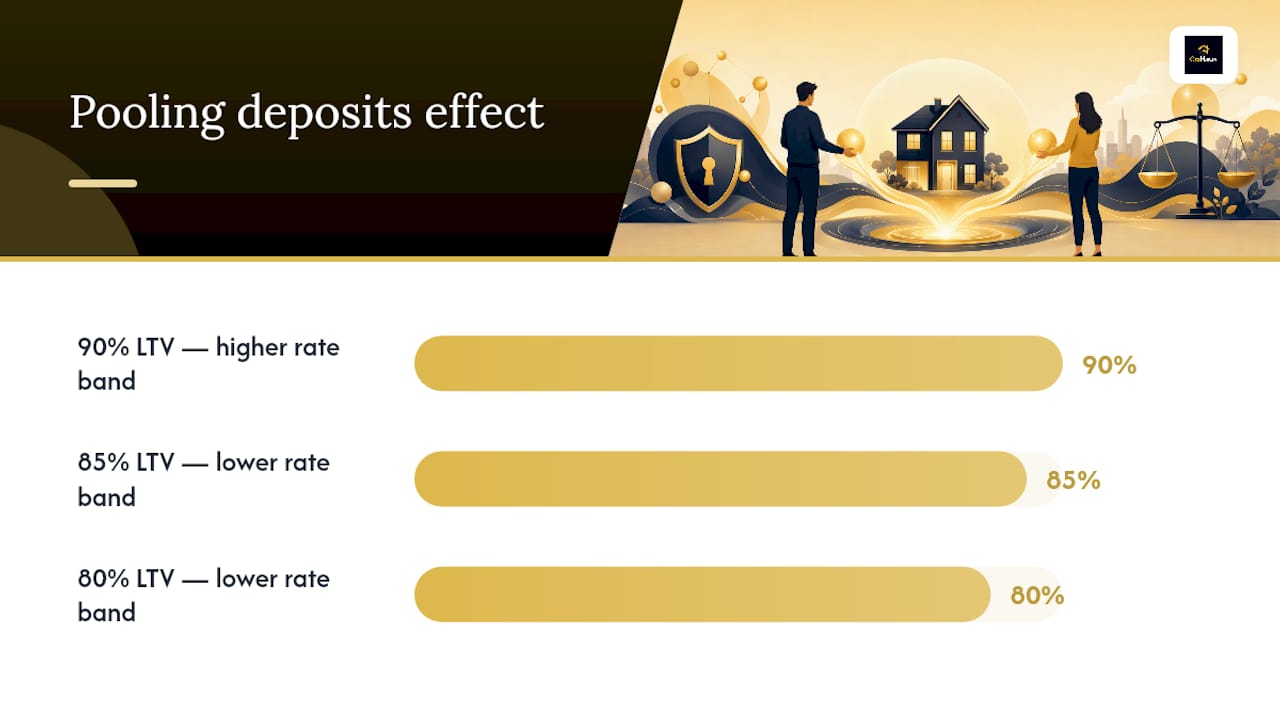
What does change the deal on offer is how much deposit you can pool together. This is where joint buying genuinely helps unmarried couples: combining two deposits often pushes you into a lower loan-to-value band, which typically unlocks meaningfully better rates than either of you could access buying alone. Moving from a 90% to an 85% or 80% loan-to-value mortgage frequently makes a noticeable difference to the rate you're offered.
Fixed-rate deals, usually over two or five years, remain the most common choice for first-time buyers wanting payment certainty while they settle into joint homeownership. Tracker and variable-rate deals suit some buyers better, particularly those expecting rates to fall or planning to remortgage again soon, but they carry more monthly uncertainty, which matters more when you're relying on two incomes with no legal marriage safety net behind you.
Shopping around matters as much for unmarried couples as anyone else. A mortgage broker who understands joint applications between unmarried buyers can flag lenders that are genuinely comfortable assessing non-standard income combinations, rather than defaulting to the most conservative reading of your file.
Do unmarried couples pay different stamp duty or capital gains tax?
Marital status makes no difference to how Stamp Duty Land Tax is calculated on the purchase itself. Both unmarried and married buyers pay the same rates based on purchase price, and both face the same additional 5% surcharge on second homes if either of you already owns property elsewhere in England or Northern Ireland (Scotland and Wales have their own separate land transaction taxes with their own rules).
Where marital status genuinely matters is Capital Gains Tax, and this is where unmarried couples lose a valuable protection married couples get automatically. Married couples and civil partners can transfer assets between themselves without triggering Capital Gains Tax. Unmarried partners cannot. If you own a second property together, or if one of you later transfers part of your share of the main home to the other outside of the usual exemptions, that transfer can be treated as a disposal for CGT purposes, potentially triggering a tax bill neither of you expected.
Private Residence Relief usually shelters your main home from CGT when you sell, provided it genuinely has been your only or main residence throughout ownership. But if you've ever rented the property out for a period, or if one partner moves out before the sale completes, the tax position gets more complicated for unmarried co-owners than for married ones. This is a genuine area where professional tax advice earns its fee, particularly before any transfer of shares or a sale involving a period of let-out use.
Does how long you've lived together affect your mortgage chances?
Lenders don't have a fixed "minimum cohabitation period" written into their criteria, but relationship stability does quietly influence how an application gets read. A couple who's rented together for three years and can show a joint bank account, shared bills, and a consistent address history presents a cleaner picture than two people who've just met and are buying together within months.
This isn't about romance. It's about risk. Underwriters are trying to gauge how likely both borrowers are to remain jointly committed to a 25 or 30-year mortgage. A longer shared history, evidenced through joint tenancy agreements, utility bills in both names, or a shared address on official documents, gives a lender more confidence that the arrangement is stable rather than speculative.
Newer couples aren't locked out. Plenty of first-time buyers who've been together a year or less get approved every day, particularly when both incomes are strong and the deposit is solid. But if your application sits on the margins of affordability, a longer, well-documented cohabitation history can tip a borderline decision in your favour. It's one more reason to start building that paper trail (joint accounts, shared council tax bills, joint contracts) well before you walk into a mortgage appointment.
How do lenders view risk differently for unmarried applicants?
Lenders don't officially price risk differently for unmarried couples, but the practical assessment process does differ in subtle ways. Married couples benefit from a body of family law that automatically governs asset division on divorce, which gives lenders an implicit, well-understood framework for what happens if the relationship ends. Unmarried couples have no equivalent statutory framework, which is precisely why lenders lean more heavily on individual affordability and credit checks for each named borrower rather than treating the application as a single unit.
This shows up most clearly in how lenders handle unequal contributions. If one partner is putting down 80% of the deposit, some lenders will ask direct questions about how ownership will be structured, partly to satisfy their own due diligence and partly because a Declaration of Trust or clear ownership agreement reduces the risk of future disputes that could complicate their security over the property.
The underlying loan itself carries identical joint and several liability whether you're married or not; that part of the risk equation doesn't change. What changes is the paperwork trail lenders and their solicitors increasingly expect to see alongside the mortgage application, particularly on higher loan-to-value deals or where deposit sources are mixed between two unrelated parties.
How can you strengthen a joint mortgage application?
Building a paper trail of financial and personal commitment does more for your application than most couples realise, and none of it requires being married. Start with the boring stuff: a joint bank account you've both used for household bills for at least six months shows a lender you already function as a financial unit.
A few things consistently strengthen an unmarried couple's application:
- Joint bills and a joint bank account with a consistent history, not one opened the week before applying
- Both names on your current tenancy agreement, if you're renting together beforehand
- A written Declaration of Trust already drafted, which some brokers say reassures underwriters that ownership is properly structured
- Clean, well-explained bank statements with no unexplained large deposits or gaps in income
- A clear, honest account of how the deposit was built up, especially if family contributions are involved
None of this guarantees approval, and no broker can promise a specific outcome. But lenders are ultimately assessing whether two people function as a reliable financial unit capable of sustaining a mortgage for decades. Showing that pattern already exists, rather than asking a lender to take it on faith, tends to make underwriting smoother and can occasionally improve the terms on offer.
The CoHaus perspective on co-buying without a safety net
Most of the legal machinery in this guide exists because unmarried couples have no automatic protection if things go wrong. That's not a flaw in the system, it's just the reality of UK property law, and it's why Cohaus was built around structure rather than assumption. Shared deposit management, legal protections for co-buyers, and transparent exit terms exist precisely to remove the guesswork that TOLATA disputes and unclear Declarations of Trust create further down the line.
If you're evaluating any co-buying platform, check three things: how disputes and exits are actually handled in writing, whether legal safeguards exist before you commit money, and how thoroughly potential co-buyers are screened before you're matched. Those three questions separate a genuinely useful structure from a well-marketed one.
— Martin
How Cohaus can help you move from planning to buying
If pooling a deposit with a partner, friend, or family member sounds sensible but the legal side feels like a minefield, a co-buying platform can help close that gap by providing community matching, shared deposit management, and legal protections for co-buyers, so the safeguards this guide has walked through (Declarations of Trust, clear exit terms, ownership shares) aren't something you're drafting from scratch with a solicitor you've never met.

Cohaus also gives you open exit terms from the outset, which matters enormously given how often separation or a change of circumstances forces a buyout or sale. Before you get that far, it's worth working out whether buying makes financial sense for you right now at all; a rent versus buy calculator is a useful first step, and if you're weighing a remortgage to buy a partner out, a joint secured loan is worth understanding too. When you're ready to see how community matching and shared deposits could work for your situation, explore Cohaus and start the conversation.
This article is general information, not a substitute for advice from a qualified lawyer. Consult a qualified legal professional about your own circumstances before acting on anything here.
FAQ
Can an unmarried couple get a mortgage together in the UK?
Yes. Most lenders assess unmarried joint applicants exactly as they would married ones, combining both incomes and treating both borrowers as jointly and severally liable for the full loan.
What's the difference between joint tenants and tenants in common?
Joint tenants own the whole property equally with automatic survivorship on death, while tenants in common hold defined shares that can be left to anyone in a will, which is why most unmarried co-owners choose the latter.
Do we need a Declaration of Trust if we're unmarried?
Yes, particularly if you've contributed unequal amounts to the deposit or mortgage, because without one, courts often assume equal shares regardless of what you actually paid.
What happens to the mortgage if we separate?
Both names remain liable for the full mortgage until the lender formally releases one of you, usually through a buyout, remortgage, or sale; if you can't agree, a TOLATA application to court may be necessary.
Does Cohaus offer joint mortgages directly?
Cohaus is a co-buying platform that provides community matching, shared deposit management, and legal protections rather than a mortgage itself, helping you get organised before you approach a lender or broker.