
A joint mortgage in principle tells two or more people how much a lender would be willing to lend them together, based on a quick affordability assessment. It is not a mortgage offer, and it does not commit either side to anything. What it does is give you a credible borrowing figure before you start viewing properties or making offers.
Three things worth knowing straight away:
- Most lenders run a soft credit check for an Agreement in Principle (AIP), so getting one will not normally affect your credit score.
- A joint AIP is typically valid for a moderate period, after which you may need to renew it.
- Having one ready before you approach estate agents signals that you are a serious buyer with a realistic budget.
Your immediate next step: gather both applicants' income figures, monthly outgoings, and deposit amount, then apply for an AIP online or through a broker before you book a single viewing.
Key takeaways
A joint mortgage in principle is the single most practical step co-buyers can take before viewing properties, because it confirms a real borrowing figure and signals credibility to estate agents.
| Point | Details |
|---|---|
| Soft credit check at AIP stage | Most lenders use a soft check for an AIP, so applying will not normally affect either applicant's credit score. |
| Valid for 60–90 days | Renew your AIP promptly if it expires or if either applicant's financial circumstances change before the full application. |
| Gather documents for both applicants | Each person needs income evidence, three years of address history, ID, and outgoings details before applying. |
| Decide ownership structure early | Choose between joint tenants and tenants in common before the full application; use a declaration of trust if contributions are unequal. |
| Cohaus for co-buyer preparation | Cohaus connects co-buyers with brokers and solicitors and manages shared deposit documentation to support a stronger joint AIP. |
Table of Contents
- What does "Agreement in Principle" actually mean for joint applicants?
- How a joint mortgage in principle works and what lenders check
- What you need to gather before applying as joint applicants
- How to get a joint mortgage in principle: three practical routes
- How long a joint AIP lasts and when to update it
- Common questions from joint applicants: edge cases and unusual situations
- Co-buying, ownership, and how a joint AIP fits the picture
- What an AIP certificate shows and how estate agents use it
- Why getting a joint AIP early gives co-buyers a real advantage
- How Cohaus supports co-buyers preparing a joint AIP
- Sources
What does "Agreement in Principle" actually mean for joint applicants?
UK lenders use several names for the same document: Agreement in Principle (AIP), Decision in Principle (DIP), and Mortgage in Principle (MIP). They all refer to the same thing. The terminology varies by lender, not by product type.
A DIP confirms how much a lender might be willing to lend based on limited information and typically uses a soft credit check. Nationwide is clear that this is not a mortgage offer — it is a conditional indication of borrowing capacity.
The distinction between an AIP and a full mortgage offer matters more than most buyers realise:
- An AIP involves a basic income and credit check. No property valuation. No legal commitment from either party.
- A mortgage offer comes after a full application, a formal credit check, detailed affordability assessment, and a property valuation. It is legally binding on the lender for a set period.
- MoneyHelper confirms that lenders carry out considerably more detailed checks at the full application stage, and an AIP does not guarantee the same outcome.
Lenders issue AIPs for a practical reason: estate agents want evidence that buyers can afford a property before arranging viewings or accepting offers. An AIP speeds up that process without requiring either side to commit to a full application.
How a joint mortgage in principle works and what lenders check
When two or more people apply for a joint AIP, lenders assess the combined picture, not just one person's finances. The borrowing figure they return reflects what both applicants can afford together.
What lenders typically consider for joint applicants:
- Combined income: Most lenders will consider employment income, self-employed profits (usually averaged over two years), and some forms of bonus or commission. Lenders often apply an income multiple (commonly 4–4.5 times combined income) to arrive at a maximum borrowing figure, though this varies.
- Existing debts: Credit card balances, personal loans, car finance, and student loans all reduce the amount lenders are willing to offer. Each applicant's commitments are assessed individually and then considered together.
- Affordability stress testing: Lenders check whether both applicants could still meet repayments if interest rates rose. This is a regulatory requirement, not a lender preference.
- Credit history: Each applicant's credit file is reviewed separately. A poor record on one file can affect the joint application.
Pro Tip: Barclays notes that an AIP can usually be completed online in around 10 minutes and involves a soft credit check. That means you can get a borrowing figure quickly without leaving a mark on either applicant's credit file.
| Check type | When it happens | Credit score impact |
|---|---|---|
| Soft credit check | AIP / DIP stage | None |
| Hard credit check | Full mortgage application | Visible on credit file |
| Property valuation | Full mortgage application | Not applicable |
HSBC's online DIP process also lists eligibility criteria that can affect whether you can complete an application digitally, including UK residency and income paid in GBP. If either applicant does not meet those criteria, a broker or branch route is often more practical.
What you need to gather before applying as joint applicants
Preparation is straightforward, but both applicants need to contribute their own information. Missing details from one person will stall the process.
Income and employment details (each applicant):
- Employed: last three months' payslips and most recent P60
- Self-employed: two years' SA302 tax calculations or accountant's certificate
- Bonus or commission: evidence of at least one year's payments
- Other income: pension statements, rental income records, or benefit letters where applicable
Outgoings and financial commitments (each applicant):
- Monthly loan repayments (personal loans, car finance)
- Credit card limits and current balances
- Childcare costs and number of dependants
- Pension contributions
Shared details for the application:
- Three years of address history for each applicant
- Proof of identity (passport or driving licence)
- Deposit amount and its source (savings, gifted deposit, equity)
- Approximate property purchase price
NatWest's AIP process asks for this level of detail from each applicant. Having it ready before you start means the application takes minutes rather than being abandoned halfway through.
If your deposit includes a gift from a family member, note that lenders will ask for a signed letter confirming it is not a loan. Prepare that early.
How to get a joint mortgage in principle: three practical routes
There is no single correct route. The right one depends on how straightforward your circumstances are and how much support you want.
-
Apply directly online with a lender. Most major lenders, including Barclays, Nationwide, NatWest, and HSBC, offer online AIP tools. This is the fastest route for applicants with straightforward employment and clean credit histories. You enter both applicants' details, the lender runs a soft check, and you receive a decision within minutes. The certificate is usually available to download immediately.
-
Use a mortgage broker. A broker can compare products across multiple lenders and submit an AIP on your behalf. This is particularly useful if one applicant is self-employed, has a complex income structure, or if either person has past credit issues. Brokers also know which lenders are more flexible on affordability criteria for joint applicants. Whole-of-market brokers are not tied to a single lender's products.
-
Visit a branch or speak to a lender's adviser. Some applicants prefer a conversation before committing to an application. Branch advisers can walk through the figures with you and flag any issues before a formal AIP is submitted. This route takes longer but can be reassuring if your situation is unusual.
After receiving a positive AIP, save or download the certificate immediately. Share it with your estate agent when you register your interest in a property or make an offer. If you are buying with friends or multiple co-buyers, confirm with the lender how many applicants they will include on the AIP.
How long a joint AIP lasts and when to update it
Most AIPs are valid for 60–90 days. Nationwide's DIP, for example, is commonly valid for around 90 days. Barclays and NatWest operate in a similar range, though the exact period varies by lender.
What that window means in practice: if you receive an AIP in January and have not exchanged contracts by March or April, you may need to renew. Renewal is usually straightforward if your circumstances have not changed.
An expired or inaccurate AIP can cause delays during the full mortgage process. Nationwide advises applicants to secure an updated AIP if their financial circumstances change, rather than relying on one that no longer reflects their position.
Situations that should prompt an immediate update:
- One applicant changes jobs or becomes self-employed
- Either applicant takes on new debt (car finance, personal loan)
- Your deposit amount changes significantly
- Your target property price moves outside the original AIP range
- A significant gap in employment occurs
If your AIP expires while an offer is pending, contact the lender or broker promptly. Most lenders will refresh the AIP quickly using the same soft check process, provided nothing material has changed. If circumstances have changed, the lender will reassess. It is better to know that before you are in the middle of a purchase than after.
A useful habit: treat the AIP expiry date as a diary entry. Set a reminder two weeks before it lapses so you have time to renew without pressure. You can also check your credit score requirements before renewing to make sure both applicants are in a strong position.
Common questions from joint applicants: edge cases and unusual situations
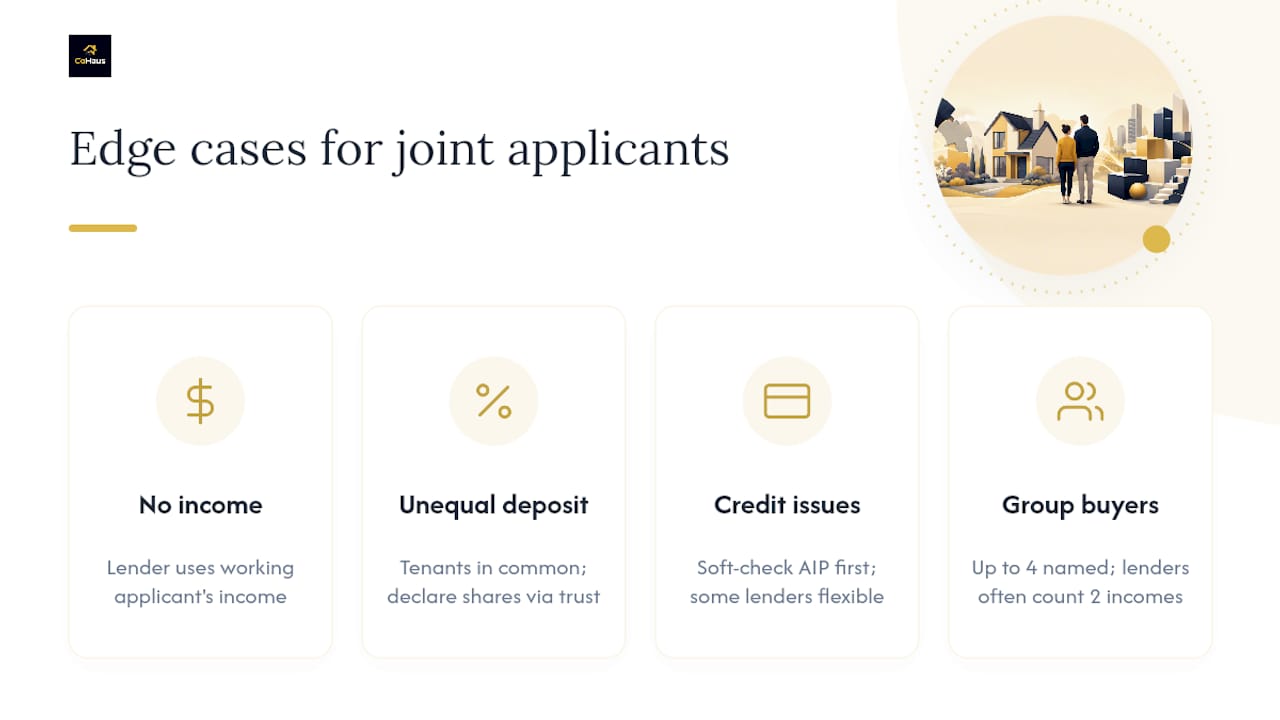
What if one applicant has no income?
Lenders will still assess affordability based on the working applicant's income alone. The non-working applicant is still a party to the mortgage and shares liability for repayments. Some lenders offer a Joint Borrower Sole Proprietor (JBSP) arrangement, where one person supports the mortgage financially without holding legal title to the property. This is worth exploring if one applicant's income is the primary driver of affordability. See the JBSP mortgage guide for a full breakdown.
What if contributions to the deposit are unequal?
This is common and entirely manageable, but it needs to be documented properly. Lenders do not usually require equal deposits, but the legal ownership structure should reflect the actual contributions. Tenants in common allows each person to hold a defined share of the property, rather than the equal split that joint tenancy implies. A declaration of trust, drawn up by a solicitor, records those shares formally. Yorkshire Building Society's joint mortgage guidance recommends this step when contributions differ.
What if one applicant has past credit issues?
A missed payment or a satisfied default does not automatically disqualify a joint application, but it will affect the lender's assessment. Some lenders are more flexible than others. Getting an AIP with a soft check first lets you gauge where you stand without leaving a mark on either credit file. If the result is unfavourable, a broker can identify lenders with more accommodating criteria before you submit a full application.
Pro Tip: Up to four people can be named on a mortgage, but many lenders only use the two highest incomes for affordability calculations. If you are buying as a group of three or more, confirm the lender's income-counting rules before applying.
Co-buying, ownership, and how a joint AIP fits the picture
A joint mortgage makes all named applicants jointly and severally liable for repayments. That means each person is responsible for the full debt, not just their share. If one applicant stops paying, the others must cover it. This is a legal reality that co-buyers need to understand before they apply.
Legal ownership is a separate question from mortgage liability. Two structures apply:
- Joint tenants: both parties own the property equally and in full. If one person dies, their share passes automatically to the other. There is no defined percentage split.
- Tenants in common: each person holds a defined share, which can be unequal. Each share can be left to someone else in a will. This is the more flexible structure for co-buyers with unequal deposits or different financial contributions.
Co-buying does not always mean equal ownership. Some lenders offer arrangements where one co-applicant takes payment responsibility without holding legal title, which can suit situations where one person is supporting another's purchase without wanting a stake in the property.
A declaration of trust is a legal document that records each person's ownership share and what happens if one party wants to sell or exit. Solicitor involvement is not optional here — it is the mechanism that protects everyone.
When you move from an AIP to a full mortgage application, the ownership structure you choose must be reflected in the legal title documents. Decide this before you apply for the full mortgage, not after.
Pro Tip: If you are co-buying with someone who has a different financial stake in the property, speak to a solicitor about a declaration of trust before you exchange contracts. It is far simpler to set up at the start than to unpick later.
What an AIP certificate shows and how estate agents use it
An AIP certificate is a short document, usually one or two pages. It typically shows:
- The names of all applicants
- The conditional borrowing amount the lender is willing to consider
- The date of issue and the expiry date
- A note confirming that a soft credit check was used
- The lender's name and branding
What it does not show is a guaranteed mortgage offer. NatWest is explicit that a full application involves deeper checks, including a formal credit check and property valuation, which may produce a different outcome.
Estate agents treat an AIP as evidence of likely affordability. It tells them you have spoken to a lender, your finances have been assessed at a basic level, and you are not wasting anyone's time. In competitive markets, some agents will not arrange viewings without one.
When presenting your certificate, share it directly with the estate agent when you register your interest or submit an offer. You do not need to show the full document to the seller. A simple confirmation from the agent that they have seen it is usually sufficient. If you have multiple AIPs from different lenders, present the one with the highest borrowing figure, provided it is still valid and your circumstances match what was declared.
Why getting a joint AIP early gives co-buyers a real advantage
The practical value of an AIP is often underestimated. Co-buyers who arrive at a viewing with a certificate in hand are in a meaningfully different position from those who have not yet spoken to a lender. Estate agents notice. Sellers notice.

When two people are buying together, the coordination challenge is real. Gathering income documents, aligning on deposit contributions, and agreeing on a target price all take time. The AIP process forces that conversation early, which is actually useful. It surfaces disagreements about budget before they become problems during an offer.
One concrete example: a couple who have agreed on a £350,000 target but have not checked their combined borrowing capacity might find, mid-negotiation, that one applicant's existing car finance reduces their joint affordability to £310,000. Knowing that before viewing properties changes which properties they look at. The AIP is the tool that produces that clarity.
The speed benefit is equally real. Barclays' online AIP takes around 10 minutes. That is a small investment for the confidence it provides when you are ready to make an offer.
How Cohaus supports co-buyers preparing a joint AIP
Getting a joint mortgage in principle is straightforward when both applicants are well-prepared. The harder part is often the coordination: aligning on deposit contributions, finding a compatible co-buyer, and knowing which solicitor or broker to use.

Cohaus is built specifically for that coordination challenge. The platform helps co-buyers manage shared deposit arrangements, connects members with vetted mortgage brokers and solicitors, and provides legal protections that reflect unequal contributions. Instead of navigating those steps alone, you have a structured process and a community of people working through the same questions.
For co-buyers preparing a joint AIP, Cohaus offers:
- Shared deposit management that documents each person's contribution clearly
- Partner introductions to mortgage brokers who understand co-buying arrangements
- Solicitor referrals for declarations of trust and co-ownership agreements
- Community forums where members share practical experience of the AIP and full application process
The result is a cleaner application, better-prepared paperwork, and more credibility with estate agents from day one. Visit Cohaus to learn more and register your interest.
Sources
These primary sources cover lender-specific procedures, validity periods, and soft check policies. Check each lender's own page before applying, as criteria and processes can change.
- Decision in Principle | Nationwide
- Agreement in Principle | Barclays
- Get a mortgage agreement in principle | NatWest
- Get a decision in principle | HSBC UK
- What happens when I get a mortgage in principle? | MoneyHelper
This article is general information, not a substitute for advice from a qualified financial advisor. Consult a qualified financial professional about your own circumstances before acting on anything here.