If you're buying a UK property with friends or family, the first job is legal, not emotional: choose your ownership type (joint tenants or tenants in common) and sign a declaration of trust before completion. This records who put in what and protects anyone who's contributed unequally. Most groups buying together choose tenants in common, because it lets each person hold a defined share rather than splitting everything equally.
Before you exchange contracts, you should:
- Agree your ownership shares in writing and tell your conveyancer which structure you want.
- Record every contribution, including deposit amounts, so there's no argument later about who paid what.
- Get independent legal advice each, even if you're all friends and it feels unnecessary.
Pro Tip: Whatever you agree verbally, put it in the deed. Verbal promises about "paying back" a bigger deposit share carry no legal weight once the property is registered.
One thing catches people out every time: your mortgage lender doesn't care about your beneficial shares. If you're named on the mortgage, you're jointly and severally liable for the whole debt, not just your percentage.
Key Takeaways
Getting a UK co‑ownership agreement right means choosing tenants in common for unequal shares, recording contributions in a declaration of trust before completion, and understanding that mortgage liability is always joint and several regardless of beneficial ownership splits.
| Point | Details |
|---|---|
| Choose tenancy type early | Tenants in common suits most friend and family groups because it allows unequal, inheritable shares. |
| Sign the deed before completion | A declaration of trust records contributions and exit terms; agree it before, not after, moving in. |
| Mortgage liability is joint and several | Every named borrower is liable for the full debt, whatever their beneficial ownership percentage. |
| Build in exit and valuation terms | Define notice periods and a RICS valuation method to avoid disputes when someone wants to leave. |
| Get independent legal advice | Each buyer should have their own solicitor to avoid conflicts when shares differ. |
| Use Cohaus for templates and referrals | Cohaus provides co‑buying guides, community support, and partner solicitor referrals to simplify the process. |
Table of Contents
- What is a cohabitation agreement for a property purchase in the UK?
- How do joint tenancy and tenancy in common work in England and Wales?
- Why does a declaration of trust matter for co-buyers?
- Mortgage realities: joint and several liability and lender expectations
- The essential contract terms co-buyers must decide
- How CoHaus supports co-buyers with templates and community guidance
- Effect of cohabitation agreements on rights to property not in joint names
- Impact of cohabitation agreements on rights upon relationship breakdown
- Differences in property laws across UK jurisdictions
- Limitations of cohabitation agreements and family law
- How cohabitation agreements differ from marriage or civil partnership agreements
- How do ownership shares affect wills and inheritance?
- Why the standard advice undersells the drafting stage
- Get co-buying templates and solicitor referrals through CoHaus
- Sources
What is a cohabitation agreement for a property purchase in the UK?
In the context of buying a home together, what people usually mean by a "cohabitation agreement" is a co‑ownership agreement, typically formalised through a declaration of trust (sometimes called a deed of trust). This is the document that governs how joint buyers, whether a couple, friends, or family, share the deposit, mortgage payments, and eventual sale proceeds. It sits alongside, but is legally distinct from, the way the property title itself is registered.
Getting this right starts with understanding beneficial ownership, because the choice you make here shapes almost everything else, from what happens if someone dies to how you'll divide proceeds when you eventually sell.
How do joint tenancy and tenancy in common work in England and Wales?
There are two separate layers to ownership. The legal estate is who's named as the registered proprietor at HM Land Registry. This is the public record, and it's usually the same people as the buyers on the mortgage. The beneficial interest is who actually owns what share of the property's value, and this is where joint tenants and tenants in common diverge.
Under a joint tenancy, all owners hold an equal, undivided interest, and the right of survivorship applies: if one owner dies, their share passes automatically to the surviving owner, regardless of what their will says. This suits couples buying together with equal contributions and long‑term commitment in mind.
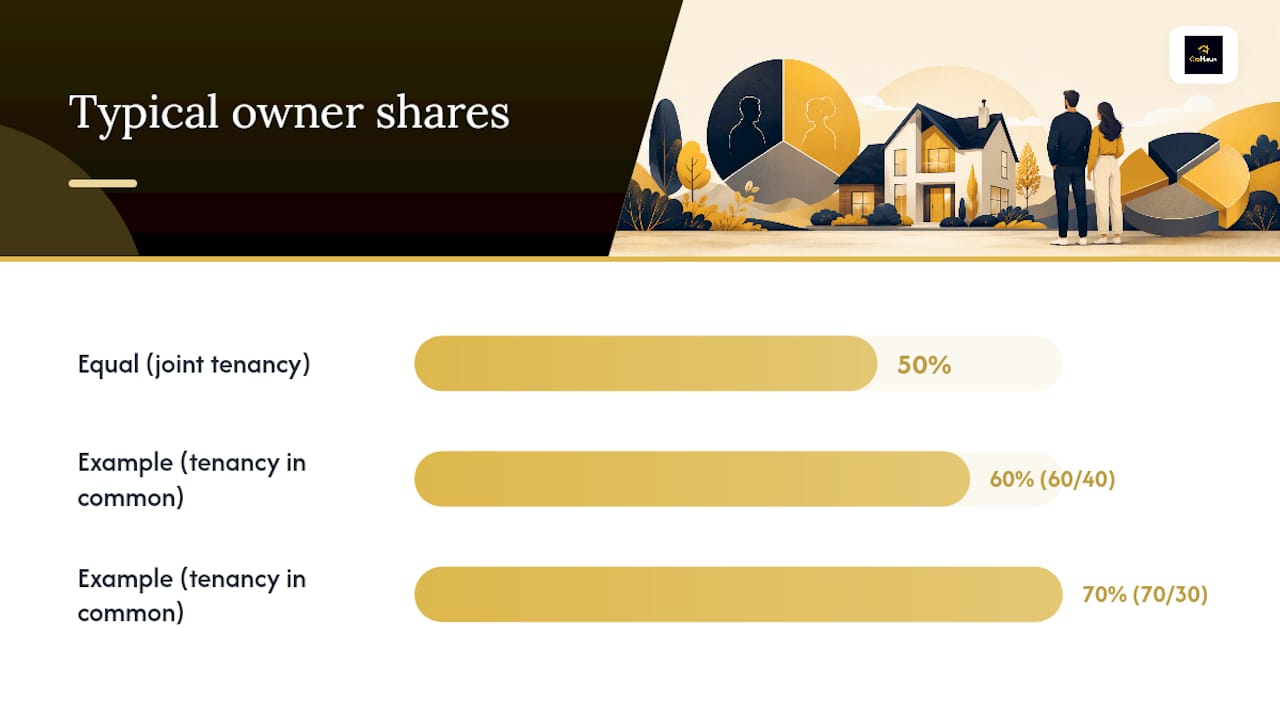
Tenancy in common works differently. Each owner holds a defined share (say, 60/40 or 70/30), which can be left to anyone in a will rather than passing automatically to the co‑owner. This is why tenants in common tends to be the default recommendation for friends, siblings, or unrelated groups pooling deposits unevenly.
Checking or changing your ownership type isn't complicated:
- Your title register at HM Land Registry will show if a Form A restriction is in place, which usually signals a tenancy in common arrangement, though it's not proof on its own.
- The TR1 transfer form, completed at purchase, records your chosen structure formally.
- Owning equally by default falls under joint tenancy unless you state otherwise, so silence has consequences.
- Severing a joint tenancy later, converting it to tenants in common, is possible but requires formal notice and updated registration.
Why does a declaration of trust matter for co-buyers?
A declaration of trust is the document that actually does the heavy lifting. Where the title register tells the world who owns the legal estate, the declaration of trust tells everyone involved, especially you, exactly how the beneficial interest splits and what happens when circumstances change.
Its core job is straightforward: record each person's contribution, trace where the money came from, and set out how sale proceeds get divided. Rocket Lawyer's guidance on declarations of trust lists the clauses that experienced conveyancers expect to see, and it's worth treating this as a minimum checklist rather than a wish list.
At minimum, your deed of trust should cover:
- Initial contributions — exact deposit amounts from each buyer, ideally with bank statement evidence attached or referenced.
- Ongoing payments — who pays what share of the mortgage, utility bills, insurance, and maintenance costs going forward.
- Occupation rights — whether all owners can live in the property, and what happens if one wants to move out while others stay.
- Valuation formula — how you'll value the property at exit (a RICS surveyor valuation is the common standard, avoiding disputes over "market value" guesswork).
- Notice period and buyout mechanics — how much warning an owner must give before forcing a sale or asking to be bought out, and how the remaining owners can raise funds to buy them out.
- Dispute resolution — a mediation step before anyone considers court action.
Timing matters enormously here. Agree the deed before completion, not after you've moved in and life gets busy. Netlawman's shared ownership templates note that registering the declaration at Land Registry is optional, but doing so gives you stronger evidence of beneficial shares if a dispute ever reaches court.
One more thing worth flagging early: if you plan to rent out a room or the whole property later, unequal ownership shares can affect how rental income is taxed between owners. That's a conversation for an accountant, not a DIY spreadsheet.
Mortgage realities: joint and several liability and lender expectations
Here's the part that trips up almost every group of friends buying together: your mortgage liability has nothing to do with your ownership percentage. If three of you take out a joint mortgage and one holds a 20% beneficial share, you're all still on the hook for 100% of the debt if repayments stop.
This is what "joint and several liability" means in practice. The lender can pursue any one borrower, or all of them, for the full outstanding balance. Which? explains this clearly: unequal shares are entirely normal and legal, but they don't reduce anyone's mortgage exposure.
The practical consequences bite hardest around credit and trust:
- If one co‑owner misses payments, it can damage everyone's credit file, not just theirs.
- Lenders generally don't ask to see your declaration of trust before approving a mortgage, so it's on you to keep your conveyancer informed of the arrangement.
- Remortgaging or adding/removing a name later requires lender consent and often a fresh affordability check for everyone remaining.
Sensible mitigation isn't complicated: keep a shared spreadsheet of who's paid what, consider income protection or life insurance to cover a share if someone can't pay, and read up on what actually happens if a co‑owner stops paying the mortgage before you're in that situation, not during it.
The essential contract terms co-buyers must decide
Beyond the legal mechanics, a working co‑ownership agreement needs practical, day‑to‑day terms that stop small disagreements becoming expensive ones. This is where most homemade agreements fall short, they cover the deposit split and stop there.
At minimum, decide and record:
- Occupation rights: can all owners live there, or is one person renting a room to the others? What happens if someone wants to move in a partner?
- Contribution tracking: not just the deposit, but ongoing mortgage payments, council tax, insurance, and repair costs, ideally reconciled monthly or quarterly.
- Exit triggers: what counts as a valid reason to force a sale or buyout (job relocation, relationship breakdown, financial hardship), and how much notice is required.
- Valuation method: a RICS chartered surveyor valuation is the standard most solicitors recommend, rather than an informal estate agent estimate, which can favour whichever party commissions it.
- Death or bankruptcy: what happens to that person's share, and whether remaining owners have first right to buy it.
Consumer guidance on declarations of trust consistently flags notice periods and valuation disputes as the two most common flashpoints when co‑owners fall out. Building in a mediation clause before any court route can save thousands in legal fees if things do go wrong. If your deposits were unequal to begin with, it's worth working through how to split ownership fairly before you finalise the percentages in your deed.
When should you instruct a solicitor or conveyancer?
Bring in a solicitor before exchange, not after. Your conveyancer needs to draft the declaration of trust alongside the TR1 transfer, so the two documents match precisely, mismatches here are a common source of later disputes.
Ask your solicitor:
- What will the declaration of trust and registration cost on top of standard conveyancing fees?
- Does our chosen structure affect Stamp Duty Land Tax, particularly if one buyer already owns property elsewhere?
- Is the deed enforceable as drafted if someone refuses to cooperate with a buyout later?
- Should the declaration be registered at Land Registry, or is a private deed sufficient for our situation?
GOV.UK's guidance on joint property ownership recommends each buyer takes independent legal advice, not a shared solicitor, to avoid any conflict of interest between parties with different financial stakes.
How CoHaus supports co-buyers with templates and community guidance
Working through all of this alone, spreadsheets, solicitor questions, valuation formulas, is exactly the friction Cohaus was built to remove. The community exists because buying with friends or family shouldn't mean improvising the legal side from scratch.
Cohaus gives co‑buyers a starting point rather than a blank page:
- Practical guides on deeds of trust and tenants in common arrangements written for people buying together, not solicitors.
- A community of other co‑buyers working through the same decisions, from unequal deposits to occupation disputes.
- Signposting to partner solicitors and mortgage brokers who already understand co‑buying structures, rather than treating your application as unusual.
Effect of cohabitation agreements on rights to property not in joint names
A declaration of trust only governs the specific property it describes and only binds the people who sign it. If your name isn't on the title register or the mortgage, a co‑ownership agreement about a shared home won't automatically give you rights to property held solely by someone else, a car, savings account, or a second property one buyer owned before you all bought together.
This matters for groups where one person already owns assets separately. Say four friends buy a house together, but one also owns a rental flat from before. Nothing about their joint declaration of trust touches that flat, unless the agreement specifically says otherwise. Equally, if you've contributed to renovations or mortgage payments on a property that's only in someone else's name, without a written agreement recording that contribution, proving you have any beneficial interest at all becomes genuinely difficult.
This is precisely why HM Land Registry's guidance on joint ownership stresses that beneficial interest has to be evidenced, ideally through a signed declaration, rather than assumed from contribution or cohabitation alone. If you're paying into a property that isn't jointly registered, get that contribution documented in writing before you hand over money, not after.
Impact of cohabitation agreements on rights upon relationship breakdown
For co‑buyers who are also a couple, a well‑drafted declaration of trust becomes far more valuable the moment a relationship ends, because it removes the guesswork about who gets what. Unlike married couples, who fall under matrimonial law with courts able to redistribute assets based on fairness and need, unmarried co‑owners are governed almost entirely by property law and whatever they wrote down in advance.
Without a declaration of trust, unequal contributions can be genuinely difficult to prove after a breakup, particularly years later when bank records have been closed or lost. With one, the valuation formula and buyout mechanics you agreed at the outset simply apply, regardless of how amicable or acrimonious the split becomes.
For groups of friends buying together rather than couples, breakdown risk looks different but is no less real: falling out over money, someone wanting to move for a new job, or simply drifting apart. The same buyout and notice clauses that protect couples protect friend groups too, which is exactly why treating the deed as a formality to skip is the most common mistake co‑buyers make.
Differences in property laws across UK jurisdictions
Everything covered so far applies specifically to England and Wales. If you're buying in Scotland or Northern Ireland, the legal framework changes, sometimes significantly.
Scotland doesn't use the joint tenancy and tenancy in common terminology at all. Property is typically held as "common property," with co‑owners holding a share (called a "pro indiviso" share) that doesn't carry an automatic right of survivorship unless a special destination is written into the title deeds. Scottish conveyancing also runs through a different system, missives of sale rather than exchange of contracts, so timings and legal advice needs differ from the England and Wales process described throughout this article.
Northern Ireland follows a system closer to England and Wales, with joint tenancy and tenancy in common both recognised, but registration runs through Land Registry Northern Ireland rather than HM Land Registry, and some procedural details around deeds differ.
If you're buying anywhere outside England and Wales, treat this article as background context only, and instruct a solicitor qualified in that specific jurisdiction. The core principle, recording your shares in writing before completion, holds everywhere, but the mechanics of how you do it don't transfer directly across borders.
Limitations of cohabitation agreements and family law
A declaration of trust is a contract, and contracts have limits that family law simply doesn't. Courts can, in narrow circumstances, look beyond a written agreement if there's evidence of fraud, undue influence, or a fundamental change in circumstances the deed never anticipated. But outside those exceptions, a properly drafted and witnessed deed is generally upheld as written.
The bigger limitation is scope. A co‑ownership agreement covers the property and the money tied to it. It doesn't address child arrangements, financial support between unmarried partners, or pension sharing, all matters that fall under separate areas of family law entirely, and which unmarried couples in England and Wales have far fewer automatic rights around than married couples do.
This is also where unmarried cohabiting couples differ sharply from married ones in a way that catches people off guard: there's no such thing as a "common law spouse" in English law, regardless of how long you've lived together. Whatever isn't written into your declaration of trust or a separate agreement generally doesn't exist legally, which is exactly why the drafting checklist earlier in this article matters as much for couples as it does for groups of friends.
How cohabitation agreements differ from marriage or civil partnership agreements
Marriage and civil partnership come with a built‑in legal framework for dividing assets if things end: courts have wide discretion to redistribute property, pensions, and income based on fairness, need, and contributions, financial or otherwise, made throughout the relationship. A co‑ownership agreement between unmarried buyers has none of that safety net.
Instead, a declaration of trust is a private contract that only covers what it explicitly states. There's no court discretion to top up someone's share because they gave up a career to raise children, or because one partner earned significantly less throughout the relationship, considerations that matrimonial courts routinely weigh. What you write in the deed is, in practical terms, what you get.
This makes precision in drafting far more important for unmarried co‑buyers than it is for married couples, who have statutory protections as a backstop. If your circumstances change substantially, a new job, children, one partner leaving work, it's worth revisiting and updating your declaration of trust rather than assuming the law will fill the gaps. It won't.
How do ownership shares affect wills and inheritance?
Your choice between joint tenancy and tenancy in common has direct, sometimes irreversible, consequences for what happens to your share of the property when you die.
Under joint tenancy, the right of survivorship overrides your will entirely. If you leave your share of the house to a sibling or a charity in your will, but you own the property as joint tenants with your co‑buyer, that instruction is void, the property passes automatically to the surviving joint owner regardless of what your will says.
Tenancy in common works differently, and it's the main reason most co‑buying groups choose it. Your defined share becomes part of your estate and passes according to your will, or under intestacy rules if you don't have one. This matters enormously for friend groups and family members buying together, where you'd generally want your share going to your own family or chosen beneficiaries, not automatically to your co‑buyers.
GOV.UK's guidance is explicit that this choice needs revisiting if your circumstances change, new relationship, children, a falling out with a co‑owner. Severing a joint tenancy to convert it to tenants in common is possible at any point, but it requires formal written notice and updated Land Registry records, so it's not something to leave until it's urgent.
Why the standard advice undersells the drafting stage
Most guidance on buying property together treats the declaration of trust as a box‑ticking exercise, something your solicitor handles while you focus on surveys and mortgage offers. That's backwards. The deed is the document that actually determines what happens in every scenario that matters: someone loses their job, a relationship ends, one buyer wants out early, someone dies.
What gets underestimated is how much the buyout mechanics and valuation formula matter compared with the headline ownership split. Groups spend hours agreeing a 65/35 share and then leave the exit clause as a vague sentence about "fair market value," which is precisely the phrase most likely to end up disputed. A RICS valuation clause and a defined notice period cost nothing extra to include and prevent almost every argument that follows a co‑buying breakup.
The other gap in conventional advice is treating this as a couples' issue. Friends and family groups pooling deposits face identical risks, arguably higher ones, since there's no matrimonial law backstop if things go wrong. If you take one thing from this article, make it this: draft the exit terms with as much care as the purchase itself, because that's the clause you'll actually need one day.
— Martin
Get co-buying templates and solicitor referrals through CoHaus
Cohaus gives you a shortcut past the trial and error most co‑buyers go through alone, ready‑made declaration of trust guidance, a community of people navigating the same deposit and ownership questions, and referrals to solicitors who already understand co‑buying structures rather than treating your application as unusual.

Rather than piecing together generic templates and hoping they fit your situation, you get resources built specifically around pooled deposits, unequal contributions, and multi‑person mortgages, the exact scenarios standard solicitor packs often gloss over. Visit Cohaus to explore the community, browse the co‑buying guides, and get matched with partner solicitors who can turn your agreed shares into a properly drafted declaration of trust before you exchange.
Sources
- What kind of joint ownership do I have? - HM Land Registry blog
- Tenants in common vs joint tenancy - Which? (and mortgage implications)
- Declaration of Trust | Template & FAQs - Rocket Lawyer UK