
No, an unequal deposit is not protected automatically under UK law. If you put in £40,000 and your partner puts in £10,000, the law does not remember that split unless you write it down. To protect unequal mortgage contributions, hold the property as tenants in common and sign a Declaration of Trust before completion, then tell your lender what you have agreed.
Before you exchange contracts, work through this list:
- Agree the model for dividing proceeds (fixed shares or return of deposit first)
- Draft the Declaration of Trust with a solicitor
- Register a Form A restriction at HM Land Registry
- Update your wills to reflect the new ownership shares
A registered Declaration of Trust is only effective once the property is held as tenants in common and the restriction is filed at HM Land Registry.
Key Takeaways
Protecting unequal mortgage contributions requires tenants in common ownership, a registered Declaration of Trust, and a Form A restriction filed before completion.
| Point | Details |
|---|---|
| Choose tenants in common | This is the only ownership type that lets you record unequal shares rather than defaulting to a 50/50 split. |
| Draft and register the trust deed | A Declaration of Trust plus a Form A restriction at HM Land Registry makes your share enforceable on sale or remortgage. |
| Mortgage liability stays joint | Lenders can pursue either co-borrower for the full balance regardless of the ownership percentages agreed privately. |
| Document everything as you go | Bank statements, gifted deposit letters, and written agreements matter far more than verbal promises if a dispute arises. |
| Consider a supported route | Cohaus offers deposit pooling, legal templates, and open exit terms for co-buyers who want this process managed from the outset. |
This article is general information, not a substitute for advice from a qualified lawyer. Consult a qualified legal professional about your own circumstances before acting on anything here.
Table of Contents
- Joint tenants vs tenants in common: which protects unequal deposits?
- What a Declaration of Trust actually protects
- Cohabitation agreement or Declaration of Trust: do you need both?
- Does an unequal deposit change who owes the lender?
- Checklist before exchange: protecting your unequal contribution
- What happens if you separate, sell, or your co-owner stops paying?
- When should you call a solicitor, and what will it cost?
- How Cohaus supports co-buyers with unequal deposits
- Sources
Joint tenants vs tenants in common: which protects unequal deposits?
Joint tenants own the whole property equally, no matter what each person paid in. If one owner dies, the other automatically inherits the entire property, known as the right of survivorship, and a will cannot override that. It is the wrong structure the moment contributions differ.
Tenants in common is different. Each person holds a defined, separate share, which can reflect exactly what they put in, and that share passes under their will rather than automatically to the co owner.
This is why tenants in common is almost always the correct choice for unequal mortgage shares:
- Your share is fixed on paper, not assumed to be 50/50
- You can leave your share to whoever you choose, including children from a previous relationship
- Disputes over who paid what become far less likely, because the answer is already written down
Getting this structural choice wrong at the Land Registry stage is the single most common source of unequal contribution disputes later.
What a Declaration of Trust actually protects
A Declaration of Trust (sometimes called a deed of trust) is the document that turns your unequal deposit into an enforceable legal share. It records each party's financial interest in the property and sets out exactly how sale proceeds will be divided. Without it, a co owner who paid more has to prove their case from bank statements and memory, which is a weak position in any dispute.
Three models are common in practice:
- Fixed percentage – shares are set once, in proportion to deposit paid, and stay fixed regardless of who overpays the mortgage later
- Return of deposit first – whoever put in the larger deposit gets that amount back off the top on sale, with the remaining equity split according to an agreed ratio
- Floating or formula based – shares adjust over time to reflect ongoing unequal contributions, recalculated against an agreed formula
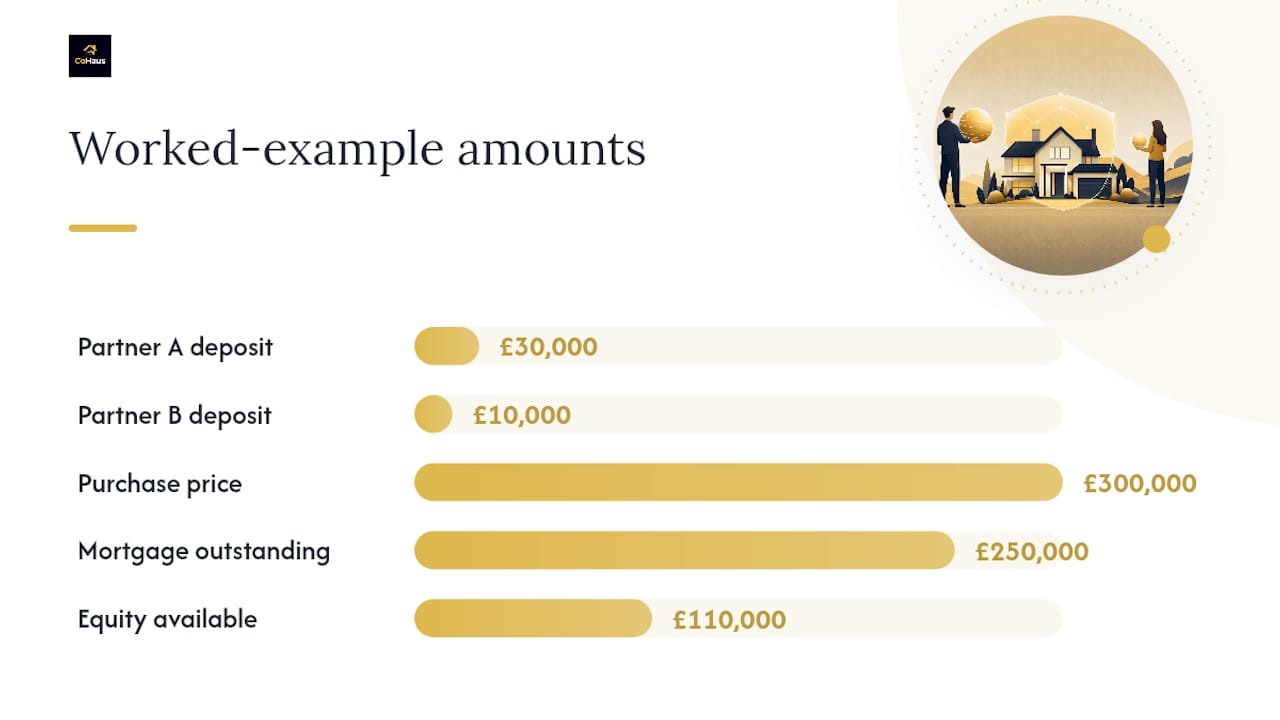
A worked example: say a property is bought for £300,000. Partner A contributes a £30,000 deposit, Partner B contributes £10,000, and the mortgage covers the rest. Under a return of deposit model, if the property later sells for £360,000 with £250,000 of mortgage outstanding, £110,000 of equity is available.
Pro Tip: Ask your solicitor to register the Form A restriction the same week you register the trust deed. Deeds signed but never registered are a leading cause of disputes at remortgage or sale.
Cohabitation agreement or Declaration of Trust: do you need both?
A Declaration of Trust deals with one thing: the property, ownership shares, and how proceeds get divided on sale. A cohabitation agreement is broader. It can cover mortgage payments, household bills, maintenance costs, and what happens to furniture or savings if the relationship ends.
Most unmarried couples with unequal deposits benefit from having both:
- The Declaration of Trust locks down who owns what percentage of the property
- The cohabitation agreement handles the day to day money, like who pays the council tax or covers a boiler repair
- Together, they close the gap between "who owns the house" and "who pays for the house," which is where most informal arrangements fall apart
If you only draft one document, make it the Declaration of Trust. The financial stakes on the property itself are almost always larger than the household running costs.
Does an unequal deposit change who owes the lender?

No. Your mortgage lender does not care how you split ownership between yourselves. Every named borrower is jointly and severally liable, meaning the lender can pursue any one of you for the full mortgage balance if the other stops paying, regardless of a 70/30 beneficial split recorded in your trust deed.
A few practical consequences follow from this:
- If your deposit came partly as a gift from parents, the lender will usually want a gifted deposit letter confirming it is not a loan that needs repaying
- Being the smaller contributor does not reduce your exposure to the full mortgage debt if your partner defaults
- Ownership percentage and mortgage liability are legally separate questions, and conflating them is a common mistake
Pro Tip: Tell your mortgage broker about the unequal deposit and the planned trust deed before you apply. Some lenders ask questions during underwriting that are easier to answer upfront than after an offer is issued.
Checklist before exchange: protecting your unequal contribution
Work through these steps before you exchange, not after:
- Agree the split model (fixed percentage, return of deposit, or floating formula) and instruct a solicitor to draft the Declaration of Trust
- Register the Form A restriction at HM Land Registry so the trust binds any future sale or remortgage
- Decide, in writing, how future overpayments, renovations, or one partner covering a larger share of monthly payments will affect the recorded shares
- Set a review point, perhaps every two years or after a major life change, to recalculate shares if contributions have shifted
- Update your will to match the new ownership share, and consider life insurance to cover your share of the mortgage
- Collect gifted deposit letters from any family members who contributed, ready for the lender and the solicitor
Pro Tip: Build a simple spreadsheet from day one logging every payment either of you makes towards the mortgage, deposit, or major repairs. It becomes the evidence base if shares ever need recalculating.
What happens if you separate, sell, or your co-owner stops paying?
On sale, proceeds are split exactly as the Declaration of Trust says, whether that is return of deposit first or a fixed percentage. One partner can also buy the other out at that agreed valuation without a full sale, provided the mortgage lender approves the refinancing.
If a co owner stops paying, act quickly:
- Send a written notice setting out the missed payments and proposed remedy
- Try mediation before anything formal, since court applications are slow and costly
- Consider a buy-out or a forced sale application if the arrears continue, because unpaid mortgage payments put both parties' credit files at risk
Without a written agreement, courts weigh bank statements, correspondence, and conduct over verbal promises. Deeds prevent exactly this kind of costly dispute.
When should you call a solicitor, and what will it cost?
A Declaration of Trust typically takes a few weeks to draft and register, and should run alongside your conveyancing rather than after it. Costs vary by firm and complexity, so ask for a fixed quote before instructing anyone.
Bring these to your first meeting:
- Bank statements showing deposit contributions
- Any gifted deposit letters
- Draft heads of terms or notes from earlier conversations with your co buyer
- Details of the mortgage offer and lender
If your co buyer disputes the split at this stage, that is an early red flag worth resolving before you exchange.
How Cohaus supports co-buyers with unequal deposits
Cohaus was built around exactly this problem: people who want to buy together but start from different financial positions. The platform helps you find compatible co-buyers, pool deposits transparently, and access legal templates covering ownership splits and exit terms, so the paperwork side of unequal contributions is not something you are drafting from scratch.
- Community matching connects you with co-buyers whose goals and finances align with yours
- Shared deposit management keeps contributions visible to everyone involved
- Legal protection templates and open exit terms reduce the risk of the disputes covered above
For related situations, see our guides on splitting mortgage payments safely and what to do if a co-owner stops paying.
A perspective on fairness and legal practicality
Most disputes we hear about did not start as legal problems. They started as an awkward conversation nobody wanted to have before completion, so it never happened. The couples and friends who avoid trouble later are the ones who treat the Declaration of Trust as a normal, unremarkable part of buying together, not a sign of mistrust.
The mistake I see most often is treating a verbal "we'll sort it out fairly" as if it were a legal document. It never holds up when someone's circumstances change. Use the templates and community guidance on Cohaus early, while the conversation is still easy to have.
— Martin
Getting started with Cohaus
Cohaus is built for exactly the situation this article describes: buyers with unequal deposits who want the ownership split protected properly from the start, without hiring a full legal team to design the process from scratch. Where a solo route to a Declaration of Trust means finding your own solicitor and negotiating a split with no template to work from, Cohaus gives you shared deposit tracking, ready legal protection templates, and clear exit terms built specifically for co-buyers.
If you are exploring buying with a partner, friend, or family member and want the ownership side handled properly from day one, visit the Cohaus co-buying platform to see how community matching and shared deposit tools work, or read the guide to splitting ownership fairly with unequal deposits for a closer look at the models in practice.
Sources
- Tenants in common vs joint tenants
- Declaration of Trust for unequal deposits
- Declaration of Trust vs Cohabitation Agreement
- Financial issues for co‑owning cohabitants after separation (Shelter)
- Cohabitation agreement or declaration of trust