
Co-ownership laws in the UK split every jointly-owned home into two layers: the legal estate registered at HM Land Registry, and the beneficial interest that decides who actually gets the money. Whether you hold that beneficial interest as joint tenants or tenants in common determines what happens on death, on sale, and on breakup. Get this wrong at the outset, and the fix usually means a solicitor, a form, or a court.
TL;DR:
- Most co-ownership disputes stem from a lack of a written declaration of trust that clearly states beneficial shares and exit plans before buying the property.
- Choosing between joint tenancy and tenants in common affects how inheritance, sale proceeds, and beneficial interests are handled, especially in uneven contribution scenarios.
- Severance of joint tenancy is straightforward and can be done unilaterally by serving notice, but legal and lender approval may be required for formal changes.
- Co-owners face joint and several liability for mortgage payments, meaning each person can be pursued for the full debt regardless of their actual beneficial share.
- Proper documentation, including a trust deed and evidence of contributions, is crucial to prevent costly legal battles and ensure clear rights and responsibilities.
Table of Contents
- What is the difference between legal estate and beneficial interest?
- Joint tenants v tenants in common: which applies to you?
- How do you sever a joint tenancy or change ownership type?
- How does TOLATA resolve co-ownership disputes?
- Practical checklist for co-buyers and co-owners
- How does co-ownership affect mortgage responsibilities?
- What are the tax implications of co-ownership?
- What are co-owners' rights and duties over the property?
- Can a co-owner force a sale or partition of the property?
- Practitioner perspective: common mistakes and realistic expectations
- How CoHaus supports co-buyers through this process
- Primary legislation and official guidance to consult
- Sources
- FAQ
What is the difference between legal estate and beneficial interest?
HM Land Registry's title register shows who owns a property in law. It does not show who owns the money behind it, and that distinction trips up more co-buyers than any other part of co-ownership law.
The people named on the register are the registered proprietors. Under the Law of Property Act 1925, no more than four people can hold the legal estate, and they always hold it as joint tenants, regardless of what was actually agreed between them financially. This is a structural rule, not a choice; even if three siblings put in wildly different deposits, the register only ever lists them as joint legal owners.
The beneficial interest is the separate, unregistered layer that determines who is entitled to the sale proceeds, rental income, or equity. This is where unequal contributions, informal agreements, and family loans actually live. A parent who lent £40,000 towards a deposit but isn't on the mortgage might still hold a beneficial interest, provable through bank transfers, texts, or a signed agreement.
The practical consequences show up at the worst possible moments:
- On sale, the registered proprietors sign the transfer, but the beneficial owners are entitled to the proceeds, which can differ from a simple 50/50 split.
- On death, what happens to the beneficial share depends entirely on whether the co-owners were joint tenants or tenants in common, not on what the will says.
- On mortgage default, lenders pursue the legal owners, but the fallout on equity depends on beneficial shares.
Pro Tip: The title register is a starting point, not proof of who owns what financially. If your name isn't on the register but you've paid into a property, keep a paper trail of every transfer and text discussing intentions from day one.
Joint tenants v tenants in common: which applies to you?
The two forms of beneficial ownership work in almost opposite ways, and choosing the wrong one by default is one of the most common and expensive co-buying mistakes in England and Wales.
Joint tenancy means all owners hold an equal, undivided interest in the whole property. No one owns a specific percentage; each owner has the entirety, together with the others. The defining feature is the right of survivorship: when one joint tenant dies, their share passes automatically to the surviving owner or owners, regardless of what their will says. A will simply cannot override this. Joint tenancy suits couples with roughly equal contributions who want the survivor to automatically inherit the whole property.
Tenants in common means each owner holds a defined, separate share, whether that's 50/50, 70/30, or any other split reflecting actual contributions. There's no survivorship. Each person's share forms part of their estate and passes according to their will, or under intestacy rules if they haven't made one. This structure suits:
- Friends or unrelated buyers pooling deposits unequally.
- Couples where one partner contributed a larger deposit or inheritance.
- Anyone with children from a previous relationship who wants their share to pass to them, not automatically to a co-owner.
HM Land Registry's guidance confirms this choice must be made explicit; without a declaration otherwise, co-buyers registering together are generally treated as joint tenants in equity by default. If you're pooling money unevenly with friends, read up on the difference between tenants in common and joint tenancy before you complete, not after.
How do you sever a joint tenancy or change ownership type?
Converting from joint tenants to tenants in common, known as severance, is more straightforward than most buyers expect, and it can be done unilaterally.
- Serve a notice of severance. One joint tenant can sever the tenancy by giving written notice to the other owner or owners. This ends the right of survivorship from that point forward and converts the beneficial interest into defined shares.
- Register the change at HM Land Registry. Owners typically apply to register a Form A restriction using form SEV or RX1, which flags on the title that the property is held on trust and that a sole surviving owner cannot sell without a second signature or court order. This is the standard mechanism for protecting an agreed beneficial share.
- Transfer legal title where ownership itself changes, using a TR1 transfer form, if someone is being added to or removed from the legal estate rather than just the beneficial split.
HM Land Registry charges a modest fee for registering a restriction, though solicitor's fees for drafting notices and applications can add to the cost. Straightforward severance can complete within a few weeks; complications arise where one party disputes the change or refuses to cooperate.
Get legal advice before severing if there's any disagreement about shares, or if the property is mortgaged, since lenders sometimes need to be notified.
How does TOLATA resolve co-ownership disputes?
When co-owners can't agree, the Trusts of Land and Appointment of Trustees Act 1996 is the statute that governs almost every dispute over a jointly owned home in England and Wales.
A TOLATA claim allows the court to determine the size of each party's beneficial share, order a sale, postpone a sale, resolve who can occupy the property in the meantime, or replace trustees who won't cooperate. Courts weigh several factors when deciding these applications, including:
- The original purpose the property was bought for.
- The parties' intentions, whether written or inferred from conduct.
- The welfare of any children living in the property.
- The interests of secured creditors, such as a mortgage lender.
None of these factors is decisive alone; judges weigh them together, which is precisely why outcomes can be hard to predict without a written declaration of trust to anchor the decision.
TOLATA litigation is expensive and slow. Legal costs can be very high for a contested trial, and cases commonly take a lengthy time to resolve. Solicitors and mediators routinely steer clients towards negotiation first, because the financial and emotional cost of a full hearing rarely matches what's actually at stake.
Pro Tip: If you're heading towards a dispute, ask for mediation before instructing a solicitor to issue proceedings. A mediated agreement can be turned into a binding consent order at a fraction of the cost of a contested TOLATA hearing.
Practical checklist for co-buyers and co-owners
Most co-ownership disputes trace back to one missing document: a declaration of trust signed before completion. Practitioners are consistent on this point. Trying to prove an implied trust in court later is unpredictable and expensive compared with simply writing it down at the start.
Before you buy, work through this sequence:
- Agree beneficial shares in writing before exchange, reflecting actual and expected contributions, not assumptions.
- Instruct a solicitor to draft a declaration or deed of trust covering shares, what happens if one party wants to sell, and how disagreements get resolved.
- Keep evidence of every payment into the deposit or mortgage, including bank transfers, solicitor invoices, and deposit receipts.
- Check whether a joint mortgage changes anyone's liability, particularly if contributions to the deposit were unequal but the mortgage debt is shared equally.
After completion, three tasks protect you going forward:
- Register a Form A restriction if you're tenants in common, so the title reflects the trust arrangement.
- Write or update your will to match your beneficial share, since a will has no effect on a joint tenancy but is essential for tenants in common.
- Store the deed of trust and payment records somewhere both owners can access, and revisit the agreement if contributions change materially.
Pro Tip: Build a simple dispute resolution clause into the deed of trust, such as a requirement to try mediation before either party can force a sale. It costs little to add and can save months of stress later. A written cohabitation agreement covering the property alongside the deed of trust closes most of the remaining gaps.
How does co-ownership affect mortgage responsibilities?
A joint mortgage makes every named borrower liable for the full debt, not just their proportional share, and this is one of the most misunderstood parts of co-ownership.
If one co-owner stops paying, the lender can pursue any or all of the other borrowers for the full outstanding balance. This is called joint and several liability, and it applies regardless of how the beneficial interest is split. A tenant in common holding only 20% of the equity can still be chased for 100% of a missed payment if their co-owner defaults.

This mismatch between mortgage liability and beneficial ownership is exactly why a deed of trust matters so much. It can record that contributions to monthly payments should be reflected in adjustments to beneficial shares over time, protecting the person paying more than their nominal share from being short-changed on sale.
Lenders generally need to consent to, or at least be notified of, any change to beneficial ownership, particularly severance of a joint tenancy, since it can affect their security. Anyone considering a joint mortgage with friends rather than a partner should treat this liability point as a deal breaker worth discussing openly before applying, not after the offer arrives.
What are the tax implications of co-ownership?
Capital gains tax and inheritance tax both follow beneficial ownership, not the names on the mortgage, which makes the deed of trust doubly important at tax time.
For capital gains tax, each co-owner is taxed on their own share of any gain when a jointly owned property that isn't their main residence is sold. Tenants in common with unequal shares are taxed unequally, in proportion to what they actually hold, so a documented 70/30 split can meaningfully change each owner's tax bill compared with an assumed 50/50 default.
For inheritance tax, the treatment depends heavily on whether you're joint tenants or tenants in common. A joint tenant's share passes automatically to the surviving owner by survivorship, outside the will, though it can still form part of the deceased's estate for inheritance tax purposes. A tenant in common's share passes under their will or under intestacy rules, and how it's taxed depends on who inherits it, spouses and civil partners generally benefit from exemptions that don't apply to unmarried co-owners or friends.
This is where unmarried co-buyers face the sharpest tax exposure. Two friends holding a property as tenants in common get none of the inheritance tax reliefs available to spouses, so the surviving owner could face a tax bill on inheriting their co-buyer's share. Speaking to an accountant or solicitor before completion, not after a bereavement, is the only sensible way to plan around this.
What are co-owners' rights and duties over the property?
Every co-owner, regardless of their beneficial share, generally has an equal right to occupy and use the whole property, not just a portion proportional to their stake.
This surprises a lot of readers. A tenant in common with a 20% share doesn't get 20% of the house; they get the same right to live in and use the whole property as an owner with 80%. Trustees of land, which is what co-owners technically become under TOLATA, hold the legal title on trust for the beneficial owners and have a duty to consult them on decisions about the property where practicable.
Responsibility for maintenance and running costs is a matter of agreement, not automatic law, which is another reason a written arrangement matters. Without one, disputes over who pays for a new boiler or a leaking roof default to informal negotiation, or eventually a TOLATA application if talks break down.
Sensible co-owners typically agree in writing:
- How day-to-day costs like utilities, insurance, and repairs will be split.
- Whether contributions towards major works should adjust beneficial shares.
- What happens if one owner wants to rent out their share of use, such as taking in a lodger.
None of this needs to be complicated, but it does need to be written down before a disagreement, not during one.
Can a co-owner force a sale or partition of the property?
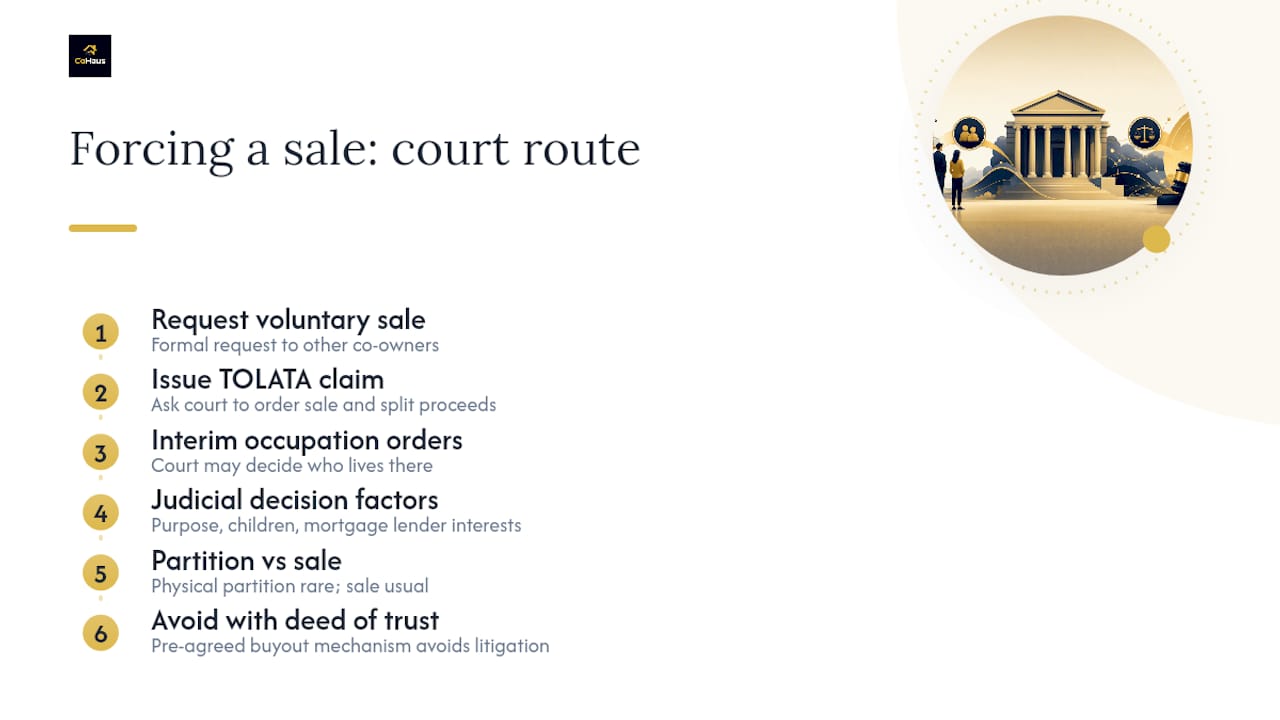
Yes. Under TOLATA, any trustee or beneficiary, including a co-owner who wants out, can apply to the court for an order forcing a sale, and courts grant these applications reasonably often where no agreement can be reached.
The process usually starts with a formal request to the other owner or owners to agree a voluntary sale. If that fails, the applicant issues a TOLATA claim asking the court to order sale of the property and division of the proceeds according to beneficial shares. The court can also make interim orders about occupation while the case is pending, deciding who lives in the property and whether the departing owner should be compensated for being excluded.
Judges don't grant sale orders automatically. They weigh the same factors used in other TOLATA disputes: the purpose the property was bought for, whether children live there, and the interests of any mortgage lender. A family home bought to house young children may be harder to force into sale than an investment property bought purely for capital growth.
Partition, physically dividing a property into separate legal units, is rare in practice for a single house or flat and tends to apply more to land than residential property. For most co-owners, "partition" in practical terms means sale and division of proceeds rather than splitting the building itself.
Because contested sale applications are costly and slow, a deed of trust that sets out an agreed exit mechanism, such as a right for one party to buy the other out at market value within a set timeframe, avoids most of this entirely.
Practitioner perspective: common mistakes and realistic expectations
The mistake I see repeated most often isn't picking the wrong ownership type. It's not picking one at all, and drifting into a default joint tenancy on the assumption that "we'll sort it out later" is good enough. Cohabitants in particular tend to overestimate what informal arrangements actually protect them; beneficial ownership is usually proved through documented financial contributions, not the length of time someone has lived somewhere.
Early documentation is cheap. A TOLATA hearing is not. The gap between those two costs is the entire argument for a declaration of trust signed before completion, not after a relationship or friendship starts to fray.
Three habits separate the co-owners who avoid disputes from those who end up in court: write the agreement down before you exchange, keep evidence of every contribution as you make it, and revisit the deed if circumstances change materially. Skipping any of the three is how a manageable disagreement becomes a manageable disagreement that costs five figures to resolve.
— Martin
How CoHaus supports co-buyers through this process
Getting the legal structure right is only half the job. Finding someone to co-buy with, agreeing shares fairly, and managing a shared deposit are the practical hurdles that come before any solicitor gets involved, and Cohaus was built around exactly that gap. This is a community-oriented platform for people seeking to buy a home collaboratively, focusing on matching co-buyers, shared deposit management, and supporting legal arrangements to help reduce the financial burden of home ownership.

It does not replace a solicitor or a deed of trust; rather, it helps users find compatible co-buyers and provides guidance on agreeing fair splits of deposits and mortgage responsibilities, supported by practical checklists and transparent exit terms. If pooling resources with others feels like the realistic route into ownership, explore the Cohaus co-buying platform to see how community matching and shared deposit guidance could work for you.
Primary legislation and official guidance to consult
- Gov
- Trusts of Land and Appointment of Trustees Act 1996
- Gov
- Law of Property Act 1925 — undivided shares and joint ownership
This article is general information, not a substitute for advice from a qualified lawyer. Consult a qualified legal professional about your own circumstances before acting on anything here.
Sources
- Gov
- Trusts of Land and Appointment of Trustees Act 1996
- Gov
- Law of Property Act 1925 — undivided shares and joint ownership
FAQ
What happens if a house is jointly owned and one person dies?
If the owners were joint tenants, the survivor automatically inherits the whole property by survivorship, regardless of any will. If they were tenants in common, the deceased's share passes under their will, or under intestacy rules if there is no will.
What is the downside of co-ownership?
The main risks are joint and several liability on any mortgage, meaning each borrower can be chased for the full debt, and the cost and uncertainty of resolving disputes through TOLATA if there's no written declaration of trust setting out shares and an exit plan.
What legal rights do I have to jointly owned property?
Your rights depend on whether you're a joint tenant or a tenant in common and on any declaration of trust you've signed; every co-owner generally has an equal right to occupy the whole property, but financial entitlement on sale follows the beneficial shares, not just who's named on the mortgage.
Am I entitled to half of my partner's house?
Not automatically. If you're not named on the title and have no declaration of trust, you'd need to prove a beneficial interest through evidence of financial contributions, which is exactly why documenting shares in writing before or during a purchase matters so much for unmarried couples.