
Co-buying delivers real financial and practical benefits for most people who go into it prepared: pooled deposits and combined incomes improve affordability, shared running costs ease monthly pressure, and joint ownership can unlock better homes sooner than buying alone. The caveat is real too. Joint liability, credit exposure, and unclear legal terms cause the disputes that erode those benefits. Bodies like The Law Society and Which? agree: the benefits hold up when co-buyers put a proper agreement in place first.
TL;DR:
- Combining deposits can significantly lower mortgage interest rates by reducing the loan-to-value ratio, often moving the purchase into a better pricing tier.
- Pooling incomes can increase borrowing capacity enough to raise a property budget by at least £100,000 compared to buying solo, especially with matched financial profiles.
- A declaration of trust that records contributions and ownership shares is essential to prevent disputes over unequal deposits and clarify legal ownership, especially when contributions differ.
- Joint liability exposes each co-buyer to the full mortgage debt, meaning missed payments or financial trouble by one can adversely impact all owners’ credit and legal standing.
- Proper legal groundwork, such as a trust agreement and clear exit plans, is crucial, as failing to document ownership shares or buyout procedures can result in costly legal disputes later.
Table of Contents
- The main co-buying benefits worth knowing about
- How co-buying changes the numbers: mortgages, deposits and long-term wealth
- Ownership structures and legal implications
- Practical risks and downsides to weigh
- How to protect yourself before you buy
- How Cohaus reduces friction in the co-buying process
- When co-buying is the right next step
- Ready to co-buy with the right support
- Sources
- FAQ
The main co-buying benefits worth knowing about
Co-buying works because it turns a solo affordability problem into a shared one. Here's what actually changes when you buy with someone else, ranked by how much difference each one tends to make.
-
Pooling deposits increases your buying power. Two deposits combined often mean a lower loan-to-value ratio, which can unlock better mortgage rates than either buyer would get alone. A 10% deposit each on a £300,000 property gets you to a 20% deposit collectively, moving you into a different pricing tier entirely.
-
Combining incomes improves mortgage eligibility. Lenders calculate affordability against household income, so two salaries stretch further than one. Which? notes that pooling incomes can meaningfully increase borrowing capacity, though every named applicant carries the same repayment liability.
-
Shared running costs reduce the monthly burden. Council tax, utilities, buildings insurance, and maintenance reserves split two or three ways instead of one. That freed-up cash tends to go straight into savings or home improvements, which compounds the benefit over time.
-
You can often access a better home earlier. Pooled resources frequently mean reaching a neighbourhood, garden, or extra bedroom that would otherwise be years away on a single income. Hudson Rose points out this is one of the clearest financial benefits of co-buying real estate, provided the co-buyers agree on what "better" means before they start viewing properties.
-
There are genuine non-financial benefits too. Companionship, shared household chores, and having someone to split the practical load with (waiting for tradespeople, managing renovations, covering emergencies) matter more than most spreadsheets admit. Market commentary on co-buying trends shows companionship is a recurring motive alongside the purely financial case.
-
The benefits are strongest under specific conditions. Matching credit profiles, similar risk tolerance, and a clear shared timeline (are you both staying five years or is one of you likely to move for work?) all determine whether co-buying feels like a shortcut or a source of friction. Mismatched profiles don't cancel the benefits, but they do require the legal groundwork covered later in this guide to be tighter than usual.
The pattern across most co-buying success stories is the same: the financial upside is real and often substantial, but it only holds if the co-buyers agree on structure before they agree on a sofa. If you're weighing co-buying against shared ownership schemes, the difference is worth understanding early, since shared ownership involves a housing association retaining part-ownership, while co-buying means you and your co-buyer own the whole property between you.
How co-buying changes the numbers: mortgages, deposits and long-term wealth
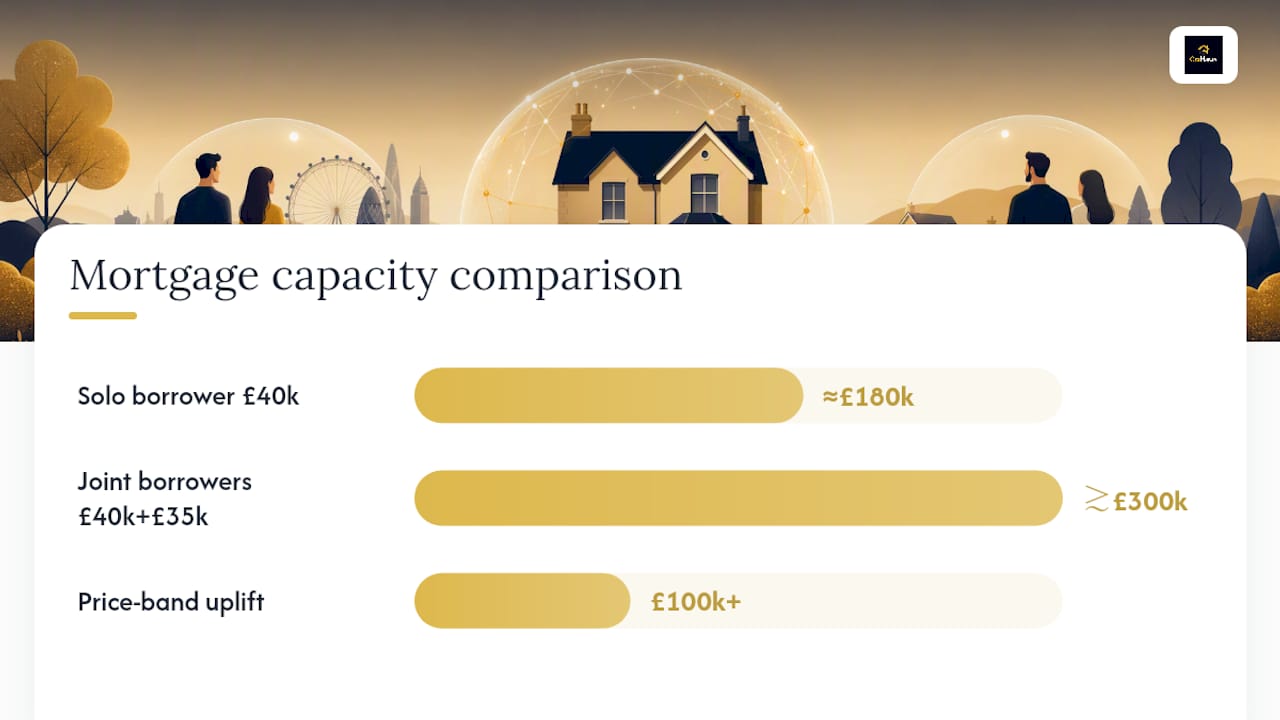
Lenders assess joint applicants on combined income and combined credit history, not an average of the two. A lender adding a second applicant on £35,000 to a first applicant on £40,000 doesn't just nudge the affordability ceiling up slightly. It can shift the achievable mortgage from around £180,000 to well over £300,000, depending on existing debt and outgoings. That difference in borrowing power is often the entire reason co-buying gets discussed in the first place.
Deposit pooling has a similar effect, but through the loan-to-value ratio rather than income multiples. Lower loan-to-value bands typically carry better interest rates, so the deposit-pooling benefit compounds with the income benefit rather than sitting alongside it.
A few practical scenarios illustrate how this plays out:
- Two first-time buyers, matched incomes: combined deposit and combined income can move a purchase price band up by £100,000 or more compared with buying solo, while also improving the mortgage rate through a lower loan-to-value ratio.
- Unequal deposits, equal mortgage liability: one buyer contributes £40,000 and the other £10,000, but both are named on the mortgage and equally liable for repayments regardless of the deposit split.
- Family co-buying with a parent as guarantor-style contributor: the parent's contribution boosts the deposit without necessarily appearing on the mortgage, which needs separate legal documentation to protect their share.
First-time buyer reliefs are more fragile than most people expect. If any co-buyer has owned property anywhere before, some first-time buyer stamp duty reliefs may be lost for the whole purchase, not just that buyer's share. Check eligibility with a solicitor before exchange, because this catches out more co-buying groups than any other tax issue.
The deed alone won't tell you who paid what. If one buyer puts in £40,000 and the other £10,000, but the property is registered as a straightforward 50/50 joint tenancy, the deed says nothing about those unequal contributions. That gap between what was paid and what the paperwork says is the single biggest source of co-buying disputes, and it's entirely avoidable with a declaration of trust (covered in the next section) that records contributions and ties equity shares to them rather than to a default 50/50 split.
Credit exposure is the part people underestimate most. A mortgage taken out jointly makes every named borrower "jointly and severally liable," which means the lender can pursue any one borrower for the full amount if the others stop paying. It doesn't split the debt into neat portions. If your co-buyer misses payments, defaults, or falls into financial difficulty, your credit file and your legal exposure are affected exactly as if you had missed the payments yourself. Consumer guidance from Which? is direct about this: pooling incomes helps you borrow more, but it also means you're on the hook for the whole repayment, not a fraction of it.
Ownership structures and legal implications
Two legal structures govern how UK property is owned jointly, and the choice between them shapes everything from inheritance to what happens if one owner wants out. Under Gov, joint tenancy means all owners hold the property equally, with no individual shares recognised in law. If one owner dies, their share passes automatically to the surviving owner or owners under the right of survivorship, regardless of what their will says.
Tenants in common works differently. Each owner holds a specific, often unequal, percentage share, and that share can be left to anyone in a will rather than automatically passing to the other co-owner. This structure fits most co-buying situations far better than joint tenancy, particularly among friends, siblings, or family members who aren't a couple and who may have contributed different amounts to the deposit.
The mechanism that makes tenants in common work properly is the declaration of trust (sometimes called a deed of trust). This is a separate legal document, distinct from the property deed itself, that records exactly how the ownership share breaks down and what happens if things change. A well-drafted declaration of trust should cover:
- The precise percentage share each owner holds, tied to their actual financial contribution.
- A record of who paid what towards the deposit, and any later capital contributions towards renovations or mortgage overpayments.
- A buyout formula setting out how a departing owner's share gets valued and paid out.
- The valuation method to be used (typically an independent RICS surveyor or agreed market appraisal) if owners disagree on price.
Bird & Co's conveyancing guidance is clear that without this document in place, courts may need to determine fair shares retrospectively if a dispute arises, which is slower and considerably more expensive than settling it on paper before completion. This is the single most practical safeguard covered in this guide, and it's worth reading a detailed breakdown of tenants in common before you commit to a structure.
When you sit down with a solicitor, ask directly: what happens if one of us wants to sell and the other doesn't? How will unequal future contributions (one person paying for an extension, say) be reflected in the shares? And critically, is the declaration of trust being drafted independently of the mortgage paperwork, or is it being treated as an afterthought? Independent legal advice for each co-buyer, rather than one shared solicitor, is worth the modest extra cost when the shares aren't a simple 50/50 split.

Practical risks and downsides to weigh
The benefits of co-buying are real, but so are the ways they can unravel. Weighing these honestly before you commit is what separates a co-buying success from a cautionary tale.
- Joint liability for the mortgage. As covered above, every named borrower is responsible for the full repayment, not a proportional share. If your co-buyer's circumstances change (job loss, illness, a new financial priority), you're still liable for the whole mortgage payment.
- Liens, bankruptcy, or judgments against one owner's share. If a co-owner runs into serious debt problems, creditors can in some circumstances pursue a charge against their share of the property. Legal Clarity's guidance on multiple-owner purchases notes this can complicate refinancing or selling significantly, even when the other owner has done nothing wrong.
- Relationship breakdown and disagreement over timing. What happens if one co-buyer wants to sell in year three and the other wants to stay for ten? Without a pre-agreed exit mechanism, this can escalate into a partition action, essentially forcing a court to order a sale neither party may want on terms neither party chose.
- Disputes from unclear governance. Who decides on a new boiler versus a full kitchen renovation? Vague or absent agreement on decision-making authority is one of the most common triggers for the kind of dispute that ends up needing legal intervention.
Pro Tip: Before you view a single property together, have the "what if" conversation: what if one of us loses our job, wants to move for a relationship, or simply wants out in two years? Getting uncomfortable answers on the table early is far cheaper than getting them from a solicitor later.
None of these risks are reasons to avoid co-buying outright. They're reasons to treat the legal and financial groundwork as seriously as the property search itself, which is exactly what the next section covers.
How to protect yourself before you buy
Every benefit covered so far holds up better when you do these things before completion, not after a problem emerges.
- Draft a co-ownership agreement or declaration of trust before completion. This should be a non-negotiable step, not an optional extra. Essential clauses include ownership shares tied to actual contributions, a clear buyout method, an agreed valuation process, notice periods for anyone wanting to sell, and default remedies if a co-owner stops paying their share.
- Run financial due diligence together. Share credit checks openly with each other before you apply for a mortgage together, so nobody is surprised by a rejection or a worse rate midway through the process. Document every deposit contribution in writing, and consider setting up a shared reserve account for repairs and unexpected costs from day one.
- Agree governance rules for day-to-day and major decisions. Set a clear threshold for what needs unanimous agreement (major works, refinancing, letting out a room) versus what one owner can decide alone (minor repairs, redecorating). This single step prevents most of the disputes covered in the previous section.
- Plan your exit mechanics in advance, with worked numbers. A workable buyout clause typically requires an independent professional appraisal, a defined window (often 60 to 90 days) during which the remaining owner has first refusal to buy out the departing owner, and a clear payment timetable. Agree upfront when a disagreement escalates to mediation or a solicitor rather than dragging on informally.
Pro Tip: Treat the declaration of trust like a prenup, not paperwork. The couples and friends who skip it because "we trust each other" are usually the ones who end up needing a solicitor two years later. Trust and a written agreement are not opposites; the agreement is what protects the trust.
For a working template on ownership shares and how to record unequal deposits fairly, Cohaus's guide on splitting ownership walks through the maths, and its exit planning guide covers buyout mechanics in more depth than most solicitors will in a single meeting.
How Cohaus reduces friction in the co-buying process
Cohaus exists because most of the friction in co-buying isn't financial, it's structural. Finding a compatible co-buyer, agreeing terms, and getting the legal groundwork right usually happens in isolation, with each person Googling their way through unfamiliar territory.
Cohaus pools deposit and mortgage responsibilities through a structured process, with legal templates and clear exit terms built in from the start rather than bolted on after a dispute. That means the declaration of trust, buyout clauses, and governance questions covered throughout this guide aren't things you draft from scratch, they're part of the framework you join.
A few starting points worth reading:
- What is co-buying, and does it suit you? for a fuller breakdown of the model.
- Buying a house with friends: your 2026 UK guide for the financial mechanics in more detail.
- Co-Buying articles for the full library of practical guides.
If you're ready to see how this works in practice, the platform's community matching and partner network of solicitors and mortgage brokers are designed to take the guesswork out of the legal and financial groundwork this guide has walked through.
When co-buying is the right next step
Co-buying suits people whose financial goals and timelines genuinely overlap, not just people who get on well. If you and a prospective co-buyer both plan to stay put for at least five years, have broadly comparable credit profiles, and are equally serious about the legal groundwork rather than treating it as a formality, the benefits covered in this guide tend to materialise as promised. Couples with wildly different risk appetites, or friends who haven't discussed what happens if one wants out early, should think twice before signing anything.
Three questions decide whether you're ready to progress: Do our timelines for staying in the property actually match? Have we been honest with each other about our credit histories and existing debts? And are we both willing to pay for a declaration of trust before we pay for a surveyor?
If the answers are yes, the practical next steps are straightforward: open a shared savings pot for the deposit, swap credit reports honestly before you apply for anything, and book a solicitor consultation before you make an offer, not after.
— Martin
Ready to co-buy with the right support
Cohaus is built for exactly the situation this guide describes: people who want the financial benefits of co-buying without carrying all the legal and organisational weight themselves. Rather than piecing together a declaration of trust, a buyout clause, and a compatible co-buyer separately, Cohaus brings community matching, pooled deposit options, legal templates, and a network of partner solicitors and mortgage brokers into a single starting point.

The practical next step is to visit the Cohaus landing page, read through the starter guides, and register to join a community of people working through the same decisions covered in this article.
| Consideration | The upside | The trade-off | Cohaus next step |
|---|---|---|---|
| Affordability | Pooled deposits and incomes increase buying power | Joint liability for the full mortgage | Community matching with compatible co-buyers |
| Legal structure | Tenants in common protects unequal shares | Needs a proper declaration of trust | Legal templates built into the platform |
| Exit planning | Clear buyout terms prevent forced sales | Requires agreement before you buy | Transparent exit terms from day one |
Register on the platform to browse the starter guides or request an introduction to a partner solicitor before you make an offer.
Sources
- Gov
- Joint ownership guidance — The Law Society
- Joint tenants vs tenants in common — Which?
- Buying a house with a friend in the UK — Hudson Rose
FAQ
What is the downside of co-ownership?
The main downside is joint and several liability: every named owner is responsible for the full mortgage repayment, and one owner's financial trouble, debt, or default can affect everyone's credit and legal position.
What is the 45% rule for shared ownership?
This typically refers to shared ownership schemes with housing associations, where buyers purchase a percentage share (historically starting around 25% to 75%) rather than the whole property; it's distinct from co-buying, where co-buyers own 100% of the property between them, so check scheme-specific rules with the provider before assuming they apply.
Why avoid joint ownership?
Joint ownership isn't something to avoid outright, but joint tenancy specifically can be unsuitable for co-buyers with unequal contributions, since it doesn't recognise individual shares; tenants in common with a declaration of trust usually fits better.
Is co-ownership a good idea in Northern Ireland?
Co-ownership can work well in Northern Ireland, but scheme rules, share percentages, and staircasing terms differ from schemes elsewhere in the UK, so check the specific Co-Ownership scheme guidance for Northern Ireland before assuming UK-wide rules apply.
Does Cohaus help with the legal side of co-buying?
Cohaus provides legal templates, including declaration of trust structures and exit terms, alongside access to partner solicitors, so co-buyers aren't drafting these agreements from scratch.