
TL;DR:
- Private co-buying involves multiple people applying jointly for a mortgage, sharing deposits, and owning the property equally or via defined shares. Success depends on finding a specialist broker, securing lender approval for multiple applicants, and drafting a solicitor-approved agreement to protect beneficial interests. Proper legal, financial, and structural arrangements ensure co-buyers can navigate ownership, liability, and exit strategies effectively.
The single most effective route to a multi-applicant mortgage is a specialist broker with direct experience of four-applicant underwriting, not a high-street bank visited in person. Once you have that broker, you target lenders that accept unrelated co-buyers, count all applicants' incomes, and will work alongside a solicitor-drafted Co-Purchase Agreement. The rest of this guide shows you exactly how.
Three trust signals to confirm before you proceed:
- Your broker has placed multi-applicant mortgages (three or more applicants) in the last 12 months and can name lenders from their panel who accept unrelated co-buyers.
- Your solicitor can draft a Declaration of Trust or Co-Purchase Agreement before exchange, not after.
- The lender you are targeting will accept a solicitor-drafted trust arrangement and will confirm joint and several liability terms in writing.
Pro Tip: Ask your broker directly: "Which lenders on your panel will underwrite four applicants, including unrelated friends?" A broker who hesitates or cannot name at least two options is not the right fit for a co-buy.
Table of Contents
- What is private co-buying, and is this guide for you?
- How to choose the right lender or broker for your co-buy
- Where to find lenders that consider multi-applicant co-buyers
- What legal protections must you have in place?
- Common mistakes groups make, and red flags to avoid
- Key takeaways
- Why the standard advice on co-buying mortgages misses the point
- How Cohaus supports your co-buying journey
- Useful sources and further reading
What is private co-buying, and is this guide for you?
Private co-buying means two or more people, whether friends, family members, or housemates, applying together for a single mortgage and sharing both the deposit and the ongoing repayments. Each person named on the mortgage is a legal co-owner. Those who contribute to the deposit but are not on the mortgage can still hold a beneficial interest, protected by a Declaration of Trust.
This guide is specifically about private multi-applicant mortgages. It is not about the government-backed Shared Ownership scheme run through housing associations, where you buy a share of a property and pay rent on the rest. That scheme has its own specialist lenders and eligibility rules. If you are looking at shared equity vs shared ownership as concepts, that distinction matters before you apply anywhere.
Who this guide helps:
- Groups of two to four people planning to be named on the mortgage together.
- Friends or housemates pooling deposits, where one or more may not be on the legal title but will contribute financially.
- Family members co-buying with adult children using a Joint Borrower Sole Proprietor (JBSP) structure.
HM Land Registry guidance confirms that up to four people can be registered as legal owners of a property in England and Wales. Additional contributors beyond four can still hold beneficial interests, but only if those interests are properly documented.
How to choose the right lender or broker for your co-buy
The single most important filter is whether the lender will underwrite four applicants and how they treat affordability across mixed incomes. Specialist brokers confirm that the pool of lenders accepting four applicants is genuinely limited, which is why broker access to a wide panel matters more here than in a standard two-applicant mortgage.
Questions to ask every broker and lender:
- What is the maximum number of applicants you will accept?
- Do you accept unrelated applicants (friends, housemates)?
- How many applicants' incomes do you count for affordability?
- How do you treat irregular or self-employed income?
- What is the minimum deposit and maximum LTV for a multi-applicant case?
- What does joint and several liability mean in your specific mortgage terms?
- What are your application and product fees?
- What are the exit and remortgage terms if one applicant wants to leave?
Red flags to watch for:
- A lender that refuses unrelated applicants outright.
- A lender that will only count two incomes regardless of how many applicants apply.
- Onerous joint and several clauses with no internal remedy mechanism.
- A broker who cannot confirm lender appetite before you pay any fees.
Decision steps, in order:
- Contact a specialist multi-applicant broker and confirm their lender panel.
- Get a soft credit search or Agreement in Principle to check lender appetite.
- Instruct a solicitor to begin drafting your Co-Purchase Agreement in parallel.
- Proceed to full application only once lender appetite and legal structure are confirmed.
Pro Tip: Experian's joint mortgage guidance notes that some lenders accept up to four applicants but only count a subset of incomes for affordability. Always ask for the lender's affordability policy in writing via your broker before committing.
Where to find lenders that consider multi-applicant co-buyers
Lender categories worth targeting, in rough order of accessibility:
Building societies and regional mutuals tend to have more flexible underwriting than large high-street banks. Many will consider unrelated applicants and are more willing to engage with mixed-income cases.

JBSP and Income Booster products allow a supporting borrower to add their income to the application without appearing on the legal title. Skipton Building Society's Income Booster is a well-known example. Supporting borrowers remain legally liable for the mortgage and must receive independent legal advice before proceeding.
Broker-only lenders often have the most flexible criteria for multi-applicant cases but are inaccessible without a broker relationship. This is the strongest practical argument for using a specialist rather than going direct.
| Dimension | What to look for |
|---|---|
| Maximum applicants | Four on the mortgage; additional beneficial owners via trust |
| Minimum deposit / max LTV | Typically 10–15% deposit; confirm per lender |
| Unrelated applicants accepted | Confirm explicitly; not all lenders allow this |
| Joint and several liability | Standard across all lenders; internal remedies via trust deed |
| Mixed/irregular income flexibility | Ask whether self-employed or variable income is counted in full |
| Application and product fees | Arrangement fees vary; broker fees may apply separately |
| Average decision timescale | Typically 2–6 weeks for Decision in Principle; longer for full underwriting |
Pro Tip: Brokers with whole-of-market access open lender panels that are simply not available on the high street. A direct approach to a lender is only worth considering if you already know their criteria fit your group exactly.
What legal protections must you have in place?
Do not exchange contracts without a solicitor-approved Co-Purchase Agreement or Declaration of Trust. HM Land Registry records legal title only and does not record beneficial interests, so without a separate document, your financial contributions and agreed shares have no formal protection.
Clauses your agreement must include:
- Defined ownership shares (percentage each party holds).
- Monthly payment duties and what happens if one party cannot pay.
- A buy-out formula and notice period if someone wants to exit.
- Forced sale triggers and the process for agreeing a sale price.
- Dispute resolution steps before any court action.
- Provisions for death, serious illness, or relationship breakdown.
A Co-Purchase Agreement is not optional paperwork. Solicitors at Gillespie MacAndrew are explicit: because HM Land Registry records legal title only, a separate solicitor-drafted agreement is the only document that specifies ownership shares, payment duties, and exit plans. Without it, you are relying on informal understanding that courts may not uphold.
All co-buyers are jointly and severally liable to the lender for the full mortgage debt. If one person stops paying, the others are responsible for the entire amount. The Declaration of Trust bridges that gap internally by specifying remedies, but it does not remove liability to the lender.
Solicitors generally recommend holding as tenants in common rather than joint tenants for unrelated co-buyers. Tenants in common can hold unequal shares and each person can leave their share by will. Joint tenancy passes a deceased owner's share automatically to the survivors, which is rarely appropriate for friends.
If disputes arise and no agreement exists, courts have wide powers under TOLATA to order a sale or determine beneficial shares. Solicitors at Slater Heelis are clear that pre-agreed exit strategies and deed-of-trust provisions are the most effective way to avoid that outcome.
Pro Tip: Instruct your solicitor before you make an offer, not after. Legal drafting for a co-purchase agreement takes time, and post-offer delays are one of the most common reasons co-buy completions fall through.
Common mistakes groups make, and red flags to avoid
Pitfalls that derail co-buys:
- Proceeding without a formal trust deed, assuming verbal agreements will hold.
- Not checking whether the lender counts all applicants' incomes before applying.
- Ignoring joint and several liability until a dispute arises.
- One applicant's poor credit history reducing the group's available rates or ruling out certain lenders entirely.
- No agreed process for managing split mortgage payments month to month.
- Informal promises about covering another person's share if they cannot pay.
Red flags from lenders and brokers:
- A lender that will not confirm in writing whether unrelated applicants are accepted.
- Opaque fee disclosures or fees that change after the DIP stage.
- A broker who cannot name specific lenders from their panel for four-applicant cases.
- Any suggestion that a solicitor-drafted trust arrangement is unnecessary or unusual.
Pro Tip: Set up a dedicated shared bank account for mortgage payments from day one. Keep a clear record of who pays what each month. This documentation becomes critical if a dispute reaches a solicitor or court, and it supports life insurance for a joint mortgage claims if a co-owner dies or becomes seriously ill.
Key takeaways
The most effective route to a private co-buying mortgage is a specialist broker with multi-applicant panel access, combined with a solicitor-drafted Co-Purchase Agreement before exchange.
| Point | Details |
|---|---|
| Use a specialist broker | Only brokers with multi-applicant panel access can reliably find lenders that accept unrelated co-buyers. |
| Legal documents are non-negotiable | A Declaration of Trust or Co-Purchase Agreement protects beneficial shares that HM Land Registry does not record. |
| Joint and several liability is real | Every named applicant is liable for the full debt; internal remedies must be set out in the trust deed. |
| JBSP products expand your options | Income Booster structures let supporters add income without legal title, but independent legal advice is required. |
| Cohaus connects you to the right people | Cohaus matches co-buyers and provides introductions to specialist brokers and solicitors experienced in multi-applicant cases. |
Why the standard advice on co-buying mortgages misses the point
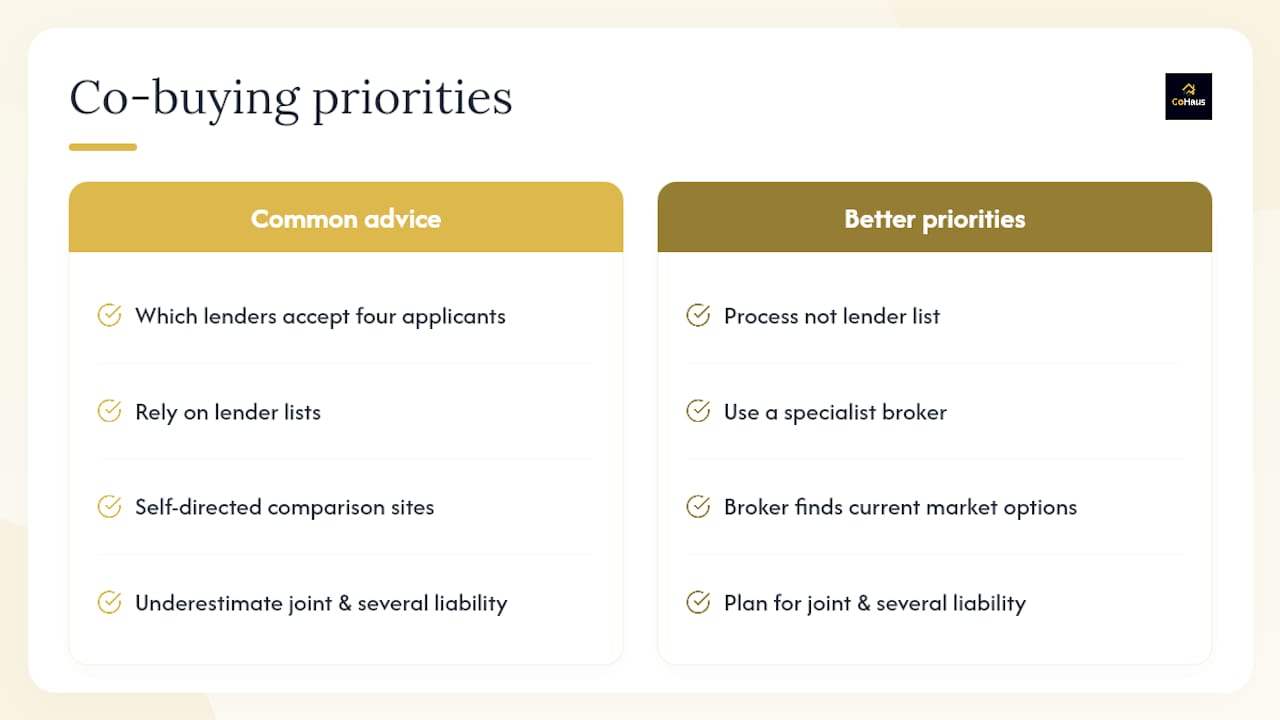
Most articles about co-buying mortgages focus on which lenders accept four applicants. That is the wrong starting question. The lender list changes constantly as appetite shifts, and a lender that accepted four unrelated applicants last year may have tightened criteria this year. What does not change is the process: a specialist broker who knows the current state of the market will always find you a better outcome than a self-directed search through comparison sites.
The legal side is where groups consistently underestimate the risk. Joint and several liability sounds abstract until one co-buyer loses their job and the others receive a demand for the full monthly payment. A well-drafted Co-Purchase Agreement does not prevent that scenario, but it gives you a clear, pre-agreed mechanism to respond to it. Groups that skip this step often find themselves in TOLATA proceedings, which are slow, expensive, and entirely avoidable.
The other overlooked point is ownership structure. Tenants in common with defined shares is almost always the right choice for unrelated co-buyers, yet many groups default to joint tenancy because it sounds simpler. It is simpler, and it is also wrong for most friend groups: joint tenancy means your share passes automatically to the surviving co-owners rather than to your family or partner.
Co-buying works. It is one of the most practical responses to the affordability gap in UK housing. But it works because of structure, not despite the lack of it.
How Cohaus supports your co-buying journey
Finding the right lender is only one part of a successful co-buy. Knowing who to buy with, how to structure the agreement, and which broker and solicitor to trust are equally important questions.
Cohaus is built around exactly this problem. The platform matches prospective co-buyers with compatible partners, then connects groups with specialist mortgage brokers and solicitors who understand multi-applicant cases. Templates for Co-Purchase Agreements, guidance on exit planning, and a community of people navigating the same process are all part of what Cohaus offers.
If you are ready to take the next step, join the Cohaus community and connect with brokers and solicitors who work with co-buyers every day. Independent legal and financial advice remains essential; Cohaus helps you find the right people to give it.
Useful sources and further reading
Official guidance:
- Why you need a co-purchase agreement when buying a property in 2026 - Gillespie MacAndrew
- 4 Person Mortgage - Mint Mortgage & Protection
- Owning land and property with someone else - GOV.UK
- Getting a joint mortgage - Experian
- Buying a home with friends - Slater Heelis
- Buying a property with friends — what happens if things go wrong - Myerson
- Buying property jointly with friends - PropertyPassport
- Income Booster | Joint Borrower Sole Proprietor mortgages - Skipton Building Society
Cohaus resources:
- Joint mortgage with friends: your 2026 UK guide
- Joint and several liability: what co-buyers must know
- Co-buying exit plans: buyouts, notice periods and forced sales
- Shared ownership pitfalls: what buyers must know
- CoHaus in-depth guides and articles
This article is general information, not legal or financial advice. Confirm current rules and your specific situation with a qualified solicitor and independent mortgage adviser before proceeding.