Use a Declaration of Trust and hold the property as tenants in common if your deposits are unequal. Instruct a solicitor promptly to draft the deed, agree the shares in writing, and register a restriction with HM Land Registry so the arrangement can't be quietly overridden later. Co-buying platforms can point you towards the right resources and legal signposting once you've decided how to buy together.
TL;DR:
- Using a Declaration of Trust with a property held as tenants in common ensures unequal deposits are properly recorded and protected against later overrides.
- Registering a Form A restriction at HM Land Registry enforces the trust deed, preventing unauthorized sale or remortgage without proper acknowledgment.
- Including clauses on deposit returns, fixed-percentage shares, buy-out mechanics, contributions schedule, and dispute resolution clarifies each owner’s rights and obligations.
- Signing the deed before exchange and immediately after completing the purchase provides stronger legal evidence of intent and safeguards contributions.
- Engaging independent solicitors for drafting and advice increases the enforceability of the trust deed, especially in complex or strained relationships.
Table of Contents
- Which legal documents protect deposit buying together arrangements?
- How does title differ from beneficial interest?
- What should a Declaration of Trust actually include?
- When should you sign the deed, and what's the correct order?
- What does this cost, and when do you need specialist help?
- How do the clause choices actually play out?
- Why early documentation matters for co-buyers
- If you're weighing up co-buying with a partner, friend, or someone new, some platforms are built specifically for people who want to pool deposits and mortgage responsibility without doing it on a handshake. Getting matched with a compatible co-buyer is one problem; getting the legal groundwork right is another, and some platforms signpost both.
- Sources
- FAQ
Which legal documents protect deposit buying together arrangements?
Three documents matter here, and most co-buyers only need two of them.
A Declaration of Trust (also called a deed of trust) is the main tool. It records exactly who paid what into the deposit, how mortgage payments will be split, and how sale proceeds get divided. If your deposits aren't equal, this document does the heavy lifting.
Before you draft it, decide how you'll hold legal title:
- Tenants in common lets you fix unequal ownership shares that match unequal deposits, and each share can be left in a will.
- Joint tenants assumes equal shares regardless of contribution, and ownership passes automatically to the surviving owner on death, not through a will.
A cohabitation agreement goes wider than the property itself, covering household bills, shared possessions, and what happens if the relationship ends. It doesn't replace a Declaration of Trust. It sits alongside it, and family law advisers often recommend using both when finances are genuinely intertwined.
How does title differ from beneficial interest?
Legal title is who's named as the registered proprietor at HM Land Registry. Beneficial interest is who actually owns what share of the value. These aren't the same thing, and that gap is where unequal deposits get lost if nobody writes anything down.
HM Land Registry records the legal owners of a property, but it doesn't automatically record who owns what percentage. Without a separate deed, the law falls back on assumptions, usually equal shares, which is exactly wrong for someone who put in 70% of the deposit.
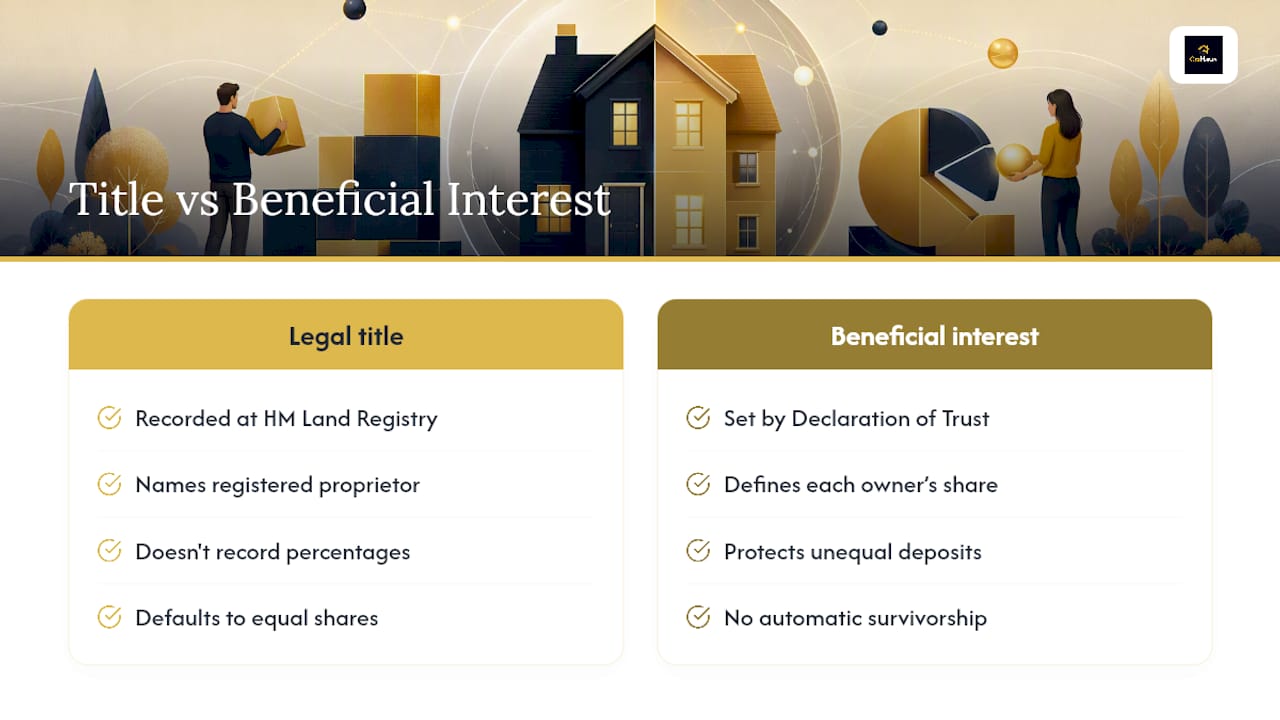
This is also where joint tenancy versus tenants in common bites hardest. Joint tenancy carries the "right of survivorship", meaning your share passes to your co-owner automatically, bypassing your will entirely. Tenants in common has no survivorship. Your defined share becomes part of your estate and goes wherever your will says.
A Declaration of Trust is enforced as a contract between the co-owners, separate from the property title itself. To stop someone selling or remortgaging without honouring it, you register a Form A restriction against the title at HM Land Registry. This forces any buyer's solicitor, and the Land Registry itself, to check the trust deed exists before a sale or transfer completes. Skip the restriction, and your deed still holds legal weight between you, but a rushed sale becomes harder to challenge after the fact.
What should a Declaration of Trust actually include?
Ask your solicitor to cover these clauses, in roughly this order of priority:
- Return-of-deposit clause. The larger contributor gets their original deposit back off the top of the sale proceeds before any remaining equity is split, according to the chosen model. This favours whoever put in the bigger lump sum, particularly on an early sale.
- Fixed-percentage shares. Instead of ring-fencing the deposit, you agree a percentage split (say 65/35) that applies to the whole property value, including any future growth or loss.
- Buy-out mechanics. How one party can buy the other out, which valuation method applies (usually an independent RICS valuation), and over what timeframe.
- A contributions schedule. An annex recording parental gifts, renovation costs, mortgage overpayments, and who covers selling costs, so later payments don't require redrafting the whole deed.
- Trigger events and dispute resolution. What happens on separation, death, or one party wanting to sell, and how disagreements get resolved before anyone reaches for a court.
Pro Tip: Ask for the contributions schedule to be a separate annex, not baked into the main clauses. That way, updating it after a kitchen renovation or a lump-sum mortgage overpayment doesn't mean re-signing the entire deed.
When should you sign the deed, and what's the correct order?
Timing matters more than most co-buyers realise, because courts treat a deed signed at the time of purchase as far stronger evidence of intention than one added months later.
- Before exchange. Agree tenants in common or joint tenancy, and start gathering evidence, bank transfer records, gift letters from parents, anything proving who paid what.
- Instruct solicitors early. Each party should ideally get independent legal advice, especially where contributions are very unequal, so nobody can later claim they didn't understand what they signed.
- Sign the Declaration of Trust alongside completion, or immediately after, with full consent from both parties and clear records of that consent.
- Apply for the Form A restriction at HM Land Registry once the deed is signed, and keep copies of everything, including the contributions schedule, somewhere both parties can access.
A contemporaneous deed prepared at the time of purchase carries far more legal weight than one drafted in a hurry after a dispute has already started.
What does this cost, and when do you need specialist help?
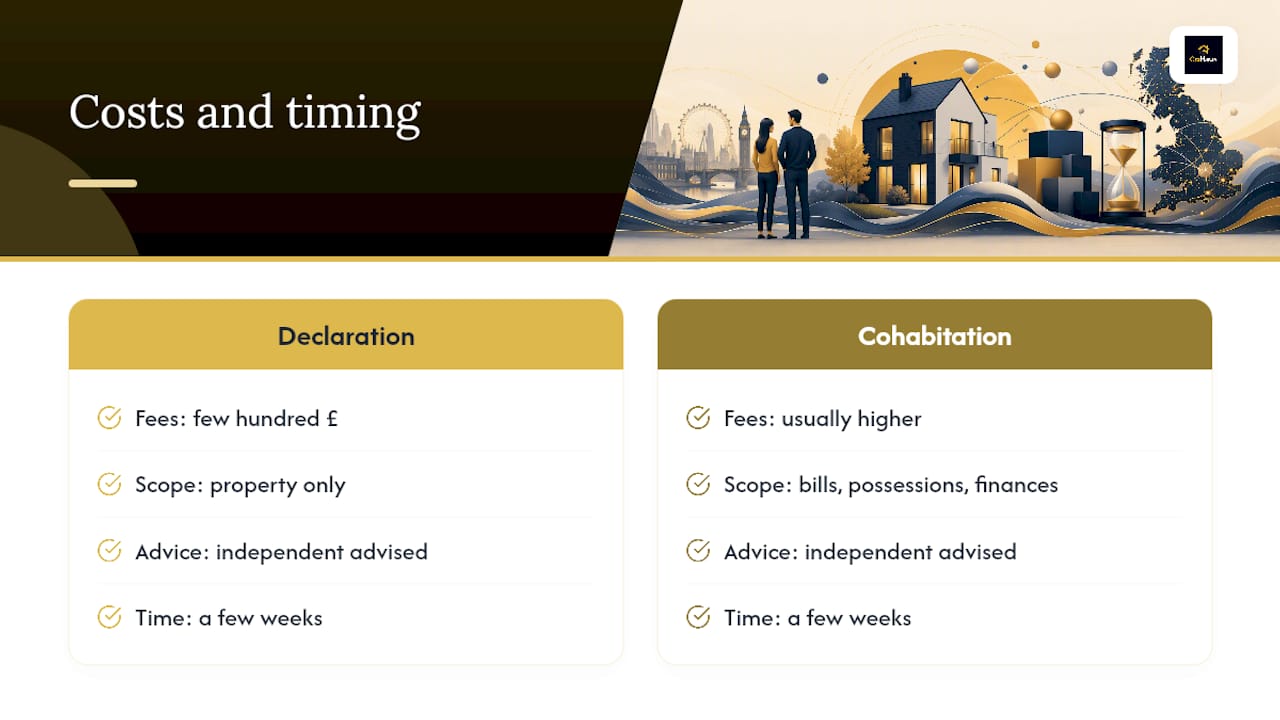
Solicitor fees for a straightforward Declaration of Trust typically run a few hundred pounds, rising if the shares are complex or contributions come from multiple sources. A cohabitation agreement usually costs more, given its broader scope covering bills, possessions, and household finances rather than just the property.
Independent advice for each party, rather than one solicitor advising both, strengthens the deed considerably if it's ever challenged. Complexity that genuinely needs a specialist family or property lawyer includes parental loans with informal repayment terms, more than two co-owners, or a relationship that's already showing strain before you've even exchanged contracts.
From instructing a solicitor to a registered Form A restriction, expect a few weeks in a simple case, longer if independent advice or a contributions schedule needs several rounds of drafting.
How do the clause choices actually play out?
Numbers make this clearer than theory. Say a property sells for £400,000 after a mortgage balance and selling costs leave £100,000 equity.
- Return-of-deposit model: One partner put in a £40,000 deposit, the other £10,000. The £40,000 comes off the top first, leaving £60,000 to split according to the agreed remaining formula, often equally if mortgage payments were shared evenly.
- Fixed-percentage model: The same couple instead agreed 70/30 shares from the outset. The full £100,000 splits £70,000 to £30,000, regardless of who paid the original deposit, which rewards the larger contributor more if the property has grown in value.
- Parental gift example: A £20,000 gift from one partner's parents, recorded in the deed as that partner's separate contribution, stays ring-fenced on sale rather than being treated as a joint asset.
Without any written agreement, none of this is guaranteed. A court can default to equal shares regardless of what actually happened at completion, leaving the larger contributor with a genuine financial loss.
Why early documentation matters for co-buyers
Buying with someone else, whether a partner, a friend, or someone matched through a co-buying community, shouldn't mean gambling your deposit on goodwill. Co-buying platforms can match people who want to pool deposits and mortgage responsibility, then point them towards the legal groundwork that makes the arrangement fair on paper, not just in conversation.
We push hard on transparent exit terms and recorded deeds because the disputes we see aren't usually about bad intentions. They're about assumptions nobody wrote down. A Declaration of Trust signed early removes the guesswork, and that's worth more to most co-buyers than any amount of trust between friends.
Read more on the Cohaus blog for guides and case studies from people who've been through this process.
— Martin
If you're weighing up co-buying with a partner, friend, or someone new, some platforms are built specifically for people who want to pool deposits and mortgage responsibility without doing it on a handshake. Getting matched with a compatible co-buyer is one problem; getting the legal groundwork right is another, and some platforms signpost both.
These platforms help you find co-buyers whose finances and goals actually align, then point you towards the guides, checklists, and legal signposting covered above, including how to structure unequal contributions before you ever speak to a solicitor. Some also offer community forums where people share what worked and what didn't, which can be valuable when preparing to sign something significant.
If you're ready to explore co-buying seriously, visit the Cohaus platform to join the community, browse the guides, and request an introduction to a mortgage broker or solicitor when you're ready to move.
Sources
For the legal basics, start with GOV.UK's guidance on joint property ownership and owning property with someone else. For co-buying specifics, see Cohaus's guide to tenants in common vs joint tenancy.
FAQ
How do I protect my deposit when buying a house with a partner in the UK?
Sign a Declaration of Trust that records your exact contribution, hold the property as tenants in common, and register a Form A restriction with the UK Tenancy Deposit Scheme at HM Land Registry once the deed is signed.
We have different deposits, what should we do first?
Agree whether you'll use a return-of-deposit clause or fixed-percentage shares before you instruct a solicitor, since that decision shapes the whole deed.
How can I protect myself when buying a house with someone who isn't my partner?
The same protections apply regardless of relationship status. A Declaration of Trust plus a cohabitation agreement covers both the property split and wider shared finances, which matters more when you're not married.
Can I buy a second property with a deposit? Deposits required vary depending on lenders and borrower circumstances; consult a mortgage broker to understand what's realistic for you.
Lenders vary, but a 10% deposit is achievable for many second properties depending on affordability and loan-to-value criteria; a mortgage broker can confirm what's realistic for your circumstances, and platforms like Cohaus can help connect you with one.
Do I need a solicitor for a Declaration of Trust?
Yes. Courts give far more weight to a deed drafted and signed contemporaneously with the purchase, and independent legal advice for each party makes it much harder to challenge later.