When friends pool money to buy a home, the safest structure is tenants in common, not joint tenancy, because it lets each person's contribution be recorded as a distinct share. Commission a Declaration of Trust, signed by everyone before completion, to lock those shares in writing. Any gifted money needs a formal gift letter for the lender before you go any further.
TL;DR:
- Tenants in common is the preferred ownership structure for friends co-buying, as it records each person's contribution and allows for unequal share explanations.
- A Declaration of Trust, costing £500–£1,000 per person, is essential to formalize the share of deposits and rights, and each co-buyer should have independent legal advice.
- Gifted deposits must be accompanied by a written gift letter and source documents; lenders scrutinize non-parent gifts more closely, risking the loss of first-time buyer relief if not handled properly.
- The choice among fixed percentage, deposit-returned-first, or loan plus equity models affects tax, inheritance, and exit strategies, making scenario analysis before committing crucial.
- Proper documentation and clear agreements prevent disputes, especially with varying credit profiles or during changing circumstances, and regular communication is key to managing ongoing participation.
Table of Contents
- How to split a house deposit: the quick checklist
- Tenants in common vs joint tenancy: which protects your deposit?
- Practical models for splitting an unequal deposit
- Lender rules and gifted deposits: letters, evidence and common pitfalls
- Step-by-step timeline from agreement to completion
- Exit options, disputes and how the Declaration of Trust helps
- How to handle deposit contributions from multiple parties with differing credit profiles
- Potential tax implications of splitting a house deposit among co-buyers
- Strategies for managing disagreements related to deposit contributions or repayment plans
- Cohaus perspective: why the paperwork is the easy part
- Ready to co-buy? Cohaus connects you with people and paperwork
- Sources
- FAQ
How to split a house deposit: the quick checklist
Before you start negotiating who paid what, get these four things moving. Each one protects you if the friendship, the property market, or someone's circumstances change later.
- Open a joint account or shared ledger. Every contribution, however small, should have a paper trail. A spreadsheet works, but a dedicated account with statements is harder to dispute.
- Get an Agreement in Principle from a broker who accepts gifted deposits. Not every lender treats gifts the same way, so ask this question at the first call, not after you've found a property.
- Instruct a solicitor to draft a Declaration of Trust and run anti-money-laundering checks. This is the document that will settle any disagreement about who owns what.
- Gather source documents for large gifts. House sale contracts, bank statements covering at least three months, and pension statements are the usual asks.
Tenants in common vs joint tenancy: which protects your deposit?
Joint tenancy treats everyone as owning the whole property equally, with no way to record that one person put in £40,000 and another put in £15,000. It also carries the right of survivorship, meaning if one owner dies, their share passes automatically to the others rather than to their family. That is fine for married couples with identical intentions. It is rarely fine for friends or flatmates who contributed different amounts and want their own share to go where they choose.
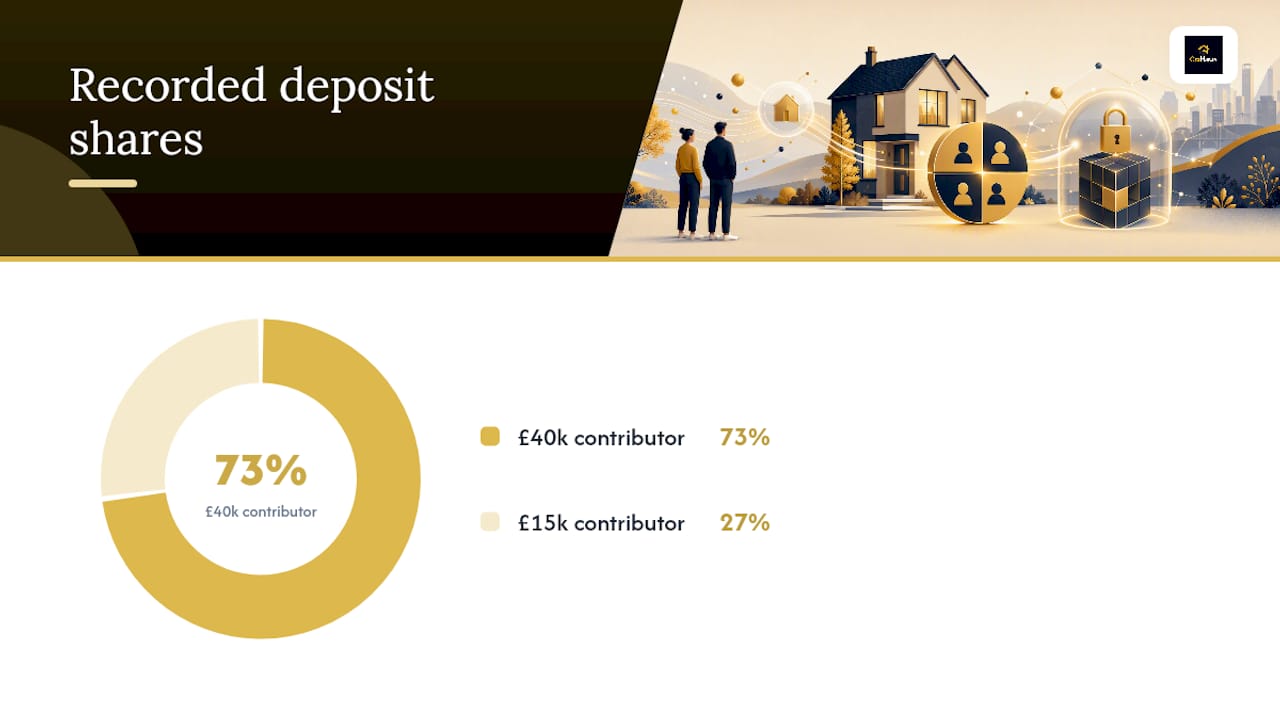
Tenants in common solves both problems. Up to four people can hold legal co-ownership of a property in England and Wales, each with a defined percentage share that can be sold, willed, or transferred independently of the others. It is the standard structure recommended for co-buying between friends, and it is what makes the rest of this article possible.
A Declaration of Trust is the legal document that records those shares. Your solicitor should make sure it covers:
- The exact deposit amount each person contributed, with dates
- The percentage share this translates to
- How the property will be valued if someone wants to sell their share
- How ongoing mortgage payments are treated if they're not split evenly
- Notice periods required before someone can force a sale or buyout
Solicitor costs for a Declaration of Trust typically run to £500–£1,000 per party, depending on complexity. Each co-buyer should take independent legal advice rather than sharing one solicitor between everyone, because your interests in the negotiation are not identical to your co-buyer's, even if you get on well now. HomeOwners Alliance makes the same point: without a written agreement, the law defaults to presuming equal shares regardless of what anyone actually paid in.
Practical models for splitting an unequal deposit
Most co-buying arrangements settle on one of three named models, each with different tax and equity consequences worth setting out explicitly in the Trust.
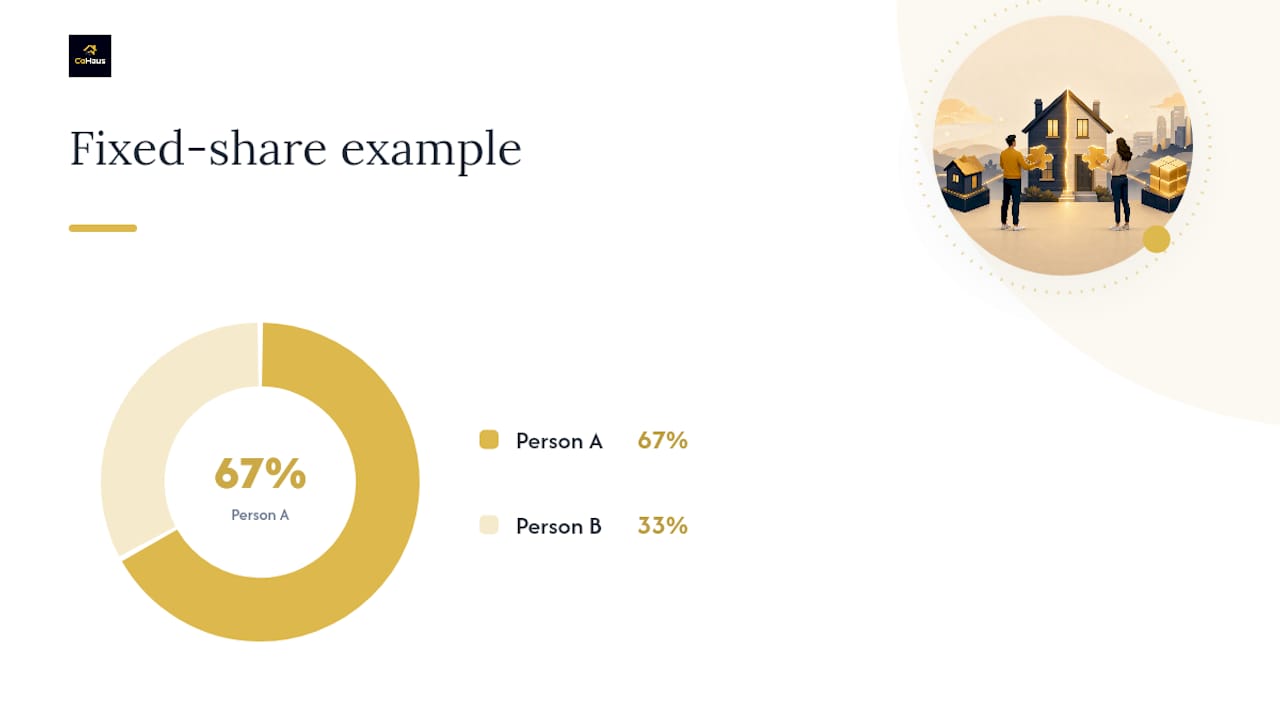
- Fixed percentage shares. Ownership is set at completion in proportion to what each person put in. If Person A contributes £30,000 and Person B contributes £15,000 of a £45,000 total deposit, A holds a two-thirds share and B holds one-third, adjusted for any difference in ongoing mortgage payments.
- Deposit-returned first. On sale, each person recovers exactly what they put in as deposit before any remaining equity or gain is split, often equally. This suits situations where one friend fronted more cash short-term but the group wants to share the eventual profit evenly.
- Loan plus equal equity. The larger contribution is structured as a repayable loan from one co-buyer to the others, with all parties then holding equal shares once the loan is repaid on sale.
Each model has trade-offs. Fixed shares are simplest to calculate but can feel unfair if one person's contribution grows in value disproportionately. Deposit-returned-first protects the larger contributor's capital but delays the point at which shares feel truly equal. Loan-plus-equity treats the excess as a debt rather than equity, which has different implications if the borrower defaults, so lenders and solicitors need to know which structure you've chosen. Conveyancing practice increasingly treats all three as standard options, provided the choice is expressly recorded rather than assumed.
Pro Tip: Run the numbers under a five-year and a ten-year hold before you pick a model. A structure that looks fair on day one can look very different once one person's original stake has grown against a rising market.
Lender rules and gifted deposits: letters, evidence and common pitfalls
Money used as a deposit that isn't a straightforward contribution from the buyer's own funds gets scrutinised closely, and rightly so. A genuine gift must be non-repayable, and both the lender and your solicitor will want that confirmed in writing before completion.
- A gift letter is compulsory, stating the donor's relationship to the buyer, confirming the money is a gift with no expectation of repayment, and confirming the donor has no future stake in the property.
- Source-of-funds evidence typically covers three months of bank statements, and if the money came from a house sale or pension drawdown, the relevant contract or statement too.
- Parental gifts are generally preferred by lenders, though gifts from less close relatives or friends may require more scrutiny. Gifts from siblings or friends may be questioned more closely, because the donor relationship is less conventional and lenders want reassurance there's no informal repayment arrangement hiding behind the word "gift".
- Never dress a loan up as a gift. Treating an undisclosed loan as a gift can amount to mortgage fraud, because the lender's affordability assessment depends on knowing your actual liabilities.
There's a stamp duty angle too. If a parent gifts money but isn't named on the title, the buyer keeps their first-time buyer stamp duty relief. Add that parent to the title and, if they already own property elsewhere, that relief can disappear. The same logic applies to any donor: adding them as a legal owner to "recognise" their contribution can cost more in tax than it solves in trust.
Step-by-step timeline from agreement to completion
Spreading the legal and financial groundwork across three stages keeps the process manageable and stops last-minute scrambles before exchange.
- Early stage. Agree your split model, get an Agreement in Principle from a broker, open the joint payments account, and start logging every contribution from day one.
- Mid stage. Instruct a solicitor to draft the Declaration of Trust, collect gift letters and source-of-funds documents, and let the lender run its anti-money-laundering checks in parallel rather than waiting until the end.
- Late stage. Exchange contracts, complete, then send Land Registry instructions to register the tenants in common arrangement. Keep dated copies of the signed Trust and gift letters somewhere all co-buyers can access them, because you'll need them again at the first buyout or sale.
Budget for solicitor's conveyancing fees, the £500–£1,000 Declaration of Trust cost mentioned earlier, and a property valuation if your mortgage broker requires one for the AIP.
Pro Tip: Ask your solicitor to run the Declaration of Trust and the standard conveyancing in parallel rather than sequentially. Doing them one after the other is the single most common reason co-buying completions overrun.
Exit options, disputes and how the Declaration of Trust helps
People's circumstances change, and a good Trust anticipates that rather than leaving it to a stressful conversation later.
- Remortgage and buyout. The remaining co-buyer takes on a new mortgage sized to buy out the departing person's share. The usual constraint here isn't willingness, it's affordability: can the remaining buyer's income support the full mortgage alone?
- Sale and split per the Trust. Often the cleanest route. A pre-agreed valuation method in the Trust, whether a formal RICS valuation or an average of two estate agent appraisals, removes the argument about what the property is actually worth.
- Non-payment. If someone stops contributing to the mortgage, the Trust should specify what happens next, whether that's a grace period, an adjustment of shares, or a forced-sale clause.
Building in a notice period, a right of first refusal for remaining co-buyers, and an agreed valuation method before you ever need them is far cheaper than negotiating those terms mid-dispute.
How to handle deposit contributions from multiple parties with differing credit profiles
Deposit size and mortgage eligibility are two separate problems, and co-buyers often conflate them. One person might contribute the largest share of the deposit but have a thinner credit file, while another puts in less cash but has the stronger, more stable income a lender wants to see.
Lenders assess the mortgage application jointly, looking at combined income and the weakest credit profile in the group, not an average. A poor credit history from one co-buyer can affect the rate offered to the whole group, or in some cases the lender's willingness to proceed at all. This is worth surfacing with your broker before you fall in love with a property, not after an offer is accepted and declined.
Some groups handle the mismatch by adjusting ownership shares rather than mortgage liability, so the person with the stronger credit profile carries more of the mortgage obligation while shares still reflect deposit contribution. Others bring in a guarantor for the weaker applicant rather than restructuring ownership at all. Either way, the split of the deposit and the split of mortgage responsibility don't have to mirror each other exactly, provided the Declaration of Trust states plainly how each is treated. What you should avoid is assuming a strong credit profile from one person automatically compensates for a weak one elsewhere in the lender's eyes. It rarely does, and finding that out at application stage rather than during the search saves weeks.
Potential tax implications of splitting a house deposit among co-buyers
The most immediate tax question for most co-buyers is stamp duty, and it hinges on who is named on the title rather than who actually paid for what. As covered earlier, adding a gift-giving parent to the title to "recognise" their contribution can forfeit first-time buyer relief if that parent already owns property, so most co-buying groups keep donors off the title and rely on the Trust to record the gift instead.
Capital Gains Tax is the other consideration, though it typically only bites if the property stops being every owner's main residence, for instance if one co-buyer moves out and rents their share to the others while retaining ownership. Each owner's tax position depends on their individual circumstances, including whether they've used their main residence relief elsewhere, so this is genuinely a case for named professional advice rather than a general rule.
The split model you choose also has a tax dimension. Structuring an excess contribution as a loan rather than an equity share, as covered in the models section above, means that repayment isn't a capital gain for the lender to declare, whereas an equity share that grows in value on sale is. None of this is exotic tax planning, but it's precisely why the Declaration of Trust needs to state the chosen structure clearly rather than leaving co-buyers to interpret it retrospectively when HMRC or a solicitor asks.
Strategies for managing disagreements related to deposit contributions or repayment plans
Most disputes between co-buying friends don't erupt over the big legal questions. They erupt over smaller, ongoing friction: one person feels they're covering more of the mortgage than their share reflects, or a contribution that was meant to be temporary starts to feel permanent.
The single best defence is the one this article keeps returning to: put it in writing before it becomes a problem, not after. A Declaration of Trust that specifies exactly how deposit and ongoing payments translate into ownership share removes most of the ambiguity that turns into resentment. Beyond the Trust itself, groups that co-buy successfully tend to build in a few habits early. Regular, brief financial check-ins, quarterly rather than only when something feels wrong, catch small imbalances before they compound. A shared ledger that everyone can see, rather than one person quietly keeping the books, removes the suspicion that numbers are being managed unfairly.
When a disagreement does happen, refer back to the Trust rather than relitigating the original conversation from memory. It exists precisely so nobody has to rely on what they think was agreed eighteen months earlier. For genuinely stuck disagreements, mediation through a solicitor is far cheaper and faster than the alternative, which is one party feeling forced into a sale they didn't want.
Cohaus perspective: why the paperwork is the easy part
The legal mechanics of splitting a deposit, tenants in common, a Declaration of Trust, a gift letter, are well understood and not particularly hard to execute once you know the sequence. What actually stops people co-buying isn't the paperwork. It's finding someone they trust enough to attempt it with, and then having a template ready when they do.
That's the gap Cohaus was built to close. We work on the assumption that pooling deposits and sharing mortgage responsibility should lower the barrier to ownership, not add a second layer of financial risk on top of it, which is why legal protections and clearly defined exit terms sit alongside the community matching itself. If you want the fuller detail on structuring shares, our guide to tenants in common versus joint tenancy and our piece on protecting unequal mortgage contributions go further than this article's checklist version.
— Martin
Ready to co-buy? Cohaus connects you with people and paperwork
There are UK co-buying communities built for people who want to pool a deposit and share a mortgage but don't yet have a solicitor, a broker, or even a co-buyer lined up. Some platforms bring community matching, shared deposit management, and legal protections into one place.

If you're weighing up a co-buy with friends, or still looking for the right people to do it with, Cohaus's forums and matching tools are built for exactly that stage. Register on the Cohaus landing page to browse the community and get access to the legal templates that back up everything covered in this article.
This article is general information, not a substitute for advice from a qualified financial advisor. Consult a qualified financial professional about your own circumstances before acting on anything here.
Sources
- Joint tenants or tenants in common? (Howells)
- Declaration of trust for property (Elite Law Solicitors)
- Gifted deposit advice from solicitors (Clapham Collinge)
- Gov
FAQ
Can friends legally split a house deposit unevenly?
Yes. Tenants in common ownership allows any percentage split, and a Declaration of Trust records the exact contribution and share for each person.
Do we need a solicitor to split a house deposit?
You need one to draft the Declaration of Trust, which typically costs £500–£1,000 per party, and each co-buyer should take independent legal advice.
What happens if we don't sign a Declaration of Trust?
The law defaults to presuming equal shares regardless of what each person actually contributed, which is rarely what unequal contributors intend.
Can a gifted deposit come from a friend rather than a parent?
Yes, but lenders often question gifts from friends or siblings more closely than parental gifts, so raise it with your broker early and get a clear gift letter in place.
Is shared ownership a better option than pooling a full deposit?
For some buyers, yes. Shared ownership lets you buy a 25–75% share with a deposit of just 5–10% of that share, though you'll pay rent on the remainder.
How does Cohaus help with splitting a deposit?
Some platforms provide community matching to find co-buyers and offer legal templates and guidance covering Declarations of Trust, gifted deposits, and exit terms.