Combining incomes with one or more co-buyers usually raises how much you can borrow, but the increase is capped hard: lenders apply a single income multiple to the group, most count only your two highest earners, and everyone named on the mortgage carries full liability for the whole debt. Group buying helps most when incomes are similar and credit files are clean.
TL;DR:
- Most UK lenders cap joint borrowing based on the two highest earners, with income multiples typically between 4 and 4.5 times, though high-earners may reach 6 times with specialist lenders.
- Stress tests at rates between 6% and 8.5% often reduce the maximum loan amount, especially for applicants with existing debts or higher expenses, impacting how much can be borrowed.
- Many lenders only consider the top two incomes when three or four applicants apply, which can limit borrowing potential despite additional earners being legally responsible.
- Co-buyers face full liability for the total mortgage debt, and legal arrangements like deeds of trust and exit plans are essential to prevent disputes.
- Finding lenders or brokers that account for three or four incomes requires asking targeted questions about income assessment policies and stress-rate conditions.
Table of Contents
- How UK lenders assess joint applications: income multiples and the two-step affordability test
- Who can be on a mortgage and which applicants' incomes lenders actually use
- Step-by-step affordability calculation for multiple buyers, with worked numeric examples
- Risks and legal responsibilities for co-buyers
- Practical ways to maximise joint borrowing without unnecessary risk
- Finding the right lender or broker for multi-applicant cases
- Considerations for non-spouse or unrelated multiple buyers applying jointly
- Effects of differing credit scores among multiple applicants on overall mortgage approval and rates
- Implications of multiple incomes from varied employment types within joint applications
- How lenders assess future income growth or stability for multiple applicants
- Tax implications for multiple buyers on a mortgage
- How ownership structure affects mortgage affordability and lending risk
- How Cohaus helps co-buyers reduce risk and act confidently
- Getting started with Cohaus
- Sources
- FAQ
How UK lenders assess joint applications: income multiples and the two-step affordability test
Every mortgage lender starts with the same basic tool: an income multiple. This is the number they multiply your combined gross annual income by to set a rough lending ceiling. For most joint applications in the UK, that multiple sits at 4 to 4.5 times combined income, though specialist lenders will occasionally stretch to 5.5 or even 6 times for high-earning professionals in specific fields.
That multiple is only half the story, and it's the half most buyers fixate on. The multiple sets a ceiling, but a second, stricter test usually decides what you actually get offered.
Lenders run what's known as a stress test. They model your repayments not at today's interest rate, but at a hypothetical higher rate, commonly between 6% and 8.5%, to check you could still cover payments if rates climbed. Whichever number comes out lower, the income-multiple figure or the stress-tested affordability figure, becomes your practical maximum loan.
This is why two households with identical joint incomes can walk away with very different offers. A couple with no debts and low monthly spending might get close to the full income-multiple figure. A trio with car finance, a couple of credit cards and a dependant between them might find the stress test bites first, capping them well below what the multiple alone suggested.
| Applicant profile | Typical income multiple | Stress test impact |
|---|---|---|
| Two employed applicants, low outgoings | 4 to 4.5× combined income | Minimal reduction |
| Two applicants, one self-employed | 4 to 4.5× combined income | Moderate reduction, income averaging applied |
| High earners, clean credit, specialist lender | Up to 5.5 to 6× combined income | Reduction depends on lender's stress rate |
| Group of three, existing debts | 4 to 4.5× combined income (often only 2 counted) | Significant reduction from committed outgoings |
Because stress rates and expenditure assumptions vary by lender, shopping around, or using a broker who already knows which lenders are generous on which criteria, can meaningfully change your outcome.
Who can be on a mortgage and which applicants' incomes lenders actually use
Legally, up to four people can be named on a UK mortgage and hold a share of the property. In practice, most high-street lenders won't go anywhere near that number.
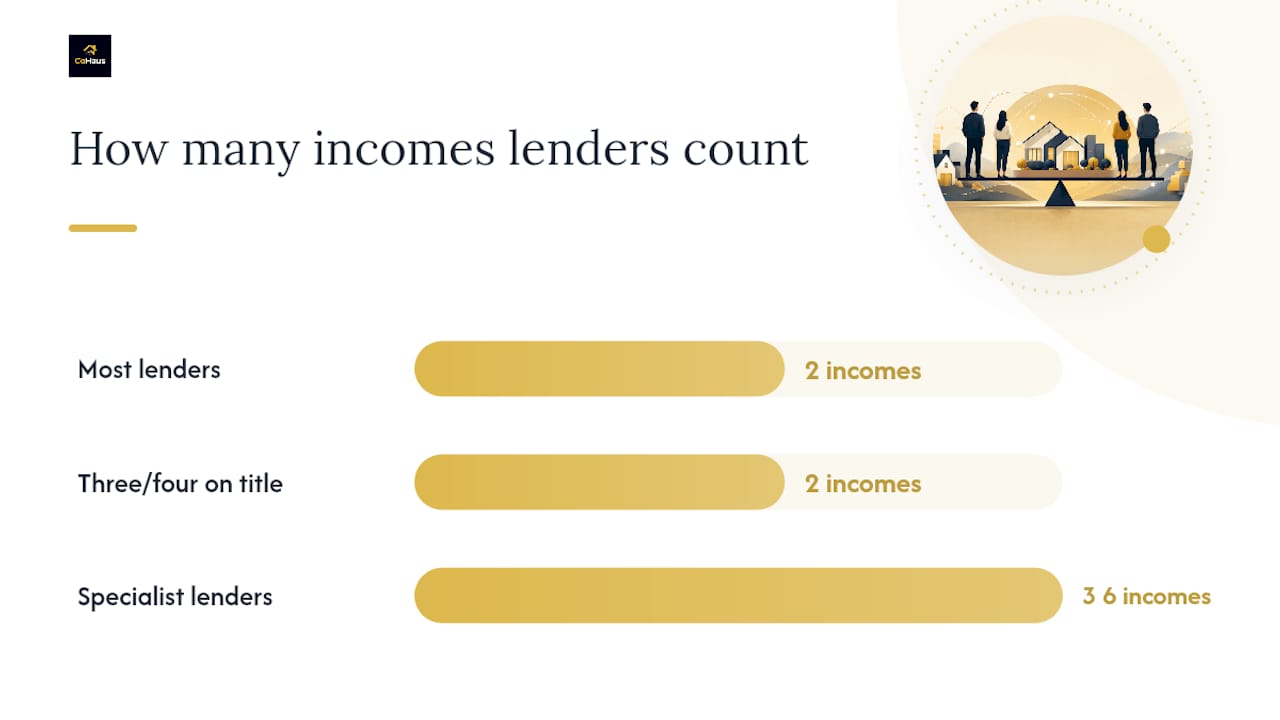
The gap between what's legally possible and what's commercially offered catches a lot of groups out. Many mainstream lenders cap applications at two people, full stop, regardless of how many names you'd like on the deeds. Others will let three or four people onto the title but only use the two highest incomes when calculating affordability, which means adding a third or fourth earner does nothing for your borrowing power even though they're legally on the hook.
What this means in practice:
- Two employed applicants: almost every lender will consider both incomes fully.
- Three or four applicants: expect most lenders to count only the top two salaries.
- Some lenders reserve multi-applicant products for family members only, excluding friend groups.
- A handful of specialist lenders will assess three or four incomes properly, but they're a minority and often require a broker to find.
- Parent-assisted purchases sometimes use JBSP arrangements instead of adding parents to the title (more on this below).
If you're buying with friends rather than a partner, this policy patchwork matters more than most people expect. Two friends earning similar salaries face a straightforward version of the process. Three or four friends pooling resources need to check, upfront, whether a lender's income-counting policy actually rewards them for having extra earners in the group.
Step-by-step affordability calculation for multiple buyers, with worked numeric examples
Here's the calculation lenders actually run, broken into its component steps:
- Add up combined gross annual income across the incomes the lender will count (usually the top two).
- Apply the lender's income multiple, typically between 4 and 4.5 times, to get the ceiling figure.
- Model monthly repayments at the lender's stressed interest rate, usually 6% to 8.5%.
- Deduct pooled committed outgoings, loans, car finance, credit card minimums, and dependant costs, from disposable income.
- Compare the multiple-based ceiling against the stress-tested affordability figure and take the lower one as your maximum loan.
Three worked examples show how differently this plays out.
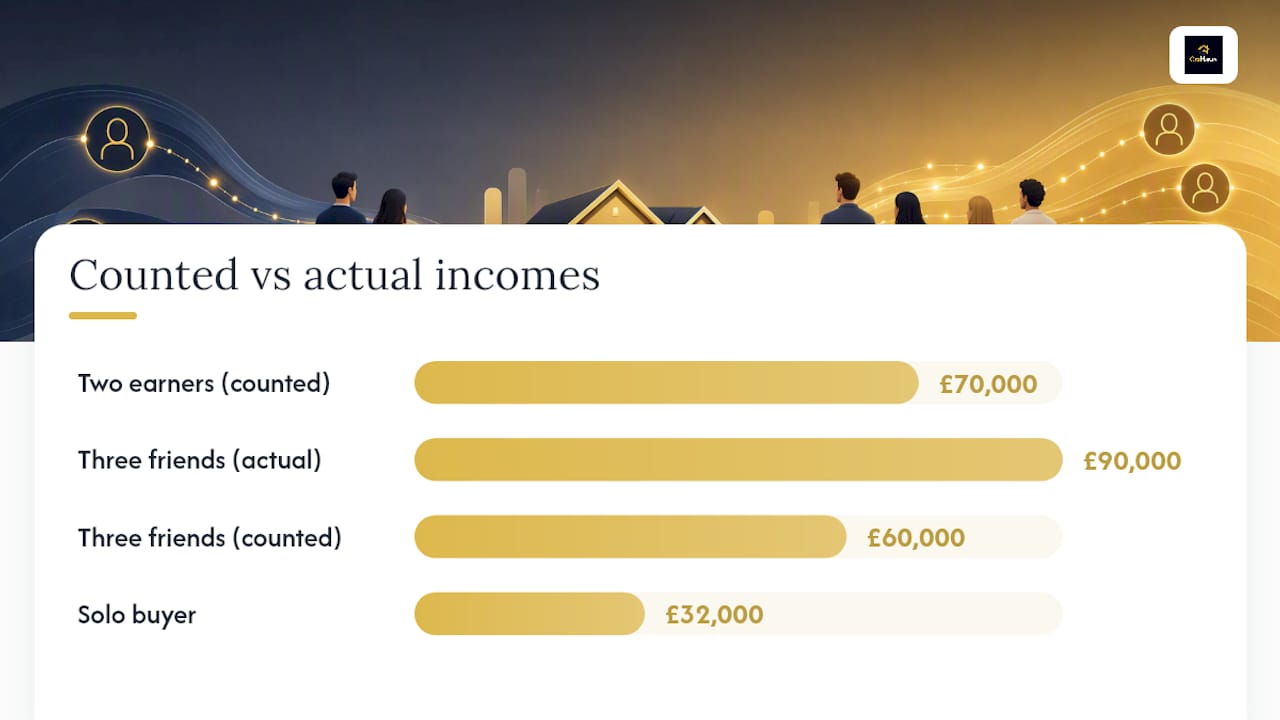
Two equal earners, no debts. Combined income of £70,000, no committed outgoings. At a typical 4.5 times multiple, the ceiling is roughly four and a half times the combined income.
Three applicants, only two counted. Three friends, each earning £30,000, apply together. The lender counts only the top two incomes, £60,000 combined, not £90,000. At around 4.25 times the counted incomes, the ceiling is notably lower than it would be if all incomes were counted. Adding a third earner bought them nothing under this lender's policy.
JBSP, parent-assisted case. A first-time buyer earning £32,000 wants to borrow more than their solo multiple allows. A parent joins as a JBSP applicant, adding income for affordability purposes without going on the title deeds. This can meaningfully lift the ceiling, but not every lender offers JBSP, and the parent takes on full liability for a property they don't own.
Pro Tip: Deposit size changes more than your loan-to-value band, it can also unlock entirely different lender products with more flexible multi-applicant rules, so a slightly larger pooled deposit is sometimes worth more than chasing a higher income multiple.
The gap between lenders on the same applicant set can run into tens of thousands of pounds, purely from differences in stress rate and expenditure assumptions.
Risks and legal responsibilities for co-buyers
Joint and several liability is the single most misunderstood part of buying with others, and it deserves attention before you sign anything.
It means each person named on the mortgage is individually responsible for the entire debt, not just their agreed share. If one co-buyer stops paying, the lender can pursue any or all of the others for the full amount. It doesn't matter whose fault the shortfall was.
There's a credit dimension too. A joint mortgage application creates a financial association on your credit file with everyone else on it. A missed payment by one applicant can drag down the credit scores of all applicants, affecting future borrowing long after the property is sold.
Before applying, sort out the legal groundwork:
- Agree a deed of trust setting out exactly what percentage share each buyer holds, especially if deposits weren't equal.
- Write down an exit plan: what happens if one person wants to sell, can't pay, or the relationship breaks down.
- Decide the ownership structure (more on this below) with a solicitor rather than defaulting to whatever the conveyancer suggests.
- Involve a solicitor early, not after an offer's accepted, since deeds of trust take time to draft properly.
- Keep a written record of who paid what towards the deposit, in case shares are ever disputed later.
None of this is paperwork for its own sake. It's the difference between a manageable disagreement and a legal mess three years into ownership.
Practical ways to maximise joint borrowing without unnecessary risk
Improving your group's borrowing position doesn't mean taking on more risk, it usually means tidying up what's already there.
- Check credit files with Experian, Equifax, and TransUnion well before applying, and dispute any errors that could be dragging scores down.
- Pay down revolving debt, credit cards, overdrafts, before applying, since lenders deduct committed outgoings from group affordability.
- Document a pooled deposit clearly, including where each contribution came from, and get gifted deposits confirmed in writing by the giver.
- Consider JBSP or guarantor arrangements when one applicant's income alone won't stretch far enough, but weigh the liability the helper takes on against the ownership they don't get.
- Set a clear ownership split and exit plan before applying, not after, since this reduces disputes and protects everyone's financial exposure if circumstances change.
Credit hygiene alone can shift outcomes more than people expect. A single applicant with a missed payment two years ago, now cleared, can still drag the whole group's stress-test result down if the lender's underwriting flags it.
Finding the right lender or broker for multi-applicant cases
Locating a lender that genuinely counts three or four incomes, rather than defaulting to the top two, is where a broker earns their fee. Brokers see policy differences across lenders that rarely make it onto public lender websites.
When you speak to a broker or lender, ask these questions directly:
- Which applicants' incomes will actually be counted in the affordability calculation?
- What stress rate is applied, and is it fixed or does it vary by product?
- How are bonuses, commission, and self-employed income treated?
- Does this lender offer JBSP, and under what conditions?
- What deposit and loan-to-value threshold unlocks better multi-applicant terms?
A lender or adviser who gives vague answers, or won't explain their income-counting policy in plain terms, is a signal to move on. Specialist advisers who work with multi-applicant and co-buying cases regularly will usually give you a straight answer within minutes, because they've asked the same question of dozens of lenders already.
Considerations for non-spouse or unrelated multiple buyers applying jointly
Buying with friends, colleagues, or other unrelated parties introduces a layer of planning that couples often skip. Lenders don't usually treat unmarried or unrelated applicants differently from a risk-assessment standpoint, the same income multiple and stress test apply, but some lenders do restrict multi-applicant products to family relationships only, so it's worth confirming this early rather than after a valuation's been booked.
The bigger consideration is practical rather than regulatory. Unrelated buyers rarely have the informal safety net a couple might assume exists, shared assumptions about splitting bills, staying together long-term, or one person covering a shortfall temporarily. That makes the deed of trust and exit plan genuinely essential rather than a nice-to-have.
It's also worth agreeing, in writing, how decisions get made once you own the property together: selling, renovating, taking in a lodger, or refinancing. Three or four unrelated adults with equal legal standing but no agreed decision-making process is a common source of friction that has nothing to do with the mortgage itself and everything to do with living arrangements afterwards.
Groups considering this route often find it easier to have these conversations structured from the outset, through a community or platform built around co-buying, rather than improvising legal and financial terms between friends as they go.
Effects of differing credit scores among multiple applicants on overall mortgage approval and rates
A joint application is only as strong as its weakest credit file. Lenders assess the group, not the individuals in isolation, which means one applicant with a patchy credit history can affect the interest rate offered, or the approval itself, for everyone.
This doesn't necessarily mean the whole application gets refused if one person's score is lower. Many lenders will still approve the mortgage, but at a higher interest rate reflecting the added risk, or with a smaller maximum loan than the stronger applicants' incomes alone would suggest. Some lenders are more sensitive to this than others, which is part of why broker-sourced comparisons matter for groups with mixed credit profiles.
The practical fix is sequencing: check every applicant's credit file with all three main agencies before applying, not after a mortgage adviser flags a problem mid-application. Small issues, a forgotten phone contract default, an old address error, are often fixable in weeks. Bigger issues, like a recent missed mortgage or loan payment, may need six months to a year of clean conduct before they stop affecting the group's rate meaningfully.
Implications of multiple incomes from varied employment types within joint applications
Mixing employment types across a joint application, one applicant employed, another self-employed, is common and entirely workable, but it changes how the numbers get built.
Employed income is usually straightforward: lenders take salary, sometimes with a portion of regular bonus or commission, and plug it straight into the calculation. Self-employed income is treated more cautiously. Lenders typically average the last two or three years of net profit or salary-plus-dividends, which means a self-employed applicant with a strong current year but a weaker previous one won't get full credit for their recent growth.
For a joint application, this averaging can drag down the group's combined income figure even when actual current earnings are healthy. It's worth flagging to a broker upfront if one applicant is self-employed, since some lenders are notably more generous than others in how they average or weight recent years, particularly for limited company directors versus sole traders.
How lenders assess future income growth or stability for multiple applicants
Lenders generally underwrite against current and historical income, not anticipated future growth, which surprises a lot of buyers expecting a promotion or new role to count in their favour.
That said, some allowances exist. A confirmed pay rise starting within a set period, backed by a signed contract or employer letter, is sometimes accepted. Newly qualified professionals in fields with predictable progression, medicine and law being common examples, occasionally get more favourable treatment from lenders familiar with those career paths. Probationary periods and short employment tenures, by contrast, tend to work against affordability, since lenders want to see income stability demonstrated, not promised.
For multiple applicants, this cuts both ways. If one earner has a long, stable employment history and another is newly self-employed or recently changed jobs, the newer income may be discounted or excluded entirely until it's proven over time. Groups planning a purchase around an expected future income jump should treat that jump as a bonus, not a guarantee, when budgeting what they can realistically borrow today.
Tax implications for multiple buyers on a mortgage
Stamp duty and capital gains tax both work differently once more than one buyer is involved, and the details matter more than most groups expect going in.
Stamp Duty Land Tax is charged on the whole purchase price, not per buyer, so adding more names to a mortgage doesn't reduce the tax owed. What can change the bill is first-time buyer status: if even one applicant in the group has owned property before, the group typically loses access to first-time buyer relief on the whole purchase, even if everyone else is buying for the first time.
Capital gains tax becomes relevant later, at sale. A property that's every co-owner's main residence usually qualifies for private residence relief, but if one buyer doesn't live there full-time, or the group later lets the property out, that owner's share of any gain may be taxable. Ownership shares recorded in a deed of trust also determine how any taxable gain gets split between co-owners, which is another reason that document needs to exist before, not after, a sale is on the table.
How ownership structure affects mortgage affordability and lending risk
Whether you register as joint tenants or tenants in common doesn't change the mortgage sum a lender will offer, but it changes what happens to your share afterwards, and lenders increasingly expect you to have thought this through.
Joint tenants own the whole property equally, with no individual shares, and if one owner dies, their portion passes automatically to the surviving owner regardless of any will. This structure suits couples buying with equal contributions who want simplicity.
Tenants in common hold defined, potentially unequal shares, say 60/40 reflecting unequal deposit contributions, and each person's share can be left to whoever they choose in a will. This is the far more common structure for friends, siblings, or unrelated groups buying together, precisely because contributions are rarely identical.
The lending risk implication is subtle but real: lenders don't underwrite differently based on this choice, but solicitors and brokers increasingly flag tenants in common as the safer default for any group without a marriage or long-term partnership behind it, because it forces the deposit-share conversation to happen before completion rather than during a dispute.
How Cohaus helps co-buyers reduce risk and act confidently
Structured co-buying works best when the financial and legal groundwork happens before an offer is accepted, not during a stressful chain. Cohaus supports this by helping groups arrange pooled deposits, put legal protections in place, and agree clear exit terms upfront, the same fundamentals this guide has walked through, but organised within a community built specifically for people doing this together.
A conventional joint purchase between two people who already know and trust each other can work perfectly well without extra structure. Where a community-based approach earns its place is with larger or less familiar groups, friends, colleagues, or matched co-buyers, where the informal assumptions a couple might rely on simply don't exist yet.
Getting these foundations right from the outset is what turns co-buying from a financial workaround into a genuinely manageable route onto the property ladder.
— Martin
Getting started with Cohaus
Cohaus exists for exactly the readers this guide is written for: people who could afford a home with others but have never had a structured way to organise the deposit, the legal paperwork, or the exit terms that make co-buying safe.

Some platforms build protections like community matching, legal templates for deeds of trust, and introductions to brokers and solicitors who understand multi-applicant cases into the process from the start, unlike relying solely on a broker to sort ownership splits and pooled deposits informally between friends. If you're weighing up a group purchase and want the financial and legal groundwork handled properly rather than improvised over group chat, visit the Cohaus platform to see how the matching and support process works, and take the first step towards a co-buying plan that's actually built to last. Before booking a broker introduction, a professional property inspection is also worth budgeting for, since lenders and co-buyers alike benefit from confirming a property's condition matches its price.
This article is general information, not a substitute for advice from a qualified financial advisor. Consult a qualified financial professional about your own circumstances before acting on anything here.
Sources
- Joint Mortgage Affordability: How Much Can Two People Borrow? (UK 2026)
- Getting a mortgage with a friend (landc)
FAQ
What is the 28% mortgage rule in the UK?
It's a general budgeting guideline suggesting monthly mortgage payments shouldn't exceed roughly 28% of gross monthly income, but UK lenders don't apply this as a formal rule, they use income multiples and stress-tested affordability calculations instead.
Do Muslims get 0% mortgages in the UK?
Some UK providers offer Sharia-compliant home purchase plans structured around rent and ownership rather than interest, though these aren't literally "0% mortgages" in the conventional sense, and availability depends on the specific lender.
What are the affordability mortgage rules in the UK?
Lenders apply an income multiple, typically 4 to 4.5 times combined income, then stress-test repayments at a higher rate, commonly 6% to 8.5%, and lend against whichever figure is lower.
What salary do I need for a £600k mortgage in the UK?
At a 4.5× income multiple, you'd typically need combined gross income in the low six figures, though the actual figure depends on your deposit size, outgoings, and the specific lender's stress-test rate.
Can multiple buyers get a mortgage together in the UK?
Yes, up to four people can legally be named on a mortgage, but many mainstream lenders cap applications at two applicants or only count the two highest incomes for affordability purposes.