
A co-borrower shares repayment liability from day one and usually holds a legal ownership claim to the property. A guarantor steps in only when the primary borrower defaults, and typically has no ownership rights at all.
- Who pays: A co-borrower pays alongside the primary borrower from the start. A guarantor pays only if the primary borrower cannot.
- Who is on the title: A co-borrower is usually named as a legal owner. A guarantor is not on the title register.
- When liability begins: Co-borrower liability starts at completion. Guarantor liability is triggered by default, and in regulated agreements, only after a properly served default notice.
Key takeaways
A co-borrower is liable from day one and holds an ownership claim; a guarantor's liability is contingent on default and carries no ownership rights, making the legal form and trigger conditions the most important things to check before signing.
| Point | Details |
|---|---|
| Liability starts differently | Co-borrower liability begins at completion; guarantor liability only triggers on default, and requires a valid default notice for regulated agreements. |
| Ownership is the decisive split | Co-borrowers are registered at Land Registry; JBSP supporters and guarantors hold no ownership interest despite repayment obligations. |
| Deed vs contract matters | A guarantee executed as a deed carries a twelve-year limitation period; a simple contract carries six years. |
| Independent legal advice is essential | JBSP lenders require it; for guarantees it is strongly recommended so supporters understand their limited rights. |
| Negotiate caps and limits | "All monies" and cross-guarantee clauses can extend liability far beyond the original loan; a written hard cap reduces that exposure. |
Table of Contents
- What do "co-borrower" and "guarantor" actually mean in the UK?
- How do the legal and financial differences compare?
- Where are guarantors and co-borrowers commonly used in the UK?
- What does each role mean for you personally?
- How can supporters limit their risk before signing?
- UK-specific rules and lender practices you need to know
- Three UK scenarios to help you decide which role to accept
- Why clear role definitions matter for co-buying
- Sources
What do "co-borrower" and "guarantor" actually mean in the UK?
These two roles sound similar but carry very different legal weight. Getting them confused before you sign anything is a costly mistake.
Co-borrower is the everyday term for a joint applicant on a mortgage or loan. Every co-borrower is assessed against the lender's criteria, is jointly and severally liable for every payment, and normally holds a legal interest in the property. Barclays describes joint mortgages as arrangements where all applicants share repayment liability and each has a legal claim to ownership. That ownership claim is registered at HM Land Registry and cannot simply be removed without the co-borrower's consent.
Guarantor is a secondary role. The guarantor is assessed like a borrower for affordability purposes but is not named on the title and does not receive any share of the property. Their liability is contingent: it only crystallises when the primary borrower fails to pay. As John Charcol's guarantor mortgage guide explains, guarantor mortgages assess the guarantor similarly to a borrower but leave them off the title and make them responsible only if the primary borrower cannot meet payments.
UK lenders also use several product labels that map onto these definitions in different ways.
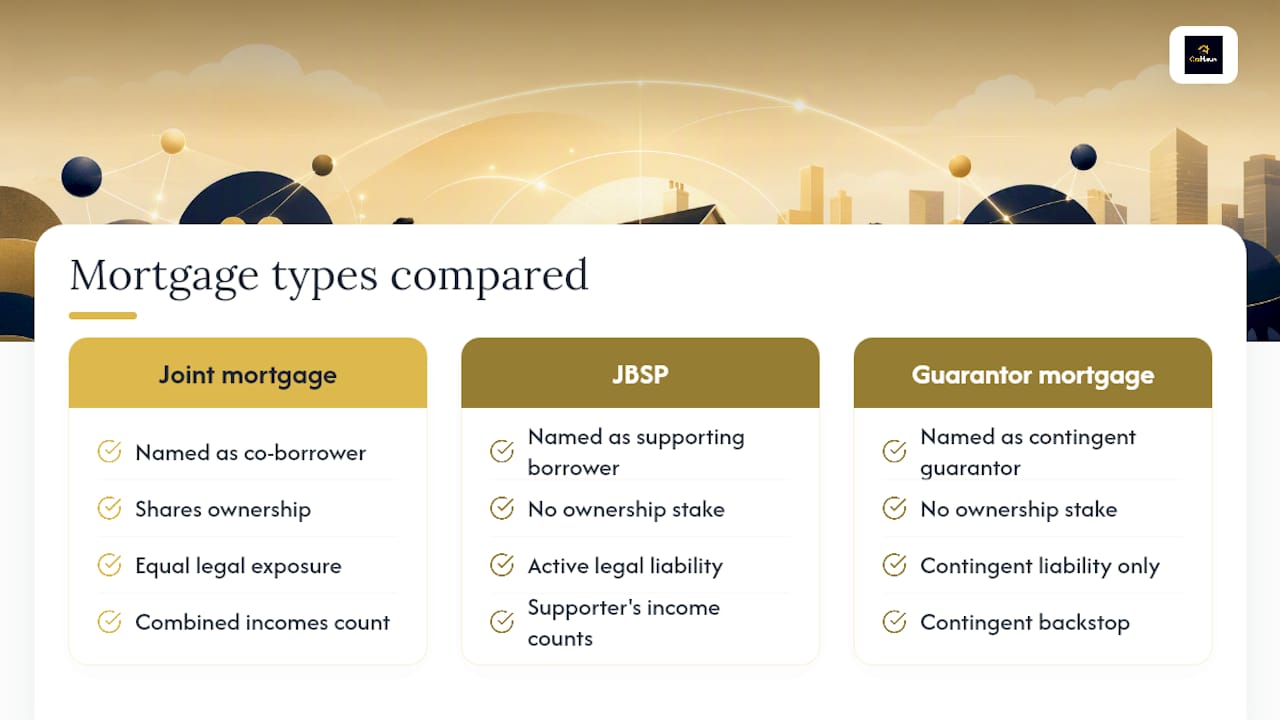
- Joint mortgage: all applicants are co-borrowers with ownership rights.
- Joint Borrower Sole Proprietor (JBSP) / Mortgage Boost: the supporting person is named on the mortgage and shares repayment responsibility from day one, but is not a legal owner of the property. Barclays' Mortgage Boost product is a well-known example; Skipton Building Society offers a similar arrangement called an Income Booster.
- Guarantor mortgage: the guarantor is off the title and off the mortgage deed unless called upon; their liability is contingent on default.
How do the legal and financial differences compare?
The table below maps the key dimensions lenders and solicitors use to distinguish the two roles.
| Dimension | Co-borrower (joint mortgage) | JBSP / supporting borrower | Guarantor |
|---|---|---|---|
| Liability trigger | From completion | From completion | On default only |
| Repayment responsibility | Ongoing, joint and several | Ongoing, joint and several | Contingent on primary borrower's failure |
| Ownership / title | Yes, registered at Land Registry | No ownership interest | No ownership interest |
| Credit reporting | Mortgage appears on credit file from day one | Mortgage appears on credit file from day one | Reported on default or if called upon |
| Independent legal advice | Not always required | Usually required by lender | Strongly recommended; required by some lenders |
| Duration / revocability | Until mortgage is redeemed or title transferred | Until mortgage is redeemed | Depends on guarantee wording; often irrevocable |
| Typical formality | Mortgage deed | Mortgage deed plus ILA certificate | Separate guarantee document (deed or contract) |
When a lender enforces against a co-borrower, they can pursue any co-borrower for the full outstanding balance immediately. There is no need to prove the primary borrower has defaulted first. With a guarantor, the lender must first exhaust remedies against the primary borrower (in most cases) and, for regulated agreements, serve a valid default notice before the guarantor's liability arises.
- A co-borrower's financial link to the property is direct and permanent until the mortgage is repaid or the title is restructured.
- A guarantor's exposure can feel abstract until enforcement begins, at which point it can be just as severe.
- UK Finance warns that personal guarantees are serious legal commitments, and that limitation periods and enforceability differ depending on whether a guarantee is executed as a deed or as a simple contract.
Pro Tip: Before signing either role, ask the lender to confirm in writing whether the guarantee or supporting borrower agreement is executed as a deed. A deed extends the limitation period from six years to twelve, which significantly changes your long-term exposure.
Where are guarantors and co-borrowers commonly used in the UK?
Mortgages
The most common co-buying scenario is a standard joint mortgage, where two or more people buy together, share the debt, and share ownership. For a joint mortgage with friends, all parties are co-borrowers with equal legal exposure.
JBSP arrangements have grown in popularity as an alternative to traditional guarantor mortgages, particularly for parents helping first-time buyers. The supporting parent is named on the mortgage and their income boosts affordability, but they hold no ownership stake. Lenders favour this structure because the supporter is an active borrower from day one rather than a contingent backstop. Our JBSP mortgage guide covers this in more detail.
Classic guarantor mortgage products still exist but are less common than they were a decade ago. Most lenders have shifted towards JBSP-style products because they are easier to underwrite and give the lender a cleaner claim against the supporting person.
Tenancy guarantees
Landlords in the private rented sector routinely ask for a guarantor when a tenant has limited income or credit history. The guarantor agrees to cover unpaid rent and, sometimes, damage costs if the tenant defaults. Shelter's tenancy guarantor guidance notes that guarantors can challenge claims based on undue influence or improper execution, so the guarantee document itself matters.
Commercial and small-business lending
Directors of small companies are frequently asked to provide personal guarantees for business loans, overdrafts, or commercial leases. These guarantees are often unlimited or "all monies" in scope, meaning they cover every debt the business owes the lender, not just the original facility. Cross-guarantees, where multiple directors each guarantee the other's obligations, add another layer of complexity.
What does each role mean for you personally?
Credit reports and borrowing capacity
As a co-borrower, the mortgage appears on your credit file from the moment it completes. Any missed payment is recorded against you, regardless of who actually failed to pay. This also reduces your available borrowing capacity if you later want to take out a separate mortgage or loan, because lenders count the full joint mortgage balance as your liability.
A guarantor's credit file is generally unaffected unless the guarantee is called upon. At that point, enforcement action and any subsequent default will be reported. The practical risk is that you can go years believing your credit is clean, then face a sudden and serious impact.
Joint and several liability
Both co-borrowers and guarantors who are called upon can face joint and several liability, meaning the lender can pursue any one of them for the full outstanding amount. If your co-borrower stops paying, you owe everything. The lender has no obligation to split the debt equally.
Sale, exit, and remortgage
A co-borrower cannot be removed from the mortgage without the lender's consent and a formal remortgage or transfer of equity. This affects retirement planning, future borrowing, and what happens if the relationship between co-buyers breaks down. For supporters in a JBSP arrangement, the same applies: they remain on the mortgage until it is redeemed or restructured, even though they have no ownership interest to show for it.
Guarantors tied to an "all monies" clause face a different problem. Their exposure is not limited to the original loan amount but extends to any future borrowing the primary borrower takes with the same lender. Mondaq's practitioner guide highlights the risks of "all monies" and cross-guarantee drafting and recommends negotiating caps or revocation clauses wherever possible.
How can supporters limit their risk before signing?
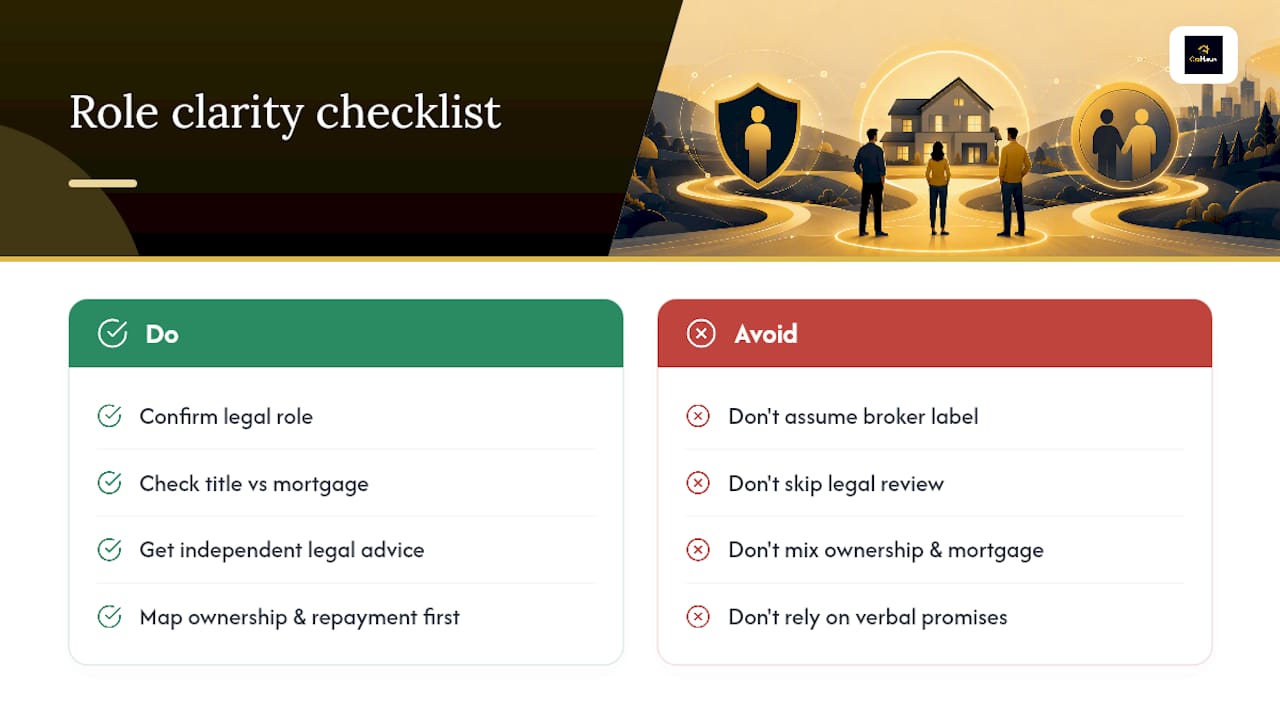
These are the questions to put to your solicitor and lender before you commit to either role.
- Am I named on the title register? If yes, you are a co-borrower with ownership rights. If no, confirm whether you are a supporting borrower (JBSP) or a guarantor.
- What exactly triggers my liability? For a guarantor, ask for the precise default event in writing. For a supporting borrower, confirm that liability starts at completion.
- Is the guarantee capped? Ask for a written hard cap on the maximum amount you can be asked to pay. Unlimited guarantees are common but negotiable in some contexts.
- Is this a deed or a contract? A deed carries a twelve-year limitation period; a contract carries six. The difference matters if enforcement is delayed.
- Can I revoke the guarantee? Many guarantees are irrevocable once signed. If revocation is possible, ask under what conditions and what notice period applies.
- Will the lender notify me before calling the guarantee? Ask for a written commitment that you will be informed before enforcement begins.
- Will the lender's product changes affect my liability? Ask whether a remortgage, rate change, or product switch by the primary borrower automatically extends your obligation.
- Do I need independent legal advice? For JBSP arrangements, most lenders require it. For guarantees, it is strongly recommended even when not mandatory.
Pro Tip: Ask your solicitor to obtain a written hard cap on your guarantee exposure and to confirm in a certificate what rights you do and do not hold. For JBSP arrangements, the independent legal advice requirement is not a formality: the solicitor must explain that you share repayment liability but hold no ownership interest, which matters significantly if the relationship with the primary borrower breaks down.
UK-specific rules and lender practices you need to know
JBSP and Mortgage Boost
JBSP arrangements sit in a distinct legal position. The supporting borrower is a party to the mortgage deed and is jointly and severally liable for repayments from day one, but their name does not appear on the title register. Barclays' Mortgage Boost and Skipton's Income Booster both operate on this basis. Lenders typically require the supporting borrower to obtain independent legal advice so that a solicitor can confirm the supporter understands they are taking on repayment liability without gaining any ownership rights.
The decisive test, as John Charcol notes, is whether the supporter is treated as an ongoing borrower or as a contingent backstop. JBSP makes the supporter an ongoing borrower. A traditional guarantor mortgage makes them a backstop.
Consumer Credit Act 1974 and default notices
For guarantees attached to regulated consumer credit agreements, the Consumer Credit Act 1974 rules add a procedural layer. The lender must serve a valid default notice on the primary borrower and allow the statutory cure period to expire before the guarantor's liability can be triggered. A guarantee that does not meet the Act's form requirements may also be unenforceable. This procedural protection does not apply to mortgage guarantees, which are not regulated under the Act.
Deed vs contract: why the form matters
UK Finance's guidance is clear that the form of a guarantee has real consequences for how long a lender can pursue a guarantor after a default. A guarantor who signed a deed in 2014 could still face a claim in 2026.
Pro Tip: Check whether your guarantee document contains an "all monies" clause. If it does, your liability is not limited to the original loan amount but extends to any future debt the primary borrower incurs with the same lender. Negotiate a specific cap tied to the original facility before you sign.
Three UK scenarios to help you decide which role to accept
-
Scenario A: Parent helping a first-time buyer. A parent wants to help their child buy a flat but does not want to own part of the property, partly to avoid additional Stamp Duty Land Tax on a second property. A JBSP arrangement is usually the better fit here. The parent's income boosts the mortgage offer, they share repayment liability, but they hold no ownership interest and the child is the sole proprietor. A traditional guarantor mortgage achieves a similar affordability outcome but gives the lender a weaker claim against the parent, which is why many lenders no longer offer them. Independent legal advice is required in either case, and a solicitor should explain the Stamp Duty position clearly. First-time buyers using a supporter may also want to review first-time buyer tax credit options before proceeding.
-
Scenario B: Friend acting as a tenancy guarantor. A friend asks you to guarantee their private tenancy. The guarantee covers unpaid rent and potentially damage costs. Your liability is limited to what the guarantee document specifies, so read it carefully before signing. Shelter's guidance confirms that guarantors can challenge claims based on undue influence or improper execution, but prevention is far easier than a legal challenge after the fact. Ask for the guarantee to be limited to the initial fixed term and to a specific monetary cap.
-
Scenario C: Director providing a personal guarantee for a business loan. A lender asks a company director to personally guarantee a business overdraft. The guarantee is likely to be unlimited and executed as a deed, giving the lender twelve years to pursue the director after any default. If there are multiple directors, a cross-guarantee may mean each director is liable for the others' obligations too. Mondaq's practitioner guidance recommends negotiating a hard cap tied to the original facility and, where possible, a time limit after which the guarantee lapses if no default has occurred.
Why clear role definitions matter for co-buying
At Cohaus, we see this confusion play out regularly. People agree to "help" a friend or family member buy a home without fully understanding whether they are becoming a co-owner, a supporting borrower, or a guarantor. Each role carries a different set of rights and risks, and the label a broker uses in conversation does not always match the legal document you are asked to sign.
Our platform guides co-buyers through the ownership and repayment structure before anyone approaches a lender. We highlight the distinction between being on the mortgage and being on the title, because those two things can be separated in a JBSP arrangement in ways that surprise people later. We also point participants towards independent legal advice as a non-negotiable step, not a box to tick.
If you are exploring co-buying and want to understand how shared deposits, mortgage responsibilities, and exit terms work in practice, the Cohaus articles hub is a good place to start. Our deed of trust guide is particularly relevant if you are considering a structure where ownership shares differ from mortgage contributions.
Sources
- Buying a property with others | Joint and guarantor mortgages | Barclays
- Guarantor Mortage Advice | Guides by John Charcol
- Understanding personal guarantees (UK Finance)
- In practice: advising a guarantor (Mondaq)
This article is general information, not a substitute for advice from a qualified financial advisor. Consult a qualified financial professional about your own circumstances before acting on anything here.