The average UK property transaction now takes 170 days from offer acceptance to completion, with roughly one in five deals collapsing before they reach the finish line. A cash purchase with no chain can still complete quickly, whereas a leasehold sale in a long chain routinely takes significantly longer. The single biggest lever you have is timing: instruct a conveyancer and gather your paperwork early, ideally before an offer is accepted.
TL;DR:
- Early instruction of a conveyancer can save up to six weeks by starting anti-money laundering checks and paperwork before an offer is made.
- Leasehold and chain transactions regularly take 14 to 24 weeks or longer, mainly due to delays in managing agent responses and chain coordination.
- Local authority searches can add between one to eight weeks depending on the council's turnaround time.
- A typical mortgage purchase on a freehold with no chain takes around 8 to 12 weeks, but long or complex chains can extend beyond 24 weeks on average.
- Preparing all documents, such as ID, proof of funds, and seller's packs, before listing or making an offer significantly reduces overall conveyancing time and fall-through risk.
Table of Contents
- Conveyancing stages UK: what happens between instruction and completion
- How long does conveyancing take for different buyer types?
- What causes conveyancing delays, and how long do they add?
- How can you speed up conveyancing and cut fall-through risk?
- Worked timeline examples: three realistic scenarios
- Why collaborative preparation shortens the timeline
- The 2026 conveyancing reality nobody's pricing in
- Sources
- FAQ
Conveyancing stages UK: what happens between instruction and completion
Every UK property purchase moves through the same broad stages, but the gaps between them are where the real variation happens. Knowing who owns each step, and roughly how long it should take, is the difference between chasing your solicitor weekly and knowing exactly when to expect news.
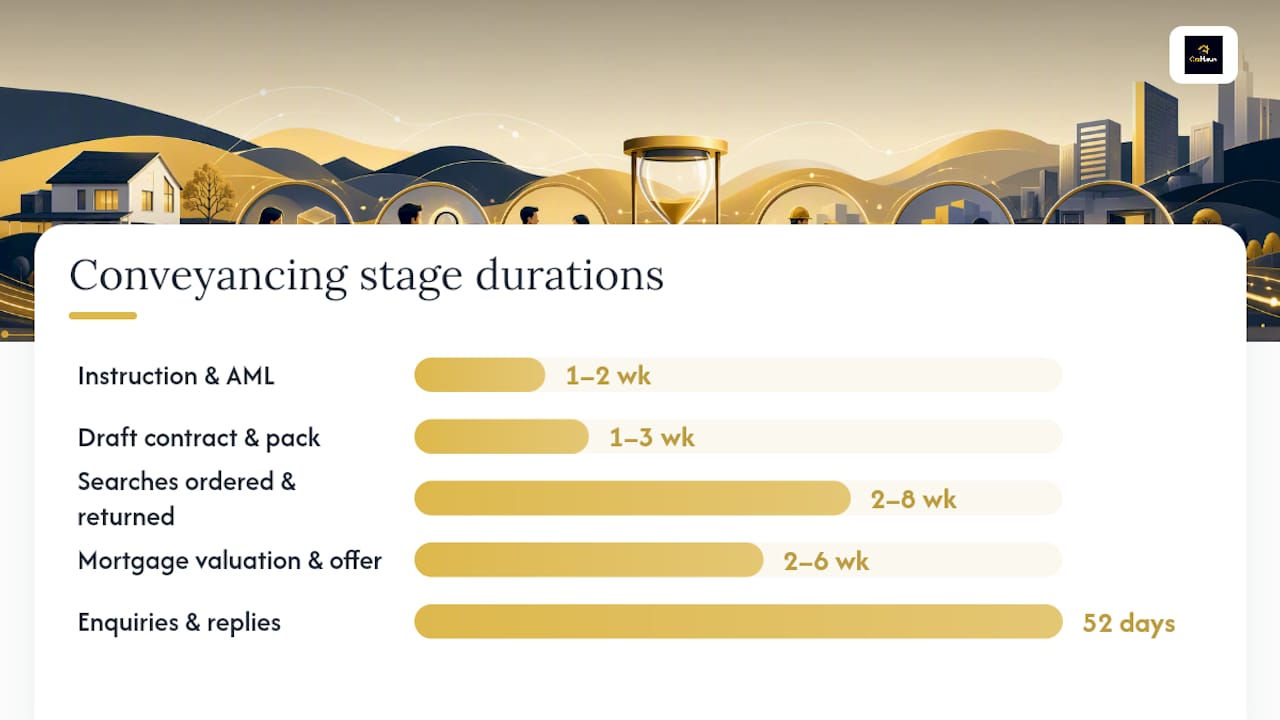
Instruction and anti-money laundering checks (1 to 2 weeks). Your conveyancer verifies identity, source of funds, and runs anti-money laundering checks the moment you instruct them. This can happen before you've found a property, which is why early instruction saves real time later.
Draft contract and seller's pack (1 to 3 weeks). The seller's solicitor drafts the contract and pulls together the property information forms (TA6), fittings and contents form (TA10), title documents, and any leasehold pack. A seller who has this ready before listing, rather than scrambling once an offer lands, can cut this stage substantially.
Searches ordered and returned (2 to 8 weeks). Local authority searches cover planning, environmental, and drainage matters, and turnaround varies enormously by council. Propelr's data puts the typical range at one to eight weeks, meaning your postcode can add or remove a month from your timeline before anyone has done anything wrong.
Mortgage valuation and formal offer (2 to 6 weeks). The lender's surveyor values the property, and the underwriting team issues a formal mortgage offer. Straightforward cases with a clean credit file and standard property type move faster; anything unusual (non-standard construction, short lease, complex income) adds weeks.
Enquiries and replies. Once searches and the mortgage offer are in, your solicitor raises enquiries based on what's come back. Propelr reports that a full round of replies averages around 52 days, and solicitors spend roughly 41% of their working time chasing third parties rather than working the file directly. Expect two or three rounds of back-and-forth on anything but the simplest transaction.
Exchange and completion. Exchange of contracts is the point everyone actually wants to reach: it's the moment the deal becomes legally binding, deposits are released, and a completion date is locked in. Gov confirms this is genuinely the first fixed commitment in the whole process, not the offer itself.
Post-completion. After keys change hands, your solicitor submits the Stamp Duty Land Tax return and applies to HM Land Registry to register you as the new owner, typically within days of completion though the registration itself can take longer to process.
A few of these stages overlap in practice:
- Searches, mortgage valuation, and enquiries often run in parallel rather than sequence
- AML checks and initial contract drafting can happen while you're still viewing properties
- Later enquiry rounds frequently continue right up to the week before exchange
How long does conveyancing take for different buyer types?
Your scenario matters more than any single average. A cash buyer purchasing a freehold with no chain is working a fundamentally different timeline to someone buying a leasehold flat with a chain above and below them.
| Scenario | Typical time to completion |
|---|---|
| Cash purchase, freehold, no chain | 4 to 6 weeks |
| Mortgage purchase, freehold, no chain | 8 to 12 weeks |
| Mortgage purchase, short chain (one link) | 8 to 12 weeks |
| Leasehold purchase | 14 to 24 weeks |
| Long or complex chain | 14 to 24+ weeks |
| New build | Variable, tied to build completion stage |
These bands broadly track NPS Law's 2026 guidance, and Connells Group's own analysis found average time from offer to exchange alone had passed 100 days by April 2026, with leasehold purchases typically taking around 155 days to exchange on their own.
Leasehold transactions run long for a specific reason: your solicitor needs a full management pack from the freeholder or managing agent, covering service charge accounts, building insurance, and any planned major works. Managing agents are frequently slow, understaffed, or simply unresponsive, and there's no statutory deadline forcing their hand.
New builds follow a different logic entirely. Your timeline is tied to the developer's build programme, not just legal process, so exchange might happen months before completion, with a long-stop date rather than a fixed one. Chain length adds its own drag, too. Each additional link means your completion date depends on someone else's completion date, and one slow party anywhere in the chain can stall everyone behind them.
What causes conveyancing delays, and how long do they add?
Most delays trace back to a small number of recurring bottlenecks, and each one has a rough cost in added weeks.
Here's what tends to slow a transaction down, and by how much:
- Local authority searches: 1 to 8 weeks depending on the council, with no consistency between neighbouring boroughs
- Leasehold management packs: unresponsive managing agents can add 4 to 8 weeks on their own
- Incomplete TA6/TA10 forms or slow seller replies: each round of missing information adds 1 to 2 weeks
- Mortgage valuation issues or lender queries: down-valuations or unusual property types can add 2 to 4 weeks
- Title defects or missing deeds: can add several weeks unless resolved via indemnity insurance
That last point deserves attention. Indemnity insurance is widely used as a practical workaround for historic paperwork gaps, such as a missing building regulations certificate for an old extension. It doesn't fix the underlying legal issue, but where a lender and solicitor accept it, it can avoid weeks of delay at relatively low cost. Raise the possibility early if your solicitor flags a missing document, rather than waiting to see if a search turns up a problem.
A significant share of transactions do not complete. Moving Compared's mid-2026 figures put average moving costs at £13,018 per transaction, which is exactly why a collapsing chain late in the process is so costly, not just in time but in money already spent on searches, surveys, and legal fees.
How can you speed up conveyancing and cut fall-through risk?
Priority matters here. Some actions save weeks; others save days. Do these roughly in this order.
- Instruct a conveyancer before your offer is even accepted. AML checks and initial paperwork can start immediately, rather than adding a week once you're under offer.
- If you're selling, prepare your pack and order searches before listing. Landmark research cited by the Law Society found that 89% of sellers would do exactly this if it sped up their sale.
- Assemble your ID, proof of funds, and mortgage documents in the first week. Have certified copies and bank statements ready rather than hunting for them when your solicitor asks.
- If you're buying leasehold or new build, choose a conveyancer with a dedicated team for that property type. Specialist teams navigate managing agents and developer processes noticeably faster than generalists.
- Ask about indemnity insurance the moment a title or paperwork gap appears, rather than waiting for a full resolution that might take weeks.
- Agree response times with your conveyancer upfront, and keep communication in writing so nothing gets lost in a phone queue.
Pro Tip: Ask your conveyancer directly how many other files they're handling right now. A caseload of 150+ active files per person is common industry-wide, and it's a fair predictor of how quickly your emails will get answered.
Worked timeline examples: three realistic scenarios
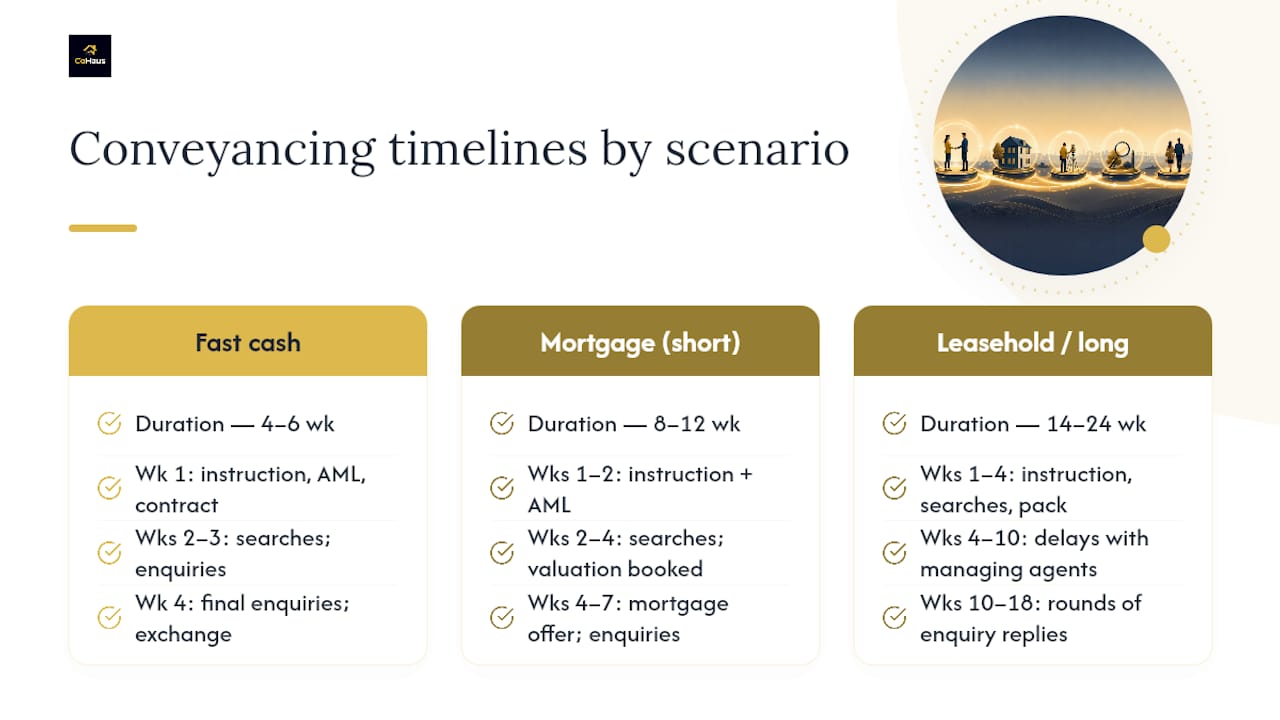
Fast cash purchase, no chain (4 to 6 weeks). Week 1: instruction, AML checks, and initial contract sent. Weeks 2 to 3: searches ordered and returned (expedited without mortgage involvement), enquiries raised and answered. Week 4: final enquiries closed, exchange. Weeks 5 to 6: completion, often same week as exchange since there's no mortgage offer to wait for.
Mortgage purchase, freehold, short chain (8 to 12 weeks). Weeks 1 to 2: instruction and AML checks. Weeks 2 to 4: searches ordered, valuation booked. Weeks 4 to 7: mortgage offer issued, enquiries raised in parallel with search returns. Weeks 7 to 10: enquiry replies, second round of queries, chain coordination. Weeks 10 to 12: exchange, followed by completion within days to a fortnight.
Leasehold or long chain (14 to 24 weeks). Weeks 1 to 4: instruction, searches, and the request for a leasehold management pack. Weeks 4 to 10: this is where delays cluster, waiting on managing agents, chasing chain links, resolving enquiries raised by multiple solicitors simultaneously. Weeks 10 to 18: rounds of enquiry replies, chain-wide coordination on a completion date. Weeks 18 to 24: exchange, then completion, sometimes with a short gap if a link in the chain needs extra time.
On exchange day, deposits move, dates are fixed, and the deal becomes binding. On completion day, funds transfer, keys are released, and your solicitor files the Stamp Duty return before applying to HM Land Registry to register the change of ownership.
Why collaborative preparation shortens the timeline
Co-buying introduces an extra layer of coordination, and at Cohaus we've seen that the transactions which move fastest are the ones where every party's paperwork is sorted before a solicitor ever asks for it. Shared deposits and joint mortgage applications can trigger extra lender checks, so having proof of funds and identity documents ready for every co-buyer at once avoids the stop-start pattern that adds weeks.
The friction in most co-buying transactions isn't the ownership structure itself. It's that one co-buyer's documents arrive on week one and another's arrive on week four, and the whole file waits on the slowest person.
Our resources on finding a co-buyer you can trust and setting out a cohabitation agreement both point to the same lesson: sort the legal and financial groundwork between co-buyers before you instruct a solicitor, not after. If you're weighing up whether to hire a conveyancer or solicitor, pick one with genuine experience handling multiple buyers on a single mortgage. It matters more for co-buyers than for a straightforward couple purchase.
The 2026 conveyancing reality nobody's pricing in
Most guidance on conveyancing still talks as though eight to twelve weeks is normal. It isn't, not anymore. The Law Society's own research shows a widening gap between what buyers expect and what the market actually delivers, and the 170-day average is proof the industry hasn't caught up with its own workload.
The conventional advice, get a good solicitor and wait, misses the point. Solicitors aren't slow because they're incompetent. They're slow because they spend nearly half their time chasing councils, managing agents, and other solicitors who are themselves under-resourced. No amount of client patience fixes a managing agent that takes six weeks to answer an email.
What actually moves the needle is removing friction before the file even opens: sellers with packs ready, buyers with documents assembled, co-buyers with their financial arrangements settled. That's not a nice-to-have squeezed in around the edges of a purchase. It's the only part of the timeline you genuinely control, which is exactly why it deserves more attention than most buyers give it.
— Martin
Sources
- Conveyancing delays push average UK home transaction to 170 days | Mortgage Introducer
- Average time from offer to exchange (Propelr)
- Conveyancing delays push time to exchange contracts past 100 days | Connells Group
- Gov
FAQ
What is the average conveyancing time in the UK in 2026?
The average UK property transaction takes 170 days from offer acceptance to completion, though a cash purchase with no chain can complete in four to six weeks.
What is the typical conveyancing timeline UK buyers should expect?
Expect roughly 8 to 12 weeks for a straightforward mortgage purchase on a freehold with no chain, rising to 14 weeks or more for leasehold properties or longer chains.
How quickly can conveyancing be done in the UK?
The fastest realistic timeline is 4 to 6 weeks, achievable only with a cash buyer, a freehold property, and no chain on either side.
Is 2026 a good time to buy a house in the UK?
Timing a purchase around market conditions matters less than preparation. With average transaction times at 170 days and roughly one in five deals falling through, buyers who instruct a conveyancer early and have documents ready reduce their own risk regardless of when they buy.