
Each co-owner pays capital gains tax only on their own beneficial share of a property gain, not on the whole sale. Every individual also has their own annual exempt amount, currently £3,000 for 2025/26, which reduces their taxable slice separately from any other owner. For most UK residential property sales, each person who owes tax must report and pay it within 60 days of completion.
TL;DR:
- Co-owners pay capital gains tax only on their own share of the gain, determined by ownership structure and beneficial interest, not the whole property.
- Transfers between spouses are tax-free, but any beneficial ownership adjustments should be documented before sale to maximize exemptions.
- Each co-owner reports and pays their CGT within 60 days from completion, using separate accounts and filings, as interest and penalties accrue individually.
- The amount of Private Residence Relief varies depending on actual occupation, not just ownership split, affecting taxable gains separately for each owner.
- Properly documenting ownership shares and gathering relevant costs beforehand helps prevent disputes and ensures HMRC compliance during sale.
Table of Contents
- How capital gains tax applies to jointly owned property
- How to calculate CGT on a jointly owned property sale
- Reliefs that change the outcome: PRR, spouses, and Form 17
- Reporting deadlines and the 60-day rule
- What happens on death, separation, or with a non-resident owner
- A practical checklist before you sell
- The CoHaus perspective: why documentation prevents disputes
- Plan your co-buying journey with CoHaus
- Where to check the official rules
- Sources
- FAQ
How capital gains tax applies to jointly owned property
A chargeable disposal happens whenever you sell, gift, or otherwise give up your interest in a property that has grown in value since you acquired it. For co-owners, the tax office does not look at the sale as one lump sum split evenly by default. It looks at who actually owned what.

Beneficial ownership, not just the name on the Land Registry title, decides who pays what. HMRC will look at Form 17 declarations, the original purchase deed, who paid the deposit and mortgage instalments, and who received the sale proceeds. Two friends who bought a flat together on a handshake agreement, for instance, may find HMRC defaults to an equal split unless there's paperwork saying otherwise.
The way you hold title matters:
- Joint tenants are treated as owning equal shares, full stop. There's no room to argue one person put in 70% of the deposit unless the ownership structure is changed.
- Tenants in common can hold defined, unequal shares. If the deed says 60/40, HMRC generally works to that split when calculating each person's gain.
- Switching from joint tenants to tenants in common (severing the tenancy) is possible before a sale, but it needs proper legal documentation, not a verbal agreement between co-owners.
If you and a co-owner disagree about who owns what percentage, sort it out with a solicitor before you exchange contracts, not after.
How to calculate CGT on a jointly owned property sale
Working out the bill is mechanical once you have the right figures. The tricky part is doing it per person, not per property.
- Calculate the total chargeable gain. Take the sale price, subtract allowable costs (legal fees, estate agent fees, stamp duty on purchase), then subtract the original acquisition cost and any qualifying capital improvements.
- Apply each owner's beneficial share. Multiply the total gain by each person's percentage of ownership to get their individual gain.
- Deduct the personal annual exempt amount and apply the right rate. Each owner subtracts their own £3,000 exempt amount, then pays tax on the remainder at the residential property rate matching their income tax band.
Here's a worked example for two co-owners, Sam and Priya, who jointly owned a buy-to-let flat as tenants in common with a 50/50 split.
Sam is a basic rate taxpayer and pays CGT on residential property at the lower rate; Priya is a higher rate taxpayer and pays at the higher rate. Even though they split the gain equally, their final tax bills differ because their income tax bands differ. That's the detail people miss: a 50/50 ownership split does not mean a 50/50 tax bill.
Reliefs that change the outcome: PRR, spouses, and Form 17
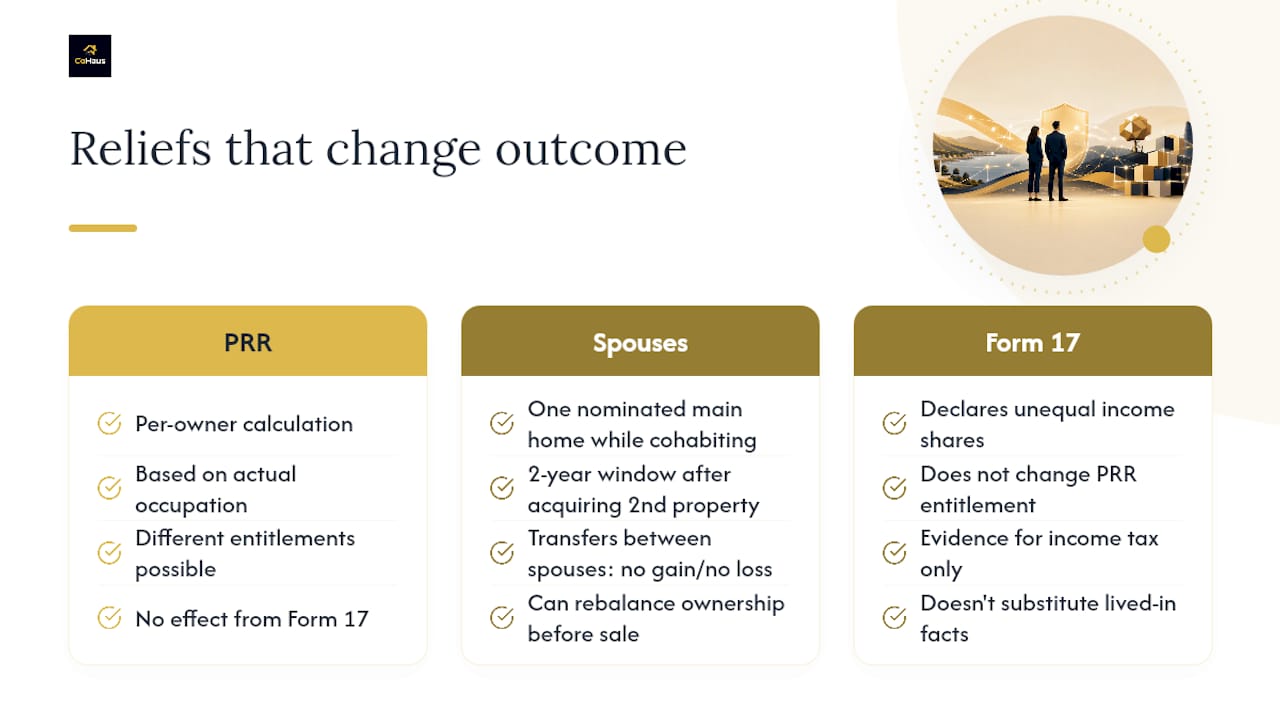
Private Residence Relief (PRR) is worked out separately for each owner, based on their own qualifying occupation of the home. If one co-owner lived in the property for the entire ownership period and the other moved out after two years to work abroad, their PRR entitlement will differ, even though they own equal shares.
Married couples and civil partners face an extra rule: while living together, you can only nominate one main residence between you. If you own two properties between you, you have a two-year window from acquiring the second one to make that nomination to HMRC. Miss the window and HMRC decides for you based on the facts.
Transfers between spouses or civil partners who live together are treated on a "no gain, no loss" basis, which means no immediate CGT charge on the transfer itself. This opens a genuine planning opportunity: rebalancing beneficial ownership before a sale so that both partners' £3,000 exemptions and lower tax bands get used efficiently.
Pro Tip: A Form 17 declaration evidences an unequal ownership split for income purposes, but it doesn't automatically shift Private Residence Relief. PRR follows who actually lived there, not what a form declares.
Any spousal transfer needs to be genuine and properly documented before contracts exchange. HMRC does not look kindly on paperwork created after the fact purely to reduce a tax bill.
Reporting deadlines and the 60-day rule
Completion date starts the clock. For most UK residential property disposals where tax is owed, each co-owner has 60 days from completion to report the gain and pay what's due, using the CGT on UK property service.
The responsibility sits with each individual, not with whoever handled the conveyancing:
- Your solicitor manages the legal transfer of the property, not your tax return. Assuming they'll file your CGT report is a common and costly mistake.
- Each co-owner needs their own Government Gateway account and must submit their own figures, even if the property was jointly held.
- Interest and penalties apply separately to each late filer, so one owner's delay doesn't protect the others from their own deadline.
- If you disagree with an HMRC calculation or penalty, you can appeal, and payment plans are available for those who can't pay in full immediately.
Practitioners who deal with this daily flag the same misconception repeatedly: co-owners assume a "lead" owner or their solicitor is filing on everyone's behalf. Confirm in writing, before completion, exactly who is filing what.
What happens on death, separation, or with a non-resident owner
Complications rarely arrive one at a time, which is exactly why co-owners need to know the rules before a life event forces the issue.
- Death of a co-owner. Where property is held as joint tenants, the surviving owner typically inherits the deceased's legal interest and their base cost is rebased to market value at the date of death. That's often good news for future CGT, since it can wipe out gains accrued before that point.
- Separation. Once you stop living together, you generally lose the ability to nominate the shared home as anyone's main residence going forward, though final-period relief rules may still soften the impact for the departing partner. Timing matters enormously here.
- Non-resident co-owner. If one owner has moved abroad, UK non-resident CGT rules interact with standard rules, and the non-resident owner will typically still have UK reporting obligations on a UK property sale. This is one area where specialist advice earns its fee.
A practical checklist before you sell
Getting the paperwork right before exchange saves arguments and HMRC penalties after completion.
- Agree and document beneficial ownership. Use a Form 17 declaration or a proper deed of trust, ideally before you exchange contracts, not during the sale process.
- Gather your cost evidence. Keep invoices for capital improvements, records of the original purchase price, and receipts for selling costs like agent and legal fees.
- Decide who registers the sale first. One owner typically creates the CGT on UK property account entry, but every co-owner still files their own individual return.
- Check your timing against the tax year. Selling just before or after 5 April can affect which year's exemption and income band applies to your gain.
Pro Tip: If you're rebalancing ownership between spouses to make better use of two exemptions, get the transfer documented and completed well before you put the property on the market, not once an offer is already on the table.
The CoHaus perspective: why documentation prevents disputes
Most tax disputes between co-owners trace back to one problem: nobody wrote anything down at the start. When people agree shared-deposit terms and exit routes clearly from day one, calculating a fair split at sale becomes straightforward rather than a fight over memory and assumptions.
Documenting ownership shares isn't just about a smoother sale. It's the exact evidence HMRC wants to see when working out who owes what.
— Martin
Plan your co-buying journey with CoHaus
Selling a jointly owned property runs far more smoothly when the ownership split, exit terms, and contribution records were agreed clearly from the start, rather than reconstructed under pressure years later. That's the gap this kind of co-buying platform exists to close for people buying together.

CoHaus gives co-buyers practical resources for getting this right from the outset: guidance on ownership splits, template language for cohabitation agreements, and a community of people who've already worked through the same questions about deposits, mortgages, and exit terms. If you're weighing up buying with friends, family, or a partner, visit CoHaus to explore community advice and get introduced to the solicitors and mortgage brokers who can help you set up beneficial ownership correctly before you ever need to think about a sale.
Where to check the official rules
- Gov: the core guidance on working out your gain as a joint owner.
- Report and pay Capital Gains Tax on UK property: the service used for the 60-day reporting requirement.
- HS283 Private Residence Relief helpsheet: full detail on PRR calculations.
For anything unusual, non-residence, complex trusts, or disputed ownership, speak to HMRC directly or a qualified tax adviser before you file.
This article is general information, not a substitute for advice from a qualified financial advisor. Consult a qualified financial professional about your own circumstances before acting on anything here.
Sources
FAQ
Do married couples in the UK have to pay Capital Gains Tax?
Yes, married couples and civil partners each pay CGT on their own share of a gain, though transfers between spouses living together are treated as no gain, no loss, which allows tax-efficient rebalancing before a sale.
How do you calculate capital gains on jointly owned property?
Work out the total chargeable gain on the property, apply each owner's beneficial ownership percentage to get their individual gain, then deduct their personal £3,000 annual exempt amount before applying their own tax rate.
What happens to a house in joint names when one owner dies?
Where the property was held as joint tenants, the surviving owner typically inherits the legal interest and their future capital gains are calculated using the market value at the date of death as the new base cost.
What is the 36-month rule for Capital Gains Tax on property?
Private Residence Relief includes a final period of ownership that qualifies automatically after you move out, with specific durations varying depending on circumstances such as disability or care needs.