
Yes, buying a leasehold with friends is legally straightforward in the UK, but only if you get the paperwork right from day one. Hold the property as tenants in common, sign a Declaration of Trust before completion, and ask your solicitor to check the lease and mortgage terms specifically for multiple owners. Skip any of these three and you're relying on goodwill, which courts don't recognise.
TL;DR:
- Holding the property as tenants in common with documented ownership shares is almost always better for friends than joint tenancy, especially when contributions are unequal.
- A Declaration of Trust must be signed before exchange to clearly record each owner's share, deposit contributions, buyout procedures, and dispute resolution terms, preventing costly court proceedings later.
- The lease's length, ground rent, service charges, and covenants directly impact affordability, resale value, and ongoing obligations, so detailed checks before purchase are essential.
- Joint and several liability means any borrower can be pursued for the full mortgage balance if one defaults, so group risk management should include insurance and contingency funds.
- Establishing clear decision-making protocols, regular cost sharing, and written dispute resolution procedures in a co-ownership agreement reduces friction and safeguards friendships throughout ownership.
Table of Contents
- Choosing the right legal ownership for buying leasehold with friends
- The document that protects each friend's deposit
- What happens to your mortgage if a friend defaults?
- Lease length, ground rent and covenants: the leasehold layer
- The due diligence checklist before you exchange
- Exit planning: buyouts, valuation and what TOLATA means for you
- Insurance and liability when several names are on the deeds
- Managing ongoing costs without falling out
- Coordinating decisions and day-to-day property management
- Drafting a collaboration agreement beyond the Deed of Trust
- Structuring ownership around voting rights and responsibilities
- Tax implications of buying leasehold jointly
- The CoHaus view on de-risking a friends' co-buy
- A supported route into co-buying
- Where to check the facts yourself
- Sources
- FAQ
Choosing the right legal ownership for buying leasehold with friends
Two friends buying a flat together face a decision that most married couples never think twice about: how to hold the title. UK law gives you two options, and picking the wrong one causes more disputes than any other part of co-buying.
Joint tenancy means you and your friends own the whole property equally, with no individual shares. If one owner dies, their portion passes automatically to the surviving owners, regardless of what their will says. Tenants in common lets each person hold a defined, often unequal, share, which can be left to whoever they choose in a will and survives independently of the other owners, as Which? explains in its ownership guide.
For friends, tenants in common is almost always the better fit. Consider a group where one person puts down £40,000 and another £15,000 on a £200,000 flat. Recording that as a 70/30 split under tenants in common means:
- Each owner's exact share is documented and legally enforceable
- Contributors get their proportionate share back on sale, not an even split
- Each person can leave their share to family or another beneficiary
- Death of a co-owner doesn't hand their equity to the others automatically
Set this up before completion. Changing tenancy type afterwards is possible but adds legal cost and delay you don't need.
The document that protects each friend's deposit
A Declaration of Trust (sometimes called a Deed of Trust) is the single most important document in any co-buying arrangement, and it's the one people skip most often because "we all trust each other." That sentiment doesn't hold up in court.
The deed should record:
- Each person's percentage share of the property
- How the deposit was funded and whether any portion counts as a loan rather than a gift
- How mortgage payments, service charges and repairs are split monthly
- The exact buyout procedure if one owner wants out
- The valuation method used to price a departing owner's share
- What happens if someone stops paying or wants a dispute resolved
A solicitor typically charges a modest fixed fee to draft one, according to Premier Solicitors, which records share percentages, deposit contributions and buyout mechanics as standard. That cost is trivial against the price of unwinding a dispute later.
Without a written deed, if disagreements arise, courts must infer everyone's intentions from bank statements and contribution records, often under the Trusts of Land and Appointment of Trustees Act 1996 (TOLATA). That process is slow, expensive, and unpredictable.
Pro Tip: Sign the Declaration of Trust before exchange, not after completion. Once the mortgage is drawn down, everyone is under pressure to move in, and the paperwork gets pushed to "next week" indefinitely.
What happens to your mortgage if a friend defaults?
Almost every joint mortgage in the UK carries joint and several liability. That single legal phrase changes the risk profile of buying with friends more than anything else in this guide.
Joint and several liability means the lender can pursue any one borrower for the entire outstanding balance, not just their agreed share, if the others stop paying. Your Declaration of Trust settles who owes what between you privately, but it has no power over the lender's contract, since the guide from Myerson explains that lender rights sit above private agreements entirely.
Lenders also assess affordability differently for groups. Many counts only the two highest incomes toward the loan, according to HomeOwners Alliance, which can cap your borrowing even with four incomes on the application. Poor credit from any single applicant can also affect the rate or approval for everyone.
Reduce the risk with:
- Payment protection insurance covering each borrower's contribution
- A Deed clause requiring a defaulting owner to be bought out on agreed terms
- A shared contingency fund covering at least one or two months of payments
- Regular joint account statements so nobody discovers a missed payment late
Lease length, ground rent and covenants: the leasehold layer
Buying leasehold adds a second contract on top of the mortgage and the Deed of Trust: the lease itself. This is where co-buyers get caught out, because lease terms affect the group differently than they would a single buyer.
Lease length matters more than most first-time buyers realise. A short lease can knock resale value and mortgageability years before it actually expires, and lease extension costs should factor into your long-term affordability model. Ground rent, service charge history and who manages the sinking fund also need scrutiny, since the Law Society notes that lease covenants govern ongoing obligations, and breaching them can risk forfeiture of the whole flat.
Common covenants restrict:
- Subletting, which matters if one friend later wants to let a room
- Keeping pets
- Structural alterations, including internal walls
- Running a business from the property
Pro Tip: If any co-buyer plans to sublet a room to cover their share of costs, check the subletting covenant before you exchange, not after you've already signed a lodger agreement.
Before committing, Gov recommends requesting the number of years remaining on the lease, current service charge figures, and details of who manages the building, directly from the freeholder or managing agent.
The due diligence checklist before you exchange
Buying with friends means running two due diligence processes at once: the usual property checks, and a parallel financial process to keep everyone's contributions transparent.
- Instruct a conveyancer and request the full lease pack, service charge accounts and management company details
- Commission a survey appropriate to the property's age and construction, and use any findings to renegotiate price
- Run local searches through your solicitor to flag planning issues or disputes affecting the building
- Open a joint payments account for the deposit and ongoing costs, with an agreed contingency reserve
- Confirm each co-buyer has a will reflecting their share, and check buildings insurance covers multiple named owners
A property due diligence checklist from Ali Legal sets out the conveyancing steps in more depth, and a survey partner such as a pre-purchase cavity wall check is worth commissioning on older buildings before you commit.
Pro Tip: Keep every receipt and bank transfer related to the deposit and renovation costs in one shared folder from day one. It's the first thing a solicitor asks for if a dispute ever surfaces.
Exit planning: buyouts, valuation and what TOLATA means for you
Every co-buying group eventually faces one friend wanting out, whether through a change in circumstances, a falling out, or simply moving on. Agree the mechanism before you need it, not during the argument.
A workable exit clause names an independent RICS valuation and a fixed timetable, commonly 60 days, for the remaining owners to complete a buyout at that agreed price. That structure keeps disputes out of court in practice, according to the Myerson TOLATA guide.
Without that clause, an unresolved dispute goes to court under TOLATA, where a judge can order a sale, adjust each owner's share through equitable accounting, or award occupational rent to someone excluded from a property another owner still lives in.
- Set a minimum ownership period before anyone can force a sale
- Give remaining owners right of first refusal over a departing share
- Fix the valuation method in the Deed, not left to negotiate later
- Build in a notice period so nobody is forced to buy in a rush
Solicitors consistently push clients toward written buyout terms for exactly this reason, as Slater Heelis notes: the risk without one is a premature-forced sale nobody actually wanted. Read more on structuring these clauses in Cohaus's exit planning guide.
Insurance and liability when several names are on the deeds
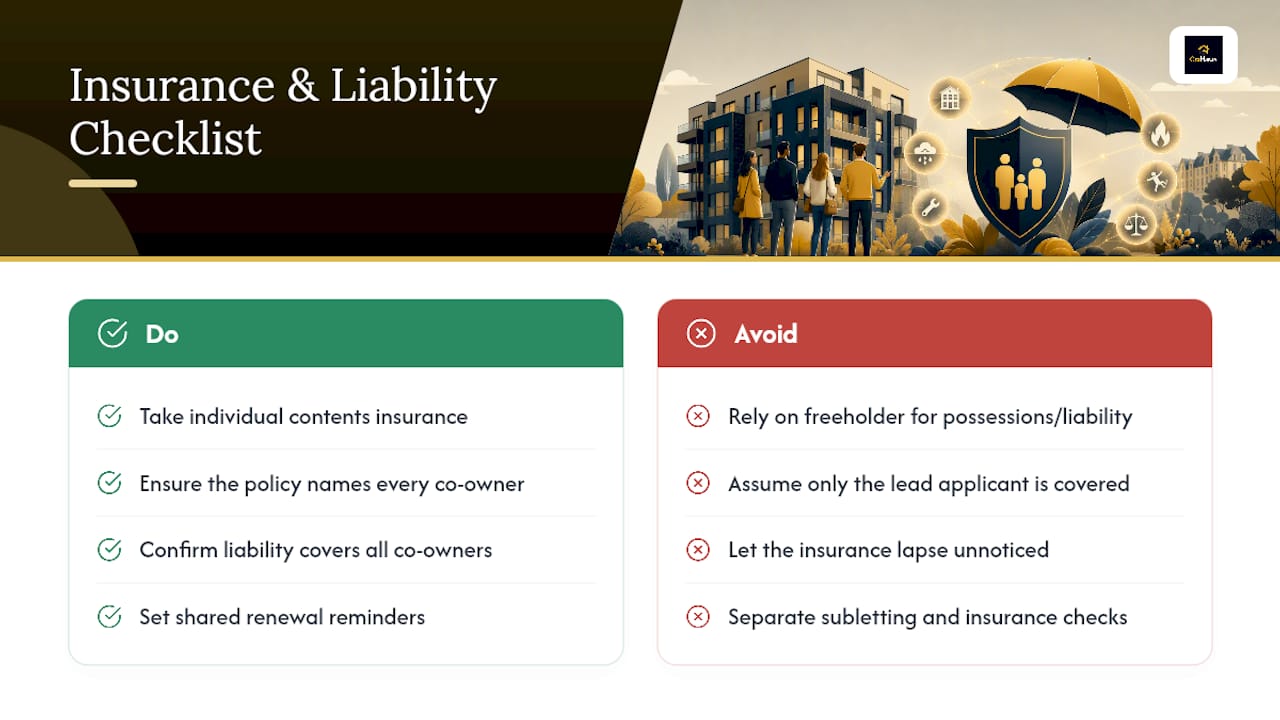
Buildings insurance on a leasehold flat is usually arranged by the freeholder or management company and recharged through the service charge, but that policy typically covers only the structure, not your possessions or personal liability. Each co-buyer needs their own contents insurance, and it's worth checking the policy explicitly names every owner rather than just the person who happened to set it up.
Liability cover deserves more attention from groups than from single buyers. If a guest is injured in a communal area, or a leak from your flat damages the one below, the freeholder's buildings policy may cover structural repair, but personal liability claims against you as occupiers often sit outside it. Ask your insurer to confirm all co-owners are covered under the same liability clause, not just the lead applicant on the account.
Mortgage lenders will also require adequate buildings insurance is in place at completion, and because of joint and several liability on the loan, a lapsed policy is everyone's problem, not just the person who forgot to renew it. Set a shared calendar reminder for renewal dates, and store the policy documents in the same shared folder as your Deed of Trust and deposit records.
If one co-buyer plans to let a room to a lodger, check whether that changes the insurance category. Standard owner-occupier policies sometimes exclude cover once part of a property is let, which means the covenant check on subletting and the insurance check need to happen together, not separately.
Managing ongoing costs without falling out
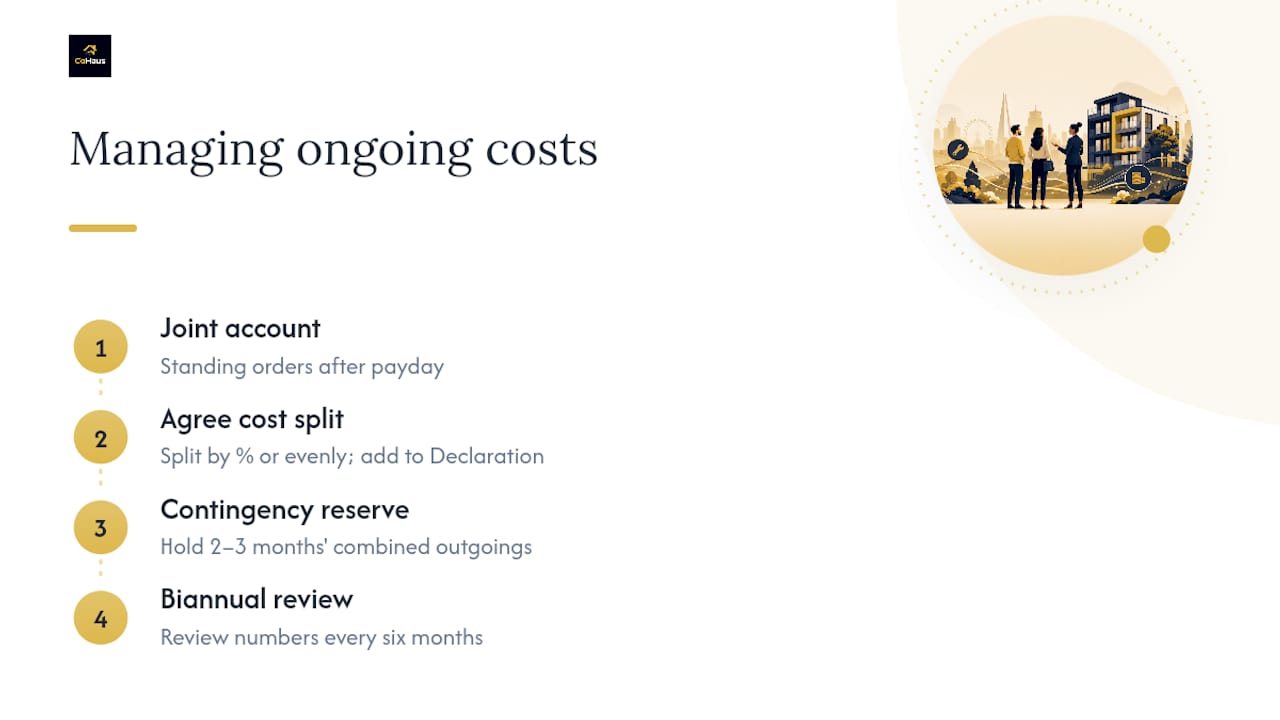
Ground rent, service charges, mortgage payments and repairs all arrive on different schedules, and that mismatch is where most co-buying friendships start to strain. A joint account funded by standing order from each owner, timed just after payday, keeps contributions predictable and removes the awkwardness of chasing a friend for their share each month.
Agree upfront whether costs split according to ownership percentage or evenly, and write that decision into the Declaration of Trust rather than leaving it as an assumption. A 70/30 owner might reasonably expect to pay 70% of the mortgage but split day-to-day costs like cleaning or a broadband bill evenly, and either approach works, provided everyone agreed to it in writing before moving in.
Build a contingency reserve equivalent to two or three months of combined outgoings, held in the joint account and topped up whenever it dips below that level. This covers an unexpected service charge increase, a major repair, or a month where one owner's income drops, without anyone needing to find emergency cash on short notice.
Review the numbers together every six months. Service charges and ground rent both tend to rise over a lease's life, and catching an increase early gives you time to adjust contributions gradually rather than discovering a shortfall when a bill is already overdue.
Coordinating decisions and day-to-day property management
Buying together is the easy part. Deciding who calls the plumber, who chases the managing agent about a leaking roof, and who has the final say on a £3,000 kitchen refit is where structure genuinely earns its keep.
Set a spending threshold in advance, perhaps £200 or £500, below which any owner can authorise a repair without consulting the others. Above that threshold, require agreement from a majority or from everyone, depending on how the group prefers to operate. Put this in writing alongside your Deed of Trust so it's not renegotiated every time a decision comes up.
Nominate one person as the main point of contact with the managing agent or freeholder, purely for efficiency, while keeping decisions themselves collective. Hold a short check-in every quarter to review the service charge account, any maintenance issues, and whether the contingency fund needs topping up. A co-ownership agreement covering house rules and dispute resolution gives a practical template for turning these habits into a written document everyone can refer back to.
Drafting a collaboration agreement beyond the Deed of Trust
The Declaration of Trust handles money and ownership shares. It doesn't usually cover the daily friction points, like whose turn it is to deal with a noisy neighbour or how you'll decide on redecorating. A separate collaboration agreement, sometimes called a co-ownership or house rules agreement, fills that gap.
A solid version covers: decision-making thresholds for repairs and improvements, how disagreements get raised and resolved before they escalate to a solicitor, what happens if someone wants to bring in a partner or lodger, and how often the group reviews the arrangement. It sits alongside the Deed of Trust rather than replacing it, since the Deed remains the legally binding document on money and shares.
Keep the collaboration agreement in plain language and revisit it annually. Circumstances change fast among friends in their twenties and thirties, jobs move, relationships change, and an agreement written for four single people sharing a flat may need updating within two or three years.
Structuring ownership around voting rights and responsibilities
Basic tenancy types settle who owns what, but they say nothing about who decides what. A group of four equal owners under tenants in common still needs a mechanism for breaking a 2-2 deadlock over, say, whether to remortgage or extend the lease.
Some groups build a simple majority rule into their collaboration agreement: decisions above the agreed spending threshold need agreement from at least three of four owners, or unanimous consent for anything affecting the mortgage or lease itself. Others weight votes to ownership percentage, so the 70% contributor has a stronger say on major financial decisions while day-to-day matters stay one-person-one-vote.
Neither approach is legally required, but leaving it undefined guarantees a stalemate the first time opinions genuinely diverge. Write the voting mechanism into the same document as your spending thresholds, and review it whenever the ownership shares themselves change, for instance if one owner buys out part of another's stake.
Tax implications of buying leasehold jointly
Stamp Duty Land Tax applies to the total purchase price of the property, not to each buyer's individual contribution, and the rate depends on the combined circumstances of everyone on the title, including whether any of you already own another property. A group where one friend owns a second home elsewhere can trigger the higher surcharge rate for the whole purchase, even if the other buyers are first-time buyers. Get your solicitor to confirm the applicable SDLT position for your specific group before exchange, since this varies by each buyer's individual property history.
Capital Gains Tax becomes relevant when you eventually sell, and it applies proportionally to each owner's share of any gain, based on the percentage recorded in your Declaration of Trust. An owner who lived in the property throughout ownership generally benefits from Private Residence Relief on their share, but a friend who moved out early, perhaps to live with a partner, may lose some of that relief on the portion of ownership after they left. This is another reason the percentage split and dates of occupation need to be clearly documented, not estimated after the fact when a tax return is due.
The CoHaus view on de-risking a friends' co-buy
Most of the risk in buying leasehold with friends isn't legal complexity, it's coordination. Matching the right group, agreeing pooled deposit structures, and setting exit terms before anyone's emotionally invested in a specific flat all happen before a solicitor even gets involved.
This approach focuses on structured deposit pooling, legal templates similar to those a solicitor would draft, and community-tested exit clauses designed to reduce the friction this guide has walked through. None of it replaces independent legal advice, but it gives friends a starting structure instead of a blank page and good intentions.
— Martin
A supported route into co-buying
If everything in this guide sounds sensible but daunting to organise alone, then using a co-buying community that helps you find compatible co-buyers, structure shared deposits, and set exit terms upfront can be helpful, rather than drafting all of it from scratch with friends who have never done this before.

On the CoHaus landing page, you'll find how the matching process works, what a typical Declaration of Trust framework looks like, and how members plan exit terms before they've even chosen a property. None of this replaces your own solicitor. Get independent legal advice on your specific lease, mortgage and Deed of Trust before you commit to anything. Visit the CoHaus site to see how the platform supports friends through the co-buying process from matching to move-in.
Where to check the facts yourself
- Gov for lease and ownership rules
- The Law Society's leasehold guidance for solicitor-level detail
- Which? for tenancy comparisons
This article is general information, not a substitute for advice from a qualified lawyer. Consult a qualified legal professional about your own circumstances before acting on anything here.
Sources
FAQ
Can two friends buy a house together in the UK?
Yes. Two or more friends can jointly apply for a mortgage and hold the title as tenants in common, which lets each person register a defined share rather than splitting ownership equally.
Why would anyone buy a leasehold property in the UK?
Leasehold is common for flats and some new-build houses, and it's often the only realistic option in that segment of the market, particularly in cities where flats dominate the leasehold stock; buyers accept ground rent and service charges in exchange for access to that housing type.
Is a 999-year lease as good as freehold?
For practical purposes, yes. A long lease is usually long enough that lease length itself creates no meaningful mortgage or resale issue within any realistic ownership period, though ground rent and service charge terms still apply and need checking separately.
What should friends prioritise before buying a leasehold together?
Hold as tenants in common, sign a Declaration of Trust before exchange, and ask your solicitor to check the lease length, service charges and covenants specifically against your group's plans, such as subletting a room.