
A share of freehold means you keep your existing lease while jointly owning the building's freehold with the other flat owners. That gives your group control over ground rent, lease extensions, and maintenance decisions, but it also creates collective legal and administrative duties. Most joint buyers hold that freehold either in personal names, capped at four people, or through a freehold management company.
TL;DR:
- A share of freehold involves joint ownership of the building's freehold while maintaining individual leasehold interests, requiring ongoing collective management.
- Buying into a freehold management company is more scalable for larger blocks, but involves more paperwork and regulatory filings.
- Co-owners must navigate dual roles, complying with lease obligations while managing building decisions collectively, which can create conflicts without clear governance.
- Purchase costs depend on property valuation, lease length, and legal fees, with lease extensions becoming more expensive once remaining lease terms fall below about 80 years.
- Successful management after purchase requires compliance with statutory duties, regular insurance, transparent costs, and well-drafted governance documents to avoid disputes.
Table of Contents
- What does share of freehold mean for joint buyers?
- The 'two hats' reality: you're still a leaseholder too
- Benefits and downsides for joint buyers
- How to buy the freehold jointly: qualifying rules and process checklist
- Costs, tax and valuation: budgeting for joint buyers
- Managing the freehold after purchase: duties, filings and compliance
- Due diligence checklist for conveyancing and sale traps to avoid
- Cohaus perspective: co-buying, shared deposits and fair ownership splits
- How joint ownership shapes decisions and disputes between co-owners
- How shares are apportioned and registered among joint buyers
- How joint buyer arrangements affect mortgage applications
- Tax implications specific to joint owners of a share of freehold
- What happens if a joint buyer wants to sell or exit?
- Author's short practical view and next steps
- How Cohaus helps joint buyers get this right
- Sources
What does share of freehold mean for joint buyers?
Two structures dominate the market, and which one applies to a building shapes almost everything else about buying into it. The personal-ownership route suits smaller blocks: up to four leaseholders hold the freehold title directly in their own names, transferred by a standard TR1 form at the Land Registry. It's simple, but it caps participation at four owners regardless of how many flats exist.
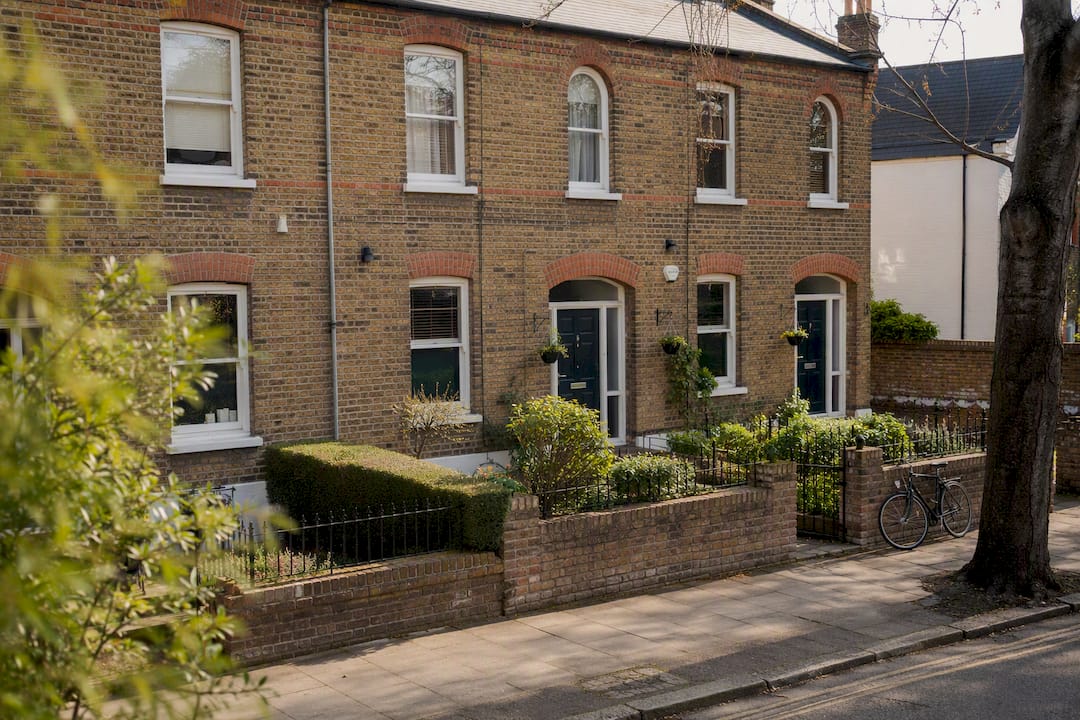
Larger blocks typically use a freehold management company (FMC) instead. Each leaseholder becomes a member or shareholder, and the company itself holds the freehold title. Selling your flat means transferring your company share via a stock transfer form, alongside the usual lease assignment, and the company must file at Companies House every year. More paperwork, but it scales far better than four names on a title deed.

The 'two hats' reality: you're still a leaseholder too
Buying into a share of freehold doesn't erase your lease. You still hold it as an individual leaseholder, subject to every covenant it contains, while simultaneously acting as part-owner (or director) of the freehold. Think of it as wearing two hats at once.
Ground rent clauses, repair obligations, and use restrictions in your original lease remain binding, even though you now sit on the other side of the landlord relationship too. This dual role catches people out. Owning "the freehold" doesn't mean you can ignore your own lease terms or act unilaterally on building decisions. Most significant changes, extending a lease, altering the building, or amending service charges, require agreement from your co-owners, sometimes unanimous, depending on what the Articles of Association or Deed of Trust actually say. Without clear governance documents, that requirement for consensus becomes the single biggest source of friction between joint freeholders.
Benefits and downsides for joint buyers
Owning a share of freehold jointly reshapes your relationship with the building in ways that go beyond the paperwork.
The upsides tend to be concrete:
- Ground rent often drops to a peppercorn (effectively nil) once you control the freehold.
- Lease extensions become far cheaper, often costing legal fees only rather than a market premium, especially useful once a lease term falls below roughly 80 years and marriage value kicks in.
- You choose your own buildings insurer and contractors, rather than accepting a landlord's arrangement.
The downsides are just as real:
- Someone has to run the administration: budgets, insurance renewals, compliance filings.
- Deadlock is possible when co-owners disagree and your Articles don't set a clear voting threshold.
- Directors of an FMC carry personal fiduciary duties and, in some circumstances, personal liability.
Share of freehold works best when your group is willing to treat it as a small, ongoing responsibility, not a one-off purchase.
How to buy the freehold jointly: qualifying rules and process checklist
Most groups get there through collective enfranchisement, a statutory right under the Leasehold Reform, Housing and Urban Development Act 1993. Before you go further, check the building against these conditions:
- Building size. At least two flats, each held on a long lease.
- Participation. At least 50% of qualifying leaseholders must take part in the claim.
- Non-residential limit. Commercial floor space must stay under roughly 25% of the total.
- Lease length. Participants generally need long leases (originally granted for more than 21 years).
Once your group qualifies, a nominated leaseholder or solicitor serves a formal Section 13 notice on the landlord, triggering a statutory response period and a valuation, either agreed or set by the First-tier Tribunal if you can't reach terms. Expect the process to run several months to over a year for contested cases. Costs are usually split proportionally among participating leaseholders, and under the statutory process, you'll also typically cover the landlord's reasonable legal and valuation costs, on top of your own. Gov sets out the framework in full, and it's worth checking before you commit time and money to a claim.
Costs, tax and valuation: budgeting for joint buyers
Your purchase cost splits into the freehold's market valuation, shared proportionally, plus a surveyor's fee to establish that value fairly and solicitor's fees for the conveyancing and, where relevant, the enfranchisement claim. Stamp Duty Land Tax may apply depending on the consideration paid for the freehold interest, so check this with your conveyancer rather than assuming it's exempt.
Lease length drives cost more than almost anything else. Once a lease drops below roughly 80 years, marriage value applies and extensions become noticeably more expensive, which is precisely why buying the freehold outright, rather than negotiating extensions individually, appeals to so many leaseholder groups. Build a reserve fund into your budget from day one, and get an independent valuation rather than relying solely on the seller's figures.
Managing the freehold after purchase: duties, filings and compliance
Buying the freehold is the easy part. Running it is the ongoing commitment, and it starts the moment completion happens.
If you're using an FMC, directors take on statutory duties: filing annual accounts and a confirmation statement at Companies House, and acting in the company's best interests rather than their own. Failure to file on time can trigger penalties or, in persistent cases, disputes among members.
Day to day, your group needs to:
- Arrange and renew buildings insurance annually.
- Set and collect service charges to a realistic budget, ideally with a sinking fund for major works.
- Run a formal Section 20 consultation whenever qualifying works exceed the statutory threshold, giving leaseholders the right to comment on cost and contractor choice.
- Check Building Safety Act obligations if the block falls within scope, particularly for buildings over 11 metres or seven storeys.
Pro Tip: Consider Directors' and Officers' (D&O) insurance alongside public liability cover before you take on a directorship. It's inexpensive relative to the personal exposure it removes.
Some groups self-manage successfully for years; others appoint a managing agent once the administrative load outgrows volunteer time. Neither choice is wrong, but decide it deliberately rather than by default.
Due diligence checklist for conveyancing and sale traps to avoid
Before you commit, ask your conveyancer to review a defined set of documents, not just the lease.
- Articles of Association or Deed of Trust, to see how decisions and disputes are actually resolved.
- Service charge accounts for the last three years, to spot underfunded reserves.
- Minutes of recent meetings, to surface any live disagreements.
- Companies House filing history, to check the company is in good standing.
- Buildings insurance policy and title deeds, to confirm cover and ownership match what's advertised.
Ask existing owners directly about past disputes, whether a sinking fund exists, and how previous lease extensions were priced. If a co-freeholder later refuses to cooperate on a sale, remedies exist but they're slow, including court applications for a Vesting Order under the Trustee Act 1925 when someone can't be located or won't sign. Lenders are increasingly alert to this risk too, so a well-documented company structure genuinely speeds up your eventual sale.
Cohaus perspective: co-buying, shared deposits and fair ownership splits
Buying a share of freehold jointly is, at its core, a co-buying decision, and it raises the same question any group purchase does: whose money bought what, and who owns which slice? Cohaus supports shared-deposit arrangements with legal protections built in from the start, rather than left to an informal understanding between friends. If contributions aren't equal, our guidance on splitting ownership fairly and drafting a proper deed of trust is the place to start before you view another flat.
How joint ownership shapes decisions and disputes between co-owners
Every joint freehold purchase eventually runs into the same question: what happens when co-owners disagree? Decision-making authority typically sits wherever the Articles of Association or Deed of Trust put it, and that document matters far more than most buyers realise at the point of purchase.
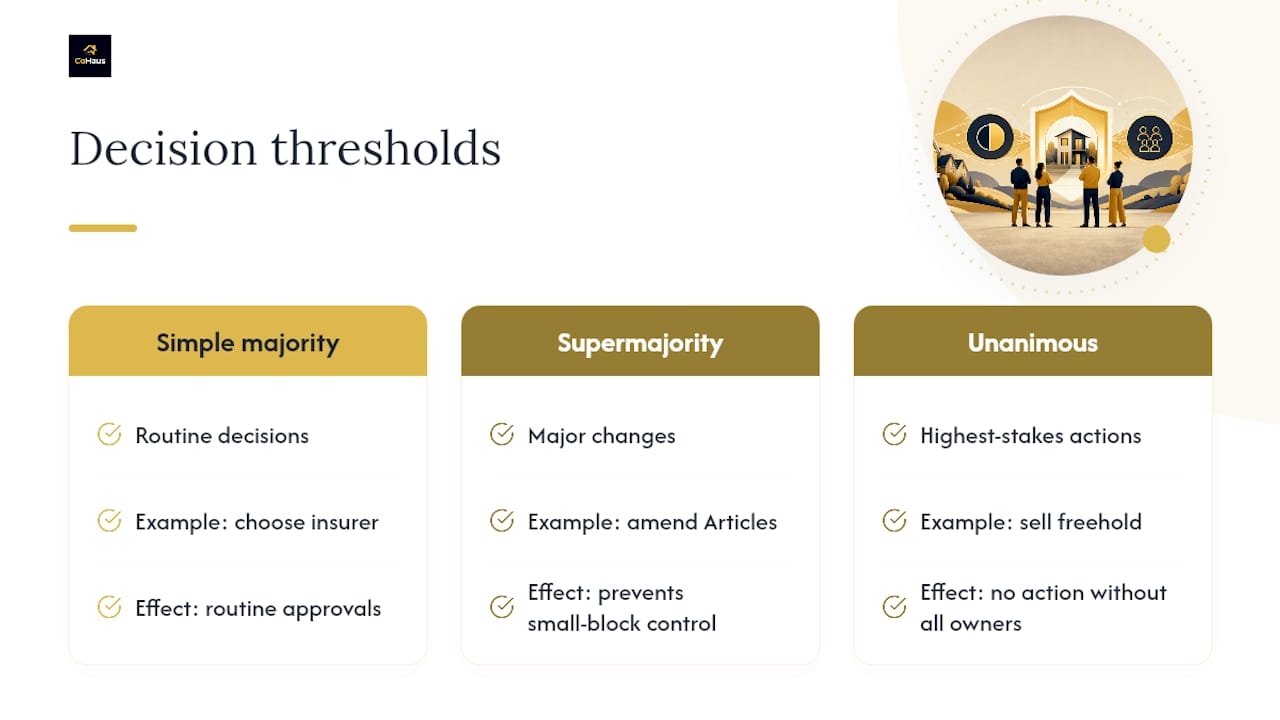
Some decisions need only a simple majority, choosing an insurer, approving routine maintenance. Others, particularly amending the Articles themselves, admitting a new member, or agreeing to sell the freehold, often require a supermajority or unanimous consent. Without clear thresholds written down in advance, disagreements over major works or unequal service charge contributions can stall the whole building's management for months.
The Bishopslaw guidance on well-drafted governance documents makes a point worth repeating: a dispute-resolution clause, whether that's mediation or a defined arbitration process, costs almost nothing to include at the drafting stage and can save thousands in legal fees later. Groups who skip this step usually only discover the gap once a genuine disagreement arises, at which point resolving it becomes far more expensive and far more personal.
Practically, this means asking your solicitor to draft explicit voting thresholds before completion, not after your first disagreement. If you're buying into an existing FMC rather than forming a new one, read the current Articles carefully. You're inheriting whatever decision-making framework already exists, disputes included.
How shares are apportioned and registered among joint buyers
Ownership shares in a jointly held freehold aren't automatically equal, even though many groups assume they will be. How you apportion and register them depends on which structure you've chosen.
Under personal-name ownership, the Land Registry title records each owner's legal share directly, and a Declaration of Trust alongside it can specify beneficial shares that differ from the legal split, useful when contributions to the purchase price weren't equal. Under an FMC structure, shares usually correspond to company membership, often one share per flat, regardless of that flat's size or original purchase price. That flat-based model works well for simple apportionment but can feel unfair in blocks where flats vary significantly in size, since a one-bedroom flat and a three-bedroom penthouse might each hold identical voting weight.
Registration itself happens in two places. The Land Registry records the freehold title and any changes to legal ownership, while Companies House records who holds shares in the FMC and who serves as a director. Keeping both registers accurate matters more than buyers expect, particularly at sale, because a mismatch between who the Land Registry shows and who Companies House shows can delay a transaction while it's untangled.
If your group's contributions to the freehold purchase weren't equal, and they rarely are in true co-buying situations, apportioning shares strictly by flat count can create resentment down the line. A Deed of Trust that separately records financial contribution alongside membership share gives you a documented, defensible position if anyone later questions how the split was decided.
How joint buyer arrangements affect mortgage applications
Lenders treat a share-of-freehold purchase slightly differently from a standard leasehold mortgage application, and it's worth knowing this before you fall in love with a flat.
Most mainstream lenders are comfortable financing a flat where the freehold is jointly owned, provided the legal structure is clean: a properly incorporated FMC with accurate Companies House filings, or a personal-names title with no more than four owners and clear documentation of who holds what. Where lenders get cautious is when the paperwork is messy, missing annual filings, no clear Articles, or a personal-names title where one of the four hasn't been traceable for years.
If you and a partner, friend, or family member are buying jointly and also becoming joint freeholders, your mortgage liability structure matters independently of the freehold question. Joint and several liability means each borrower is individually responsible for the full mortgage debt, not just their proportional share, regardless of how you've split the freehold ownership between you. Lenders will also usually want to see that the freehold company's finances are separate from your personal mortgage arrangements, so a director's personal liability for company debts doesn't inadvertently affect their mortgage standing.
A joint secured loan works on similar principles if your group needs additional borrowing for major works rather than routine service charges. Speak to a broker experienced with share-of-freehold properties specifically, since not every lender's standard leasehold criteria map cleanly onto a jointly owned freehold, and a broker who's seen the structure before will flag issues your solicitor might not catch until later in the process.
Tax implications specific to joint owners of a share of freehold
Owning a share of freehold jointly creates several tax touchpoints that a standard leasehold purchase doesn't, and they're worth raising with an accountant early rather than discovering them at sale.
Stamp Duty Land Tax may apply to the consideration paid for the freehold interest itself, separate from any SDLT paid on your flat purchase, so check the specific treatment with your conveyancer rather than assuming the freehold transfer is automatically exempt. If your group extends leases at nominal or below-market cost between members, as collective freeholders often do, that transaction still needs proper documentation, since an undocumented below-market transfer between connected parties can attract scrutiny later.
If the freehold is held through an FMC, the company itself has its own filing obligations, including annual accounts, even where the company makes no profit and exists purely to hold the freehold and manage the building. Most FMCs are structured as companies limited by guarantee specifically to avoid distributing profit, which simplifies the tax position considerably compared with a profit-making landlord company, but it doesn't remove the filing requirement itself.
Capital gains considerations can also arise if you sell your share of the freehold separately from your flat, though in practice the two nearly always transfer together. Where they don't, or where a departing member is bought out by the remaining owners at a value above what they originally paid, that gain may be taxable depending on individual circumstances. None of this is exotic, but it's exactly the kind of detail that gets missed when everyone's focused on the flat purchase and treats the freehold share as an afterthought.
What happens if a joint buyer wants to sell or exit?
Exit routes exist, but how smoothly they work depends entirely on what your governance documents say before anyone wants to leave.
Under personal-names ownership, an outgoing owner transfers their share of the legal title via a TR1, alongside the standard lease assignment to their flat's buyer. This usually works cleanly when all parties cooperate. Problems arise when a co-freeholder is uncooperative, uncontactable, or simply slow, since all named freeholders typically need to sign the transfer. In genuinely stuck cases, a court application for a Vesting Order under the Trustee Act 1925 can compel the transfer, though this is a last resort that costs time and legal fees no one budgeted for.
Under an FMC structure, exit is generally more straightforward on paper: the outgoing member transfers their company share via a stock transfer form, and the incoming flat buyer becomes the new member and, if willing, a director. The company's Articles should specify this process, including any approval steps the remaining members must complete, and a well-drafted set of Articles will set out exactly how quickly this needs to happen so a sale doesn't stall waiting for a board meeting.
Either way, a clear Deed of Trust or shareholders' agreement drafted at purchase, not retrofitted during a crisis, makes an exit dramatically simpler. It should specify how a departing member's share is valued, what happens if remaining owners want to buy them out rather than accept a new co-owner, and a realistic timeframe for completing the transfer. Groups who document this upfront rarely have problems. Groups who don't tend to discover the gap at the worst possible moment, mid-sale, with a buyer waiting and a chain at risk.
Author's short practical view and next steps
Clear company Articles and a proper deed of trust matter more than almost any other decision you'll make here. Review the documents, talk to your co-owners honestly, then instruct a solicitor who's handled this structure before.
— Martin
How Cohaus helps joint buyers get this right
There are other routes into a share of freehold: buying solo and negotiating later, or joining an existing FMC as a lone new member and hoping the paperwork holds up. Both leave you carrying the legal and financial weight alone from day one.

Cohaus takes a different approach for people who'd rather share that weight with the right co-buyers from the start. Our platform matches you with compatible co-buyers, helps structure shared deposits with proper legal protections, and connects you with specialist mortgage brokers and solicitors who understand share-of-freehold purchases specifically, not generic leasehold sales. Unequal contributions, exit terms, decision-making thresholds: these get documented before you complete, not negotiated under pressure after a dispute. If you're weighing up a joint freehold purchase and want to see how the numbers and the people side actually fit together, start exploring compatible co-buyers and resources at Cohaus.
This article is general information, not a substitute for advice from a qualified lawyer. Consult a qualified legal professional about your own circumstances before acting on anything here.
Sources
- What is share of freehold? — Darlows
- Becoming a director or member of a residents' company — Companies House
- Buying a share of the freehold for your flat — Lease Advice
- Share of Freehold Lease — Bishopslaw