
For most co-buyers in the UK, a cash Lifetime ISA with a stable base rate and clear conveyancer procedures is the right starting point. It offers FSCS protection on savings up to £85,000, a predictable 25% government bonus on up to £4,000 per year, and straightforward withdrawal mechanics that work with conveyancing timelines.
- The GOV.UK LISA rules allow each co-buyer to contribute up to £4,000 per tax year and receive up to £1,000 in government bonus annually. Both bonuses count toward your shared deposit.
- Cash LISAs held with FCA-authorised providers carry FSCS protection, which matters when large sums are parked ahead of exchange.
- Cohaus helps co-buyers coordinate deposit timing, legal protections and mortgage introductions alongside their individual LISA strategies.
The single most critical constraint for co-buyers: LISA funds must go directly from the provider to your conveyancer. You cannot withdraw the money yourself without triggering a 25% withdrawal charge. Notify your conveyancer early and confirm they are set up to receive LISA transfers before you exchange.
Table of Contents
- How do you compare lifetime ISA providers effectively?
- What are the LISA rules that affect your shared deposit?
- How do co-buyers use Lifetime ISAs together?
- How do you choose the right LISA provider for a co-buy?
- What does the practical timeline look like for co-buyers?
- Which provider type suits your co-buy situation?
- Key takeaways
- The part most co-buyers overlook
- How Cohaus helps co-buyers go further than a LISA alone
- Where to verify rates and provider terms
How do you compare lifetime ISA providers effectively?
The table below maps the dimensions that matter most when you are pooling deposits with another person. Use it as a scoring sheet when you speak to providers or check comparison sites such as Moneyfactscompare and Which?.
| Dimension | What to check | Why it matters for co-buyers |
|---|---|---|
| Account type | Cash LISA vs Stocks & Shares LISA | Les comptes LISA en espèces conviennent aux échéances plus courtes, tandis que les comptes LISA en actions et obligations conviennent aux plans de plus de cinq ans. |
| Headline rate vs base rate | AER including intro bonus vs rate after bonus period | Top cash LISA rates often include 12-month intro bonuses |
| Fees | Platform fee, fund OCF/TER, trading fees | High fees erode the 25% bonus on S&S accounts |
| Bonus handling | Monthly vs annual payment; reinvestment policy | Monthly bonus payments (as MoneyHelper confirms) improve compounding |
| Withdrawal/penalty terms | 25% charge on non-qualifying withdrawals | Applies to each co-buyer's account independently |
| FSCS/custodian protection | FSCS up to £85,000 for cash; custodian arrangements for S&S | Critical when deposits are large |
| Transfer options | Transfer-in and transfer-out accepted? Fees? | Needed if one co-buyer switches provider mid-save |
| Mortgage integration | Partner broker, mortgage guidance, referral service | Reduces friction at the mortgage application stage |
| Platform/UX | App quality, customer service responsiveness | Delays in support can affect completion timing |
How to verify figures: check the provider's own T&Cs for the base rate after any intro period. Use Moneyfactscompare for live rate tables and Which? for transfer-acceptance status. GOV.UK confirms statutory rules. Never rely on a headline rate alone.
- Ask: "What is the variable rate once the introductory bonus ends?"
- Ask: "Do you accept transfers in from another LISA provider, and what is the fee?"
- Ask: "How do you transfer funds to a conveyancer, and what paperwork do you require?"
What are the LISA rules that affect your shared deposit?
The Lifetime ISA is a government-backed savings account for UK residents aged 18–39. You must open one before your 40th birthday, and contributions stop at 50. Each tax year, you can pay in up to £4,000 and the government adds a 25% bonus, worth up to £1,000 per year. That yearly maximum counts toward your overall annual ISA allowance.
£1,000 per person, per tax year. Two co-buyers each maximising their LISA contributions can receive up to £2,000 in combined government bonuses annually, directly boosting the shared deposit pot.
To use a LISA for a first home, the property must cost no more than £450,000. Both co-buyers must be first-time buyers. If either person has owned a property before, their LISA cannot be used for the purchase without incurring the withdrawal penalty.
- Bonus is paid monthly by most providers, so timing your contributions early in the tax year maximises the compounding effect before completion.
- Un retrait non qualifié (achat supérieur à £450,000 ou retrait avant 60 ans sans achat immobilier) entraîne une pénalité gouvernementale de 25 %. Par exemple, sur £10,000 retirés, la pénalité sera de £2,500.
- The GOV.UK consultation on a First Time Buyer ISA confirms that existing LISA holders can continue saving under current rules while any future product is developed.
How do co-buyers use Lifetime ISAs together?
Each co-buyer must hold their own LISA. There is no joint LISA. Both accounts operate independently, and the 25% bonus applies separately to each person's contributions. The combined effect on your shared deposit can be significant, but coordination is what makes it work.
Conveyancer coordination is non-negotiable. Under HMRC's technical guidance for conveyancers, LISA funds must be sent directly by the provider to the conveyancer. You cannot withdraw the cash yourself. Your conveyancer must complete a formal declaration confirming the purchase qualifies, and the provider then transfers the funds. If your conveyancer is unfamiliar with this process, find one who is before you exchange.
- Tell your conveyancer you are using a LISA (or two LISAs) at the very first meeting, not at exchange.
- Both providers must receive the conveyancer's request in time to process the transfer before completion.
- If one co-buyer's LISA transfer is delayed, it can hold up the entire completion.
Timing pitfalls are the most common problem co-buyers face. Bonus payment cycles, transfer processing windows and mortgage offer expiry dates all need to align. Some providers take longer to process conveyancer transfers than others. Check this before you commit to a provider.
Some providers offer mortgage guidance or partner broker services for LISA holders, which can reduce the coordination burden at the mortgage stage. For co-buyers, this is worth prioritising. A joint mortgage with friends involves more moving parts than a solo purchase, and a provider with a clear mortgage referral pathway saves time.

Pro Tip: Create a shared document listing both providers' transfer timelines, the conveyancer's contact details, and the expected bonus payment dates. Confirm in writing with both providers that they can meet your target completion date before you exchange contracts.
How do you choose the right LISA provider for a co-buy?
Work through these questions with your co-buyer before opening any account.
- How long until you plan to buy? Under three years: cash LISA. Three to five or more years: consider a Stocks & Shares LISA, accepting investment risk for potentially higher returns.
- Do you need FSCS protection? If yes, choose a cash LISA with an FCA-authorised provider. Verify status at register.fca.org.uk.
- What is the base rate after any intro period? Many top rates include a 12-month introductory bonus. The base variable rate is what you will earn for most of your saving period.
- Does the provider accept transfers in and out? You may want to switch if rates change. Not all providers accept transfers. Check Which? for a current list.
- How does the provider handle conveyancer transfers? Ask for their written process. Vague answers here are a red flag.
- Does the provider offer mortgage support? Useful for co-buyers who have not yet secured a mortgage.
Red flags to rule a provider out quickly:
- No published base rate after the intro period
- No clear written process for conveyancer transfers
- High platform or fund fees on S&S accounts that eat into the government bonus
- No transfer-out option if you want to switch providers
- Poor customer service ratings on independent review sites
For a savings rate comparison that covers intro bonuses versus base rates in detail, Rate Grove's guide is a practical reference before you commit.
What does the practical timeline look like for co-buyers?
- Open your LISAs — both co-buyers open accounts separately. ID verification typically takes one to three working days online.
- Make your first contribution — pay in before the tax year deadline (5 April) to secure that year's bonus. The government bonus is paid monthly by most providers.
- Contribute regularly — up to £4,000 each per tax year. Set up standing orders so neither co-buyer misses a contribution window.
- Notify your conveyancer — do this as soon as you have an offer accepted, not at exchange. Confirm they handle LISA transfers and understand the declaration process.
- Instruct your provider — once the conveyancer sends the formal request, the provider processes the transfer. Allow at least two to four weeks for this step; some providers take longer.
- Funds reach the conveyancer — the provider sends the money directly. The conveyancer applies it to the deposit at completion.
- Mortgage offer expiry dates and LISA transfer windows must align. If your mortgage offer is close to expiry, speak to your broker before instructing the LISA transfer.
- Transfer between LISAs (if switching provider) can take up to 30 days. Do not initiate a transfer close to your target completion date.
- Get written confirmation from both providers of their expected transfer timelines before you exchange.
Pro Tip: If completion is delayed and your mortgage offer expires, contact your lender immediately. Extending a mortgage offer is usually possible but takes time. Do not instruct the LISA transfer until the new completion date is confirmed, as reversing a transfer is complex and may trigger penalties.
Which provider type suits your co-buy situation?
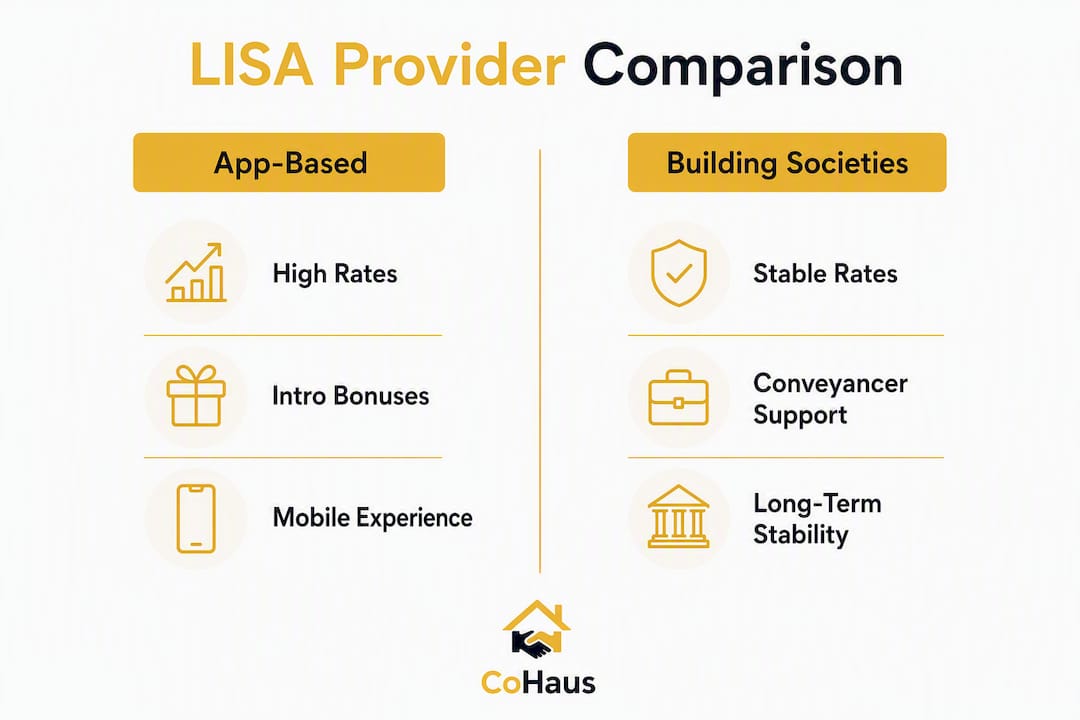
Independent comparisons show that app-based challengers frequently top short-term headline rate tables, while building societies and banks tend to offer steadier base rates.
App-only challengers typically offer the highest headline AERs and slick mobile experiences. The trade-off: intro bonuses expire, base rates may drop, and customer service can be slower for complex queries like conveyancer transfers. Best for: tech-comfortable savers with a clear timeline who will actively monitor rates.
Building societies tend to publish stable base rates and often have established conveyancer transfer processes. Their platforms may be less polished, but their reliability at completion is well-regarded. Best for: co-buyers who prioritise predictability over chasing the top rate.
Investment platforms (S&S LISAs) suit co-buyers with five or more years before purchase. Fees vary significantly; check the platform fee plus the fund's ongoing charges figure (OCF). FSCS protection does not apply in the same way as cash accounts. Best for: longer-term savers comfortable with market risk.
High-street banks offering cash LISAs provide familiarity and branch access but rarely top the rate tables. Their FSCS protection and established processes are reassuring. Best for: co-buyers who value simplicity and existing banking relationships.
- Short timeline + FSCS protection needed: cash provider (building society or bank) with a published conveyancer process.
- Longer timeline + comfortable with risk: S&S platform with low fees and a clear custodian arrangement.
- Highest short-term rate: app challenger, but verify the base rate and transfer process before committing.
For co-buyers navigating a three-person mortgage or more complex arrangements, provider stability and clear transfer procedures matter more than a marginal rate advantage.
Key takeaways
Each co-buyer must hold their own LISA, and the provider must transfer funds directly to the conveyancer — this single rule shapes every provider and timing decision you make.
| Point | Details |
|---|---|
| Cash LISA for most co-buyers | FSCS protection and predictable bonus mechanics suit shorter timelines and shared deposit planning. |
| Check the base rate, not just the headline | Intro bonuses often last 12 months; the base variable rate is what you earn for most of your saving period. |
| Notify your conveyancer early | LISA funds go directly from provider to conveyancer; late notification risks delaying completion. |
| Align both co-buyers' timelines | Les cycles de versement du bonus, les délais de transfert et les dates d'expiration d'offre de prêt doivent tous être coordonnés sur les deux comptes. |
| Cohaus supports co-buyer coordination | Cohaus helps co-buyers manage shared deposits, legal protections and mortgage introductions alongside their LISA strategy. |
The part most co-buyers overlook
The rate comparison is the easy part. What actually trips co-buyers up is the operational detail: who notifies the conveyancer, whose provider is slower to process transfers, and what happens when completion slips by two weeks.
Most LISA comparison articles focus on the headline AER and stop there. But for co-buyers, the provider's conveyancer transfer process is at least as important as the interest rate. A provider offering 0.2% less but with a clear, documented transfer process and responsive customer service will cause fewer problems at completion than one topping the rate table with a vague "contact us" policy for conveyancer queries.
The other thing worth saying plainly: the government bonus is generous, but it is not free money without conditions. The 25% withdrawal penalty on non-qualifying withdrawals means you can end up with less than you put in if circumstances change. Co-buyers should discuss what happens if one person needs to exit the purchase before completion, and factor that into both their LISA choice and their deed of trust arrangements.
How Cohaus helps co-buyers go further than a LISA alone
Choosing the right LISA provider is one piece of the co-buying puzzle. The harder work is coordinating two or more people's deposits, legal protections and mortgage applications so everything lands on the same completion date.
Cohaus is built for exactly that. The platform helps co-buyers find compatible partners, manage shared deposit arrangements, access legal protections through structured agreements, and get introductions to mortgage brokers who understand joint purchases. Where a LISA provider handles your savings, Cohaus handles the coordination layer that sits around it: matching timelines, clarifying exit terms, and connecting you with the right professionals at the right moment.
If you are ready to take the next step, visit Cohaus to see how the platform supports co-buyers from first conversation through to completion.
Where to verify rates and provider terms
Before committing to any provider, check these sources directly:
- GOV.UK Lifetime ISA overview: statutory rules, contribution limits, bonus mechanics and eligible property criteria.
- GOV.UK conveyancer technical guidance: the formal process your conveyancer must follow to receive LISA funds.
- MoneyHelper LISA guide: plain-English explanation of how cash and S&S LISAs work, including bonus payment timing.
- Moneyfactscompare LISA rates: updated hourly; use it to check current headline and base rates and to spot intro bonus periods.
- Which? Lifetime ISA comparison: independent provider reviews, transfer-acceptance status and mortgage support notes.
- Friendly Financial Group: mortgage advice and broker support for LISA holders navigating a joint purchase.
Always read the provider's own T&Cs for the base rate that applies after any introductory period, and contact your conveyancer before you open an account to confirm they are familiar with LISA transfer procedures.
This article is general information, not financial or legal advice. Confirm current rules and your personal eligibility with GOV.UK or a qualified financial adviser before making decisions.