
Yes, you can add a co-buyer to a joint mortgage within a Cohaus co-buying arrangement. Whether you are pooling deposits with a friend, a flatmate, or another non-traditional partner, the process follows a clear sequence: apply to the mortgage as joint applicants, instruct a solicitor to draft a Declaration of Trust, and register a Land Registry restriction using form RX1 if a trust of land exists. Cohaus supports each stage with pooled deposit management, co-buyer matching, and connections to mortgage advisers and solicitors who understand co-buying structures.
Immediate next steps:
- Check lender eligibility and affordability with a qualified mortgage adviser
- Agree ownership shares with your co-buyers before approaching a lender
- Instruct a solicitor to prepare a Declaration of Trust recording contributions and exit terms
- Apply for a Land Registry restriction (RX1) once the trust is in place
- Each co-buyer should obtain independent legal advice before signing anything
Pro Tip: Get independent legal advice before the mortgage application, not after. Solicitors can flag share or liability issues that are far cheaper to fix at the start than to dispute under the Trusts of Land and Appointment of Trustees Act 1996 (ToLATA) later.
Key takeaways
Adding a co-buyer to a mortgage within a Cohaus co-buy requires lender eligibility checks, a Declaration of Trust recording each person's share, and a Land Registry restriction (RX1) where a trust of land exists.
| Point | Details |
|---|---|
| Joint application required | All co-buyers apply to the mortgage together; lenders assess combined income and individual credit histories. |
| Declaration of Trust is essential | Without it, the law may assume equal shares regardless of actual deposit contributions. |
| RX1 restriction protects everyone | Register a restriction at Land Registry when a trust exists to flag beneficial interests to future buyers or lenders. |
| Joint and several liability is real | Any named borrower can be pursued for the full mortgage debt; missed payments affect all applicants' credit files. |
| Cohaus supports the whole process | Cohaus provides co-buyer matching, pooled deposit tracking, and introductions to specialist advisers and solicitors. |
Table of Contents
- What lenders look for when you add a co-buyer
- Step-by-step: how to add a co-buyer to a joint mortgage
- How do you record ownership shares fairly?
- What does it cost and how long does it take?
- How do you exit, sell, or resolve a dispute?
- Checklist to bring to your solicitor and mortgage adviser
- Why co-buying with clear agreements is the smarter path
- Start your co-buy with Cohaus
- Useful sources and further reading
What lenders look for when you add a co-buyer
Lenders assess all joint applicants together: combined income, individual credit histories, existing debts, and the source of each person's deposit contribution. Some lenders accept up to four joint applicants, but not every lender counts all applicants' incomes equally, so a mortgage adviser is the fastest way to identify which lenders suit your group's profile.
| Document | Why lenders need it |
|---|---|
| Photo ID (passport or driving licence) | Identity and right to reside verification |
| Last 3 months' payslips | Income evidence |
| Last 3 months' bank statements | Spending, savings, and existing commitments |
| Proof of deposit and source of funds | Anti-money-laundering compliance |
| Credit report (each applicant) | Existing liabilities and payment history |
| Proof of pooled deposit (if applicable) | Confirms each co-buyer's contribution |
If any co-buyer has a low credit score, specialist lenders may still be an option. A mortgage adviser can assess whether your group qualifies and what buying with a low credit score means for your application.
Step-by-step: how to add a co-buyer to a joint mortgage
- Instruct a mortgage adviser. A broker familiar with joint mortgages for friends will identify lenders that accept your group size and count each income correctly.
- Register a Land Registry restriction (RX1). When a trust of land exists, you normally apply for a restriction at this stage to flag beneficial interests to any future buyer or lender.
| Stage | Who does it | Typical timing |
|---|---|---|
| Mortgage in principle | Mortgage adviser | 1–3 days |
| Mortgage offer | Lender underwriting | 2–6 weeks |
| Declaration of Trust drafted | Solicitor | 1–2 weeks |
| Conveyancing and completion | Solicitor/conveyancer | 4 weeks |
| RX1 restriction registered | Solicitor at Land Registry | 2–4 weeks post-completion |
How do you record ownership shares fairly?
The Land Registry records legal title, not beneficial interest. If you do not document how value is split, the law may assume equal shares or apply survivorship rules that do not match what you intended.
Tenants in common lets each co-buyer hold a defined percentage, for example 60/40 or 70/30, and leave their share in a will. Joint tenants hold the property equally, and if one person dies their share passes automatically to the survivor regardless of any will.

For friends co-buying with unequal deposits, tenants in common is almost always the right choice. A worked example: if one person contributes £40,000 and another £20,000 towards a £60,000 deposit, a 67/33 split reflects those contributions. The Declaration of Trust records this split, how monthly mortgage costs are shared, and what happens when one person wants to leave. For more on splitting ownership with unequal deposits, Cohaus has a dedicated guide.
Pro Tip: Every co-buyer should instruct their own solicitor to review the Declaration of Trust. Independent legal advice for each party is the single most effective way to prevent disputes later.
What does it cost and how long does it take?
| Item | Estimated cost |
|---|---|
| Solicitor/conveyancer fees | £1,500 (varies by property value and complexity) |
| Declaration of Trust drafting | £200 (often included in solicitor fee) |
| Mortgage adviser fee | Many brokers are fee-free, paid by lender |
| Land Registry restriction (RX1) | £40 (current Land Registry scale fee) |
| Stamp Duty Land Tax | Depends on purchase price, buyer status and shares |
The most common cause of delay is missing paperwork, particularly proof of deposit source for pooled funds. Prepare these documents before you approach a lender. Complex Declarations of Trust, where shares are unequal or exit mechanics are detailed, also add time at the solicitor stage.
How do you exit, sell, or resolve a dispute?
- ToLATA application. Where parties cannot agree, courts can order a sale or declare beneficial interests under ToLATA. Courts consider each person's contributions, any rental income received, and improvements made to the property.
Pro Tip: Include a named mediation provider and a specific valuation method (for example, average of two independent RICS valuations) in your Declaration of Trust from the start. It costs nothing to add and can save thousands later.
Checklist to bring to your solicitor and mortgage adviser
| Item | Solicitor | Mortgage adviser |
|---|---|---|
| Photo ID (all applicants) | ✓ | ✓ |
| Last 3 months' payslips | ✓ | |
| Last 3 months' bank statements | ✓ | |
| Proof of deposit source (each applicant) | ✓ | ✓ |
| Evidence of pooled deposit | ✓ | ✓ |
| Proposed ownership split (%) | ✓ | |
| Draft Declaration of Trust | ✓ |
Questions for your solicitor: How will the Declaration of Trust record each person's deposit and exit rights? Should an RX1 restriction be applied at completion? What are your fees for drafting the trust and registering the restriction?
Questions for your mortgage adviser: Which lenders will accept our co-buy structure and group size? Will all applicants' incomes be counted in full? Is a transfer of equity required, or do we apply as new joint applicants from the start?
Why co-buying with clear agreements is the smarter path
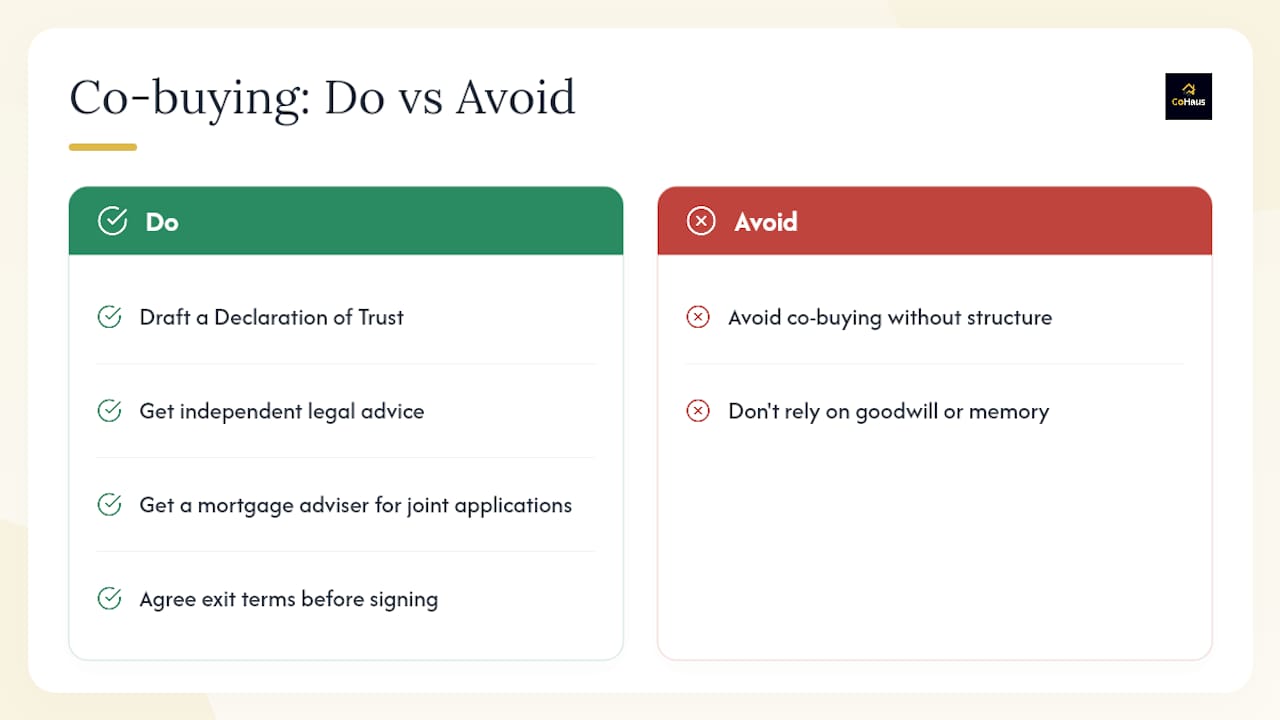
The conventional wisdom is that buying with friends is risky. We think that framing misses the point. The risk is not co-buying itself; it is co-buying without structure. A properly drafted co-ownership agreement, independent legal advice for each party, and a mortgage adviser who understands joint applications removes most of the uncertainty people worry about.
What people consistently underestimate is how much the Declaration of Trust does. It is not just a formality. It is the document that decides what happens when life changes: a job loss, a relationship shift, a desire to move on. Without it, you are relying on goodwill and memory, neither of which holds up in a dispute. With it, you have a written plan that courts will refer to and that most disputes never reach court because the answer is already on paper.
The other thing worth saying plainly: the friends who co-buy successfully are not the ones who trusted each other most at the start. They are the ones who had the slightly uncomfortable conversation about exit terms before they signed anything. That conversation, supported by the right platform and the right professionals, is exactly what Cohaus is here to help you have.
Start your co-buy with Cohaus
Cohaus gives you a structured way to add a co-buyer and manage the whole process, from pooling deposits to connecting with solicitors and mortgage advisers who know co-buy structures inside out.
Through the platform you can match with compatible co-buyers, track each person's deposit contribution transparently, and access templated Declaration of Trust guidance before your first solicitor meeting. Cohaus also connects you with mortgage advisers who know which lenders accept joint applicants and count every income correctly.
- Pooled deposit tracking for each co-buyer's contribution
- Co-buyer matching based on financial compatibility and shared goals
- Introductions to solicitors and mortgage advisers experienced in co-buys
- Clear exit term templates built into the process from day one
Join Cohaus and take the first step towards co-buying with confidence.
Useful sources and further reading
The following sources are referenced in this article. Bring the relevant ones to your solicitor and mortgage adviser meetings.
- Practice guide 24: private trusts of land
- Owning land and property with someone else | GOV.UK
- Getting a mortgage with a friend | L&C Mortgages
- Everything you need to know about sharing a mortgage with friends | Mortgage Advice Bureau
- Buying a house with a friend in the UK — Hudson Rose
- Buying a property with friends: what happens if things go wrong | Myerson
- Buying a home jointly in England and Wales? Here’s what you need to know | The Guardian
- Buying Property With Friends: Legal Structure, Risk and What to Agree First | Property Passport UK