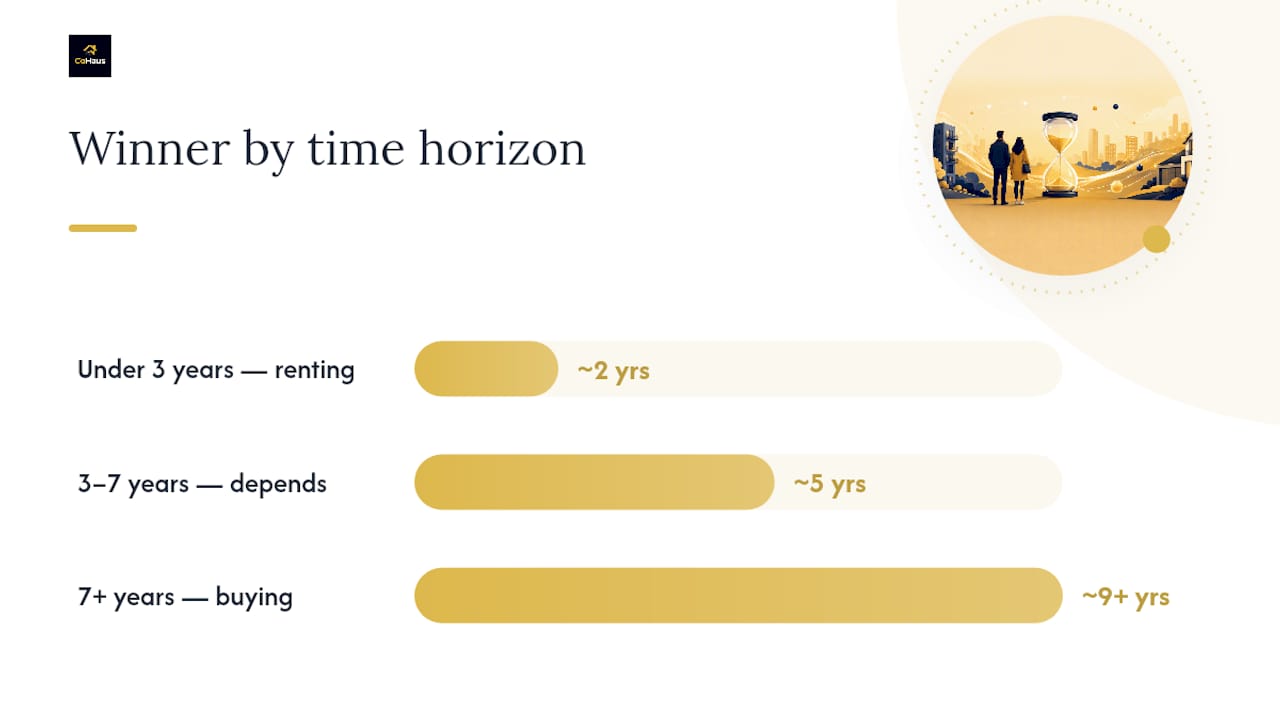
There is no universal winner between renting and buying. Your time horizon and your deposit decide it: stay under three years and renting almost always wins; commit to seven or more and buying usually pulls ahead if you can raise a deposit and absorb rate movement. The three‑to‑seven‑year band is where local numbers, not national headlines, make the call. Everything below shows you how to run that calculation for your own postcode, and what to do if the deposit, not the maths, is what's holding you back.
TL;DR:
- Renting is almost always cheaper for stays under three years due to transaction costs and stamp duty.
- Buying becomes more cost-effective after seven or more years if the deposit is at least 5 to 10 percent and mortgage rate increases can be absorbed.
- Local rent-to-price ratios significantly influence the breakeven point, which ranges from three to ten years depending on regional housing market conditions.
- A thorough calculation should include deposit opportunity costs, potential rate rises, and all buying costs like SDLT, legal fees, maintenance, and insurance for an accurate comparison.
- Co-buying offers a practical way to overcome deposit barriers, especially in high-price areas like London and the South East, with legal protections ensuring fairness among joint buyers.
Table of Contents
- Rent vs buy UK: the headline rules for 2026
- The maths: every cost a fair comparison must include
- Why your postcode matters more than the national picture
- A practical checklist before you decide
- How to run your own rent vs buy calculation
- Co‑buying: how pooling a deposit changes the whole calculation
- What I usually recommend to people in 2026
- Cohaus: when buying is right but the deposit isn't
- Official stats and calculators to check
- Sources
- FAQ
Rent vs buy UK: the headline rules for 2026
Three rules of thumb cut through most of the noise. Stay under three years in a property and renting wins on cost almost every time, because stamp duty and moving costs rarely get repaid in the time available. Commit to seven years or more and buying tends to overtake renting, assuming you can find a deposit of at least 5 to 10% and your income can absorb a mortgage rate rise of a percentage point or two. Between those two points, the winner depends on your local rent-to-price ratio, not the national picture.
The national numbers illustrate why averages mislead. Average UK private rent hit £1,381 a month in April 2026, up 3.5% on the year, against an average house price near the national typical value with growth flatlining at 0.0% provisional. On paper, that gap favours renting almost everywhere. But regional analysis shows buying still beats renting in many northern and Scottish localities, even as new mortgage repayments often exceed average rent nationally by a moderate amount.
- Renting under 3 years: almost always cheaper once you factor in moving costs and SDLT.
- Buying 7+ years: usually favourable with a workable deposit and rate‑shock tolerance.
- 3 to 7 years: genuinely marginal, decided by local rent‑to‑price ratios.
Pro Tip: Run your own numbers against your postcode's rent and price data before trusting a national average. A £1,381 average rent means nothing if your local flat rents for £950.
The real barrier for most people isn't the monthly comparison. It's the lump sum. A 10% deposit on a typical property based on national average house price is a mid five-figure sum before solicitor fees, and that single hurdle explains why so many people who could comfortably afford mortgage repayments are still renting.
The maths: every cost a fair comparison must include
A rent vs buy calculation that only compares monthly rent to monthly mortgage repayment is worthless. It ignores the biggest costs on both sides. Here's what a credible model needs.
- Deposit opportunity cost. Money locked into a deposit stops earning elsewhere. Model this at a 3 to 7% annual return, since that range spans a cautious cash ISA and a long‑run equity fund.
- Mortgage interest and capital repayment. Not just the headline rate; check what happens if it rises 1 to 2 percentage points during a fixed‑term renewal.
- Stamp Duty Land Tax. SDLT, and any first‑time buyer relief you qualify for, is a real upfront cost and must be pulled from the Gov for your specific purchase price, not a rule of thumb.
- Solicitor, survey and conveyancing fees. Typical upfront costs beyond the deposit sit typically several thousand up to mid five-figure sums, depending on the property and the services you use.
- Ongoing maintenance and repairs. A sensible working assumption is 1 to 2% of property value per year, lower for new builds, higher for older stock.
- Buildings insurance and, where relevant, service charges. Flats with high service charges can quietly erase much of the "buying is cheaper" advantage.
- Selling costs. Estate agent fees and further conveyancing when you eventually move on.
Rent inflation and house price growth both need sensitivity testing rather than a single guess. A reasonable approach varies house price growth by ±2% and investment return on the deposit between 3 and 7%, because the buy case is often far more fragile than a single optimistic scenario suggests.
Why your postcode matters more than the national picture
National averages flatten enormous regional differences, and that's the single biggest reason generic rent vs buy advice fails people. London and the South East combine the country's highest prices with some of its highest rents, which can actually shorten the breakeven period for buyers who can clear the deposit hurdle, because rent is expensive enough to make ownership pull ahead sooner. The North and Scotland tend to show the opposite pattern: lower prices make deposits more achievable, and buying frequently beats renting on a monthly basis even where national headlines suggest renting is winning.
Breakeven is the point where cumulative buying costs (deposit opportunity cost, interest, maintenance, tax) fall below cumulative renting costs. Typical UK calculator outputs show buying becoming favourable after roughly 7 to 10 years under conservative assumptions, though this shifts sharply with local inputs.
- Fast breakeven (3 to 5 years): high‑rent, moderate‑price areas where rent absorbs a large share of income relative to the mortgage that would replace it.
- Typical breakeven (5 to 7 years): most commuter towns and mid‑sized cities, where rent and mortgage costs sit closer together.
- Slow breakeven (7+ years): expensive southern markets where the deposit is large relative to income, even if rent is also high.
Rent and price growth also vary by property type. ONS data broken down by bedroom count and property type shows flats and houses moving at different speeds, so a calculation built on "average UK house price" for a one‑bed flat purchase will mislead you. Always substitute your own local rent and price figures before trusting any breakeven estimate.
A practical checklist before you decide
Work through these points honestly rather than answering on instinct.
- How long will you realistically stay? Under 3 years favours renting outright; over 7 years favours buying if the deposit is achievable.
- Do you have a deposit plus a separate emergency fund? Aim for a deposit of 5 to 15% of the purchase price and a cash buffer covering 3 to 6 months of costs, kept entirely separate from the deposit itself.
- Have you stress‑tested the mortgage at a higher rate? Check what your payment looks like 1 to 2 percentage points above today's rate, not just the deal you'd sign today.
- How stable is your job and location? A likely relocation for work in the next few years pushes hard towards renting.
- What's your tolerance for maintenance and unexpected repairs? Ownership means you fix the boiler yourself, financially and practically.
Aim to keep total housing costs, rent or mortgage plus running costs, below roughly 35% of take‑home pay. Red flags that should tip you towards renting include an unstable income, a deposit funded entirely by short‑term borrowing, or a stay of less than three years in the area.
Pro Tip: If your mortgage stress test at +2% wipes out your monthly savings entirely, that's the calculation telling you something a spreadsheet won't: wait, or buy smaller.
How to run your own rent vs buy calculation
Collect these inputs before you open a calculator: local monthly rent for a comparable property, your target purchase price, deposit size, an achievable mortgage rate, SDLT due on that price, an annual maintenance estimate, your expected holding period, and an assumed investment return on your deposit if you didn't buy.
- Enter conservative assumptions first: house price growth near 0%, investment return at 6 to 7%, and a mortgage rate a point above today's cheapest deal.
- Run the same inputs with optimistic assumptions: 3% house price growth and a 3% investment return.
- Compare the breakeven year in both scenarios. If they differ by more than two or three years, treat the result as fragile rather than settled.
- Identify which single input moves the outcome most, usually mortgage rate or house price growth, and focus your real‑world research there.
A UK rent vs buy calculator that models deposit opportunity cost, SDLT, and maintenance alongside price growth will get you a far more honest answer than a simple monthly comparison.
Co‑buying: how pooling a deposit changes the whole calculation
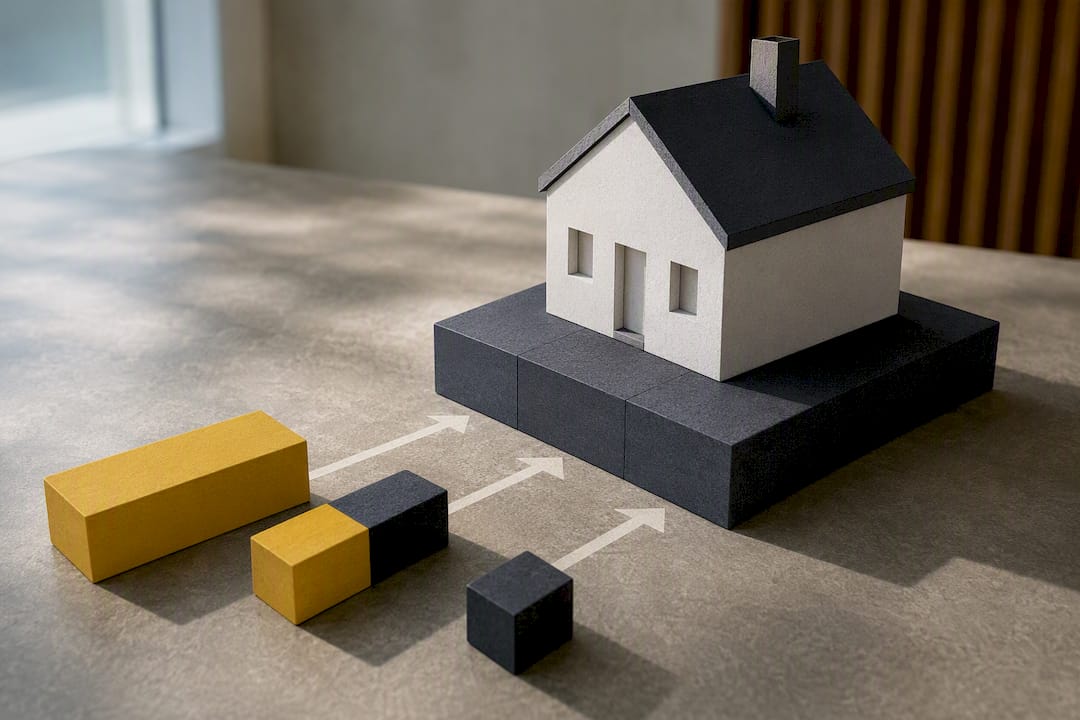
Co‑buying tackles the actual blocker for most renters, which is the deposit, not the monthly maths. Splitting a deposit and mortgage between two or three people can cut each person's required deposit and monthly share substantially, and that shift is particularly powerful in London and the South East, where high prices make solo deposits hardest to reach. A £26,800 deposit split three ways is roughly £8,900 each, which turns an impossible savings target into a realistic one or two-year plan.
Safe co‑buying depends on the legal groundwork, not goodwill. Before joining any arrangement, check for:
- A formal co‑ownership agreement covering shares, contributions and decision‑making.
- Clear, pre‑agreed exit terms for what happens if one co‑buyer wants to sell or leave.
- Independent conveyancer advice for each buyer, not a single shared solicitor.
- A proper affordability check on every co‑buyer, not just the one with the strongest income.
Cohaus builds these protections into its co‑buying process, including guidance on structuring a joint mortgage and vetting a potential co‑buyer before you commit money to a search.
Pro Tip: Never skip the co‑ownership agreement, even with close friends. The point of the paperwork is protecting the relationship, not preparing for a fight.
What I usually recommend to people in 2026
The financial case rarely tells the whole story. Two people can run identical numbers and land on different answers, because stability and flexibility carry real weight alongside the spreadsheet.
Take a young professional renting a flat in London who might relocate for a better role within two years. The checklist points firmly at renting, whatever the local breakeven maths suggests, because flexibility has a price that a calculator won't capture. Now take a family in the North with stable local jobs, a five‑year‑plus horizon, and £15,000 saved. The same checklist points towards buying, and the regional numbers back it up.
If the maths says buy but the deposit is what's stopping you, that's a solvable problem before it's a verdict. Run your own numbers, speak to a mortgage adviser, and treat co‑buying as a genuine third option rather than a fallback.
— Martin
Cohaus: when buying is right but the deposit isn't
If your checklist points to buying and the only thing standing between you and a mortgage is the deposit, that's exactly the gap Cohaus was built to close. Cohaus is a community for people who want to buy but feel locked out by the size of a solo deposit, matching you with co‑buyers, helping structure shared deposits and mortgage responsibility, and building in legal protections, including clear exit terms, so the arrangement stays fair if circumstances change.

The people who get the most from this route are usually those who've already run the numbers above and concluded that buying makes financial sense, but the lump sum is the sticking point rather than the monthly affordability. Before joining any co‑buying arrangement, check the vetting process for co‑buyers, confirm independent legal advice is built in for every party, and read the exit terms carefully, guidance Cohaus sets out in its co‑buyer vetting checklist. If a shared deposit is what's keeping you renting, Cohaus to see how the matching and legal framework works, and take the first step towards a deposit you can actually reach.
Official stats and calculators to check
Verify every figure in this article against the primary source before you act on it.
- ONS private rent and house price statistics, for national and regional rent and price data.
- Stamp Duty Land Tax rates and thresholds, for current buying tax costs.
- First Homes scheme eligibility, for discounted first‑time buyer routes.
- Calks, for modelling your own breakeven scenario.
This article is general information, not a substitute for advice from a qualified financial advisor. Consult a qualified financial professional about your own circumstances before acting on anything here.
Sources
- Private rent and house prices, UK: May 2026 — ONS
- Gov
- Renting vs Buying in the UK 2026: The numbers explained — InsightHQ
FAQ
Is rent to buy a good idea in the UK?
Rent‑to‑buy schemes can help you save towards a deposit while living in the property, but check the small print on how much rent actually counts towards the purchase, and get independent legal advice before signing, the same protection Cohaus builds into its co‑buying agreements.
What is the 2% rule for renting?
Applied to the average UK house price of around £268,000, that would put fair monthly rent far above the actual average rent of £1,381, which shows why the rule works better as a rough sense check than a precise UK benchmark.
Is it better to buy or rent in London in 2026?
It depends heavily on your time horizon and deposit. High London rents can shorten the breakeven period for buyers who clear the deposit hurdle, but that hurdle is steep enough that co‑buying is particularly effective in the capital compared with cheaper regions.
How long does it typically take for buying to break even against renting?
Most UK calculators put breakeven at roughly 7 to 10 years under conservative assumptions, though high‑rent areas can shorten this to 3 to 5 years and expensive southern markets can push it beyond a decade.