
Yes, you can remove a name from a mortgage in the UK, but only with your lender's consent, and only after the remaining borrower passes a full affordability check on their sole income. This isn't a paperwork formality. It's a fresh lending decision.
The process runs through a legal step called a transfer of equity, alongside a change to who's named on the mortgage itself. Here's the short version of how it works:
- The lender reassesses affordability as if the remaining borrower were applying fresh, alone.
- If approved, a solicitor drafts and registers the TR1 form at HM Land Registry.
- The new sole mortgage offer and the TR1 registration typically complete on the same day.
If the sole income doesn't stack up, the whole plan needs rethinking before anyone signs anything.
Key Takeaways
Removing a name from a UK mortgage always requires lender consent and a sole-income affordability check, completed alongside a TR1 transfer of equity at the Land Registry.
| Point | Details |
|---|---|
| Lender consent is non-negotiable | Affordability is reassessed as a fresh sole application; private agreements carry no weight with the lender. |
| Liability continues until completion | Both parties stay jointly and severally liable for the full debt until the transfer and mortgage both change. |
| Budget for three cost lines | Admin fee, solicitor and disbursements, and SDLT filing where the transfer value triggers it. |
| Expect six to ten weeks | Panel solicitors and cooperative parties speed things up; chains and valuation disputes slow it down. |
| Plan exits before you need them | Cohaus helps co-buyers agree buyout funding upfront and connects them to panel solicitors and brokers when it's time to act. |
Table of Contents
- What changes legally when you remove a name from a mortgage
- How does the mortgage name removal process actually work?
- What does it cost and how long does it take?
- What if the lender refuses to remove a name?
- What should you have ready before you call the lender?
- What does this mean for co-buyers specifically?
- Why the standard advice misses the co-buying angle
- Get help with a mortgage name change through Cohaus
- Sources
What changes legally when you remove a name from a mortgage
Removing a name from a mortgage and removing a name from the property title are two separate legal actions, and conflating them causes real problems. The Land Registry title records who owns the property. The mortgage deed records who owes the lender money. Change one without the other and you can end up with someone owning a share of a house they have no legal duty to pay for, or worse, someone with a mortgage debt attached to a home they no longer legally own.
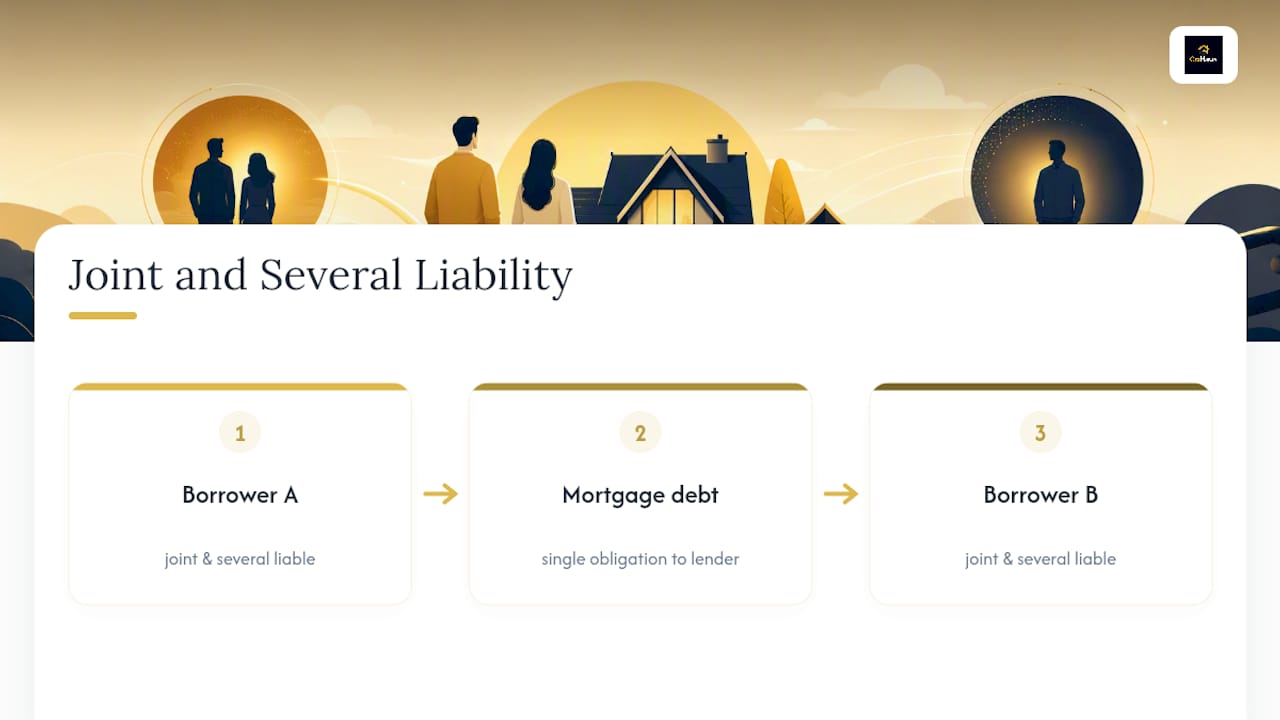
Until completion, both parties carry joint and several liability. That means the lender can chase either person for the full mortgage balance, not just half, regardless of what an informal agreement between the two of you says. A private arrangement to "just pay your share" carries no weight with the lender until the transfer of equity and the new mortgage are formally registered.
One in every household mortgage change of this kind hinges on the same pinch point: whether the remaining borrower's income alone satisfies the lender's affordability model.
Credit impact matters too. Missed payments during the transition show on both credit files, since both names remain liable until the deed and mortgage both change. Once removed, the outgoing party's credit report should stop reflecting that mortgage's future conduct, but historical payment records don't vanish. If you're the one leaving, check your joint and several liability exposure before agreeing to any handshake deal on timing.
How does the mortgage name removal process actually work?
Treat this as a sequence, not a single event. Skipping steps or doing them out of order is the most common reason removals stall.
- Contact the lender first. Ask specifically about their change-of-parties process, whether they charge an admin fee, and whether they'll consider a product transfer rather than a full remortgage.
- Get an affordability assessment or agreement in principle for the remaining borrower before agreeing any buyout figure with the person leaving. Numbers agreed before this step often need renegotiating.
- Instruct a conveyancer on the lender's panel. They'll draft the TR1, handle any Stamp Duty Land Tax filing if the transfer value crosses a threshold, and register the change with the Land Registry. If your chosen solicitor isn't on the lender's approved panel, expect delays while a second solicitor gets involved.
- Agree a completion date where the new mortgage offer and the TR1 registration happen together. These two events are meant to land on the same day, which avoids any gap where ownership and mortgage liability don't match.
Some lenders will offer a product transfer, amending the existing mortgage rather than issuing a brand new one, if sole affordability checks out. It's often quicker and cheaper, though it may not give you the sharpest rate on the market, so weigh convenience against cost before choosing that route.
Pro Tip: Don't agree a buyout figure with your co-borrower until you have written confirmation of what the lender will actually approve on sole income. Verbal agreements based on guesswork about affordability regularly fall apart at the underwriting stage.
What does it cost and how long does it take?
Budget for three separate cost lines, not one. Lenders typically charge an administration fee for processing a change of parties, often in the low hundreds of pounds, though this varies by lender and should be confirmed in writing before you proceed. On top of that sits your solicitor's fee for preparing the TR1 and handling Land Registry registration, plus disbursements. Where the transfer value triggers it, SDLT may also need filing.
- Lender admin fee: confirm the exact figure before instructing anyone.
- Solicitor/conveyancer fee: covers TR1 drafting, panel checks, and registration.
- SDLT return: only applies above certain transfer value thresholds.
Most completions land somewhere between six and ten weeks, from initial application through to Land Registry registration. Faster where both parties cooperate and the solicitor sits on the lender's panel already. Slower where there's a chain, a disputed valuation, or a solicitor outside the panel who needs extra sign-off.
What if the lender refuses to remove a name?
A refusal usually comes down to one thing: the remaining borrower's income doesn't meet the lender's sole-affordability threshold. When that happens, you've got a handful of realistic paths forward.
- Remortgage to a different lender. A new lender might apply different affordability criteria, but check for early repayment charges on your current deal first, and expect a full fresh application.
- Sell the property. If no borrowing route works, this is sometimes the cleanest option, particularly where emotions around a shared home are already running high.
- Make a lump-sum reduction. Paying down part of the balance before reassessment can bring the remaining mortgage within reach of sole affordability.
- Extend the mortgage term. Stretching repayments over more years lowers the monthly figure, which can be enough to pass the test.
- Approach a specialist lender. Some lenders take a broader view of income types or credit history than mainstream high-street providers.
If the removal follows a separation, it's worth confirming the maximum a sole mortgage will actually stretch to before agreeing how the equity gets split. Settling on numbers first and discovering the mortgage math doesn't work afterwards is a common and avoidable mistake.
What should you have ready before you call the lender?
Getting organised before you pick up the phone saves weeks. Lenders and solicitors will typically ask for:
- Proof of identity and proof of address for both parties.
- Recent payslips or, for the self-employed, tax returns and accounts.
- Bank statements covering the last three to six months.
- Your current mortgage statement showing the outstanding balance.
- Evidence of buyout funds, if one party is paying the other out.
Foreign nationals should also check what additional documentation their lender requires, as requirements can differ from standard UK applications.
When you speak to the lender, ask directly: what's the admin fee, must the solicitor be on their panel, and will they confirm the process in writing? Treat vague answers to any of these as a red flag.
Pro Tip: Ask your lender to email you their change-of-parties process rather than relying on a phone call summary. Written confirmation protects you if the person you spoke to gives incomplete information.
What does this mean for co-buyers specifically?

Co-buying arrangements add a layer that separating couples don't usually face: a written exit agreement drawn up before anyone moved in. That's exactly the point of planning ahead.
A well-structured co-buy sets out open exit terms in advance, so if one buyer needs to leave, everyone already knows how a buyout gets valued and funded rather than negotiating it under pressure. Remortgaging to buy out a co-buyer is often the most straightforward route, and it works best when the funding plan exists before anyone contacts the lender.
- Agree in principle how a buyout would be funded, before you need it.
- Check whether a remortgage to buy out a co-buyer suits your specific structure.
- Read up on adding a partner to an existing mortgage if your co-buying group is changing shape rather than shrinking.
Why the standard advice misses the co-buying angle
Most guidance on removing a name from a mortgage assumes a divorcing couple with a single, well-understood relationship to unwind. That's a fair assumption for a lot of readers, but it leaves co-buyers, house-sharing friends, and family groups with a gap in the advice they actually need.
The conventional playbook says: contact your lender, get an affordability check, instruct a solicitor. All correct, all necessary. What it skips is the work that should happen before any of that: agreeing, in writing, how an exit gets valued and funded while everyone's still on good terms. Waiting until someone wants out to start that conversation is where most of the stress in this process comes from, not the paperwork itself.
If you're in a co-buying arrangement, the single biggest lever you control is timing. Sort the funding principle early, and the lender conversation becomes a formality rather than a crisis. That's a very different experience from scrambling to prove sole affordability after a relationship has already broken down.
— Martin
Get help with a mortgage name change through Cohaus
Cohaus is the practical alternative to figuring this out alone. Where most co-buying arrangements only think about the exit once someone's already trying to leave, Cohaus builds those terms in from the start, so a name removal or buyout follows a plan rather than a scramble.

Cohaus can connect you to conveyancers and mortgage brokers who understand co-buying structures specifically, not just standard divorce transfers, and the site hosts practical guides covering remortgaging to buy out a partner and what happens if a co-owner stops paying their share. If you're weighing up a buyout, exploring the Cohaus platform is a sensible next step, whether you're already co-buying or considering it for the first time.
Sources
Cross-check anything here against primary sources before acting, particularly on fees and timelines, which vary by lender.
- MoneyHelper — dividing the family home and mortgage during divorce or dissolution
- CompletelyMoved — how to transfer equity in a property with a mortgage
- Stephensons Solicitors — the process of transferring the equity in a property