For long-term illness, income protection insurance usually protects your mortgage payments better than mortgage payment protection insurance (MPPI). MPPI is built for short, sharp shocks like redundancy or a temporary injury, typically paying out for 12 to 24 months. Income protection replaces a slice of your salary for as long as you're unable to work, sometimes right up to retirement. Both are optional, both are regulated, and the right choice hinges on your deferred period and benefit period, covered in the comparison and checklist below.
TL;DR:
- Income protection offers longer-term, more comprehensive coverage than MPPI, often paying until retirement for long-term illness or injury.
- MPPI is designed for short-term, trigger-specific events like redundancy or temporary sickness, typically lasting up to 24 months, with limited exclusions.
- Income protection premiums vary widely based on health, occupation, age, deferred period, and benefit length, often costing more but providing better long-term security.
- Shared ownership require each co-buyer to hold their own protection policies, matching their actual share of the mortgage to avoid gaps if one person falls ill.
Table of Contents
- What is mortgage payment protection insurance (MPPI)?
- What is income protection insurance, and how does the mortgage version work?
- MPPI vs income protection: which suits your situation?
- What does income protection mortgage cover cost in the UK?
- How to choose and buy an income protection mortgage plan
- What happens if you need to make a claim?
- Protection considerations for co-buyers and joint mortgage applicants
- Managing affordability if full cover feels out of reach
- Sources
- FAQ
What is mortgage payment protection insurance (MPPI)?
MPPI is a short-term, debt-specific safety net. It's designed to cover your mortgage repayments, and sometimes a portion of household bills, after you're made involuntarily redundant or become unable to work due to accident or sickness. Cover typically runs for 12 to 24 months, which is usually long enough to find new work or recover from a short illness, but not much beyond that.
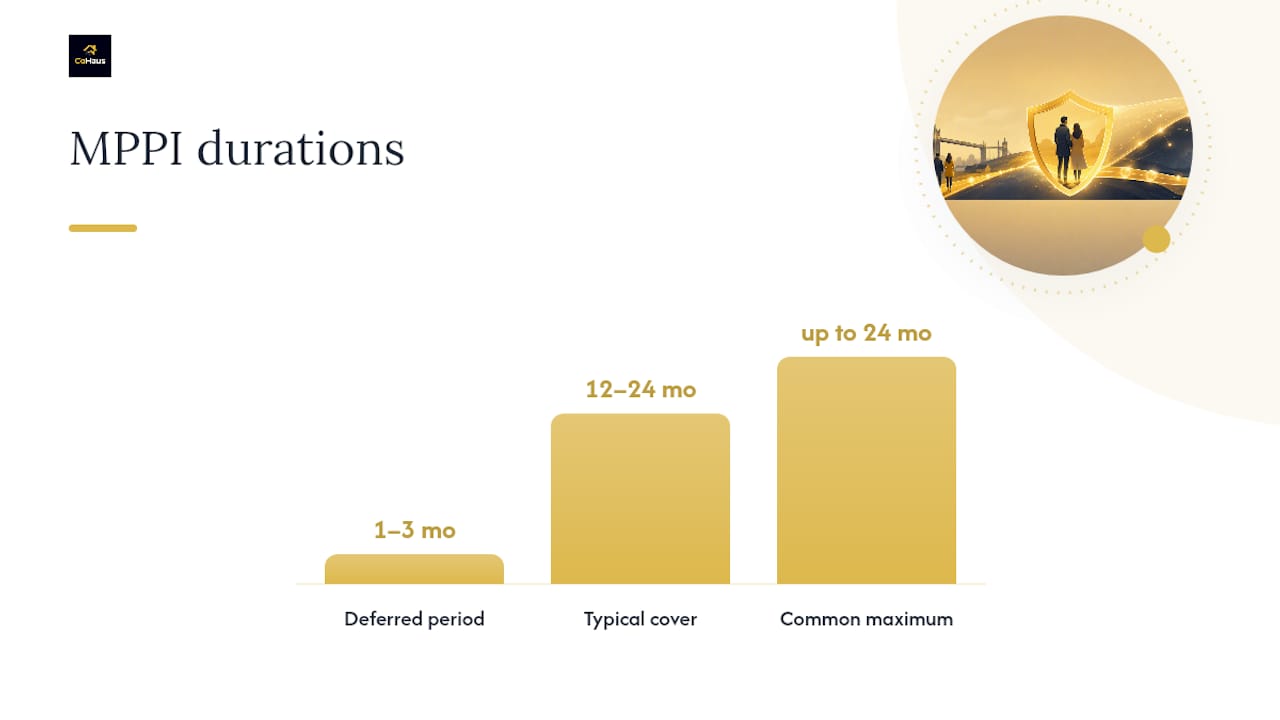
Most policies have a deferred period, the gap between your claim starting and payments beginning, usually around one to three months. The payout target is either your full monthly mortgage payment or a set percentage of it, agreed when you take out the policy.
MPPI comes with several standard exclusions worth reading closely before you buy:
- Pre-existing medical conditions are almost always excluded, or at least heavily restricted.
- Voluntary redundancy doesn't count. If you resign or take voluntary terms, you won't be covered.
- Stress and some mental health conditions are frequently excluded or capped, depending on the insurer.
- Self-employed borrowers often face tighter eligibility rules, since "redundancy" doesn't apply in the same way and insurers need alternative proof of income loss.
Payments are usually made as a fixed monthly sum straight to you, though some policies route the money directly to your lender instead. Which? notes that MPPI generally pays for a limited period, commonly up to 24 months, which is the single biggest factor to weigh against income protection before you commit.
What is income protection insurance, and how does the mortgage version work?
Income protection insurance replaces part of your earnings, not your mortgage specifically, if you can't work due to illness or injury. Most policies pay 50 to 65% of your gross income, continuing until you return to work, the policy term ends, or you retire, depending on the type you choose.
There are three broad shapes to this product, and the difference matters more than most comparison sites let on:
- Short-term income protection pays out for a fixed window, often one or two years per claim, similar in spirit to MPPI but based on income rather than debt.
- Full-term (long-term) income protection can pay until retirement age if you never return to work, making it the strongest option against chronic or degenerative conditions.
- Own-occupation policies pay out if you can't do your specific job; any-occupation policies only pay if you can't do any job you're reasonably qualified for. Own-occupation cover costs more but pays out far more readily for specialists, tradespeople, and anyone with a physically demanding role.
Some insurers offer a mortgage income protection variant, where you can direct an agreed slice of your monthly benefit straight towards your mortgage rather than managing the whole payment yourself. Because these policies are medically underwritten at application rather than at claim, you generally get a clearer picture of what's covered before you ever need to claim, which is one reason income protection tends to suit long-term incapacity risk better than MPPI.
Pro Tip: Ask for the policy's definition of incapacity in writing before you buy. "Own-occupation" and "any-occupation" sound similar but can mean the difference between a paid claim and a declined one.
The trade-off is straightforward: income protection costs more and takes longer to arrange because of medical underwriting, but it covers far more ground and doesn't run out after two years. MPPI is cheaper and quicker to set up, but it's a stopgap, not a long-term plan.
MPPI vs income protection: which suits your situation?
The two products solve different problems, and the table below makes the split clear.
| Factor | MPPI | Income protection |
|---|---|---|
| Trigger | Redundancy, accident, sickness | Illness or injury preventing work |
| Typical duration | 12 to 24 months | Until recovery, term end, or retirement |
| Underwriting | Often minimal at outset, checked at claim | Medical underwriting at application |
| Who receives payment | You, sometimes paid to lender | You, directed as you choose |
| Scope | Mortgage payment only | A percentage of gross income |
| Price tendency | Lower premiums | Higher premiums, better long-term value |
A few real scenarios show how this plays out. A single earner with limited savings and a stable job in a redundancy-prone sector often does well with MPPI, since the risk is short-term and specific. Someone with a family history of long-term illness, or a physically demanding job, is usually better served by full-term income protection, even at a higher premium. Self-employed borrowers should look closely at MPPI eligibility, since many insurers restrict or exclude cover where there's no formal employer redundancy process. Joint mortgage or co-buying arrangements raise a different question entirely: whose income actually needs replacing, and does each party need their own policy.
The FCA has previously stepped in on MPPI, setting expectations around variation clauses and disclosure after historic problems with unclear terms. Always check whether your insurer can alter the policy mid-term, and get that in writing.
What does income protection mortgage cover cost in the UK?
Premiums depend on six main levers: your age, smoker status, occupation class, deferred period, benefit period, and how much of your income you want replaced. A younger non-smoker in an office job will pay considerably less than an older smoker in a manual trade, sometimes by a factor of three or four for equivalent cover.
The deferred period does the heaviest lifting on price. Someone who can rely on their employer's sick pay scheme for the first three months might choose a 90-day deferred period and see their premium drop noticeably compared with a 30-day deferred period, since the insurer is taking on less early-stage risk. If your employer offers only statutory sick pay, which is considerably less generous than most occupational sick pay schemes, a shorter deferred period is usually worth the extra cost.
Ways to bring the premium down without gutting the cover include:
- Extending the deferred period if you have savings or employer sick pay to bridge the gap.
- Choosing any-occupation rather than own-occupation cover, if your job allows it.
- Reducing the replacement ratio slightly, from 65% down to 55%, for example.
- Improving your risk class over time, since quitting smoking or moving to a desk-based role can lower future premiums.
The UK protection market paid out £7.84 billion across 280,992 claims in 2025, with individual protection policies showing a 97.9% claims-paid proportion. That figure should reassure anyone worried that these policies are designed to reject claims. The acceptance rate is high, and insurers have a clear commercial incentive to keep it that way.
How to choose and buy an income protection mortgage plan
Work through these steps in order, and you'll avoid most of the common mistakes borrowers make when buying protection under time pressure:
- Decide what you're actually protecting. Is it the mortgage payment specifically, or your broader household income? This single question usually settles whether MPPI or income protection is the right starting point.
- Set your deferred and benefit periods based on real numbers, not guesswork. Check your employer's sick pay policy and your savings buffer before choosing.
- Confirm redundancy is actually covered if that's your main worry. Some income protection policies exclude redundancy entirely, while MPPI is built around it.
- Check how payments are routed. Some policies pay you directly, others pay the lender. A partner-network breakdown of how lenders handle third-party payments shows why some borrowers prefer funds landing in their own account first.
- Read the variation clause. Can the insurer change your premium or terms mid-policy, and under what conditions?
For evidence, insurers typically want proof of income (payslips or accounts for the self-employed), a medical history declaration, and, for MPPI claims, an employer redundancy letter. A broker who specialises in protection can be worth the fee if your case is complex, self-employment, multiple income streams, or existing health conditions, but always ask whether they're tied to a panel of insurers or genuinely independent.
Pro Tip: Get at least three quotes before deciding, and ask each insurer the exact same question about their definition of incapacity. The wording differences between "own" and "any" occupation are where most disputes start.
Red flags include pressure to buy alongside your mortgage offer with no cooling-off period, vague answers about exclusions, and reluctance to put variation terms in writing.
What happens if you need to make a claim?
Most insurers ask for medical reports from your GP or specialist, confirmation from your employer if relevant, and ongoing evidence that your condition continues to prevent work. For MPPI, expect a request for a redundancy letter or fit note fairly early in the process. Payouts are usually made monthly, either directly to you or, for some MPPI policies, straight to your lender.
If a claim is declined, you have a clear path:
- Ask the insurer for a written explanation and raise a formal complaint if you disagree.
- Escalate to the Financial Ombudsman Service if the insurer's final response doesn't resolve things.
- Keep every letter, email, and medical report. Disputes are won or lost on paperwork.
Industry reporting shows musculoskeletal and mental health conditions now drive a large share of income protection claims, and insurers are increasingly bundling in return-to-work support such as physiotherapy referrals or occupational health advice alongside the payout itself.
Protection considerations for co-buyers and joint mortgage applicants
Shared ownership changes the maths on protection in ways a lot of guides skip entirely. When two or three people share a mortgage, the risk isn't just "can I pay my share", it's "what happens to everyone else if one co-buyer can't pay theirs." A policy that only covers one name on the mortgage leaves the others exposed the moment that person falls ill or loses their income.
It is recommended that every co-buyer hold their own protection sized to their actual share of the mortgage, not a generic blanket figure. Leaving one person uninsured because "someone else will cover it" is a significant gap in shared-ownership arrangements. Clear exit terms, shared-deposit governance, and a proper joint agreement matter just as much as the insurance policy itself. Legal clarity on what happens if a co-buyer needs to leave, temporarily or permanently, protects everyone's stake regardless of how good anyone's insurance turns out to be.
For long-term health risk, individual income protection sized to each person's share tends to outperform a single MPPI policy covering multiple borrowers. MPPI can still make sense as a stopgap for short-term redundancy risk across the group, but it shouldn't be the only plan. If you're weighing up how life insurance interacts with a joint mortgage, it's worth reading alongside your income protection decision, since the two typically get arranged together.
— Martin
Managing affordability if full cover feels out of reach
Not everyone can stretch to a full income protection premium on top of a mortgage, and that's a common challenge. Some solutions reduce the pressure by helping buyers co-buy with others so individual mortgage exposure, and the amount of income needed to protect, is smaller from the start.

If you're weighing whether to buy income protection or MPPI, it's worth asking a different question first: how much of your income is actually tied up in your mortgage share, and could that share be smaller? Cohaus matches you with compatible co-buyers, manages shared-deposit arrangements, and puts legal protections and open exit terms in place so pooling resources doesn't mean pooling risk blindly. It's a complement to your protection decision, not a substitute for it, life and income cover still matter. But a smaller mortgage share often means a smaller, more affordable protection premium too. If that sounds like a route worth exploring, visit Cohaus to see how co-buying could change your numbers before you commit to a policy size.
Sources
- Mortgage protection - MoneySuperMarket
- Protection insurers pay out £7.84 billion to help customers safeguard their finances - ABI
- Mortgage Payment Protection Insurance (MPPI) - FCA
- What is mortgage payment protection insurance? - Which?
FAQ
Do I need income protection for a mortgage?
It's not legally required, but if you have no savings buffer and would struggle to pay your mortgage without your salary, income protection or MPPI significantly reduces that risk.
Does Martin Lewis recommend income protection insurance?
Consumer finance commentators, including Martin Lewis's MoneySavingExpert site, generally encourage people to weigh income protection seriously, particularly if they lack employer sick pay or savings, though the right policy depends on individual circumstances.
Is income protection worth it in the UK?
For most people with limited sick pay or savings, yes, particularly full-term, own-occupation policies, given the 97.9% claims-paid proportion reported across the individual protection market.
How do I protect my mortgage if I lose my job?
MPPI is specifically designed for involuntary redundancy and typically pays your mortgage for 12 to 24 months, though voluntary redundancy is excluded, so check your policy's exact wording before relying on it.
Will income protection cover my mortgage directly?
Most income protection pays into your bank account as income replacement, but some insurers offer a mortgage payment option letting you direct part of the benefit straight towards your mortgage each month.