A household expenses agreement must do three things: tie every deposit and mortgage payment to a specific, enforceable beneficial share; set out what happens on sale, dispute or death; and be signed as a deed before you complete. Get this wrong and your mortgage lender's rights stay exactly the same regardless of what you and your co-buyer agreed privately. Get it right, and you have a document a court will actually enforce.
TL;DR:
- A household expenses agreement must be signed as a deed before completion and include specific, enforceable clauses on property identification, contributions, and sale mechanics.
- Beneficial ownership is separate from legal title and requires a declaration of trust, especially when contributions are unequal, to ensure enforceability and fairness.
- Private agreements do not alter the lender’s joint and several liability, meaning all borrowers are responsible for the entire mortgage regardless of internal shares.
- Drafting the agreement before exchange reduces potential disputes and costs, with key steps including proper legal signing, witnessing, and timely submission of Form 17 if needed.
- Building in review and amendment mechanisms prevents issues from unequal contributions over time, avoiding silent resentments and costly legal disputes later.
Table of Contents
- What a household expenses agreement actually is
- Key clauses your household expenses agreement needs
- Does a private agreement change what you owe the lender?
- Steps: from agreement to registered deed
- How do you avoid a stalemate on exit?
- Mistakes that undo good intentions
- Why co-buyers underestimate this document
- Getting your agreement from idea to enforceable deed
- Sources
- FAQ
What a household expenses agreement actually is
Most co-buyers assume that whoever is named on the mortgage owns the property in those proportions. That's not how it works. HM Land Registry only records legal title, not who actually put money in or who's entitled to what share of the value. Beneficial ownership, the part that determines who gets what when the property is sold, lives in a separate document: a declaration of trust.
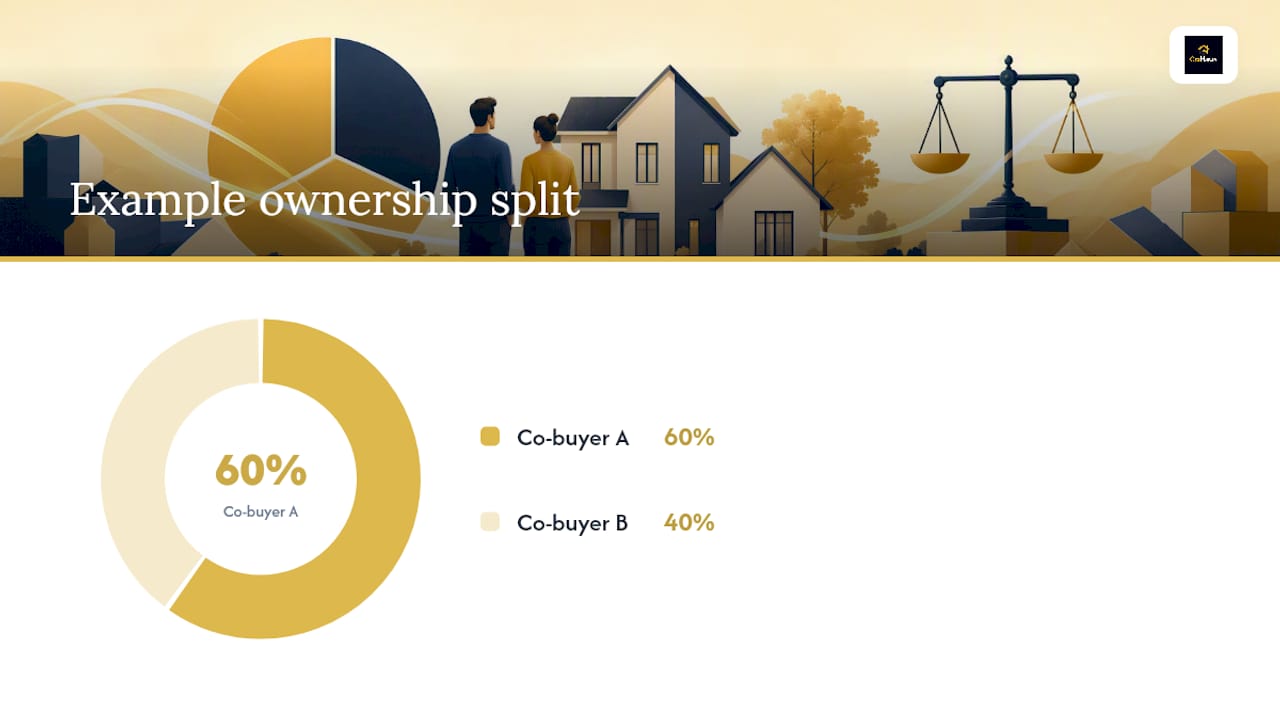
If you buy as joint tenants, you each own the whole property equally and there's no way to record unequal contributions. If you buy as tenants in common, you can hold defined shares, say 60/40 based on deposit size, and that split gets written down. This second route is what most co-buyers pooling different amounts of money actually need, and switching between the two structures later requires notifying Land Registry and rethinking your wills.
The practical rule: instruct a declaration of trust before completion, not after.
- It defines what "your share" means in pounds, not vague assumptions
- It protects the person who put in a bigger deposit
- It gives you evidence if a relationship or friendship later breaks down
- It's far cheaper to draft before you exchange than to litigate after a dispute
A cohabitation agreement checklist is a useful starting point for working out which responsibilities need recording before you get anywhere near a solicitor's office.
Key clauses your household expenses agreement needs
A declaration of trust that a solicitor will actually stand behind needs specific, non-negotiable content. Templates exist, but if your contributions aren't equal or ongoing, bespoke drafting from a property law guide's formal requirements is worth the fee.
Mandatory elements:
- Full property identification, including the Land Registry title number
- Names of all parties and their legal capacity (individuals, trustees)
- Deposit and contribution figures, stated precisely
- Beneficial share percentages or the formula used to calculate them
- The date the agreement takes effect
Core operational clauses:
- A mortgage clause confirming who pays what, and how missed payments are handled internally
- An entitlement clause linking income and capital contributions to share size
- Sale and buyout mechanics, including notice periods
- A named valuation method, agreed in advance
- An amendment clause allowing shares to be adjusted later
- A dispute resolution route, ideally mediation before anything more formal
- Survivorship provisions tied to your wills
Deeds commonly also list how sale proceeds get distributed and how capital improvements, like an extension one owner pays for alone, get reflected in later valuations.
Pro Tip: Build in a floating-share formula rather than a fixed percentage if you expect uneven future payments. A fixed split looks fair on day one and feels wildly unfair three years later when one person has covered every boiler repair and mortgage overpayment.
Does a private agreement change what you owe the lender?
No. This is the single most misunderstood part of co-buying. Your mortgage lender doesn't care what your declaration of trust says about internal shares. Lenders hold "joint and several" liability over every named borrower, meaning if your co-buyer stops paying, the lender can pursue you for the entire outstanding balance, not just your agreed percentage.
Your private agreement governs how you settle up between yourselves afterwards. It does nothing to stop the lender knocking on your door first.
Two further traps catch co-buyers out:
- SDLT on assumed debt. If a declaration of trust transfers a beneficial share at the same time as someone takes on a portion of the mortgage debt, that assumed debt counts as chargeable consideration for Stamp Duty Land Tax. There are three ways round it: avoid transferring debt and equity simultaneously, time the deed carefully around any mortgage variation, or accept the charge and budget for it upfront.
- Form 17 timing. If you want HMRC to recognise unequal beneficial shares for income tax purposes, the deed has to exist first. Form 17 must then reach HMRC within 60 days of the declaration, not before.
A deed of trust guide is worth reading in full if any part of your arrangement involves debt assumption or a later mortgage variation, since the drafting order genuinely changes your tax exposure.
Steps: from agreement to registered deed
Getting from a verbal understanding to an enforceable document follows a fairly fixed order.
- Agree the numbers before you exchange. Contribution amounts, share percentages, exit terms and a valuation method all need to be settled while everyone's still on good terms.
- Instruct a solicitor to draft the deed. A declaration of trust should be in writing, signed by everyone, and ideally executed as a deed rather than a simple contract, since deeds carry stronger legal weight.
- Witness and deliver it properly. Each signature typically needs an independent witness for the deed to be valid.
- Address mortgage variation if needed. Adding someone as a mortgagor triggers fresh affordability checks with the lender, and that process takes weeks, not days.
- Submit Form 17 within 60 days if you need HMRC to recognise the split.
Solicitor fees for a bespoke declaration of trust typically sit in the low hundreds of pounds, small money against the cost of a dispute three years later. Loop your mortgage broker in early too, particularly if debt assumption is on the table; a broker such as Haven Mark Advisers can flag affordability issues before they derail your completion date.
How do you avoid a stalemate on exit?
The clause co-buyers skip most often is the one they need most: what happens when one person wants out and the other doesn't. Without it, practitioners warn that a refusing owner can force the whole thing into a TOLATA application, which means court, and court means months and legal fees neither of you budgeted for.
Build these in from the start:
- A minimum notice period before either party can trigger a sale or buyout
- A right of first refusal for the remaining owner
- An objective valuation method, ideally an average of three independent estate agent appraisals rather than one party's chosen figure
- A clear buyout formula with a realistic funding window, since remortgaging to buy someone out takes time
- A mandatory sale trigger if a buyout can't be funded within that window
Our exit planning guide sets out the fuller mechanics, but the sequencing on any sale should always be: repay the mortgage first, return each owner's original deposit contribution next, then split whatever surplus remains according to the agreed shares.
Mistakes that undo good intentions
Most disputes trace back to the same handful of errors, and they're all avoidable.
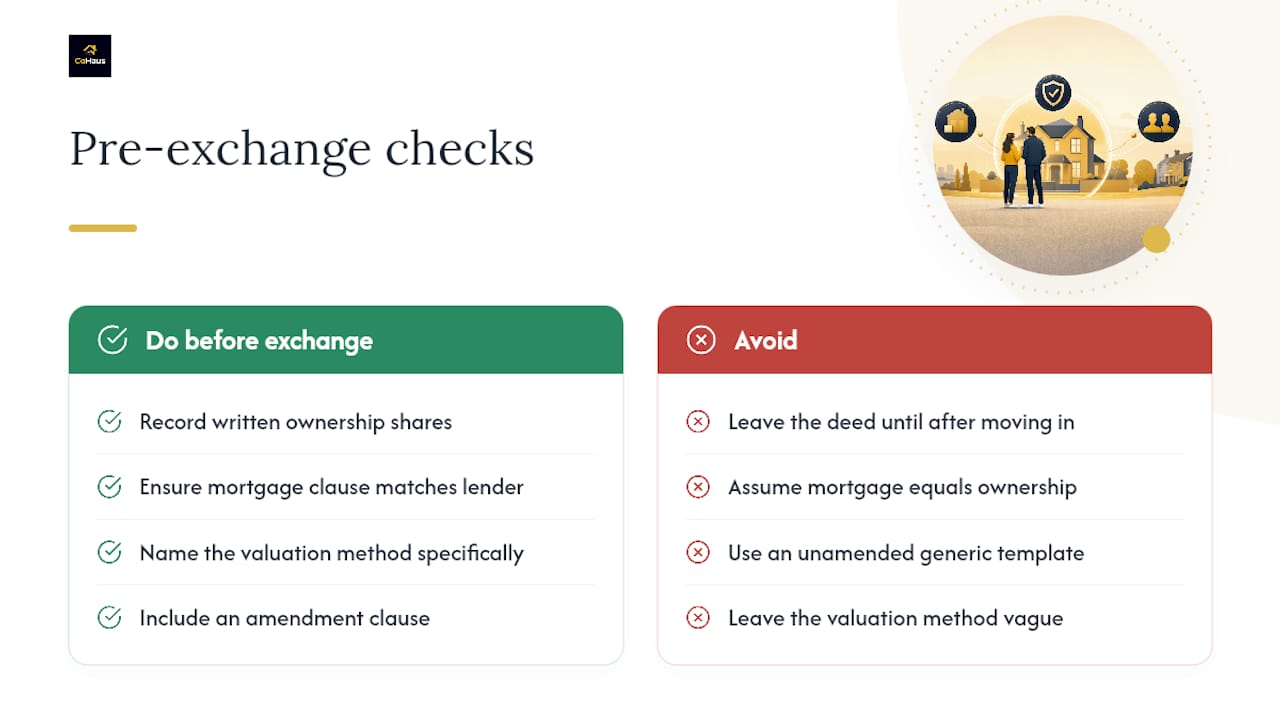
Leaving the deed until after you've moved in is the biggest one. So is assuming that being named on the mortgage settles the ownership question, using a generic downloaded template without amending it for your actual contributions, leaving the valuation method vague, and ignoring the SDLT consequences of debt assumption until the tax bill arrives.
Pro Tip: Before you complete, check five things: shares are written down, the mortgage clause matches what the lender actually agreed, the valuation method is named specifically, an amendment clause exists, and Form 17 timing is planned if relevant. If any of those five are missing, don't exchange yet.
Why co-buyers underestimate this document
Most people treat the declaration of trust as paperwork to tick off, something the solicitor handles while you focus on surveys and mortgage offers. That's backwards. The mortgage offer determines whether you can buy the house. The deed determines whether the arrangement survives contact with real life, a breakup, a job loss, one person wanting to move abroad, a parent's illness.
What tends to get missed isn't the big obvious clause, it's the amendment mechanism. Co-buyers draft a deed reflecting today's contributions and never revisit it. Three years on, one person has covered every mortgage overpayment while the other's income dropped, and nobody adjusted the shares to match. Building in a review point, even an informal one, costs nothing at drafting stage and prevents years of quiet resentment.
At Cohaus, we built our platform because we kept seeing the same pattern: people who wanted to co-buy but had no structured way to work out shares, find compatible co-buyers, or get to a solicitor with the right questions already answered. Community matching and shared deposit tools only work if the legal side keeps pace.
— Martin
Getting your agreement from idea to enforceable deed
Working out fair shares is one problem. Finding someone to co-buy with, then getting both of you to a solicitor with contribution records already organised, is another. Cohaus exists for that second part.
Cohaus offers community matching for prospective co-buyers, shared deposit management so contributions are tracked from day one rather than reconstructed later from bank statements, and introductions to partner solicitors and mortgage brokers who already understand co-buying arrangements. You also get access to templates and checklists built around exactly the clauses this article has covered, so you're not starting from a blank page.
None of this replaces independent legal advice, and it shouldn't. What it does is get you to that advice with the groundwork already done. If you're ready to see how it works, visit Cohaus and start building a co-buying plan with the deposit, mortgage and exit terms mapped out before you ever speak to a conveyancer.
Sources
- Declaration of trust UK: property legal guide | Connaught Law
- Declaration of trust: beneficial ownership mechanics and Form 17 | Property Tax Partners
FAQ
What is a household expenses agreement for co-buyers?
It's a document, usually paired with a declaration of trust, that records deposit and mortgage contributions and links them to enforceable beneficial ownership shares.
Do I need a declaration of trust if I'm on the mortgage?
Yes. Being named on the mortgage confirms legal title only; a declaration of trust is the separate document that records your actual beneficial share.
Does splitting mortgage payments privately protect me from the lender?
No. Lenders hold joint and several liability, meaning they can pursue any borrower for the full mortgage balance regardless of your private agreement.
When should Form 17 be submitted to HMRC?
Only after the declaration of trust exists, and within 60 days of that deed being signed.
Can a household expenses agreement be changed later?
Yes, if it includes an amendment clause, which practitioners recommend building in from the start to handle future unequal contributions.
How does Cohaus help with a household expenses agreement?
Cohaus provides community matching, shared deposit tracking, and referrals to partner solicitors and brokers who help co-buyers draft and execute these agreements correctly.