Yes, include a clear exit clause in your deed of trust. Insist on a notice period, an AI-based valuation method, a right of first refusal, a buyout timetable and a fallback sale provision. Get these five terms right and most co-ownership disputes resolve themselves on paper rather than in court. Skip them, and your ownership type plus your lender's consent will decide your fate instead.
TL;DR:
- Including a clear exit clause with a notice period, valuation method, and buyout process prevents disputes and ensures a private, enforceable resolution.
- A tenants in common ownership structure is necessary for a meaningful buyout clause, unlike joint tenancy, which automatically passes ownership after death.
- A proper legal process requires serving formal notice, commissioning an independent valuation, and obtaining lender approval before the owner can exit.
- Litigation under TOLATA is costly, unpredictable, and should be avoided through well-drafted contractual exit arrangements.
- Coordinated exit planning resources support co-owners in drafting enforceable terms and choosing the right ownership structure before purchase.
Table of Contents
- What is a co-ownership exit clause and why do you need one?
- Key elements every co-ownership exit clause should include
- How does joint tenancy versus tenants in common affect your exit?
- What are the practical steps when a co-owner wants to leave?
- What happens if you end up in court under TOLATA?
- Structured exit plans as practical risk management
- How Cohaus supports your exit planning
- Official pages and practitioner resources to check
- Sources
- FAQ
What is a co-ownership exit clause and why do you need one?
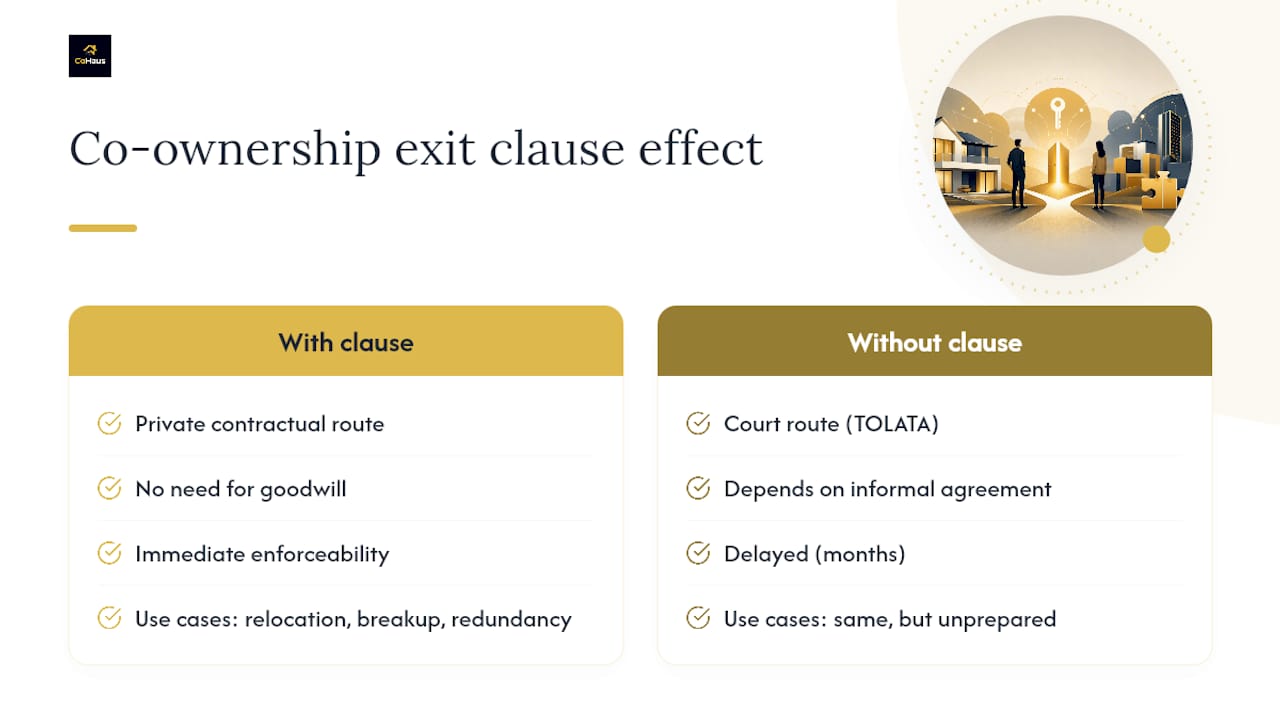
A co-ownership exit clause is the section of your declaration of trust that sets out, in advance, what happens when one owner wants out. It records ownership shares, contributions and, crucially, the mechanism for ending the arrangement without needing anyone's goodwill six months later.
Without one, you're relying on informal agreement between people who may no longer be on speaking terms. With one, you have a private, contractual route that sidesteps the Trusts of Land and Appointment of Trustees Act 1996 (TOLATA), the court process that otherwise governs disputes between co-owners.
Life doesn't wait for tidy timing. A job relocates you to Manchester. A relationship ends. Redundancy hits and one owner needs their deposit back urgently. These are the moments an exit clause is built for, and they're also the moments when co-owners are least equipped to negotiate calmly from scratch. Writing the terms while everyone still gets on is the whole point.
Key elements every co-ownership exit clause should include
A solicitor drafting your deed of trust should build the clause around six components. Miss one and you've left a gap for a dispute to grow into.
- Notice period: often a few months, giving the remaining owner or owners time to arrange finance and giving the departing owner certainty about when their money arrives.
- Valuation method: an independent RICS-qualified surveyor, ideally with the deed specifying whether one valuation is binding or whether two figures get averaged.
- Right of first refusal: the remaining owner gets a defined window to buy the departing share before the property goes to the open market.
- Buyout mechanics: how the buyer funds the purchase (savings, remortgage, staged payments) and what security the departing owner has if payment is delayed.
- Fallback sale: what triggers a full market sale if nobody buys out, how the property gets marketed, and how proceeds split.
- Running costs during notice: who pays the mortgage, insurance and bills while the exit is underway, and what happens if one party stops paying.
Pro Tip: Specify whether valuations are averaged or whether the departing owner can reject a low figure and demand a second surveyor. This single line prevents most of the arguments that later escalate into TOLATA applications.
How does joint tenancy versus tenants in common affect your exit?
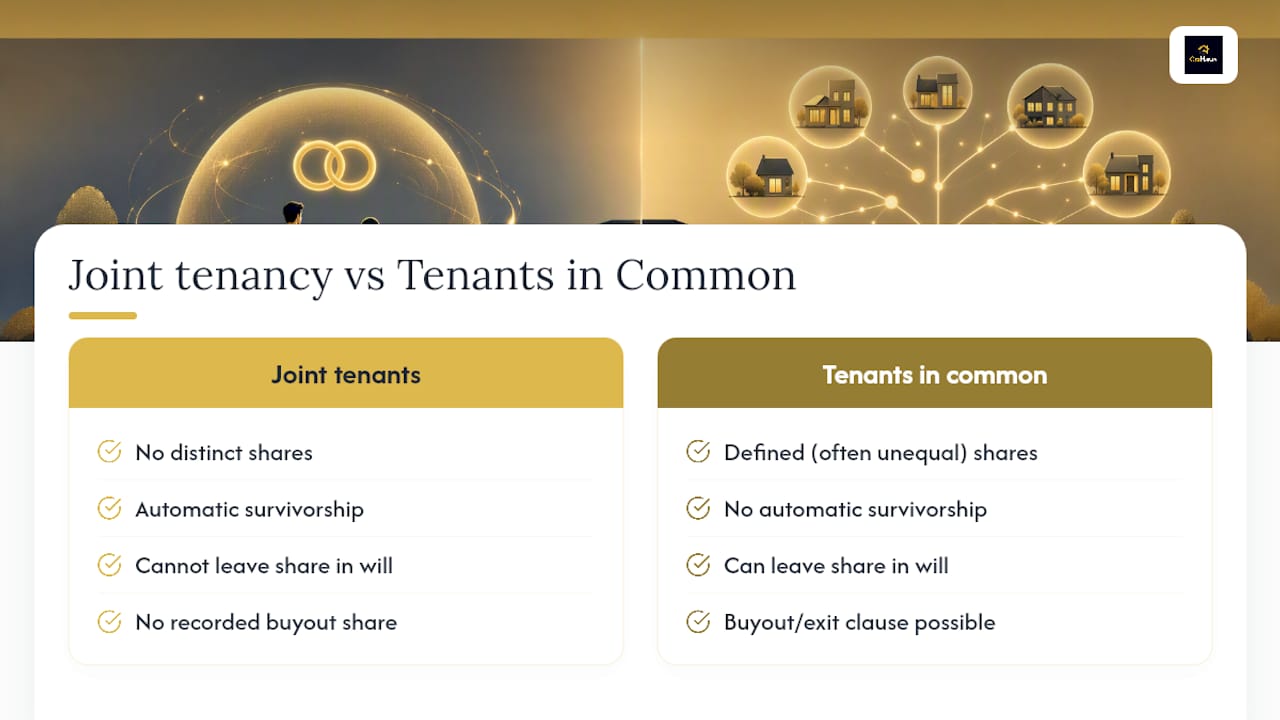
The legal form your ownership takes decides whether you even have an exit clause worth using. Joint tenants hold the whole property together with no distinct shares, and survivorship applies automatically. If one owner dies, their interest passes to the other, not to their will. There's no percentage to buy out because none is recorded.
Tenants in common is different. Each owner holds a defined, often unequal, share that can be sold, gifted or left in a will. This is the structure that makes a meaningful exit clause possible, because there's an actual share to value and transfer. HM Land Registry will typically enter a Form A restriction on the title where owners hold as tenants in common, flagging that the beneficial interests need separate handling from the legal title.
For co-investors, friends buying together, or anyone contributing unequal deposits, tenants in common paired with a deed of trust is usually the sounder structure. It's possible to sever a joint tenancy into tenants in common by serving written notice, but that step has permanent consequences and deserves proper legal advice before you act.
What are the practical steps when a co-owner wants to leave?
When someone actually wants out, the process should follow the sequence your deed of trust sets, not whatever feels urgent that week.
- Serve formal notice. Follow the exact method the deed specifies, usually written notice to the other owner or owners, and keep a dated copy. Informal texts or verbal notice rarely satisfy a properly drafted clause.
- Commission the valuation. Instruct the RICS-qualified surveyor named or described in the deed, and apply whatever averaging or dispute rule you agreed at the outset.
- Attempt the buyout. The remaining owner arranges funds, whether from savings, a remortgage, or a staged payment plan, within the deadline the clause sets.
- Notify the mortgage lender. Co-owners remain jointly and severally liable to the lender until a transfer or remortgage is formally agreed; an exit clause between owners doesn't touch that liability. Lender consent is not optional here.
- Escalate only if needed. Mediation resolves most valuation disagreements faster and cheaper than litigation. A TOLATA application under section 14 is the last resort, kept for cases where a co-owner simply refuses to engage.
Step four trips people up more than any other. A departing owner can sign every document their solicitor puts in front of them, but they remain on the mortgage until the lender formally releases them.
What happens if you end up in court under TOLATA?
TOLATA section 14 lets any co-owner apply to the court for an order for sale when informal or contractual routes have failed. The court weighs the section 15 factors: the purpose the property was bought for, whether children live there, and the interests of any secured creditor.
Judges can order a sale, postpone one, or occasionally order something else entirely, and outcomes are genuinely hard to predict from case to case. What's predictable is the cost. Litigation under TOLATA routinely runs to tens of thousands of pounds in legal fees, takes many months to resolve, and erodes the very equity the parties are fighting over. It is, in almost every case, the worst practical outcome available. A well-drafted exit clause exists specifically to make this route unnecessary.
Structured exit plans as practical risk management
Most co-ownership disputes don't start as legal problems. They start as vague expectations that nobody wrote down. That's the gap Cohaus was built to close: structured exit plans covering buyouts, notice periods and forced sale provisions, agreed before anyone moves in rather than negotiated mid crisis.
Support is also available for the valuation and documentation side, along with guidance for situations where a co-owner stops cooperating. If you're drafting or reviewing your own arrangement, Cohaus's exit planning resources are a sensible starting point before you brief a solicitor.
— Martin
How Cohaus supports your exit planning
There are alternatives to drafting a co-ownership agreement alone with no template and no second opinion. For UK co-buyers weighing up exit terms, resources, deed of trust guidance and introductions to solicitors who can turn your notice period, valuation method and buyout timetable into an enforceable clause rather than a wish list are available.

If you're deciding between tenants in common and joint tenancy before you've even chosen a property, or you're already co-owning and want a clearer buyout process, Certain communities and resources are built for exactly this stage. Read exit-planning guides, then speak to a conveyancing solicitor before you sign anything. Forums may help you see how other co-buyers have structured their own exit clauses, and get pointed towards suitable advisers for your situation.
Official pages and practitioner resources to check
For legal specifics, consult GOV.UK on joint ownership, HM Land Registry's ownership guidance, and RICS valuation standards.
Sources
- Gov
- Buying a house together but unequally: Why you need a declaration of trust | Gorvins Residential LLP
- What kind of joint ownership do I have? — HM Land Registry blog
FAQ
What is a co-ownership exit clause?
It's the part of a deed of trust that sets out how a co-owner can leave the arrangement, covering notice periods, valuation method, buyout terms and a fallback sale if no buyout happens.
Do I need a solicitor to write an exit clause?
You should use a solicitor, since an exit clause needs to be enforceable and consistent with how your ownership is registered at HM Land Registry, and errors here are expensive to fix later.
Can one co-owner force a sale without an exit clause?
Only through a TOLATA section 14 court application, which is slower, costlier and less predictable than following an agreed contractual exit clause.
Does an exit clause remove someone from the mortgage?
No. The clause governs the arrangement between owners, but the lender must separately agree to a transfer or remortgage before a departing owner's liability ends.
What is the typical notice period in an exit clause?
Most UK co-ownership deeds set a notice period of three to six months, long enough to arrange a valuation, financing and any buyout paperwork.
How does Cohaus help with exit planning?
Cohaus provides structured exit plan resources, deed of trust guidance and introductions to partner solicitors, helping co-buyers agree buyout and notice terms before they move in.