
If your finances are straightforward, a direct-to-lender application can work perfectly well. If your case involves co-buying, self-employment, or a patchy credit history, a regulated whole-of-market broker is usually the fastest route to a mortgage that actually fits. Before anything else, check the broker's FCA register status, ask if they cover the whole market, and get their fee structure in writing.
TL;DR:
- Brokers with extensive market access and experience with non-standard cases can offer better mortgage terms and save time on rejected applications.
- Choosing a broker requires verifying FCA registration, market coverage, fee transparency, qualifications, and their experience with joint or complex buying arrangements.
- Broker fees typically range from fixed amounts around £500 to a percentage of the loan, but total costs should be compared against potential interest savings.
- For co-buying cases, prioritize brokers with specific experience in joint applications and shared deposit structures, and work with providers who understand exit and liability terms.
- Avoid selecting brokers based solely on ratings; focus on FCA authorisation, relevant experience, fee clarity, and professional memberships for a more reliable choice.
Table of Contents
- What does a mortgage broker actually do?
- Who actually needs a broker?
- How to choose a mortgage broker in the UK
- What does a broker cost, and is it worth it?
- How do you verify a broker's credentials?
- Choosing a broker for co-buying and shared deposits
- What matters most when choosing a broker
- How Cohaus supports co-buyers choosing a broker
- Where to check broker credentials and fees
- Sources
What does a mortgage broker actually do?
A mortgage broker searches the market on your behalf, matches you to lenders likely to say yes, and manages the paperwork that would otherwise land on your desk at the worst possible moment. Good brokers chase lenders when a case stalls, flag issues before underwriters do, and translate the small print into plain English.
Brokers are not lenders. They do not lend you money; they advise you on who might, then package your application to give it the best chance. Service scope varies more than most people expect:
- Full case handling: the broker manages the application from enquiry to completion, including document chasing and liaison with solicitors.
- Advisory only: the broker recommends a product and leaves you to submit the application yourself.
- Specialist packaging: relevant for co-buyers, contractors, or anyone with irregular income, where a broker's knowledge of lender criteria matters far more than for a standard salaried case.
Ask exactly which of these you're getting before you sign anything, because "broker service" means different things to different firms.
Who actually needs a broker?
Some borrowers gain far more from broker advice than others. If you're self-employed, have multiple income sources, a credit blip, or you're buying with someone who isn't a spouse or partner, a broker's knowledge of which lenders accept your kind of case can save weeks of rejected applications.
- Self-employed borrowers with variable or recently changed income
- Co-buyers pooling deposits with friends, family, or non-partners
- Applicants with historic credit issues or thin credit files
- Expats or those with foreign income
- First-time buyers unfamiliar with lender criteria and product types
If your income is simple, salaried, and your credit file is clean, applying directly to a lender or comparison site is a reasonable option, and MoneySuperMarket's own guidance notes that fee-free brokers earning only lender commission can be just as effective for straightforward cases. The trade-off is usually time versus cost: a broker takes longer to onboard but often finds better terms for complex cases, while going direct is faster but limits you to that lender's own criteria.
Pro Tip: Getting declined by one lender leaves a mark. A hard credit search from a rejected direct application can sit on your file, whereas an experienced broker often knows in advance which lenders won't touch your case, so they steer you elsewhere first.
How to choose a mortgage broker in the UK
Choosing a mortgage broker in the UK comes down to a handful of checks that take minutes but save you from months of frustration. Work through them in order before you commit.
- Confirm FCA authorisation. Search the Financial Services Register for the firm's name and Firm Reference Number (FRN). Every broker giving regulated advice in the UK must appear here.
- Check if they're an Appointed Representative. Some brokers trade under a larger "principal" firm's authorisation rather than their own. Ask who the principal is, because that firm carries regulatory responsibility if advice goes wrong.
- Ask about market access. A whole-of-market broker can search the widest range of products sold through intermediaries, but even they may miss direct-only deals some lenders reserve for their own website. Ask them plainly whether they'll flag those.
- Get the fee model in writing. Fee-free, fixed fee, percentage of loan, or hourly rate. Ask for an illustration showing the total cost of the mortgage including any broker fee, not just the headline rate.
- Confirm qualifications and memberships. Ask if the adviser holds a CeMAP qualification (Certificate in Mortgage Advice and Practice) and whether the firm belongs to bodies such as the Association of Mortgage Intermediaries (AMI) or the Personal Finance Society.
- Ask about lender panel size and specialisms. A broker with 90 lenders on their panel and experience with co-buying cases is a different proposition from one who mainly places standard salaried applications.
- Clarify service scope and timescales. Will they chase your lender if things go quiet? What's their typical turnaround from application to offer?
- Ask about the complaints route. A regulated broker must have an internal complaints process, with escalation to the Financial Ombudsman Service if you can't resolve things directly.
A broker who answers all eight without hesitation is usually one worth trusting. A broker who dodges even one deserves a follow-up question, not a signature.
What does a broker cost, and is it worth it?
Broker fees vary more than most guides admit, and the honest answer is that value depends on your case, not just the invoice. Lenders typically pay brokers a procuration fee, roughly a modest percentage of the mortgage value, which is why some brokers charge you nothing directly. That commission alone shouldn't be the deciding factor in whether their advice is any good.
Where brokers do charge a client fee, recent UK research puts the average purchase broker fee at a moderate amount and average remortgage fee slightly lower, with a fixed fee commonly cited as typical.
| Fee type | Typical range | Who pays |
|---|---|---|
| Procuration fee | 0.35%–0.45% of loan value | Lender (built into their pricing) |
| Fixed client fee | Around £500 (commonly cited) | Borrower |
| Average purchase fee | a moderate amount | Borrower |
| Average remortgage fee | a moderate amount | Borrower |
A £500 fixed fee on a £250,000 mortgage adds roughly 0.2% to your effective borrowing cost, small change if the broker secures you a rate even a fraction of a percent better than you'd find alone.
When comparing brokers, fold their fee into your total cost calculation rather than looking at it in isolation. Add the fee to the loan amount, then compare the two-year (or however long the deal runs) interest cost across your shortlisted options. For straightforward cases, it's entirely reasonable to ask a broker to reduce or waive their fee, particularly if they're already earning procuration from the lender.
How do you verify a broker's credentials?
Checking a broker properly takes ten minutes and removes almost all the risk of dealing with the wrong firm. Start with the FCA register, then work outward.
- Search the FCA Financial Services Register by firm name or FRN, and note whether they're a principal firm or an Appointed Representative.
- Verify CeMAP qualification and check membership of AMI or the Personal Finance Society directly with those bodies.
- Ask for examples of similar cases they've handled, co-buying arrangements are a good test question, since not every broker has real experience with joint deposits and multiple borrowers.
- Insist on written fee disclosure before any work begins, not a verbal estimate you're told to trust.
Pro Tip: If a broker won't put their fee in writing before you've given them any personal details, that's not caution on their part, it's evasion. Walk away.
Watch for red flags: pressure to sign quickly, vague or shifting answers about fees, no written client agreement, or a broker who seems oddly reluctant to explain how many lenders they actually access.

Choosing a broker for co-buying and shared deposits
Co-buying brings questions a standard broker conversation rarely covers. You need someone comfortable explaining how lenders assess joint incomes, how shared deposits are structured, and what happens if one buyer wants to exit the arrangement later.
Before engaging a broker for a co-buying case, ask:
- How many joint applications with unrelated co-buyers have they actually placed?
- Which lenders on their panel are genuinely comfortable with multiple, non-family borrowers?
- Do they understand how shared deposit arrangements and exit terms affect mortgage structuring?
Some brokers specialise in exactly this kind of case, and that specialism tends to show in smoother approvals for non-standard or joint arrangements. Cohaus's own guidance on private co-buying mortgage lenders and on guarantor versus co-borrower structures is a useful starting point before you even pick up the phone to a broker.
What matters most when choosing a broker
The conventional advice on choosing a mortgage broker tends to fixate on finding the "best rated" firm, as though a star rating tells you anything about whether that broker understands your specific case. It doesn't. A five-star review from a salaried couple buying their first two-bed flat tells you nothing about whether the same broker has ever placed a joint application for three unrelated co-buyers pooling deposits.
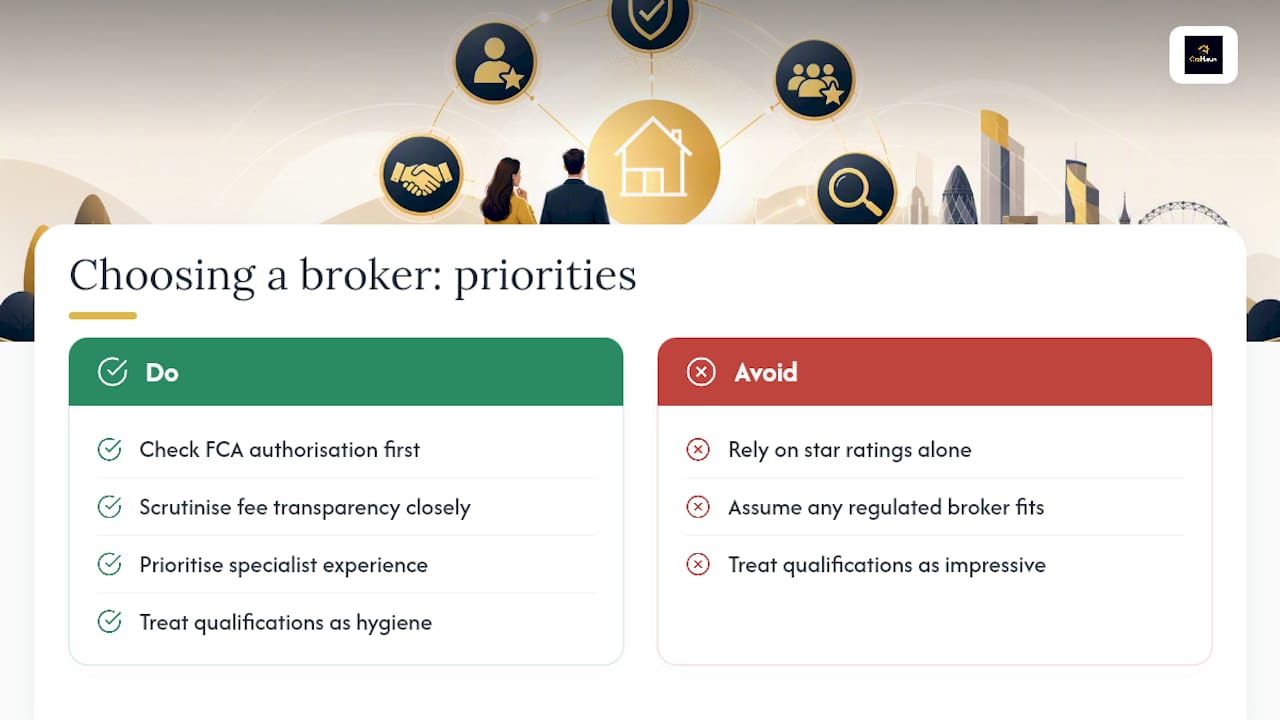
What the evidence actually supports is narrower and more useful: check FCA authorisation first, always, no exceptions. Then interrogate fee transparency harder than most people do, because a broker's price structure often reveals more about how they operate than their marketing ever will. Qualifications like CeMAP and memberships like AMI or the PFS are baseline hygiene, not a differentiator, treat their absence as disqualifying rather than their presence as impressive.
Where readers go wrong most often is assuming any regulated broker can handle any case equally well. For co-buying or non-standard income, specialist experience matters more than general reputation. Prioritise relevant experience over generic star ratings, and you'll make a better decision than most guides encourage.
— Martin
How Cohaus supports co-buyers choosing a broker
A good broker gets you to the right mortgage. Cohaus exists for everything around that decision, matching you with compatible co-buyers, managing shared deposit contributions transparently, and putting legal protections and clear exit terms in place before anyone signs a mortgage offer.

If you're weighing up co-buying as a route into homeownership, Cohaus gives you the structure that makes a broker conversation far easier: a clear picture of who's contributing what, and what happens if circumstances change later. It's the difference between walking into a broker meeting with a half-formed plan and walking in with a co-buying agreement already sorted. Explore how Cohaus matches co-buyers and manages shared deposits, and start putting your own case together before you book that first broker call.
Where to check broker credentials and fees
- FCA Financial Services Register for authorisation checks
- MoneyHelper for impartial mortgage advice guidance
- Which? for consumer-focused broker comparisons
- Personal Finance Society to find a regulated adviser
This article is general information, not a substitute for advice from a qualified financial advisor. Consult a qualified financial professional about your own circumstances before acting on anything here.
Sources
- Choosing a mortgage broker - Which?
- Financial Services Register — FCA
- Average Mortgage Broker Fees Charged in the UK 2026 Research — Boon Brokers